
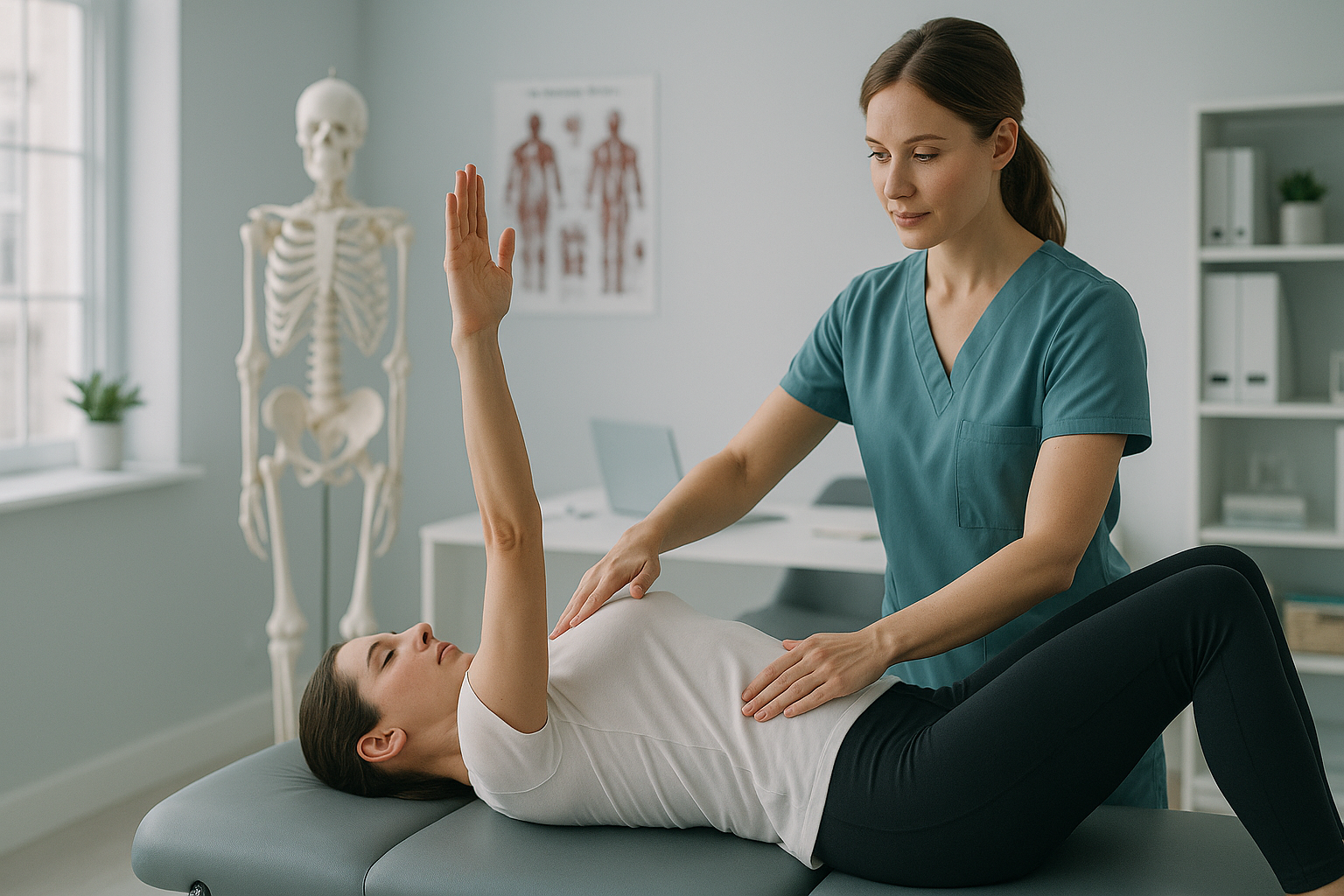
How Do Pilates and Movement Instructors Use Alignment Data?
A standing alignment scan gives Pilates and movement instructors an objective picture of a client's skeleton under load. It shows what is structural and what can be trained. This helps you plan sessions safely, track real progress, and know exactly when a client needs a medical referral rather than another session.
Key Takeaways
- Alignment data separates structural findings from movement habits you can influence.
- Objective baseline measurements let you show a client's progress clearly.
- Knowing when to refer protects your client, your reputation and your insurance.
- A standing scan captures the skeleton under gravity, unlike scans done lying down.
- No referral from a doctor is needed for a private standing EOS scan.
Why do Pilates instructors need objective alignment data?
Because posture checks by eye and by touch have limits. You can see that one of a client's shoulders sits higher, or that their pelvis looks tilted. But looking alone cannot tell you where that difference comes from. It could be a difference in the length of the leg bones, a curve in the spine, a variation in the hip joint, or simply a muscle imbalance. Each of these causes needs a very different approach to programming.
An alignment scan gives you a baseline measurement of the whole skeleton. It is taken while your client stands and bears their own weight. This matters because scans done lying down, such as a standard X-ray or MRI, relax the muscles. They can hide differences that only appear under gravity. A standing image shows what the body actually does when it is upright.
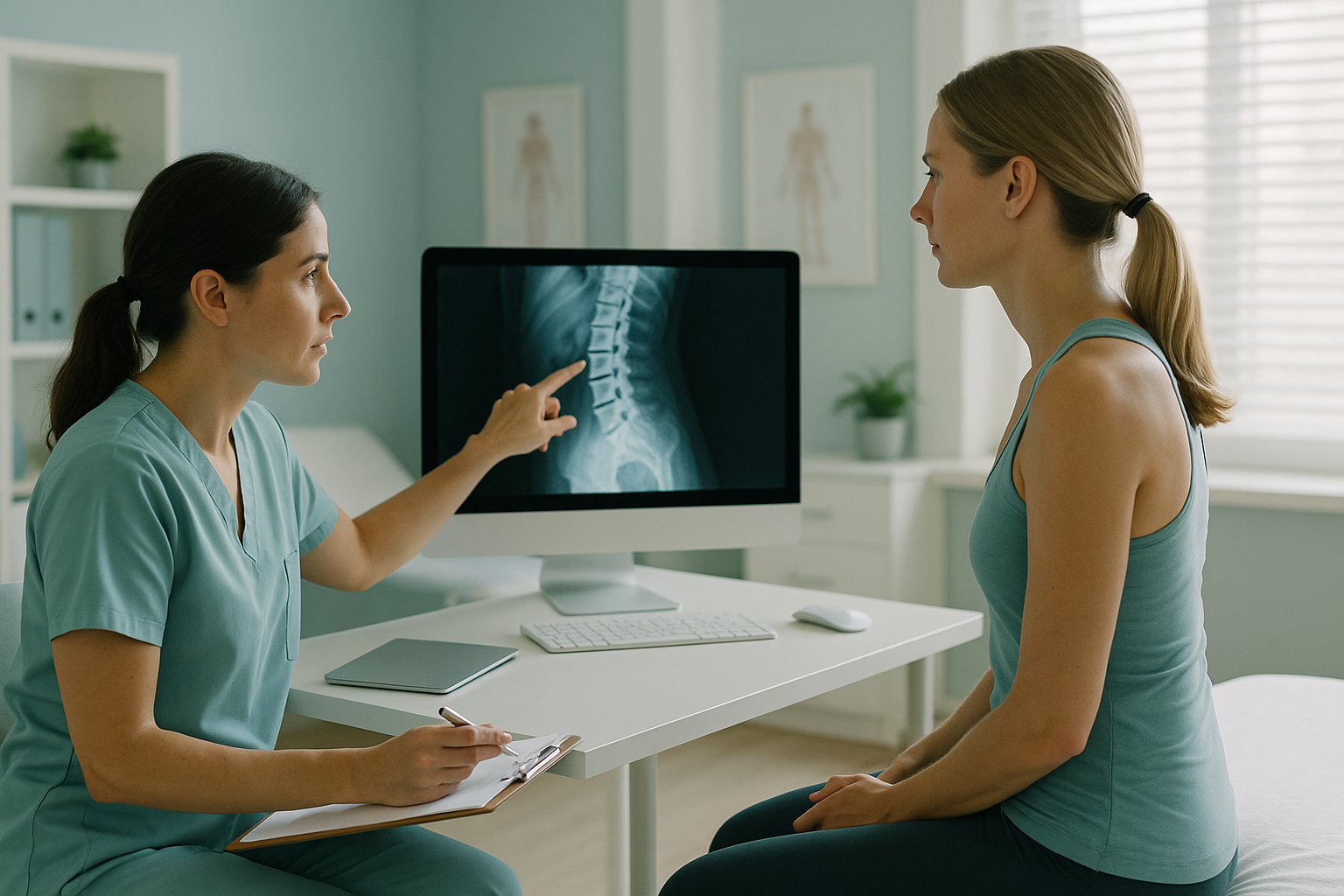
With this data, you can decide with confidence which differences will respond to your programming and which are structural. That one distinction changes everything, from the exercises you choose to the expectations you set with your client.
How does an alignment scan help you stay within your scope of practice?
It draws a clear, written line between what you can work on and what falls outside your role. As a movement instructor, your scope of practice covers exercise programming, retraining movement and motor control. It does not extend to diagnosing medical conditions or treating disease.
- Planning sessions around a confirmed structural finding
- Tracking changes in movement quality over time
- Sharing scan reports with a client's physiotherapist or consultant
- Adapting reformer or mat work to suit a known scoliosis
- Reading scans yourself to diagnose a condition
- Telling a client they have a disc problem or joint disease
- Prescribing exercises as a treatment for a medical condition
- Ignoring red flags and continuing to train through pain
When the client's file holds an alignment scan reported by a radiologist, you are not guessing. You are working from documented findings. That is better for the client and better for your professional standing. It also strengthens your insurance position, because you can show that clinical data informed your programming decisions.
When should you refer a Pilates client instead of continuing to train them?
Any time you suspect that what you see goes beyond a movement or muscle issue. Some situations call for a scan or a medical assessment before more exercise.
If a client's symptoms keep increasing during or after sessions, something may need investigating before you continue.
If weeks of targeted work bring no change in a tilt or shift, it may be structural rather than muscular.
Working with scoliosis clients is valuable, but you need to know the features of the curve before you plan sessions around it.
If a client is about to have joint surgery or is recovering from it, an up-to-date picture of their alignment helps you and their surgeon stay on the same page.
A note on soft-tissue concerns. EOS imaging shows bones, joints and alignment very clearly. For soft-tissue problems such as disc issues, nerve compression or ligament tears, MRI is usually the better tool. If your client's symptoms suggest a soft-tissue cause, guide them towards an MRI rather than an alignment scan.
Important: if a client reports numbness, weakness, loss of bladder or bowel control, or sudden severe symptoms, advise them to get urgent medical help from their doctor or the nearest emergency department. Do not try to manage these situations in the studio.
How does a standing EOS scan work for your clients?
ScanAlign standing EOS imaging takes a full-length picture of the skeleton, from head to feet, in one standing exposure. The client is upright and bearing their own weight. So the image shows how their bones, joints and curves actually behave under gravity, not how they look when relaxed on a table.
From one image, the scan shows spinal curves, pelvic position, hip angles, knee alignment and leg length. A consultant radiologist reports the findings, so you receive a clinical document rather than a raw image. That report tells you what is structural, which gives you the information you need to plan sessions with confidence.
EOS uses about 90% less radiation than a standard X-ray, around ten times less. The scan takes only seconds and needs no preparation. Your client stands still, fully clothed (metal-free clothing), and walks out straight away.
The body is a connected chain. A structural issue at the hip can make the spine compensate. That compensation might show up as shoulder tension or lower-back stiffness. A whole-body standing scan captures that entire chain in one go. This is exactly why it is so useful for instructors who think in terms of whole-body movement patterns.
How do you refer a client for a standing alignment scan?
The process is simple. No referral from a doctor is needed. You can suggest that your client books directly, or you can register to refer clients through a simple professional referral route.
You notice a difference between sides, a plateau, or a concern that falls outside your scope. You and your client agree that objective data would help.
Either refer a client through the professional route, or ask them to book a free video consultation themselves. No paperwork, no doctor's letter.
Your client travels to 19 Harley Street, London, for their standing EOS scan. A consultant radiologist reviews the images and writes a detailed report.
With the report in hand, you know what is structural and what you can influence. You can adapt your programming, set realistic goals and track objective progress over time.
Before a client starts any treatment, or changes the one they are on, it is worth getting a detailed diagnosis first. Knowing whether the cause sits in the pelvis, the legs or the spine changes what will actually help them.
Want to build alignment scans into the way you assess clients? Register as a referring professional and receive reports directly.
Register to refer clientsFrequently asked questions
No. Pilates instructors, movement coaches, personal trainers and other movement professionals can all refer clients for a private standing EOS scan. No doctor's letter is required.
With the client's consent, the report can be shared with you as the referring professional. This lets you build the findings into your programming.
Yes. EOS uses about 90% less radiation than a standard X-ray, around ten times less. It is one of the lowest-dose skeletal imaging methods available.
The price for patients travelling from abroad is confirmed during the free video consultation, where the team will also explain what the scan involves.
A standing alignment scan shows the full picture of a scoliosis under gravity. Knowing the features of the curve helps you plan reformer or mat work that respects the client's structure rather than fighting it.
They serve different purposes. EOS shows bones, joints and alignment. MRI is the better tool for soft-tissue problems such as discs, nerves or ligaments. Some clients may benefit from both.
The scan itself takes only seconds. Your client should allow a short time for check-in and positioning. No special preparation is needed.
Yes. A follow-up scan after a period of training gives you an objective comparison. It shows whether changes in posture are happening at the level of the skeleton. This is far more convincing than looking alone.
Having clinical imaging to support your programming decisions strengthens your position. It shows you acted on documented evidence rather than assumption. That is good practice from both a clinical and an insurance point of view.
ScanAlign is based at 19 Harley Street, London, operating under The Harley Street Hospital's CQC licence.
Ready to add alignment data to your client assessments?
A free video consultation is the first step. We will talk about how standing scans fit into your practice and answer any questions.
Book a free video consultationSources
- Deschênes S, Charron G, Beaudoin G, et al. "Diagnostic imaging of spinal deformities: reducing patients radiation dose with a new slot-scanning X-ray imager." Spine, 2010; 35(9): 989-994.
- The Chartered Society of Physiotherapy. "Scope of practice guidance for physiotherapists and support workers." CSP, 2024.
- Pilates Method Alliance. "Scope of practice for Pilates professionals." PMA position paper, 2015.
Written by Abbas Dhami (Specialist Diagnostic Radiographer)
This page is general information and not a diagnosis.
ScanAlign is the trading name of CoreMed Solutions Ltd and operates under The Harley Street Hospital's CQC licence.