
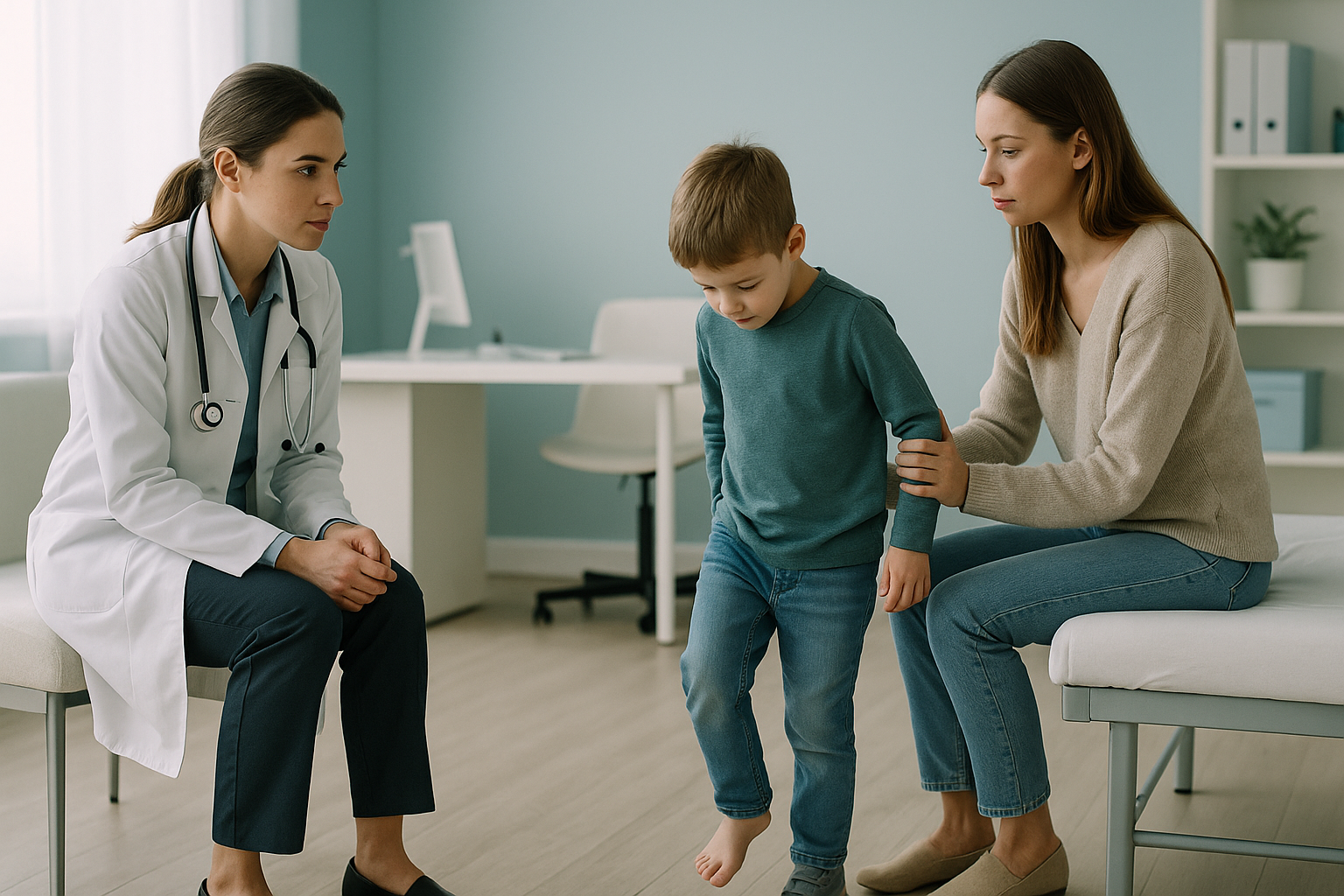
Urgent. Read this first.
A limping child who has a fever, severe pain, refuses to bear weight, or seems unwell needs a medical check the same day. Do not wait. Contact your child's doctor urgently or go to the nearest emergency department. A hot, swollen joint with a fever can be a sign of septic arthritis. This is a medical emergency that needs treatment within hours.
Why Is My Child Limping With No Obvious Injury?
When a child limps with no obvious injury, the cause is usually something you cannot see from the outside. Common reasons include irritable hip (transient synovitis), Perthes disease, changes linked to growth, or an infection in the joint. Most causes can be treated, but some need urgent attention, especially if there is a fever or severe pain. A proper check by a doctor is always the right next step.
Key points
- A limp without a clear injury is common in children and always deserves to be looked into.
- A fever together with a limp is a red flag. Get urgent medical help the same day.
- The most likely cause depends a lot on the child's age.
- Hip problems in children often show up as knee or thigh pain, not hip pain.
- Once a doctor has examined your child, imaging can help find or rule out structural causes.
It is natural to feel alarmed when your child starts limping and you cannot see a bruise, a twist or a fall to explain it. The good news is that most causes are not serious. But a limp always means the body is protecting something, and it matters to find out what that is. This page explains the common reasons, the warning signs that need urgent action, and when imaging can help.
What are the warning signs of a serious limp in a child?
The signs below suggest your child may need medical attention the same day. If any of them are present, contact your child's doctor or go to the nearest emergency department.
A temperature together with a limp, or a refusal to walk, can be a sign of a joint infection (septic arthritis). This is a medical emergency.
Pain that stops your child sleeping or sitting still, or that gets worse over days instead of better.
A child who will not put any weight on one leg, or who screams when you try to move a joint, needs an urgent check.
Weight loss, night sweats, tiredness, or a child who just does not seem right, together with a new limp.
If none of these red flags apply and your child is otherwise well, a routine visit to your child's doctor within a few days is usually suitable. Understanding when to see a specialist can help you decide.
What causes a child to limp with no injury?
Several conditions can make a child limp without any obvious injury. The most common ones depend on the child's age, but the list below covers the main possibilities your doctor will think about.

Also called transient synovitis. The most common cause in young children. It often follows a viral illness. It usually settles within two weeks.
Reduced blood supply to the ball of the hip joint. Most common between the ages of four and eight. It causes a limp that comes on gradually, and stiffness.
Slipped upper femoral epiphysis. The growth plate at the top of the thigh bone slips. Most common in teenagers. It needs prompt treatment.
A bacterial infection inside a joint. Rare but serious. It causes fever, severe pain and refusal to move the joint. A medical emergency.
Less common causes include developmental dysplasia of the hip, stress fractures, juvenile arthritis, and bone or soft-tissue conditions. If they are not diagnosed, some hip problems in childhood can develop into hip dysplasia in adults. This is why it matters to look into them early.
Does the child's age affect what is causing the limp?
Yes. A child's age is one of the most useful clues to the likely cause. Doctors use age as a starting point when they examine a limping child.
Toddlers (ages 1 to 3): The most common cause is irritable hip (transient synovitis), especially after a cold or viral illness. Toddlers may simply refuse to walk instead of limping in an obvious way. A "toddler's fracture" of the shin bone that has not been recognised is also common at this age. It can happen from a very small stumble that the parent did not notice.
Children (ages 4 to 10): Perthes disease becomes more relevant in this age group. The child may complain of hip, thigh or knee pain, and you might notice a limp that comes and goes over weeks. Irritable hip is still common. Juvenile arthritis can also start at this stage.
Teenagers (ages 11 and up): Slipped upper femoral epiphysis (SUFE) is the main concern in this group, particularly during growth spurts or in children carrying extra weight. The teenager often describes pain in the groin, thigh or knee instead of the hip. SUFE needs a prompt referral to an orthopaedic specialist.
One important point for all ages: hip problems often cause pain in the knee or the front of the thigh, not in the hip itself. This is called referred pain. If your child complains about their knee but nothing seems wrong there, the hip should be checked.
How is a limping child assessed with imaging?
Once a doctor has examined your child, imaging is often the next step. The type of imaging depends on what the doctor suspects.
Standard X-rays are usually the first test. They can show the shape of the bones, problems with the growth plates, and the spacing in the joints. Ultrasound is sometimes used to check for fluid inside the hip joint, which helps tell irritable hip apart from septic arthritis.
For ongoing or complex problems, standing weight-bearing imaging can add information that scans taken lying down miss. When a child stands, gravity puts load on the joints and shows how the bones line up in real conditions. Paediatric imaging at ScanAlign uses EOS technology. It captures a full standing image of the legs, hips and spine in one scan, with about 90% less radiation than a standard X-ray, around ten times less. This matters especially for children, who are more sensitive to radiation.
When is MRI the better choice? EOS shows bones, joints and alignment clearly. For soft tissue, cartilage or a suspected infection inside the joint, MRI is usually the better tool. Your doctor or our radiographer can advise which is most suitable for your child.
If your child has an ongoing or unexplained limp and your doctor wants further imaging, our specialist radiographer can advise whether a standing scan would help before you plan a trip to London.
Book a free video consultationWhat should I do if my child is limping with no injury?
Your first step depends on how unwell your child seems. Here is a simple guide.
- Fever with a limp
- Severe pain or not able to walk at all
- Hot, swollen, red joint
- Child seems generally unwell
- Limp after a serious fall or accident
- Mild limp, child otherwise well
- No fever, eating and sleeping normally
- Limp that comes and goes over weeks
- Knee or thigh pain with no knee problem found
- Limp that has not improved after a week of rest
ScanAlign is a diagnostic imaging clinic, not an emergency service. We do not diagnose or treat your child's condition. What we can do is provide detailed, low-dose standing imaging when your doctor or specialist needs it to understand what is happening in the bones and joints. Learn more about ScanAlign, low dose standing imaging.
Before your child starts treatment, or changes the one they are on, it is worth getting a detailed diagnosis. Knowing whether the cause sits in the pelvis, the legs or the spine changes what will actually help.
Frequently asked questions
It is worth getting it checked even if your toddler seems happy. Children are not always good at telling you about pain. The most common cause at this age is irritable hip, which usually settles on its own. But a visit to your child's doctor within a few days is sensible to rule out anything else.
Yes. Transient synovitis (irritable hip) often follows a viral infection. The lining of the hip joint becomes inflamed, which causes a limp. It usually clears up within one to two weeks with rest.
This is called referred pain. The nerves that supply the hip also supply the knee and thigh, so the brain can read hip problems as knee pain. Doctors routinely check the hip whenever a child comes in with unexplained knee pain.
Common symptoms of Perthes disease include a limp that comes and goes, stiffness in the hip (especially when turning the leg inward), and pain in the groin, thigh or knee. It usually affects children between four and eight years old, and is more common in boys.
Go to the emergency department if your child has a fever with a limp, a hot or swollen joint, severe pain, refuses to bear any weight, or seems generally unwell. A hot, swollen joint with fever could be septic arthritis, which needs treatment within hours.
Yes. ScanAlign offers paediatric imaging using EOS technology, which uses about 90% less radiation than a standard X-ray, around ten times less. This is particularly helpful for children. You can learn more about paediatric imaging at ScanAlign.
No formal referral letter is needed. You can book a paediatric assessment directly. However, for a limping child, we always recommend a check by your child's doctor or a specialist first, to rule out anything that needs urgent treatment.
When a child lies down, gravity is taken away and the muscles relax. This can hide alignment problems that only appear when the body is bearing weight. A standing scan shows the hips, knees and spine under real load, which gives a more complete picture of how the bones line up.
ScanAlign is a private, self-pay clinic. The price for patients travelling from abroad is confirmed during the free video consultation.
Not always. Muscle strains, growing pains, or even a splinter or verruca on the foot can cause a limp. Rarely, conditions outside the musculoskeletal system can be responsible. Your child's doctor can help work out the most likely cause and decide which tests are needed.
Want a clearer picture of your child's limp?
If your child has an ongoing or unexplained limp and you want to understand what is happening in the bones and joints, our specialist radiographer can advise whether imaging would help.
Book a free video consultationSources
- NHS. "Limping in children." nhs.uk. Accessed 2024.
- Royal College of Emergency Medicine. "Management of the limping child." Best practice guidelines.
- Perry DC, Hall AJ. "The epidemiology and aetiology of Perthes disease." Orthopaedic & Trauma, 2011;25(4):276-283.
Written by Abbas Dhami (Specialist Diagnostic Radiographer).
This page is general information and not a diagnosis.
ScanAlign is the trading name of CoreMed Solutions Ltd and operates under The Harley Street Hospital's CQC licence.