

Connective Tissue Disorders: What Are They and How Do They Affect Your Joints?
A connective tissue disorder affects the proteins that hold your body together, including collagen and elastin. When these tissues are weaker or stretchier than normal, your joints can become too loose. This laxity changes the way you stand, move and carry your weight. It often causes pain far away from the original problem.
Key points
- Connective tissue disorders weaken the structural "glue" of your body, especially collagen.
- Joint laxity means joints move beyond their normal range. This leads to instability and pain.
- Pain often shows up in the back, hips or knees, because loose joints shift your alignment.
- Standing, whole-body imaging shows alignment problems that lying-down scans can miss.
- ScanAlign provides diagnostic imaging only, not treatment.
What is a connective tissue disorder?
A connective tissue disorder is a condition in which the proteins that support and connect your organs, bones, muscles and skin do not work properly. Connective tissue is found all over the body. It forms the scaffolding that keeps everything in place. The most important protein in connective tissue is collagen. It gives structure and strength to your joints, tendons, ligaments and skin.
When collagen or other structural proteins are faulty, the tissues become weaker, stretchier or more fragile than they should be. You may be born with this (hereditary), or it may develop later in life. Either way, the result is the same. The structures that should hold your skeleton steady become less reliable, and your joints can start to move more than they should.

What are the symptoms of a connective tissue disorder?
Symptoms depend on the type of condition and how severe it is. Most people notice problems in their joints, muscles or posture. Because connective tissue is everywhere, symptoms can be widespread. They are easy to brush off as "just being flexible."
Frequent popping or clicking, or a feeling that a joint slides out of place and back in again.
Ongoing aches in several joints, often worse after activity or at the end of the day.
Difficulty holding yourself upright. Muscles tire quickly because they work harder to steady loose joints.
Skin that bruises easily, feels unusually soft, or stretches more than expected.
Important: if you have sudden numbness, weakness, loss of bladder or bowel control, or any severe symptoms that come on without warning, get urgent medical help. Contact your doctor or go to the nearest emergency department.
What are the main types of connective tissue disorders?
There are many types of connective tissue disorders. A few are most often linked with joint laxity and musculoskeletal pain. They are usually hereditary, which means the faulty gene is passed from parent to child.
A group of conditions affecting collagen. The hypermobile type is the most common. It causes widespread joint laxity and pain.
Affects a protein called fibrillin. People are often tall with long arms and legs. Joints, eyes and the heart can all be involved.
Sometimes called "brittle bone disease." A collagen defect makes bones break more easily than normal.
Joint hypermobility with pain, but without meeting the full diagnostic criteria for EDS. It still has a big effect on daily life.
Many people ask how Marfan syndrome and EDS differ. Both are hereditary connective tissue disorders, but they affect different proteins. EDS mainly involves collagen. It usually causes very flexible joints and fragile skin. Marfan syndrome affects fibrillin. Along with joint laxity, it is more closely linked with heart and eye complications. Both can greatly change your skeletal alignment.
How does joint laxity change your alignment?
Joint laxity shifts your alignment because loose joints cannot hold your skeleton in its ideal position. Your body is a connected chain from your feet to your head. When one area moves too much, the areas above and below it have to make up for it.
For example, loose ligaments around the pelvis can cause a pelvic tilt. Your spine then adjusts its curves to keep your head balanced over your feet. That extra curve might cause pain in your lower back, mid-back or neck, even though the problem started in the pelvis. In the same way, lax knee ligaments can change the angle of your legs and increase stress on your hips.
This chain of compensation is one of the most overlooked parts of connective tissue disorders. A scan that only looks at the painful area will often miss the bigger picture.
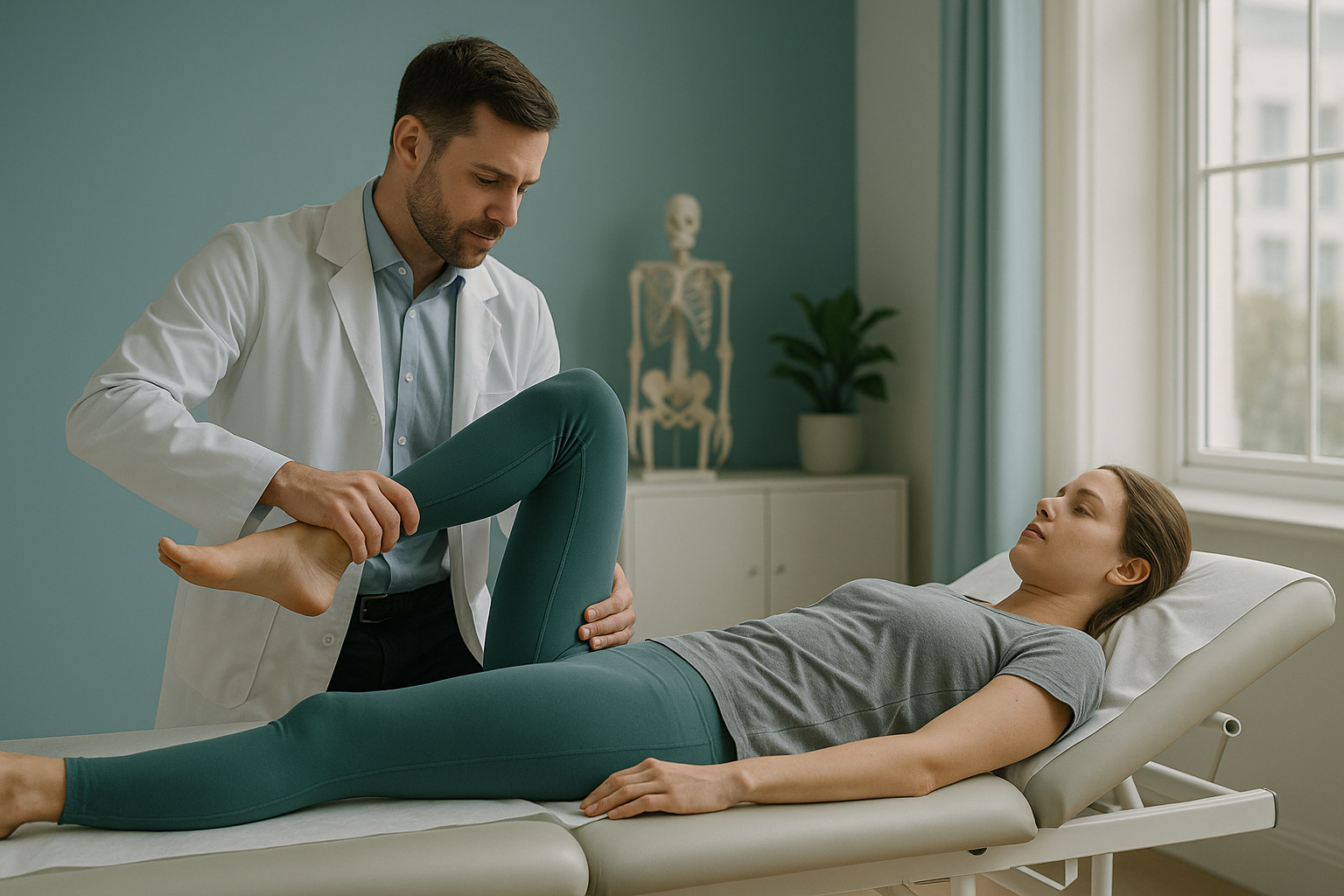
How does a standing EOS scan help with connective tissue disorder diagnosis?
A standing EOS scan captures your whole skeleton in one image while you are upright and carrying your own weight. This matters because diagnosing a connective tissue disorder depends on understanding how your body really behaves under gravity, not how it looks relaxed on a table.
Standard imaging, such as a lying-down X-ray, CT or MRI, removes the effect of gravity and lets your muscles relax. Loose joints may look normal because there is no load on them. Once you stand up, your lax connective tissue lets joints shift, curves change and your weight spread unevenly. A standing whole-body image shows these compensations clearly.
The EOS system uses about 90% less radiation than a standard X-ray, around ten times less. This makes it a practical option if you need follow-up imaging over time, which is common with hereditary connective tissue disorders.
When MRI is the better choice: EOS shows bones, joints and alignment. For soft tissue, discs or nerves, MRI is usually the better tool. If your specialist needs to look at cartilage, ligament tears or nerve compression, they will likely recommend MRI alongside EOS or instead of it. The two work well together.
If you have a diagnosed or suspected connective tissue disorder and want to understand how it affects your alignment, a free video consultation can help you decide whether a standing scan in London is the right next step.
Book a free video consultationWhat helps with connective tissue disease and joint pain?
Managing joint pain from a connective tissue disorder usually involves several approaches working together. ScanAlign is a diagnostic imaging clinic, so we do not provide treatment. But a clear picture of your alignment gives your treatment team, whether a physiotherapist, rheumatologist or orthopaedic surgeon, the information they need to plan care that fits your body.
Without whole-body alignment data, treatment can focus on where the pain is rather than its cause. For someone with joint laxity, strengthening the wrong area or stretching a joint that already moves too much could make things worse. Accurate imaging helps avoid that.
Before you start a treatment, or change the one you are on, it is worth getting a detailed diagnosis. Knowing whether the cause sits in your pelvis, your legs or your spine changes what will actually help.
You do not need a referral from your doctor to book a scan at ScanAlign. Many people refer themselves because they want answers about pain that earlier imaging has not explained. The price for patients travelling from abroad is confirmed during the free video consultation. You can find details about what to expect and safety on our FAQs page.
Frequently asked questions about connective tissue disorders and imaging
Joint hypermobility means your joints move beyond the normal range. A connective tissue disorder is the underlying cause of that extra movement. Not everyone with flexible joints has a disorder. But if hypermobility comes with pain, tiredness or other symptoms, a connective tissue condition may be responsible.
No. Both are hereditary connective tissue disorders, but they involve different proteins. Marfan syndrome affects fibrillin. Along with joint laxity, it is more linked with heart and eye problems. EDS mainly affects collagen and tends to cause more widespread joint hypermobility and fragile skin.
Yes. Loose ligaments in the pelvis or spine allow extra movement between the vertebrae. Your muscles then work harder to keep you upright, which can cause persistent back, hip and knee pain.
When you lie down, gravity is removed and your muscles relax. Joints that are loose or out of line under your body weight can look normal on a lying-down scan. A standing scan captures what really happens when you are upright, which is how you spend most of your day.
The EOS system uses about 90% less radiation than a standard X-ray, around ten times less. This lower dose is especially helpful if you need follow-up scans over time.
No. You can refer yourself. Many people book because they want a clearer picture of their alignment without waiting for a referral from their doctor or consultant.
The price for patients travelling from abroad is confirmed during the free video consultation. More details are on our FAQs page. ScanAlign is a private, self-pay clinic.
An EOS scan does not diagnose the disorder itself. That needs a clinical assessment, often by a rheumatologist or geneticist. What the scan does is show how the disorder affects your skeletal alignment. This is valuable information for your diagnosis and treatment planning.
Yes. The scan is quick and you simply stand still. If you are worried about standing for that time, a free video consultation beforehand lets us discuss your situation and make sure the scan is right for you.
ScanAlign provides imaging for adults. If you need imaging for a child, please speak to your doctor or paediatrician for a suitable referral.
Understand how your connective tissue affects your alignment
A free video consultation lets you talk through your symptoms and find out whether a standing whole-body scan could give you and your treatment team the answers you need.
Book a free video consultationWritten by Abbas Dhami (Specialist Diagnostic Radiographer)
Sources
- Malfait F, et al. "The 2017 International Classification of the Ehlers-Danlos Syndromes." American Journal of Medical Genetics Part C: Seminars in Medical Genetics, 2017; 175(1): 8-26.
- NHS. "Joint hypermobility." nhs.uk. Available at: https://www.nhs.uk/conditions/joint-hypermobility/
- Loeys BL, et al. "The revised Ghent nosology for the Marfan syndrome." Journal of Medical Genetics, 2010; 47(7): 476-485.
This page is general information and not a diagnosis.
ScanAlign is the trading name of CoreMed Solutions Ltd and operates under The Harley Street Hospital's CQC licence.