
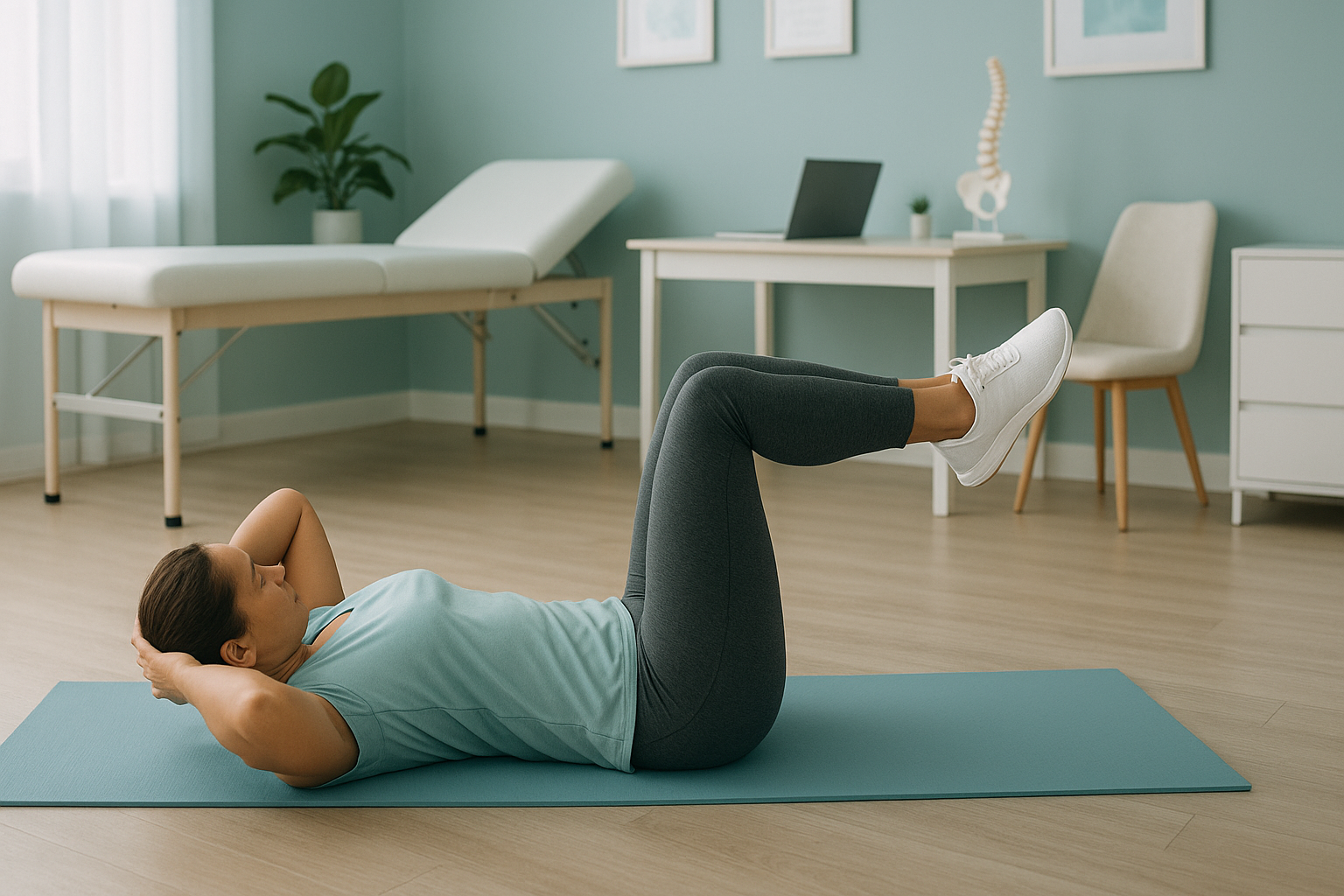
What Actually Counts as Core Stability Training?
Core stability exercises train the deep muscles around your spine, pelvis and diaphragm. These muscles hold your trunk steady while you move. Sit-ups and crunches aim for strength. Core stability aims for endurance and control instead. Research shows this kind of training can reduce recurring lower back pain when the right muscles are targeted.
Key points
- Core stability is about control and endurance, not how many sit-ups you can do.
- The deep core muscles (transversus abdominis, multifidus, diaphragm, pelvic floor) matter most.
- Exercises such as the dead bug, bird dog and side plank build stability better than crunches.
- If your alignment is off, general core work can reinforce the wrong patterns.
- A standing whole-body scan can show whether a muscle imbalance or a structural tilt is driving your problem.
What is the difference between core strength and core stability?
Core strength is the ability to produce force, like curling your trunk upwards in a crunch. Core stability is the ability to resist unwanted movement. It keeps your spine in a safe position while your arms and legs work. The two are related, but they are not the same thing.
Think of it this way. A gymnast doing a handstand needs huge core stability to stay rigid, yet the muscles barely shorten. A boxer throwing a hook needs core strength and rotational power. Most people with back pain need the first quality far more than the second.
Goal: Hold your spine steady under load or during movement.
How it feels: Quiet, controlled, often harder than it looks. You resist movement rather than create it.
Main approach: Endurance over maximum effort. Longer holds, slower movement, good quality of position.
Goal: Produce force by bending, straightening or rotating the trunk.
How it feels: Muscles shorten and work hard. Sit-ups, cable rotations, weighted crunches.
Limitation: Training strength without building stability first can compress the spine under load and aggravate back pain.
Which deep core muscles actually stabilise the spine?
Four muscles form an inner cylinder that wraps around your lower spine and pelvis. When they work together, they create a pressurised support system. This protects your back before you even think about moving.
The deepest stomach muscle. It wraps around your trunk like a corset and compresses the abdomen to stiffen the spine.
Short, deep muscles that run along each side of the spine. They control segmental movement between individual vertebrae.
Your main breathing muscle also forms the roof of the core cylinder. It creates pressure inside the abdomen that supports the spine from above.
The muscular sling at the base of the pelvis. It seals the bottom of the cylinder and works with the diaphragm to control pressure.
If any one of these four is weak or badly timed, the outer muscles (rectus abdominis, obliques, erector spinae) try to make up for it. This often shows up as tightness, pain or a muscle imbalance that you can feel but struggle to fix with general exercises.
What are the best core stability exercises for back pain?
The best core stability exercises load the deep muscles without forcing your spine through large ranges of movement. For people with recurring back pain, research consistently favours these patterns over sit-ups or crunches.
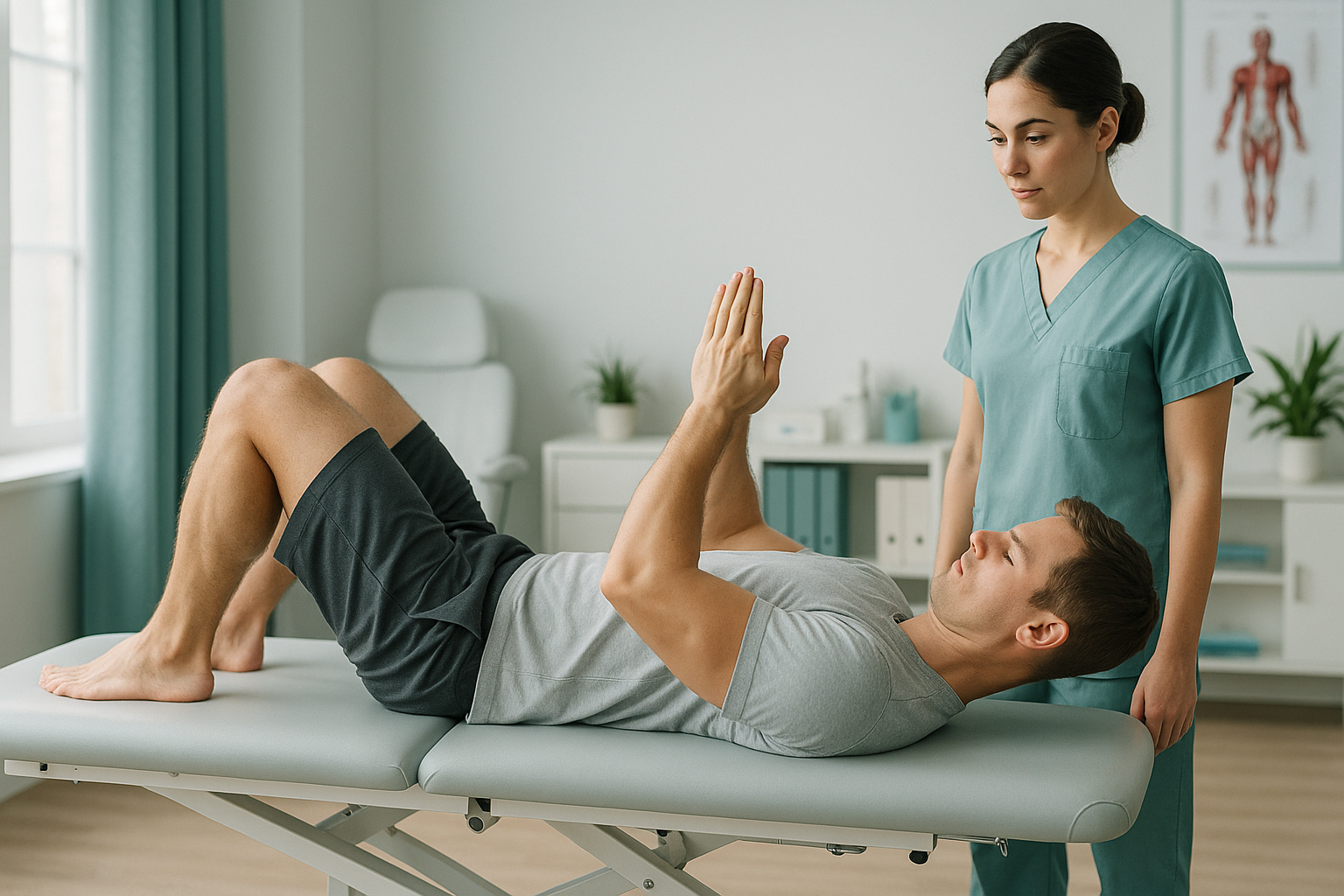
Dead bug
Lie on your back with your arms pointing at the ceiling and your knees bent at a right angle. Slowly lower one arm overhead while you straighten the opposite leg. Keep your lower back pressed flat. Return and repeat on the other side. The challenge is keeping your trunk completely still while your arms and legs move.
Bird dog
On your hands and knees, stretch one arm forward and the opposite leg back. Do not let your hips rock or your back sag. Hold briefly, return, and swap sides. This trains the multifidus and transversus abdominis to work as a team.
Side plank
Lie on your side, propped on your elbow, with your hips stacked. Lift your hips so your body forms a straight line. Hold for time. This targets the quadratus lumborum and obliques, which are key side stabilisers. If you have wondered whether planking is good for your back, the side plank generally has stronger evidence than the front plank for reducing back pain.
Loaded carries
Pick up a weight in one hand and walk with a tall posture. The uneven load forces your deep core to brace against bending to the side. Carry variations (farmer's carry, suitcase carry, overhead carry) are among the most functional core stability exercises you can do.
Bracing versus hollowing
You may have been told to "draw your belly button in" (hollowing). Or you may have been told to "brace like someone is about to push you" (bracing). Current evidence slightly favours bracing for most people. This is because it activates all the deep core muscles together rather than isolating one. Either cue can help, but bracing tends to give better spinal stiffness under load.
If you are also looking for stretches for lower back pain, combining mobility work with stability training often gives a better result than either one alone.
How does alignment affect which core exercises work for you?
Your pelvis may be tilted, your spine may be shifted sideways, or your hips may sit at different heights. If so, your core muscles are already working unevenly before you even start exercising. Doing a dead bug when one side of your pelvis is higher than the other may simply reinforce the compensation rather than fix it.
Your body is a connected chain from your feet to your head. A structural shift in one area makes the muscles above or below compensate. So pain often shows up away from the real cause. Standard imaging done lying down relaxes the muscles and can hide these alignment problems. Standing, weight-bearing imaging shows your skeleton the way it actually carries load. It reveals the tilts and shifts that drive muscle imbalance.
ScanAlign standing EOS imaging captures your full body in a single upright scan with about 90% less radiation than a standard X-ray, around ten times less. The result is a head-to-foot picture of your alignment. It helps you and your clinician understand exactly which areas need stability work, and which areas are compensating for a problem somewhere else.
Before you start treatment, or change the one you are on, it is worth getting a detailed diagnosis. Knowing whether the cause sits in your pelvis, your legs or your spine changes what will actually help.
Not sure whether your alignment is adding to your problem? A whole-body standing image can make clear what is structural and what is muscular.
Book a free video consultationWhen MRI is the better tool: EOS shows bones, joints and alignment. For soft-tissue problems such as disc bulges, nerve compression or ligament tears, MRI is usually the better choice. Your clinician can advise which scan you need.
How do you know if your core is actually weak?
Poor core stability does not always look like a weak stomach. It often shows up in unexpected ways.
Pain that comes back with long periods of sitting, standing or walking, especially after periods of inactivity.
One hip dips noticeably when you stand on the opposite leg. This is a sign the side core muscles are not holding.
Struggling to hold a plank or side plank for even a short time, or feeling your back "give way" during holds.
You stand tall when you think about it, but your posture folds the moment you carry something or get tired.
If you notice numbness, weakness in your legs, or any loss of bladder or bowel control along with back pain, these are red-flag symptoms. Please seek urgent medical care from your doctor or your nearest emergency department rather than booking a scan.
Frequently asked questions about core stability exercises
Side planks have fairly strong evidence for helping lower back pain. Front planks can be useful too, but they load the spine in flexion, which may aggravate some disc-related problems. If planks cause pain, stop and seek advice.
Sit-ups bend the lumbar spine again and again under load. For people who already have back pain or disc problems, this can make things worse. Core stability exercises that keep the spine in a neutral position are generally safer and more effective.
Most evidence suggests three to five sessions a week, each lasting around 10 to 20 minutes. Doing it regularly matters more than doing a lot. Short daily sessions tend to work better than one long weekly workout.
Core stability training can help reduce recurring lower back pain in many people. But if the underlying cause is structural, such as a pelvic tilt or a spinal shift, exercise alone may not address the root of the problem. Understanding your alignment first helps you target the right areas.
Hollowing means drawing your belly button inwards to activate the transversus abdominis on its own. Bracing means tensing the whole trunk as if getting ready for an impact. Current evidence slightly favours bracing for spinal stiffness, though both cues have a place in rehabilitation.
No. ScanAlign is a private self-pay clinic. You can refer yourself without a referral from your doctor or a consultant. The process starts with a free video consultation.
An EOS scan uses about 90% less radiation than a standard X-ray, around ten times less. This makes it one of the lowest-dose options available for full-body skeletal imaging.
The price for patients travelling from abroad is confirmed during the free video consultation.
Lying-down imaging relaxes your muscles and can hide alignment problems that only appear when you are upright and bearing weight. A standing EOS scan shows your skeleton the way it actually carries load. Your clinician can then see whether a tilt or shift is making your core work unevenly.
Core exercises support and protect the spine, but they cannot change the position of a bone or joint. If there is a structural cause behind your pain, knowing what it is helps you choose exercises that work with your body rather than against it.
Wondering if alignment is part of your problem?
A free video consultation can help you decide whether a standing whole-body scan would add useful information before you start, or restart, core training.
Book a free video consultationWritten by Abbas Dhami (Specialist Diagnostic Radiographer)
Sources
- Hodges PW, Richardson CA. Inefficient muscular stabilization of the lumbar spine associated with low back pain. Spine. 1996;21(22):2640-2650.
- McGill SM. Low back stability: from formal description to issues for performance and rehabilitation. Exercise and Sport Sciences Reviews. 2001;29(1):26-31.
- National Institute for Health and Care Excellence (NICE). Low back pain and sciatica in over 16s: assessment and management (NG59). 2016, updated 2020.
This page is general information and not a diagnosis.
ScanAlign is the trading name of CoreMed Solutions Ltd and operates under The Harley Street Hospital's CQC licence.