

How Do You Avoid CrossFit Injuries When Your Alignment Is Working Against You?
Most CrossFit injuries happen when the body compensates for an alignment problem. You cannot see or feel this problem during lighter training. High-rep Olympic lifts, overhead movements and kipping pull-ups make small imbalances bigger when you are tired. A standing, weight-bearing scan of your whole body can show these hidden asymmetries. You and your coach can then address them before they cause pain.
Key takeaways
- CrossFit is not by nature more dangerous than other sports. But when technique breaks down with fatigue, the risk of injury goes up.
- The shoulders, lower back and knees are the areas injured most often.
- Hidden alignment issues, such as a pelvic shift or hip restriction, can force other joints to compensate during heavy or fast movements.
- Lying-down scans can miss alignment problems that only appear when you are standing and loaded.
- Knowing your own anatomy helps you and your coach scale movements safely.
What is the real CrossFit injury rate?
The injury rate in CrossFit is broadly similar to other strength and conditioning sports. Research published in the Orthopaedic Journal of Sports Medicine found rates of roughly 2 to 3 injuries per 1,000 training hours. That is similar to gymnastics, weightlifting and recreational running. CrossFit is not uniquely dangerous.
But CrossFit works in a different way. It combines Olympic lifting, gymnastics and metabolic conditioning, often at high speed and high reps. When fatigue sets in, technique breaks down. That is when injuries tend to happen. The movements are not bad. The problem is that the body is asked to keep doing them when control is fading.
The key question is not whether CrossFit is safe or unsafe. It is whether your body is set up to handle the specific demands you place on it.
Where do most CrossFit injuries happen?
Most CrossFit injuries happen in three areas: the shoulders, the lower back and the knees. Each one takes heavy load during common WOD movements. Each one is vulnerable when alignment is off.
One pattern links all three: the painful area is often not where the problem started. A muscle imbalance in the hips can show up as knee pain months later. A restriction at the hip joint, such as hip impingement (FAI), can change how you squat and in time cause back pain.
Why does alignment matter for CrossFit performance?
Alignment matters because your body is a connected chain. Every joint from your feet to your head works together when you move. If one link is out of position, the links above and below it have to compensate. With light loads and low reps, you may never notice. Under the demands of a competitive WOD, those compensations get bigger.
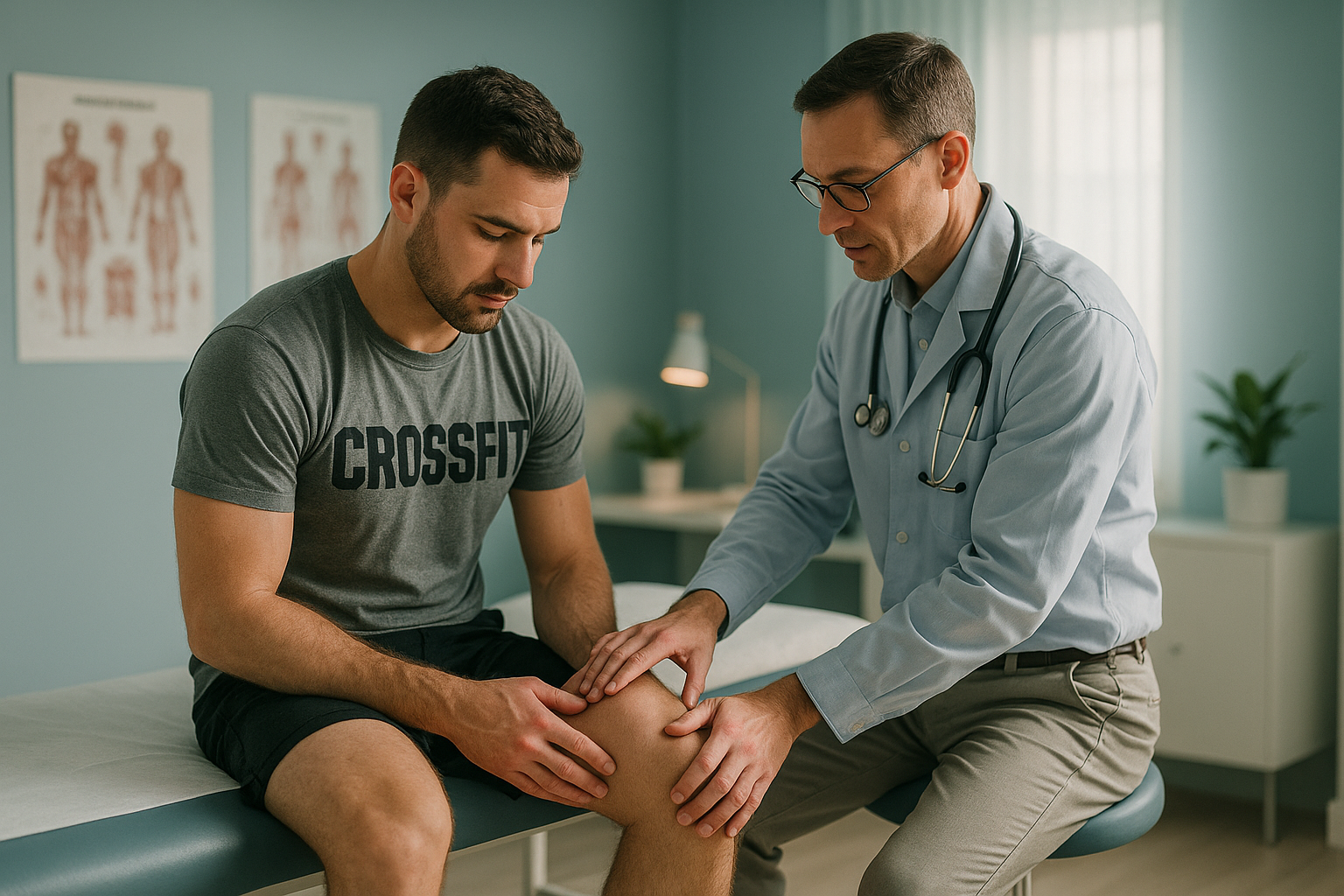
Think about a heavy overhead squat. You need ankle mobility, stable knees, hip range, a neutral spine and open shoulders, all at once. If your pelvis is slightly tilted, your spine adjusts. Your shoulder has to reach further on one side. Under a heavy barbell, that tiny extra reach adds up across dozens of reps.
This is why two athletes can follow the same programme and get very different results. Their alignment is different. Their anatomy is different. What works for one body may overload another.
How does standing imaging show what lying-down scans miss?
Standard imaging, such as a conventional X-ray, CT scan or MRI, is usually done lying down. When you lie flat, gravity is removed. Your muscles relax. Your joints decompress. Any tilt, rotation or shift that only appears when you are upright and weight-bearing can simply disappear from the image.
Standing EOS imaging captures your skeleton from head to foot in one upright exposure. Because you are standing, the scan shows your bones and joints exactly as they work under load. A pelvic shift, a leg-length difference, a rotated hip or a subtle spinal curve all become visible. It uses about 90% less radiation than a standard X-ray, around ten times less.
Lying-down scans are essential for many things. But they remove the very force, gravity, that reveals alignment problems. A small tilt that causes pain when you squat may look perfectly normal on a supine X-ray. The scan is not wrong. It is simply not showing the whole picture.
For a CrossFit athlete, knowing your alignment in a standing, weight-bearing position is directly relevant. That is the position you train in. ScanAlign standing EOS imaging gives you and your coach objective data about your skeleton. You can then make informed decisions about scaling, mobility work and load progression.
A note on MRI: EOS shows bones, joints and alignment. If you have concerns about soft tissue, discs or nerves, such as a suspected labral tear or disc bulge, MRI is usually the better tool. The two types of imaging answer different questions. In some cases you may benefit from both.
What can you do to reduce your risk of CrossFit injury?
Good coaching, sensible scaling and regular recovery work are the foundations. But some structural factors cannot be addressed by coaching alone, because they are invisible to the naked eye.
If you have a niggle that keeps coming back despite good coaching, it may be worth looking deeper. A whole-body alignment assessment can show whether something structural is contributing. That gives you and your coach the information needed to adjust your training.
Wondering whether alignment might be behind a recurring issue? A free video consultation can help you decide if travelling to London for an alignment scan is the right next step.
Book a free video consultationImportant: if you have sudden weakness, numbness, loss of bladder or bowel control, or severe symptoms after a training session, get urgent medical help straight away. Contact your doctor, call your local emergency number, or go to the nearest emergency department. Do not wait for a scan.
Who should consider an alignment scan?
An alignment scan is not for everyone. It is most useful for athletes with specific, recurring problems that have not responded to standard approaches.
- Keep injuring the same shoulder, back or knee
- Feel one side works harder than the other during lifts
- Have been told your squat looks uneven but cannot fix it with coaching alone
- Are preparing for a competition and want to train around a known weakness
- Have had earlier imaging lying down that showed "nothing wrong"
- Have a new acute injury that needs immediate treatment
- Suspect a soft-tissue problem such as a torn ligament (MRI is better)
- Are training pain-free with no recurring issues
- Need emergency care for sudden severe symptoms
If you would like to book an alignment scan in London, the process starts with a free video consultation to make sure it is the right option for you.
Before you start treatment, or change the one you are on, it is worth getting a detailed diagnosis. Knowing whether the cause sits in the pelvis, the legs or the spine changes what will actually help.
Frequently asked questions
Not by nature. Back injuries in CrossFit usually come from technique breaking down with fatigue, poor load management or an underlying alignment issue that makes certain positions riskier for your own anatomy. Done with good coaching and suitable scaling, CrossFit can actually strengthen the back.
The shoulders, lower back and knees are the areas injured most often. Shoulder injuries often relate to overhead movements and kipping pull-ups. Lower back problems commonly come from deadlifts and cleans. Knee problems tend to come from squatting and jumping.
The kipping pull-up puts high forces on the shoulder in a stretched, dynamic position. If you lack enough shoulder mobility or your scapula does not track well, the movement can aggravate the rotator cuff or labrum. Scaling to strict pull-ups or ring rows is a sensible change if you feel shoulder discomfort.
Olympic lifts demand symmetry through the whole body. A pelvic tilt, hip restriction or leg-length difference can shift the barbell path, so one side takes more load than the other. Under heavy weight, even a small asymmetry can increase injury risk significantly.
A standing EOS scan captures your whole skeleton from head to foot in an upright, weight-bearing position. This reveals alignment problems, such as a pelvic shift, spinal asymmetry or rotational issues, that can disappear when you lie down for a conventional X-ray.
Yes. EOS uses about 90% less radiation than a standard X-ray, around ten times less. It is one of the lowest-dose skeletal imaging systems available.
No. ScanAlign accepts self-referrals. Every scan starts with a free video consultation to make sure imaging is appropriate for you.
The price for patients travelling from abroad is confirmed during the free video consultation.
Absolutely. The report gives clear, visual information about your skeletal alignment. A coach can use it to adjust your programming, modify movements and make informed decisions about scaling and load progression.
No. EOS imaging shows bones, joints and alignment. For soft-tissue problems such as ligament tears, disc injuries or nerve compression, MRI is usually the better tool. In some cases, both types of imaging are useful.
Find out what your alignment looks like under load
A free video consultation helps you decide if a standing alignment scan in London is the right next step for your training.
Book a free video consultationSources
- Weisenthal BM, Beck CA, Maloney MD, DeHaven KE, Giordano BD. Injury rate and patterns among CrossFit athletes. Orthopaedic Journal of Sports Medicine. 2014;2(4):2325967114531177.
- Hak PT, Hodzovic E, Hickey B. The nature and prevalence of injury during CrossFit training. Journal of Strength and Conditioning Research. 2022;36(7):1–8.
- NHS. Overview: Sports injuries. nhs.uk. Available at: https://www.nhs.uk/conditions/sports-injuries/ (Accessed 2024).
Written by Abbas Dhami (Specialist Diagnostic Radiographer)
This page is general information and not a diagnosis.
ScanAlign is the trading name of CoreMed Solutions Ltd and operates under The Harley Street Hospital's CQC licence.