
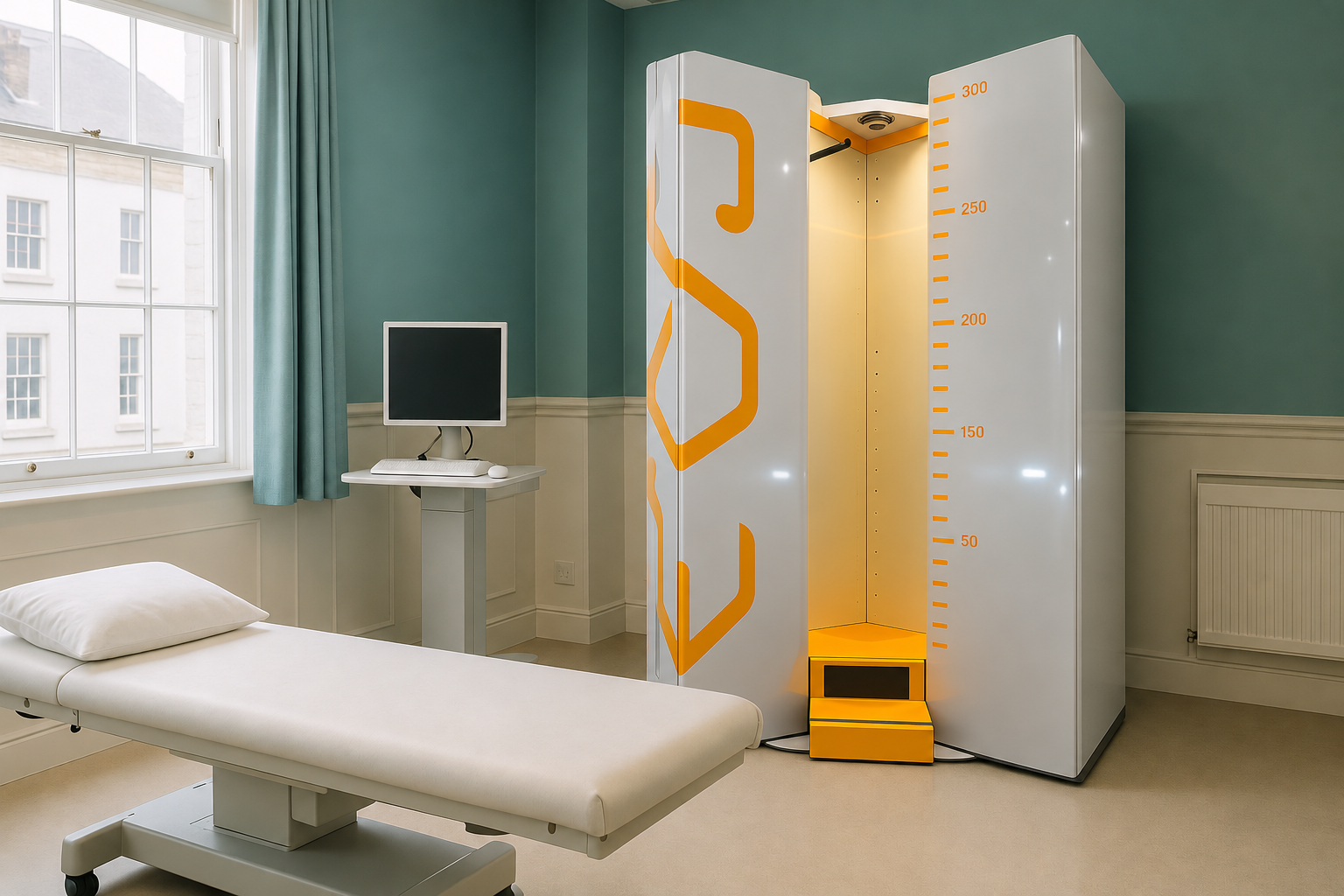
Is an EOS Scan Available on the NHS in the UK?
Yes, some NHS hospitals in the UK have EOS scanners, mainly at larger tertiary centres. But access is usually limited to specific referral pathways and certain clinical criteria. Most adults in the UK with back, hip or knee alignment problems will not be routinely offered an EOS scan through the NHS. A private self-pay scan is another option. It avoids waiting lists and does not need a referral from your doctor.
Key takeaways
- Some NHS hospitals in the UK have EOS scanners, but they are not widely available.
- NHS EOS scans usually need a consultant referral and may involve a long wait.
- You do not need a referral from your doctor to book a private scan.
- An EOS standing x-ray uses about 90% less radiation than a standard X-ray, around ten times less.
- Private results can be shared directly with your own medical team.
Can you get an EOS scan on the NHS?
In some cases, yes. A number of NHS hospitals have installed EOS systems, mostly at specialist orthopaedic and spinal units. These are most often found at larger teaching hospitals and tertiary referral centres in England, Scotland and Wales.
The problem is access. NHS EOS scans are usually kept for patients who have already been referred to a specialist consultant. This is usually for complex spinal conditions, planning before surgery, or ongoing monitoring. On the NHS, a GP cannot usually request one directly. The patient first needs to be under the care of a relevant hospital team.
Even then, waiting times for NHS imaging can be long. If you have ongoing back, hip or knee pain and want answers sooner, a private scan may be a faster route.
Why is EOS imaging not widely available on the NHS?
EOS scanners are specialist equipment. They cost much more than standard X-ray machines. Each one also needs its own space and trained staff. NHS imaging budgets in the UK are stretched, so most NHS trusts still rely on standard X-rays, CT and MRI for routine work.
| Factor | NHS pathway (UK) | Private self-pay |
|---|---|---|
| Referral needed | Consultant referral (usually through a GP first) | No referral needed |
| Scan type | Varies by hospital (may not be EOS) | EOS standing whole-body scan |
| Position during scan | Often lying down (CT/MRI) | Standing, weight-bearing |
| Waiting time | Can be weeks to months | Appointments available promptly |
| Cost | Free at the point of care for NHS patients | Self-pay. The price for patients travelling from abroad is confirmed during the free video consultation. See EOS scan cost |
Where NHS hospitals do have EOS, it is often kept for surgical planning rather than general alignment checks. That leaves a gap for adults who want to understand their posture and alignment but do not meet the criteria for an NHS specialist referral.
How do I get a private EOS scan without waiting?
You can refer yourself. At ScanAlign, private standing EOS imaging, you do not need a letter from your doctor or a consultant. You book directly, come to 19 Harley Street in London, and receive your results with a specialist report.
The scan captures your whole skeleton from head to foot while you stand naturally. Because you are upright and bearing your weight, the images show how your bones and joints actually line up under gravity. Lying-down scans often miss this, because the muscles relax and the spine, pelvis and legs settle into a different position.
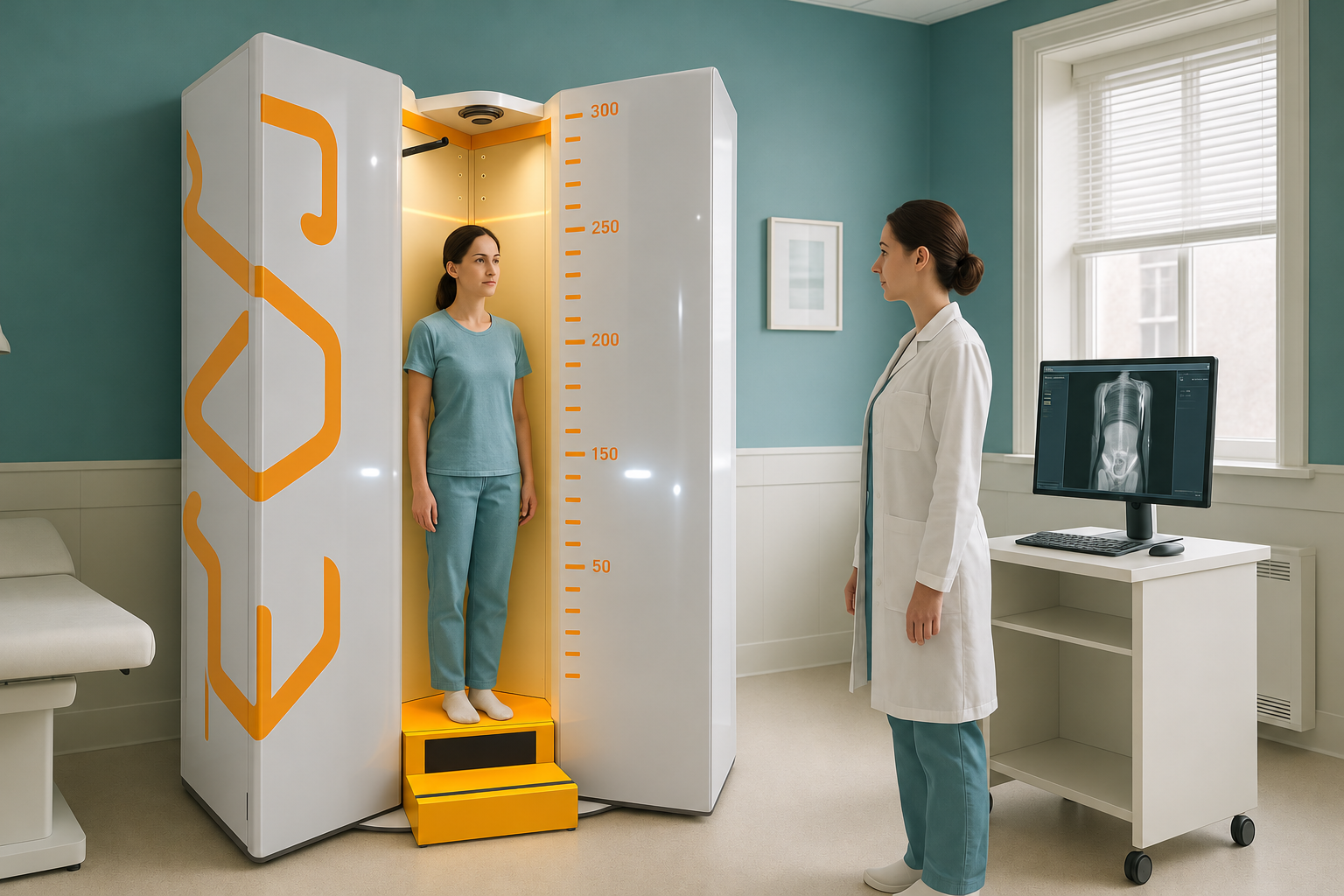
This matters because your body is a connected chain from your feet to your head. A tilt in the pelvis can change how your spine curves. That can shift load through one hip or knee. Pain often appears away from its true cause. A standing whole-body image shows these compensations in a way that single-area, lying-down scans cannot.
When is MRI the better choice? EOS shows bones, joints and alignment clearly. For soft tissue problems such as disc injuries, nerve compression or ligament tears, MRI is usually the better tool. If you are not sure which scan you need, a free video consultation can help you decide.
What are the steps to book a private EOS scan?
The process is simple. No paperwork, no referral letter, no waiting list.
Speak with a specialist radiographer about your symptoms and confirm the scan is right for you. Check who our scan is suitable for.
Come to 19 Harley Street, London. The scan itself takes only a few minutes while you stand still in the EOS booth.
A specialist report analyses your alignment from head to foot and highlights any areas of concern.
Your images and report can be sent directly to your doctor, consultant or physiotherapist.
Can I share private scan results with my own medical team?
Yes. Your images and report belong to you. We can send them electronically to your doctor, consultant, surgeon or physiotherapist. Many patients use a private EOS scan to give their medical team more detailed alignment information than standard imaging provides. This can help guide treatment decisions or referrals.
If you are already waiting for surgery, bringing a standing whole-body alignment scan to your appointment gives your surgeon a fuller picture of how your skeleton behaves under load.
Before you start a treatment, or change the one you are on, it is worth getting a detailed diagnosis. Knowing whether the cause sits in the pelvis, the legs or the spine changes what will actually help.
Want to find out whether a standing alignment scan could help with your symptoms?
Book a free video consultationFrequently asked questions
Some NHS hospitals in the UK do have EOS scanners, mainly at specialist orthopaedic and spinal centres. Access usually needs a consultant referral and may involve a long wait.
No. You can refer yourself for a private EOS scan at ScanAlign without a letter from your doctor or consultant.
The price for patients travelling from abroad is confirmed during the free video consultation. You can also visit our EOS scan cost page.
Yes. EOS uses about 90% less radiation than a standard X-ray, around ten times less. It is one of the lowest-dose skeletal imaging methods available.
When you lie down, gravity no longer acts on your skeleton in the same way. Muscles relax and your spine, pelvis and legs shift position. A standing scan captures your true, weight-bearing alignment. It shows problems that lying-down imaging can miss.
Yes. We can send your images and report directly to your consultant, doctor or physiotherapist. How to use them is their decision, but most clinicians welcome extra diagnostic information.
EOS captures your whole skeleton in one standing image, from head to foot. A standard X-ray usually covers one body area at a time and is often taken lying down. So it cannot show how your whole alignment connects.
They answer different questions. EOS is excellent for bones, joints and standing alignment. MRI is usually better for soft tissue, discs and nerves. In many cases, the two complement each other.
The scan itself takes only a few minutes. The full appointment, including preparation and positioning, is simple and much quicker than most hospital imaging visits.
ScanAlign is at 19 Harley Street, London, within The Harley Street Hospital.
No waiting list. Get answers now.
Find out whether a standing alignment scan is right for you with a free, no-obligation video consultation.
Book a free video consultationWritten by Abbas Dhami (Specialist Diagnostic Radiographer)
Sources
- NHS England. Diagnostic Imaging Dataset. Available at: england.nhs.uk/statistics/diagnostic-imaging-dataset/
- Illés T, Somoskeöy S. The EOS imaging system and its uses in daily orthopaedic practice. International Orthopaedics, 2012;36(7):1315-1322.
- Royal College of Radiologists. Standards for the communication of radiological reports and failsafe alert notification. RCR, 2016.
This page is general information and not a diagnosis.
ScanAlign is the trading name of CoreMed Solutions Ltd and operates under The Harley Street Hospital's CQC licence.