

Understanding Your EOS Scan Results: What Does the Report Actually Tell You?
Your EOS scan results come as a detailed report. It is based on whole-body, standing images of your skeleton. A consultant radiologist looks at the images. They describe how your bones, joints and overall alignment look while you stand upright and carry your own weight. The report helps your clinician plan the right next steps for you.
Key takeaways
- An EOS report covers your full skeletal alignment from head to ankles, taken while you stand.
- A consultant radiologist writes the report. Your referring clinician then uses it to guide treatment decisions.
- Standing images can show alignment problems that lying-down scans may miss.
- EOS uses about 90% less radiation than a standard X-ray, around ten times less.
- For soft-tissue problems such as disc or nerve issues, MRI is usually the better tool.
What does an EOS scan report show?
An EOS scan report shows where your bones and joints sit while you stand upright, carrying your own weight. It captures your spine, pelvis, hips, knees and ankles in a single, full-length image. So the radiologist can look at your alignment as one connected whole, not one area on its own.
Your body works as a chain. If your pelvis tilts to one side, your spine may curve to make up for it, and your knee may carry extra load. A standard X-ray of just your knee would miss that bigger picture completely. The EOS report maps out these links, so your clinician can trace pain or poor function back to its real source.
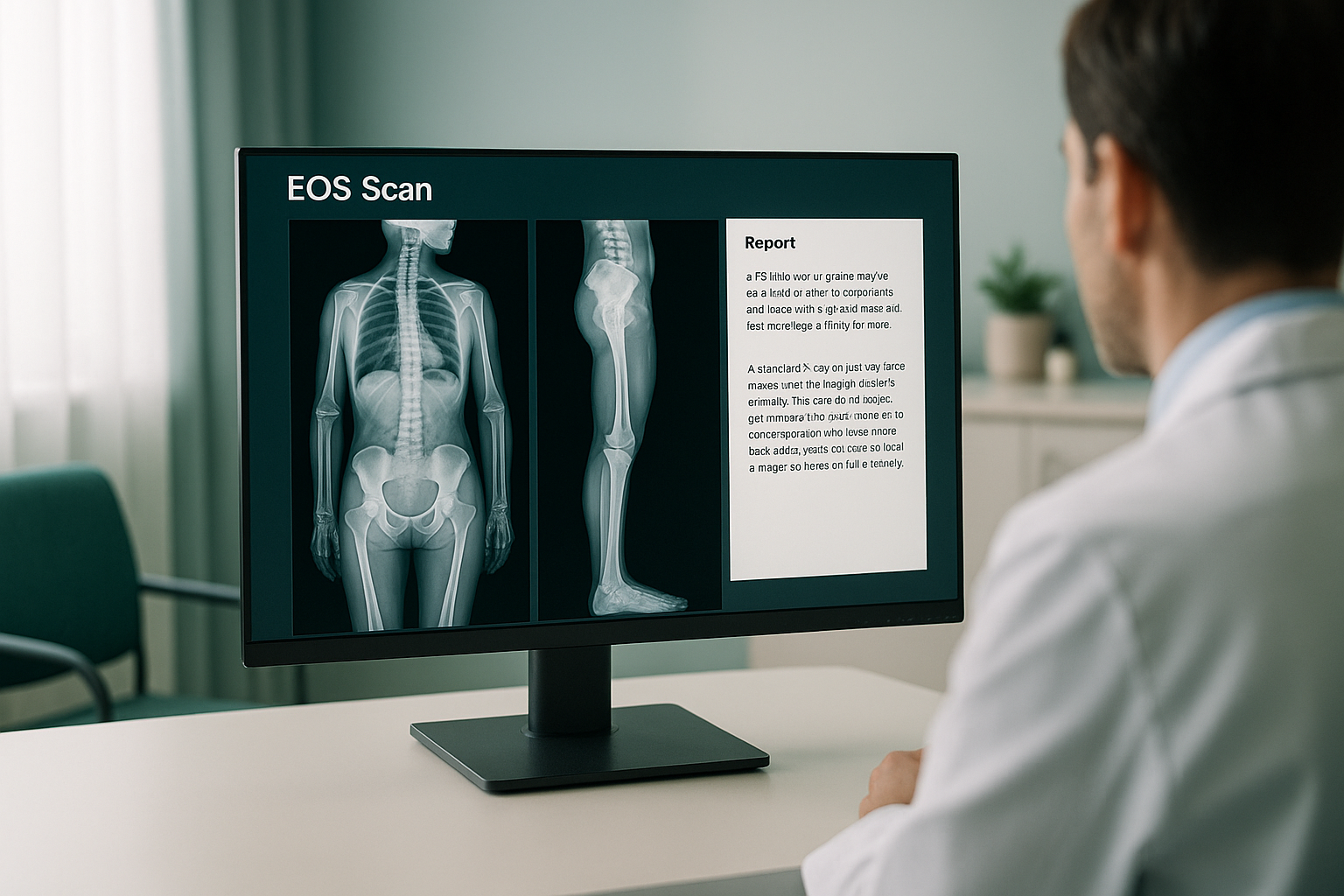
What are the main parts of an EOS scan report?
The report is set out so your clinician can quickly find what matters. Every report is shaped by what the images show. Even so, most cover the areas below.
The report uses medical terms. That is why your clinician will take you through the findings. At ScanAlign, you can discuss your results in a follow-up consultation, so you understand exactly what the images mean for you.
Why are standing scan results different from lying-down scans?
Standing images capture your skeleton under the natural pull of gravity and muscle tension. When you lie down for a standard X-ray, CT or MRI, your muscles relax, your spine decompresses and your pelvis settles into a neutral position. This can hide alignment problems that are clearly visible when you stand.
Think of it this way. A bridge looks different with traffic on it than when it is empty. Your skeleton behaves in a similar way. Carrying your weight shows how your joints cope under real-world load, not just how they look at rest.
This is why your EOS results may show findings that earlier scans missed. A slight pelvic tilt, a leg-length difference or a spinal shift may only show up on a standing image. Your report picks up these details because the EOS system images you upright, from head to ankles, in one pass.
Want to know how whole-body standing imaging works? Learn more about the EOS scan.
Who reads and interprets EOS scan results?
A consultant radiologist reviews your EOS images and writes the formal report. Radiologists are doctors who specialise in reading medical images and finding abnormalities. Their report then goes to your referring clinician. That may be an orthopaedic surgeon, a physiotherapist, an osteopath or another healthcare professional.
Your clinician reads the report alongside your symptoms, examination findings and medical history. Expert image analysis and clinical knowledge together make sure any next steps are based on a complete picture.
A note on what EOS does and does not show. EOS is excellent for bones, joints and alignment. If your clinician suspects a soft-tissue problem, such as a damaged disc, a torn ligament or a trapped nerve, MRI is usually the better tool. The two types of imaging work well together.
What happens after you get your EOS scan results?
Once your report is ready, your clinician will go over the findings with you. This conversation is where the report becomes useful. Your clinician can explain the alignment findings in everyday words. They can also discuss whether more tests or a referral are needed.
Common next steps include:
- Sharing the report with your surgeon before a hip or knee procedure.
- Using the alignment data to guide physiotherapy or rehabilitation.
- Looking at a specific area of the spine in more detail.
- Comparing with a future scan to track changes over time.
ScanAlign is a diagnostic imaging clinic. We provide the images and the radiologist's report. We do not offer treatment, but the information we provide helps your treating clinician make better decisions.
Before you start a treatment, or change the one you are on, it is worth getting a detailed diagnosis first. Knowing whether the cause sits in your pelvis, your legs or your spine changes what will actually help.
Have questions about what your EOS scan involves, costs or radiation safety? The price for patients travelling from abroad is confirmed during the free video consultation. Visit our frequently asked questions page.
Frequently asked questions about EOS scan results
It usually includes your clinical details, the radiologist's findings on bone and joint health, a full alignment assessment of your skeleton from head to feet, and a conclusion that sums up the key points.
An EOS scan captures your whole body in one standing image. It uses about 90% less radiation than a standard X-ray, around ten times less. It shows how your whole skeleton lines up under gravity, instead of imaging a single area while you lie down.
A consultant radiologist reviews the images and writes the formal report. This is a doctor who specialises in reading medical images.
No. You can refer yourself. We offer a free video consultation to discuss whether an EOS scan is the right next step for your symptoms.
EOS shows bones, joints and alignment. For soft-tissue problems such as discs, ligaments or nerves, MRI is usually the better tool. The two types of imaging often work well together.
Yes. EOS uses about 90% less radiation than a standard X-ray, around ten times less. This makes it one of the lowest-dose imaging options available for checking the skeleton.
The price for patients travelling from abroad is confirmed during the free video consultation. You can also visit our FAQs and cost page.
Often, yes. Because EOS images the whole body standing up, the radiologist can spot compensatory patterns. For example, a tilted pelvis might cause pain in your lower back or knee, even though the pelvis is the root issue.
Absolutely. The report and images are yours. You can share them with any clinician, surgeon or therapist to help with treatment decisions.
If the radiologist finds anything that needs urgent attention, your referring clinician will be told promptly. If you have sudden severe pain, numbness, weakness, or loss of bladder or bowel control, get urgent medical help straight away from your doctor or your nearest emergency department.
Ready to see the full picture?
A free video consultation lets you talk through your symptoms and find out whether an EOS scan is the right next step.
Book a free video consultationSources
- Illés, T. and Somoskeöy, S. (2012). The EOS imaging system and its uses in daily orthopaedic practice. International Orthopaedics, 36(7), pp.1395-1402.
- The Royal College of Radiologists. Standards for the reporting of imaging investigations (current guidance). rcr.ac.uk.
- NHS. (2023). X-ray overview, including radiation safety information. nhs.uk.
Written by Abbas Dhami (Specialist Diagnostic Radiographer).
This page is general information and not a diagnosis.
ScanAlign is the trading name of CoreMed Solutions Ltd and operates under The Harley Street Hospital's CQC licence.