
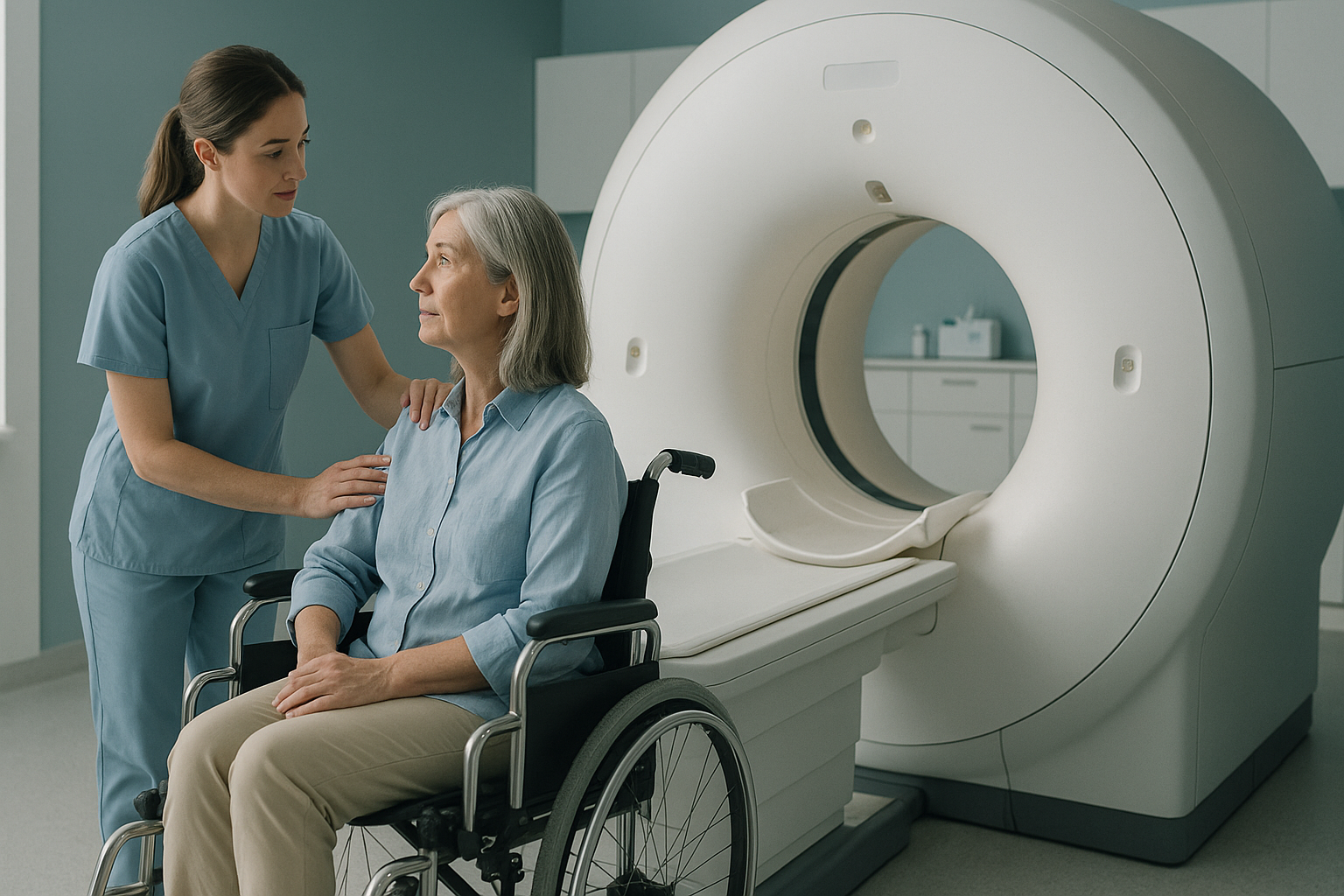
Can You Have the Scan With Limited Mobility or in a Wheelchair?
You may be able to have an EOS scan with limited mobility. But you do need to stand still for a short time during the scan. If you can stand with the help of support handles, a walking frame or another person, we can often make it work. If you cannot stand at all, even for a moment, this scan is not suitable for you.
Key points
- The EOS scan is a standing scan. You must be able to stand, even with support, for the image to be taken.
- The scanner has built-in support handles, and a carer or family member can stay close by.
- ScanAlign at 19 Harley Street has step-free access to the scanning room.
- A free video consultation before you book lets us check whether the scan will work for you.
- If standing is not possible, we will tell you honestly and help you think about other options.
We know that travelling to a clinic and having a scan can feel like a lot when moving is hard for you. This page gives you a clear, honest picture of what we can and cannot do. That way, you can decide whether the trip to London is worth it before you travel.
Why does the EOS scan need you to stand up?
The main purpose of an EOS scan is to see your skeleton while it carries your real body weight. When you stand, gravity acts on your spine, hips, knees and feet just as it does in daily life. This shows alignment problems that a scan taken lying down can miss. The scan captures your body in its natural standing position, so it cannot be done sitting in a wheelchair or lying on a table.
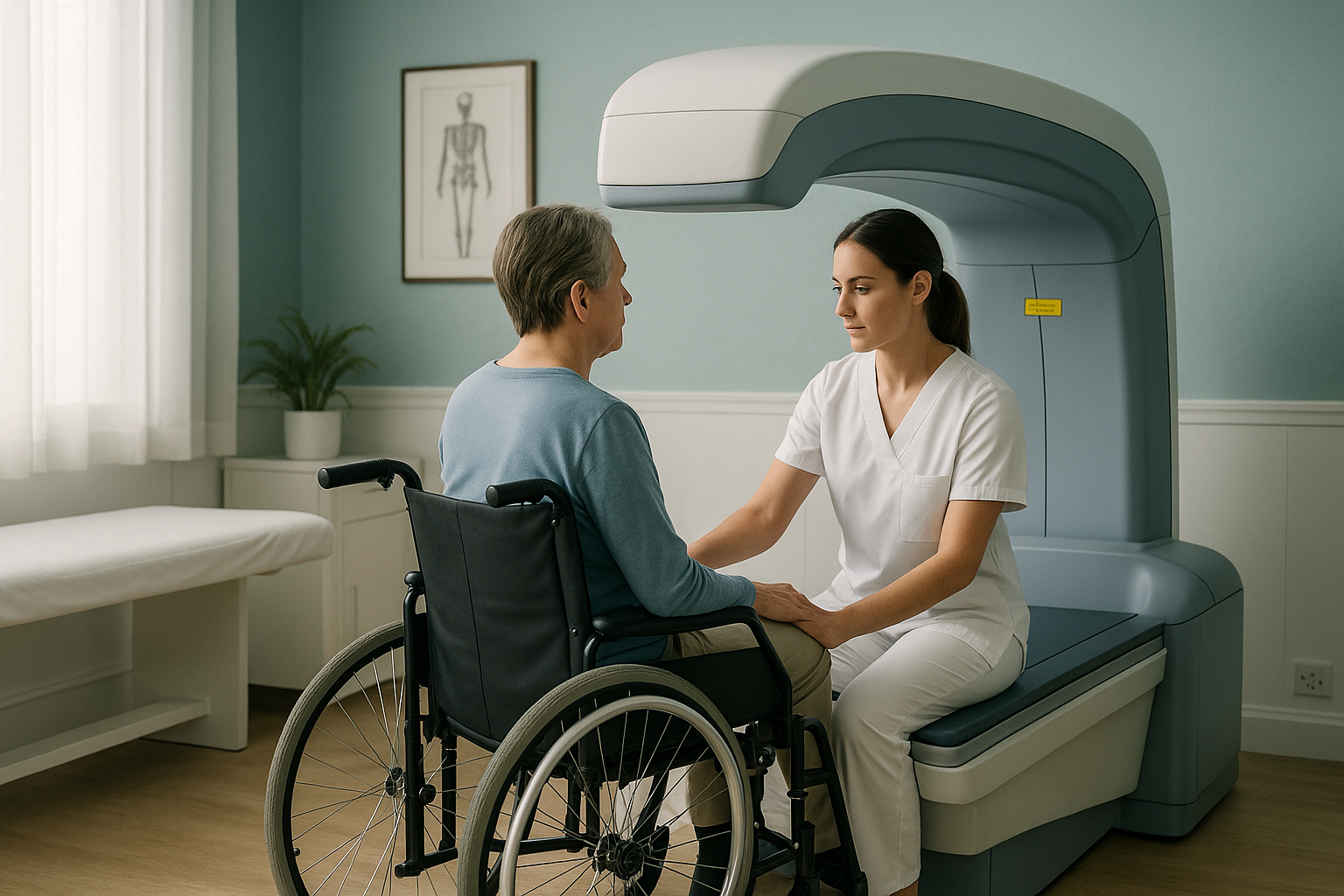
The scan itself is quick. You stand inside the scanner and hold the built-in support handles if you need to. The imaging arm then moves from head to toe. The main thing is to stay fairly still while it does.
Is the clinic step-free and wheelchair accessible?
Yes. The scanning room at 19 Harley Street has step-free access. If you come in a wheelchair, you can reach the scanning room without any stairs. But please remember that you will need to move from the wheelchair to a standing position for the scan itself.
No stairs between the entrance and the scanning room.
A family member or carer can come with you into the scanning room.
Built into the scanner to help you keep your balance.
If you have any communication or sensory needs, please tell us when you book. We want your appointment to be as comfortable as possible. If you tell us what would help, we can change the way we work.
Who can have this scan and who cannot?
We want to be open with you. The scan is suitable for some people with limited mobility, but not for everyone. Here is a simple summary.
- You can stand using support handles or a walking frame
- You can stand for a short time with help from someone with you
- Your mobility is reduced but you can bear your own weight
- You use a wheelchair but can move from it to standing
- You cannot stand at all, even with help
- You cannot bear weight through your legs
- Standing causes severe pain that makes staying still impossible
- You would need a hoist to move, as we do not have hoist facilities at the clinic
If you are not sure which group you are in, the best step is to talk to us first. A free video consultation lets us understand your situation and give you an honest answer before you travel to London. You can read more about who our scan is suitable for.
A note on MRI and other scans done lying down. EOS is excellent for bones, joints and whole-body alignment, but it must be done standing. If you need imaging of soft tissue (discs, nerves, ligaments) and you cannot stand, MRI is usually the better choice and can be done lying down. We are happy to advise you on which type of imaging may suit your needs.
How do you book if you have mobility needs?
It starts with a conversation, not a commitment. Here is what to expect.
When you tell us your needs and book, let us know how your mobility is affected. Mention anything that might matter: using a wheelchair, walking aids, pain when standing, or communication or sensory needs.
We will talk through your situation on a video call. This lets us judge honestly whether the scan is right for you and answer your questions, all before you travel to the clinic.
If the scan is suitable, we will plan ahead. This might mean giving your appointment extra time, confirming access arrangements, or noting that a carer will come with you.
On the day, we will help you settle in at your own pace. You can read more about what to expect at an alignment assessment.
Not sure if this scan will work for you? Start with a conversation. There is no obligation and the consultation is free.
Book a free video consultationWhat happens if you cannot have the scan?
If we decide the EOS scan is not right for you, we will tell you clearly and explain why. We would rather be honest than have you make a hard journey for nothing. Depending on what your treating specialist or therapist needs to see, imaging done lying down, such as MRI, CT or a standard X-ray, may be a better option. We can suggest next steps. You can also ask your own doctor which type of imaging suits you best.
Before you start a treatment, or change the one you are on, it is worth getting a detailed diagnosis. Knowing whether the cause sits in the pelvis, the legs or the spine changes what will actually help.
For more about our patient support, including what to tell us before your visit, please get in touch.
Frequently asked questions
Yes, if you can move from the wheelchair to a standing position and stay standing with support for the whole scan. If you cannot stand at all, the scan is not suitable.
The scan itself is quick. You need to stand fairly still for a short time while the imaging arm moves from head to toe. We will tell you exactly what to expect during your video consultation.
No. We do not currently have hoist transfer facilities at the clinic. If you need a hoist to move from sitting to standing, this scan is not suitable at this time.
Yes. A carer or family member is welcome in the scanning room. They can help you get into position and stay close by the whole time. The radiation dose from an EOS scan is very low, about 90% less than a standard X-ray, around ten times less, so this is safe.
No. The medical value of this scan comes from imaging your body while it carries its natural weight. A seated image would not show the alignment details that make the EOS scan useful.
Yes. There is step-free access from the entrance to the scanning room at 19 Harley Street. Please mention any access needs when you book so we can prepare.
Tell us during your free video consultation. If you can stand for a short time with the help of the scanner's built-in handles, it may still be possible. We will give you an honest answer based on your situation.
No. You can book directly yourself. It starts with a free video consultation where we discuss your needs and confirm whether the scan is suitable.
The price for patients travelling from abroad is confirmed during your free video consultation.
We will tell you openly. Depending on what your treating specialist or therapist needs, other types of imaging done lying down, such as MRI or CT, may be more suitable. We can help guide you to the right next step.
Not sure if you can have the scan?
Start with a free video consultation. We will look at your situation honestly and let you know before you travel.
Book a free video consultationWritten by Abbas Dhami (Specialist Diagnostic Radiographer)
Sources
- EOS imaging. Illés, T., Somoskeöy, S. European Spine Journal, 2012;21 Suppl 2:S205-S213. Overview of EOS biplanar radiography in clinical practice.
- NHS England. Accessible Information Standard, 2017. Guidance on meeting communication and access needs in healthcare settings in England.
- Equality Act 2010. UK Government law on reasonable adjustments for disabled people using services in the UK.
This page is general information and not a diagnosis.
ScanAlign is the trading name of CoreMed Solutions Ltd and operates under The Harley Street Hospital's CQC licence.