
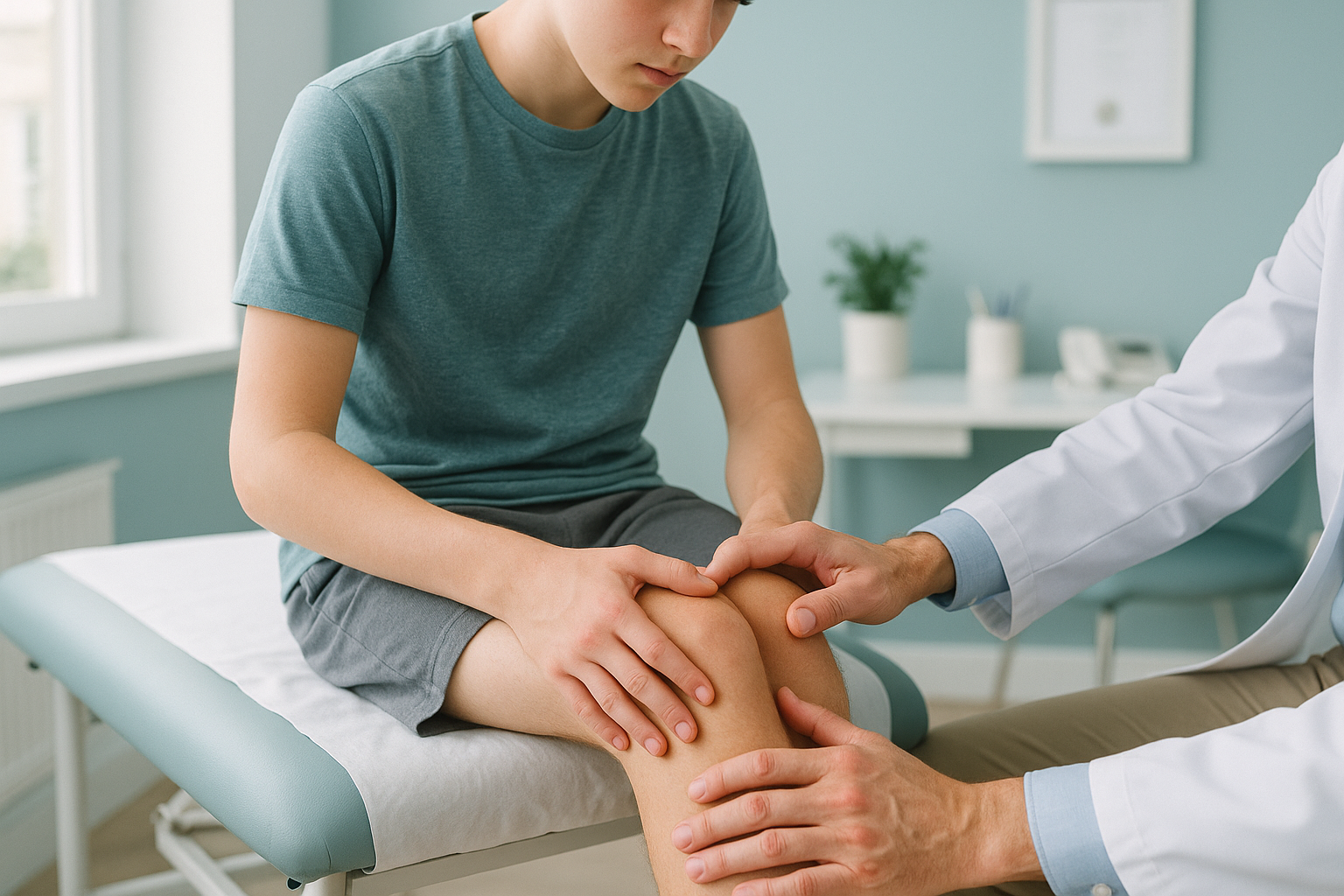
What Causes Pain in the Front of the Knee in Teenagers?
Pain in the front of the knee, also called anterior knee pain, is usually caused by fast bone growth during a growth spurt, together with the repeated load of sport. The front of the knee is under extra stress because the muscles and tendons have not yet caught up with the longer bones. It is very common and almost always harmless. It usually settles with time and by changing how much activity your child does.
Key points
- Growth spurts make the front of the knee vulnerable, because tendons pull on growing bone.
- Osgood-Schlatter and Sinding-Larsen-Johansson are the two most common causes. Both are self-limiting.
- Most knee pain in teenagers does not need a scan and goes away with simple measures.
- If the pain is severe or on one side only, or comes with swelling, locking or pain at night, it is important to see a doctor.
- When a scan is needed, a standing assessment can show alignment problems that lying-down scans may miss.
What is anterior knee pain in teenagers?
Anterior knee pain is a general term for any pain felt at the front of the knee, around or behind the kneecap. It is one of the most common reasons teenagers see a doctor about their joints. In most cases it is not caused by damage. It is caused by the normal stresses of a growing skeleton.
During a growth spurt, the bones get longer before the muscles and tendons around them have time to adjust. This puts extra pulling force on the growth plates (apophyses) at the front of the knee. The result is irritation, soreness and sometimes a bump you can see just below the kneecap.
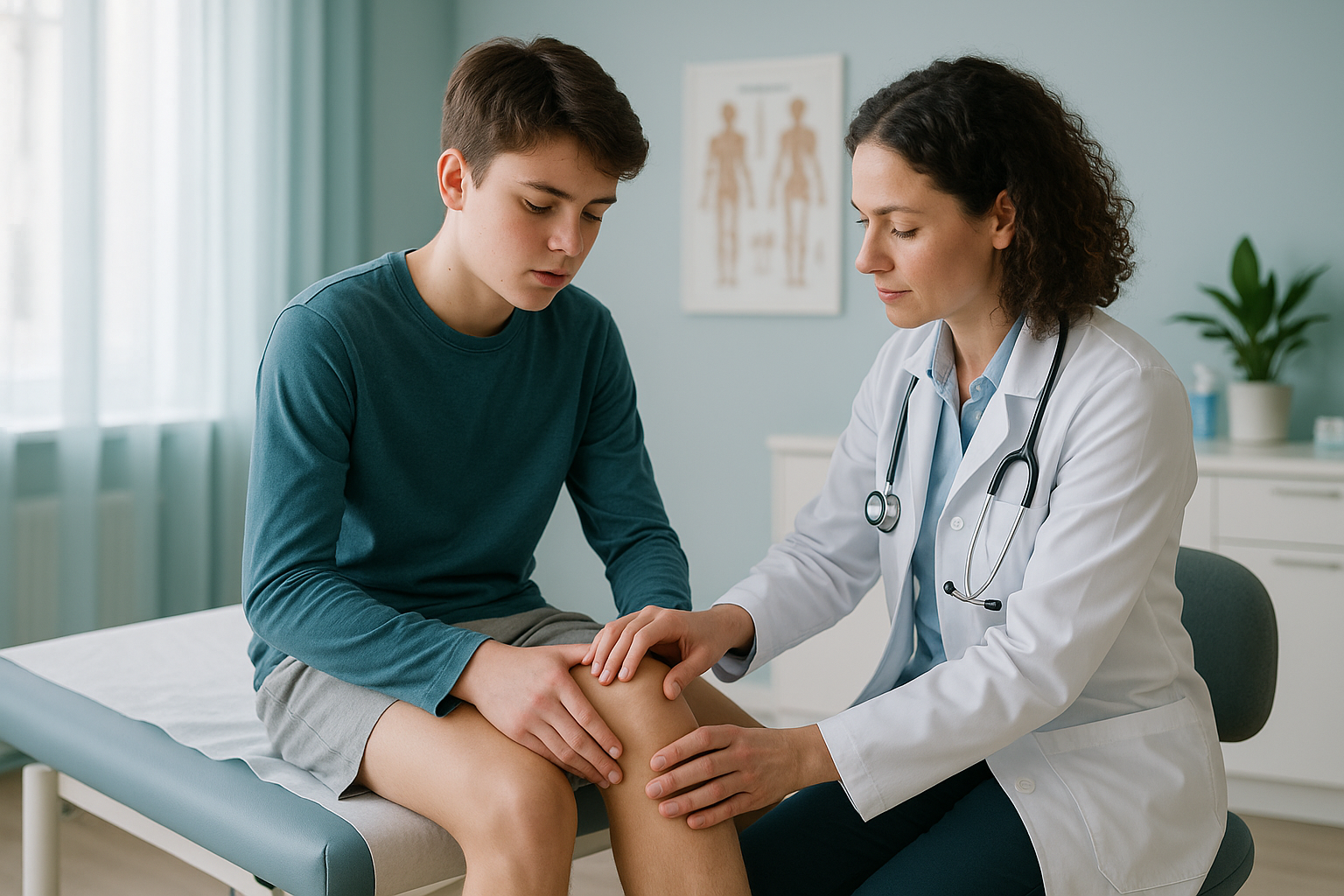
How can you tell if your teenager has anterior knee pain?
The pain usually builds up slowly, rather than starting with one injury. It tends to get worse with running, jumping, squatting or going up and down stairs. Your child may describe a dull ache around or just below the kneecap.
An ache during or after running, jumping, kicking or climbing stairs.
A bony lump at the top of the shin that is sore to touch. Very common in Osgood-Schlatter.
Pain or stiffness at the front of the knee after sitting with bent knees for a long time. This is sometimes called "cinema sign".
Kneeling directly on a hard surface becomes uncomfortable or painful.
What are the most common causes of knee pain in teenagers?
Conditions linked to growth are by far the most common cause. They are not injuries in the usual sense. They happen when normal growing bones are stressed by normal activity. The main conditions are listed below.
Irritation of the growth plate at the top of the shin bone, just below the kneecap. It causes a painful bump. Very common in active teenagers during a growth spurt.
Similar to Osgood-Schlatter, but it happens at the bottom of the kneecap rather than the top of the shin. The pain is felt right at the lower edge of the kneecap.
A broader term for pain around the kneecap. It is often linked to how the kneecap moves in its groove when the knee bends. Learn more about patellofemoral pain syndrome.
Overloading of the tendon that joins the kneecap to the shin, sometimes called jumper's knee. It is related to the patellar tendonitis seen in older athletes.
Less often, knee pain in teenagers can be linked to cartilage problems, ligament strains or, very rarely, more serious conditions. That is why any knee pain that gets worse over time, comes with swelling or wakes your child at night should be checked by a doctor.
Why does leg alignment matter in knee pain in teenagers?
Alignment plays a bigger role than most people think. If a teenager's legs are slightly rotated, knock-kneed or bowed, the kneecap does not sit in the centre of its groove. That changes how force passes through the knee with every step.
The body is a connected chain from the feet to the hips. A small twist at the hip, or a foot that rolls inward, can add stress to the front of the knee. The knee is often where the pain is felt, but the real cause may be higher or lower in the chain.
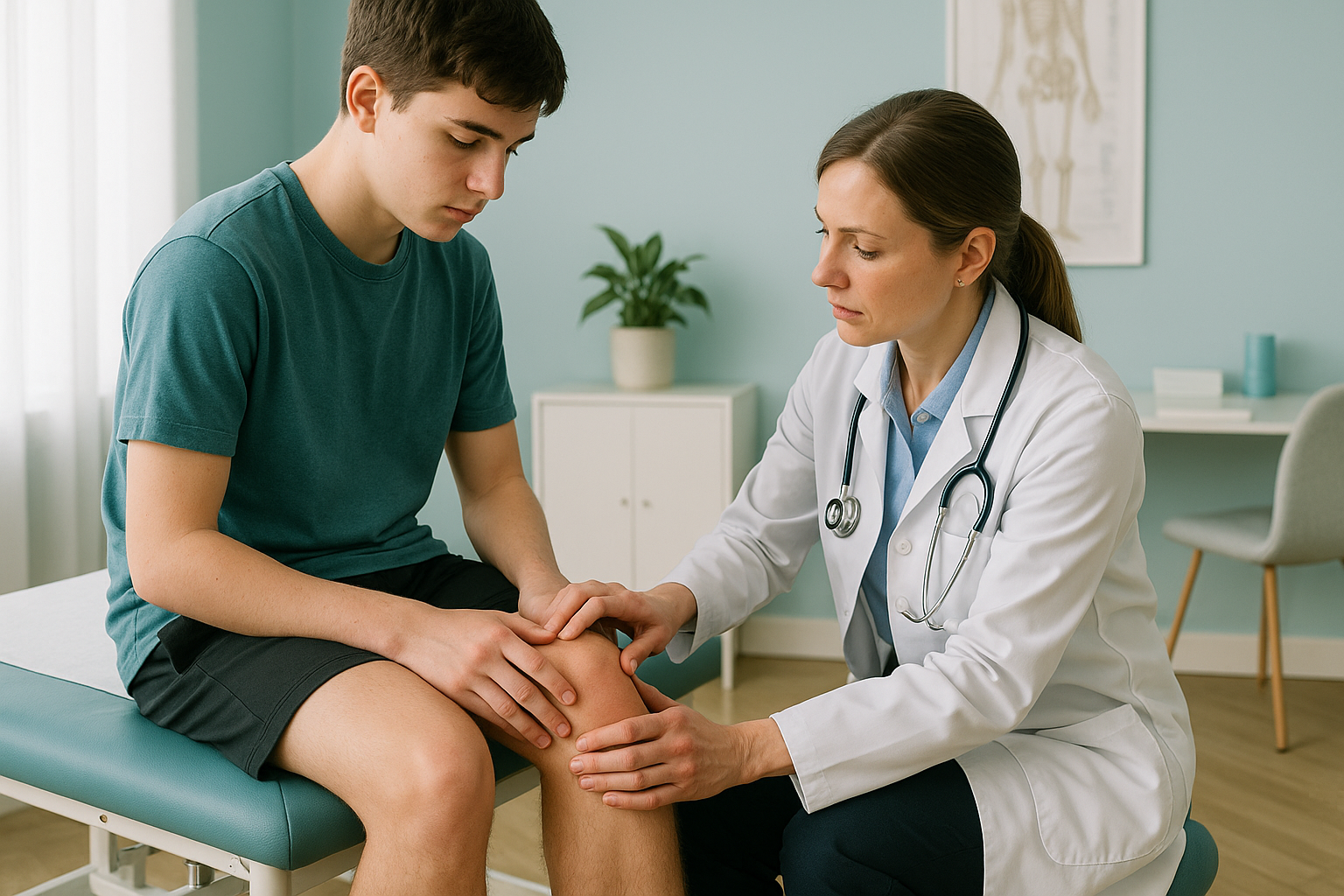
Standard scans are usually done lying down. In that position, gravity is removed and the muscles relax, so small alignment problems may not show. A standing, weight-bearing image shows the skeleton exactly as it works during walking and sport. At ScanAlign, low dose standing imaging uses about 90% less radiation than a standard X-ray, around ten times less, which matters when the patient is young.
Does knee pain in teenagers need an X-ray or scan?
Most of the time, no. A doctor or physiotherapist can usually diagnose the common growth-related conditions from the history and a physical examination alone. Scans are generally kept for cases where the picture is unclear, the pain is not following the expected pattern, or symptoms are not settling after several months of suitable care.
- Pain has lasted many months despite rest and rehabilitation
- There is concern about how the kneecap moves, or about alignment
- A clinician suspects a structural problem beyond a growth-related condition
- Planning before surgery is needed (rare at this age)
- Symptoms are typical of Osgood-Schlatter or Sinding-Larsen-Johansson
- Pain is mild and only comes on during heavy sport
- The teenager is still in the middle of a growth spurt and getting better
- A clear clinical diagnosis has already been made
When is MRI better? EOS imaging shows bones, joints and alignment very well. For soft-tissue problems such as cartilage damage, ligament tears or meniscus problems, MRI is usually the better tool. Your clinician can advise which type of scan, if any, is right.
If you are not sure whether a scan would help your teenager, you can learn more about children's imaging at ScanAlign.
What helps anterior knee pain in teenagers?
The good news is that most front knee pain in teenagers settles as growth slows down. The aim of care is to keep your child comfortable and active while their skeleton matures. Common approaches include the following.
- Changing activity. Doing less of the activities that bring on pain, and doing them less hard, without stopping exercise completely.
- Stretching and strengthening. Gentle stretching of the thigh muscles (quadriceps and hamstrings), plus targeted strengthening exercises guided by a physiotherapist.
- Managing load. Going back to full training step by step, rather than straight back to top intensity.
- Reassurance. Understanding that the condition is common, temporary and not a sign of damage really does help.
ScanAlign does not provide treatment. It is a diagnostic imaging service. If a scan is appropriate, the findings give your teenager's treating clinician a clearer picture of alignment and structure to guide their care plan.
Before your teenager starts a treatment, or changes the one they are on, it is worth getting a detailed diagnosis. Knowing whether the cause sits in the pelvis, the legs or the spine changes what will actually help.
Wondering whether a standing alignment assessment could help your teenager? A short video call, with no obligation, can answer that question before you plan a trip to London.
Book a free video consultationWhen to get urgent help
If your teenager has sudden severe knee pain after an injury, the knee locks or gives way, there is significant swelling within hours, or they develop numbness, weakness or difficulty walking, get urgent medical help from your doctor or the nearest emergency department.
Frequently asked questions
In the vast majority of cases, no. Growth-related conditions like Osgood-Schlatter and Sinding-Larsen-Johansson are self-limiting and go away as the skeleton matures. Symptoms that last or get worse should always be checked by a clinician.
Most teenagers do. The conditions linked to growth spurts usually settle once the growth plates close, which usually happens in the mid to late teenage years. Symptoms can come and go during the growth period.
Complete rest is rarely needed or helpful. Doing painful activities less often and less hard, while keeping up general fitness, is usually the recommended approach. A physiotherapist can help tailor a plan.
Both involve irritation of a growth plate near the knee. Osgood-Schlatter affects the top of the shin bone, just below the kneecap. Sinding-Larsen-Johansson affects the bottom tip of the kneecap itself. Both are managed in similar ways.
Not usually. Most growth-related knee pain can be diagnosed through examination. A scan helps when symptoms do not follow the expected pattern, last a long time, or when alignment needs to be assessed in detail.
When you lie down, gravity is removed and your muscles relax. Small alignment problems that affect the knee under load may not show. A standing image shows the skeleton exactly as it works during walking and sport, showing the true position of bones and joints.
EOS uses about 90% less radiation than a standard X-ray, around ten times less. This makes it particularly well suited for younger patients when imaging is clinically needed.
No. ScanAlign is a private, self-pay service and you can book directly yourself. A free video consultation is the first step to check whether a scan is appropriate for your teenager.
The price for patients travelling from abroad is confirmed during the free video consultation. There is no obligation to go ahead.
Yes. The knee sits in the middle of a chain that runs from the foot to the hip and pelvis. Flat feet, the ankle rolling inward too much, or a rotational difference at the hip can all add stress to the front of the knee. A whole-body standing assessment can show these links.
Not sure if your teenager needs a scan?
A short, free video consultation with our team can help you decide the right next step before you travel to London.
Book a free video consultationWritten by Abbas Dhami (Specialist Diagnostic Radiographer)
Sources
- Rathleff MS et al. "Anterior knee pain in adolescence and young adulthood." Current Opinion in Rheumatology, 2019.
- NHS. "Osgood-Schlatter disease." NHS online guidance, nhs.uk.
- Circi E et al. "Treatment of Osgood-Schlatter disease: review of the literature." Musculoskeletal Surgery, 2017.
This page is general information and not a diagnosis.
ScanAlign is the trading name of CoreMed Solutions Ltd and operates under The Harley Street Hospital's CQC licence.