
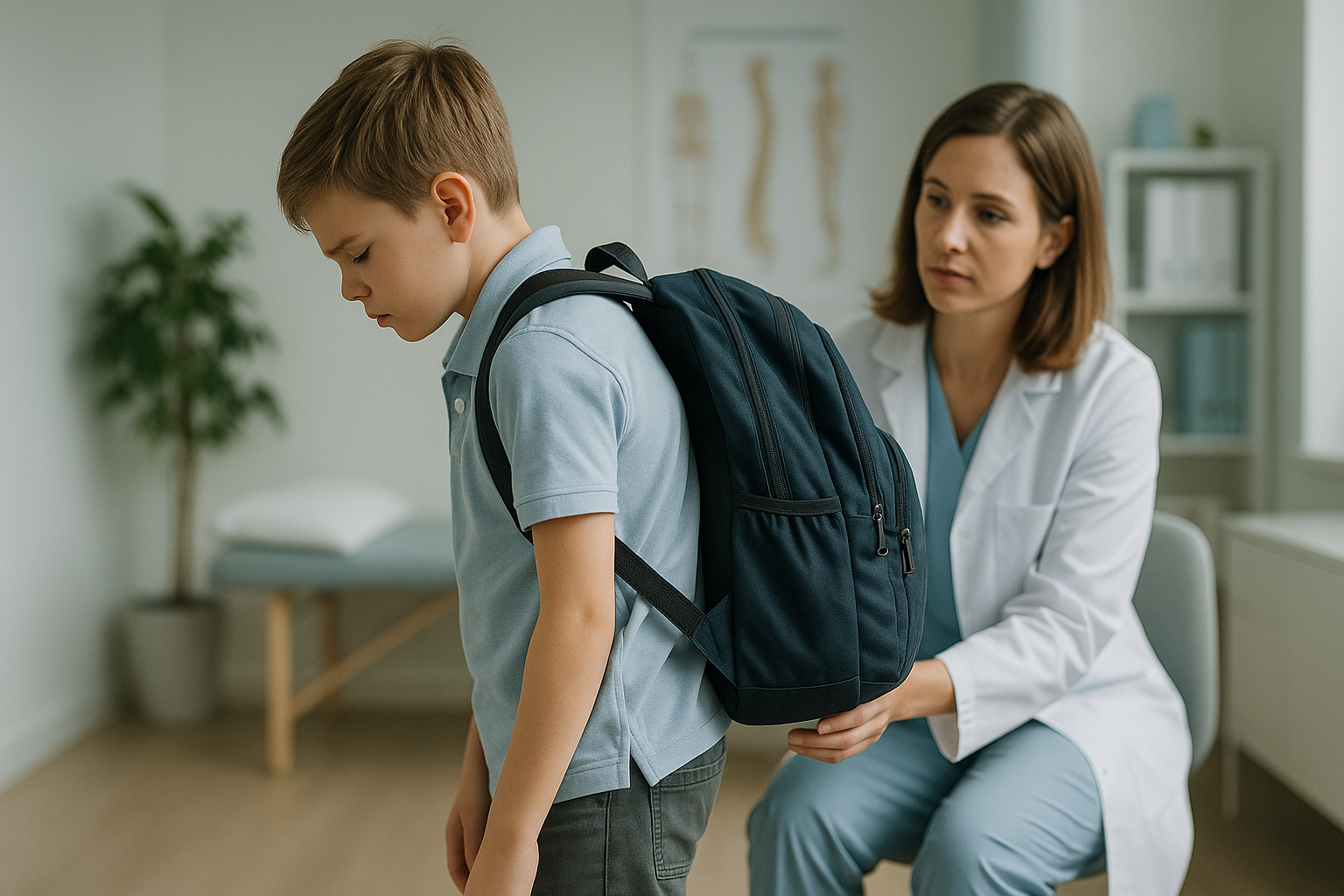
Do Heavy School Bags Damage Children's Posture?
A heavy school bag can cause short-term back pain, tired muscles and a clear forward lean while your child is carrying it. However, current evidence does not show that bags cause lasting structural damage to a growing spine. The discomfort usually goes away once the load is taken off, but pain that persists deserves proper investigation.
Key takeaways
- Heavy bags cause temporary posture changes and muscle fatigue, not permanent damage to the spine.
- Most guidelines recommend that a bag weighs no more than 10 to 15 percent of a child's body weight.
- School bags do not cause scoliosis. That is a common myth.
- Carrying a bag on one shoulder puts more load on one side and may lead to uneven shoulders while the bag is on.
- If back pain continues after the bag is off, a standing posture assessment can help find the cause.
What are the signs a school bag is too heavy?
The most obvious sign is that your child leans forward, rounds their shoulders, or complains of back, neck or shoulder pain on the way to or from school, or afterwards. You might also see red marks on the shoulders from the straps, or your child may keep asking to put the bag down.
Why do heavy school bags cause back pain in children?
A heavy load shifts your child's centre of gravity backwards. To make up for it, they lean forward, and their back muscles have to work harder. Over a school day, this leads to tired muscles and discomfort. The body is a connected chain. Extra load at the shoulders changes posture all the way down to the pelvis and legs.

Does carrying a heavy bag cause scoliosis?
No. This is one of the most common myths about school bags and children's spines. Scoliosis is a structural curve in the spine that develops for reasons that have nothing to do with outside load. It is usually idiopathic, meaning the exact cause is unknown, and it has a strong genetic link.
A heavy bag on one shoulder can make your child lean to one side, which may look like a curve in the spine. But this is a temporary change in posture, not a structural change. Once the bag comes off, the lean goes away. Research consistently shows no causal link between carrying a school bag and scoliosis.
If you notice uneven shoulders or a visible curve even without the bag, that is worth looking into separately.
How heavy should a school bag be?
Most guidelines recommend that a school bag weighs no more than 10 to 15 percent of your child's body weight. So a child who weighs 40 kg should carry no more than about 4 to 6 kg. Staying below this limit reduces muscle fatigue and the way posture shifts to cope with the load.
Practical packing advice
- Use both straps. Two padded straps spread the load evenly across both shoulders and reduce the one-sided lean of carrying on one shoulder.
- Pack heavy items close to the back. This keeps the weight nearer your child's centre of gravity and reduces the forward pull.
- Clear out daily. Old worksheets, forgotten water bottles and spare sports kit add up fast. A weekly clear-out helps.
- Choose a bag with a waist strap. A hip belt moves some of the load from the shoulders to the pelvis, which handles weight much better.
- Use a locker if there is one. Splitting the load between a locker and the bag can halve what your child carries at any one time.
When should you get your child's posture checked?
If your child's back pain continues even when they are not carrying a bag, or if you can see that their posture is uneven at rest, it makes sense to look into it further. Pain that lasts more than a few weeks, or that stops them being active, deserves attention.
Standard imaging is usually done lying down. But lying down relaxes the muscles and removes the effect of gravity, which can hide alignment problems that only show up when the body is upright and carrying its own weight. A standing, whole-body image captures the skeleton under real-world load, from head to feet, in a single view. This makes it easier to spot small asymmetries, differences in leg length, or early curvature that lying-down imaging might miss.
Paediatric imaging at ScanAlign uses EOS technology, which delivers about 90% less radiation than a standard X-ray, around ten times less. That is especially important for growing children, who are more sensitive to radiation than adults.
Before your child starts treatment, or changes the one they are on, it is worth getting a detailed diagnosis. Knowing whether the cause sits in the pelvis, the legs or the spine changes what will actually help.
Worried about your child's posture or back pain that will not go away? A free video consultation can help you decide whether imaging is the right next step before you plan a trip to London.
Book a free video consultationWhen MRI is the better choice: EOS shows bones, joints and alignment very clearly. For soft tissue, discs or nerves, MRI is usually the better tool. The specialist treating your child can advise which is right for their situation.
Frequently asked questions
Current research does not support the idea that school bags cause permanent damage to the spine. They can cause temporary muscle fatigue and posture changes, but these usually settle once the load is taken off.
Most guidelines recommend no more than 10 to 15 percent of your child's body weight. For a child who weighs 35 kg, that means a bag of roughly 3.5 to 5 kg.
No. Carrying on one shoulder creates a temporary lean, but it does not cause scoliosis. Scoliosis is a structural condition with a strong genetic link and is not caused by outside load.
Back pain that rises during term time is usually linked to carrying a heavy bag every day, often together with long hours of sitting. If the pain goes away in the holidays, the weight of the bag is the most likely cause.
A bag with two wide, padded shoulder straps and a waist or chest strap is best. This spreads the weight evenly and keeps the load close to the body. Avoid single-strap shoulder bags for heavy loads.
If a lighter bag and using both straps clears up the pain, a doctor's visit may not be needed. However, if the pain lasts more than a few weeks, is there without the bag, or comes with numbness or weakness, see your doctor promptly.
A standing, whole-body image captures the whole skeleton while it carries its natural weight. This shows alignment from head to feet in a single view, which a standard lying-down X-ray of one area cannot do.
Yes. EOS delivers about 90% less radiation than a standard X-ray, around ten times less. This makes it especially suitable for children, who are more sensitive to radiation than adults.
No referral is needed. ScanAlign, low dose standing imaging, accepts self-referrals. You can start with a free video consultation to talk through whether imaging is suitable for your child.
The price for patients travelling from abroad is confirmed during the free video consultation, which you can use to book a paediatric posture assessment.
Worried about your child's posture?
A free video consultation with our specialist radiographer can help you decide if imaging is the right next step, before you travel to London.
Book a free video consultationWritten by Abbas Dhami (Specialist Diagnostic Radiographer)
Sources
- Dockrell S, Simms C, Blake C. Schoolbag weight and the effects of schoolbag carriage on secondary school students. Ergonomics. 2015;58(11):1870-1882.
- NHS. Back pain in children and teenagers. nhs.uk.
- American Academy of Pediatrics. Backpack safety. healthychildren.org.
This page is general information and not a diagnosis.
ScanAlign is the trading name of CoreMed Solutions Ltd and operates under The Harley Street Hospital's CQC licence.