
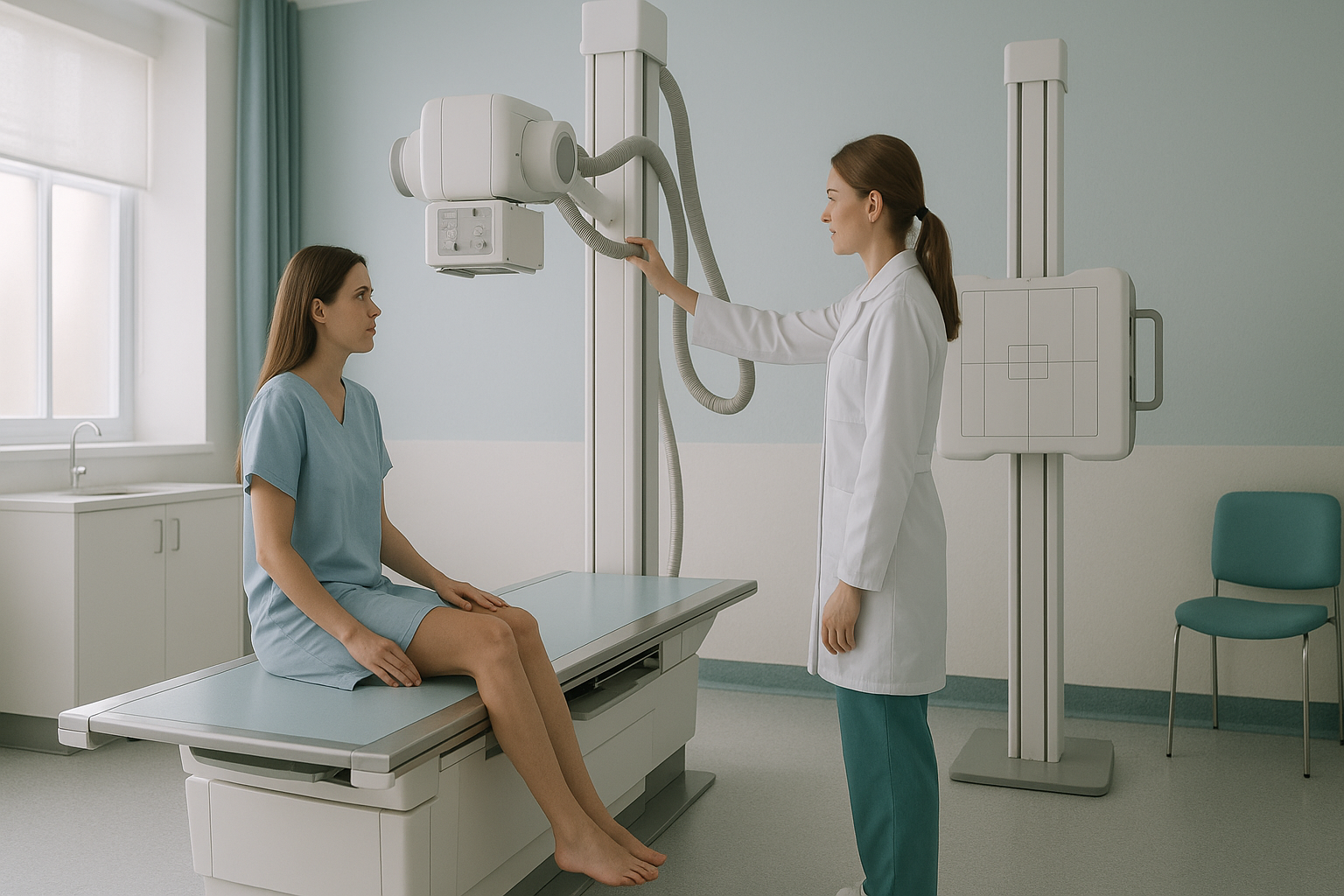
How Often Can You Safely Have an X-ray?
In the UK, there is no fixed legal limit on how many X-rays you can have in a year. Every scan must be clinically justified. This means the benefit of getting a clear answer must outweigh the very small radiation risk. So the real question is not "how many?" It is whether each X-ray is the right test for you at that time.
Key points
- There is no yearly cap on how many X-rays are safe for patients in the UK.
- Every X-ray must be justified. This means the clinical benefit must outweigh the risk.
- Radiation dose varies hugely between types of scan. A chest X-ray gives far less than a CT scan.
- Low dose systems like EOS use about 90% less radiation than a standard X-ray, around ten times less.
- Keeping a record of your past scans helps your clinicians make better decisions.
Is there a limit on X-rays per year?
No. UK regulations under IRMER (Ionising Radiation (Medical Exposure) Regulations) do not set a maximum number of X-rays a patient can have in any period of time. Yearly dose limits exist for people who work with radiation. Those limits do not apply to patients having diagnostic scans.
Instead, UK law places the responsibility on the person who requests the scan and the person who carries it out. Every request for a scan must meet the principle of justification: the expected benefit to you must outweigh the small risk from radiation. If a scan is justified, it is safe to go ahead, even if you have had several X-rays recently.
This surprises many people. The common belief that you are "only allowed a certain number per year" is a myth. What really protects you is the rule that no X-ray should ever be done without a good clinical reason.
What keeps repeated X-rays safe?
Two principles work together: justification and optimisation (often called ALARA, meaning "as low as reasonably achievable").
Every scan needs a clear clinical question. The person requesting your scan decides whether the expected information justifies the exposure.
Once a scan is justified, the radiographer uses the lowest dose that still gives an image good enough for diagnosis. Better technology means lower doses.
Keeping a record of past scans helps your clinicians avoid repeats that are not needed. It also helps them track your total exposure over time.
In practice, this means a well-justified series of X-rays carries very little extra risk. The dose from a single diagnostic X-ray is extremely small compared to the natural background radiation you receive every day from the environment.
How much radiation does an X-ray give compared to other scans?
Radiation dose varies a lot between different types of scan. The table below gives a general sense of scale. Effective dose is measured in millisieverts (mSv), a unit that accounts for how sensitive different body tissues are to radiation.
As you can see, a single chest or limb X-ray gives a tiny fraction of the radiation you receive naturally each year. Even a lumbar spine X-ray is well below your yearly background dose. CT scans give much more. This is one reason clinicians think carefully before requesting them.
How does low dose imaging reduce your total exposure?
Low dose imaging systems are designed to capture the same diagnostic information using about 90% less radiation than a standard X-ray, around ten times less. This is especially useful when you need standing, weight-bearing images of the whole body. It means you can get a detailed alignment assessment with a very small dose.
At ScanAlign, low dose standing imaging, we use EOS technology. EOS captures full-length standing images of your skeleton from head to feet in a single pass. Because it uses so little radiation, it is well suited to follow-up scans where you may need more than one scan over time, for example before and after a procedure. You can read more about EOS scan safety and radiation or find out whether an EOS scan is safe for your situation.
A note about MRI. EOS shows bones, joints and whole-body alignment. For soft tissue, discs or nerves, MRI is usually the better tool. MRI uses no radiation at all. Your clinician can advise which test suits your question best.
If you need standing whole-body imaging with very low radiation, we can help. Our free video consultation lets you talk through your imaging needs before you decide to travel.
Book a free video consultationWhat happens when you book a low dose scan at ScanAlign?
You do not need a referral from your doctor. You can refer yourself as a private, self-pay patient. Here is what to expect.
Free video consultation
A short call to understand your symptoms, look at any previous scans and confirm whether an EOS scan is the right next step.
Come for your scan
You stand naturally inside the EOS machine at 19 Harley Street, London. The scan takes around 15 to 20 seconds and uses about 90% less radiation than a standard X-ray.
Receive your report
A specialist radiologist studies your images and writes a detailed report on your alignment. You receive this directly.
Share it with your clinician
You can share your report with any treating clinician, surgeon or physiotherapist back home to guide your next steps.
ScanAlign also offers paediatric imaging at ScanAlign for children and younger patients who may benefit from the lowest possible dose. If you would like to book a low dose scan, the process starts with a free video call.
Before you start a treatment, or change the one you are on, it is worth getting a detailed diagnosis. Knowing whether the cause sits in the pelvis, the legs or the spine changes what will really help.
Frequently asked questions about X-ray safety
UK law sets no maximum number for patients. Each X-ray must be clinically justified. If every scan has a clear purpose, the total risk stays very low.
No. Yearly dose limits apply to people who work with radiation, not to patients having diagnostic scans. For patients, the guiding principle is justification, not a number.
Yes, as long as each scan is justified. For example, checking how a fracture is healing may need several X-rays. Each one helps your clinician make decisions, and the dose per image is very small.
ALARA stands for "as low as reasonably achievable." It means radiographers use the lowest dose that still gives a useful image of diagnostic quality. Modern equipment and techniques make this more and more effective.
It depends on the part of the body. A chest X-ray is roughly 0.02 mSv, about the same as a few hours of natural background radiation. A lumbar spine X-ray is higher, at around 0.7 mSv. This is still well below what you receive naturally in a year.
Yes. EOS uses about 90% less radiation than a standard X-ray, around ten times less. This is especially helpful for full-body or spine imaging, where the area being scanned is large.
No. ScanAlign accepts patients who refer themselves. You book a free video consultation first to talk about your symptoms and confirm that an EOS scan is right for you.
It is a good idea. There is no legal requirement for patients to track their own scans. Still, a list of past scans helps any new clinician decide whether more imaging is needed, or whether existing images can answer the question.
Diagnostic X-rays carry a very small theoretical risk. For a single test, the extra risk is tiny compared to the natural lifetime risk of cancer. That is why justification matters: the clinical benefit should always outweigh this very small risk.
ScanAlign is a private, self-pay clinic. The price for patients travelling from abroad is confirmed during the free video consultation. This first step is always free.
Worried about radiation from repeated scans?
Talk to us. Our free video consultation helps you understand whether a low dose standing scan is right for your situation.
Book a free video consultationSources
- UK Health Security Agency (formerly PHE), "Ionising Radiation: Dose Comparisons," ukhsa.gov.uk
- The Ionising Radiation (Medical Exposure) Regulations 2017 (IR(ME)R), legislation.gov.uk
- European Society of Radiology, "EOS imaging system: a review of the literature," Insights into Imaging, 2019
Written by Abbas Dhami (Specialist Diagnostic Radiographer)
This page is general information and not a diagnosis.
ScanAlign is the trading name of CoreMed Solutions Ltd and operates under The Harley Street Hospital's CQC licence.