
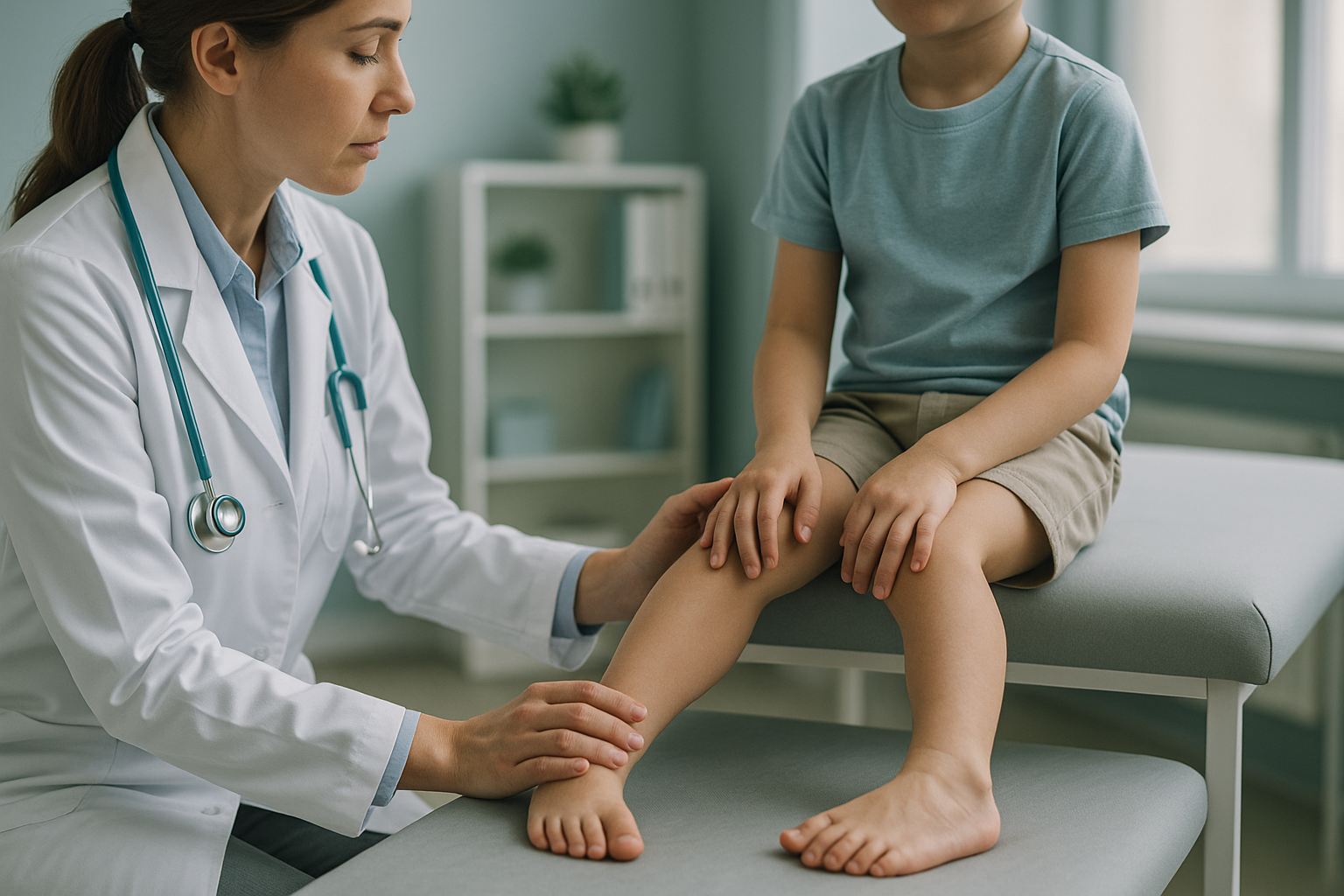
Why Does My Child Walk With Their Feet Turned In?
In-toeing, sometimes called being pigeon toed, is when a child walks with one or both feet pointing inward. It is very common in young children. It is usually caused by normal differences in the shape of the bones in the foot, shin or thigh. Most children grow out of it without any treatment. Now and then, if it carries on or causes problems, imaging can help find the cause.
Key points
- In-toeing is one of the most common reasons parents take their child to a children's orthopaedic clinic.
- There are three main causes, each linked to a different part of the leg.
- The vast majority of cases settle on their own as the child grows.
- Surgery is rarely needed. It is only considered when the problem carries on into later childhood and makes everyday movement difficult.
- If in-toeing has not improved by age eight, or it causes pain, tripping or limping, a further check is worthwhile.
What is in-toeing in children?
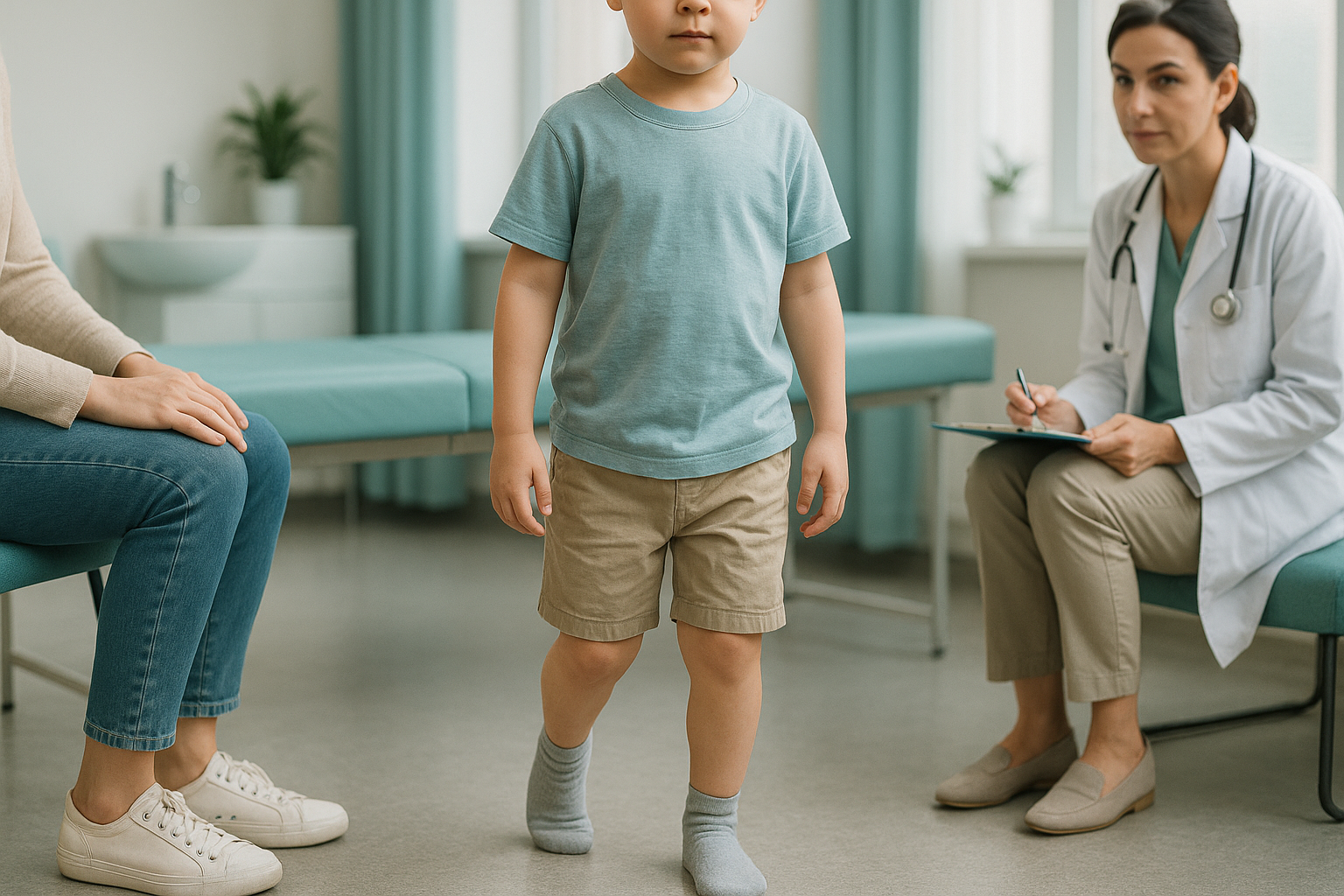
In-toeing is a walking pattern where the feet angle inward instead of pointing straight ahead when a child walks or runs. It is not a disease. It describes how the legs and feet are positioned. It can come from the foot, the shin bone (tibia) or the thigh bone (femur).
You may notice it most when your child runs, because the inward twist shows more at speed. Many parents also spot it when they watch their child from behind.
What causes a child to walk with their feet turned in?
There are three main causes. Each one is a normal twist in a different bone that is a little stronger than average. In most cases, none of them is an injury or a deformity.
A curve in the front part of the foot. Most common in babies and infants. Usually corrects by age two.
The shin bone twists inward more than usual. Usually noticed between ages one and three. Generally settles by school age.
The thigh bone angles inward at the hip. Most obvious between ages three and six. The child may prefer W-sitting. Usually improves by age eight to ten.
Femoral anteversion is the most common cause in children over three. If it carries on into adulthood, it can affect hip and knee alignment. You can read more about femoral anteversion in adults and how anteversion versus retroversion affect the way joints work.
How can you tell if your child is pigeon toed?
You can usually spot in-toeing by watching your child walk towards you and away from you. Common signs include the following.
One or both feet angle towards each other when walking or running.
The child trips over their own feet more often than other children of the same age.
Sitting on the floor with the knees in front and the feet out behind, making a W shape. This is common with femoral anteversion.
When standing, the kneecaps point towards each other instead of straight ahead. This suggests the twist is in the thigh or shin.
Does in-toeing go away on its own?
Yes, in most children it does. The bones slowly untwist as the child grows, and the walk straightens without any treatment. How long this takes depends on the cause.
- Metatarsus adductus usually settles by age one to two.
- Internal tibial torsion usually corrects by age four to five.
- Femoral anteversion usually improves a lot by age eight to ten.
Special shoes, insoles and braces have not been shown to speed this up. Research consistently finds that careful watching over time is the right approach for the vast majority of pigeon toed children.
When should you worry about in-toeing?
Most of the time, in-toeing is nothing to worry about. Still, a small number of children benefit from a further check. Think about speaking to your doctor or a children's specialist if any of the following apply.
- In-toeing is only on one side
- It is getting worse, not better
- Your child is over eight and it has not improved
- It causes pain, a limp, or trouble keeping up with other children
- There is stiffness in the hip, knee or ankle
- Both sides are affected equally
- Your child is under six
- There is no pain or limping
- Your child runs, plays and keeps up with other children
- The in-toeing is slowly getting better over time
Surgery for in-toeing is rarely needed. It is only ever considered when a significant twisting problem carries on well past the age it is expected to correct, and it causes real difficulty with everyday movement. Even then, a specialist plans it carefully after a thorough assessment.
How is in-toeing assessed with standing imaging?
When a physical examination leaves questions, imaging can help measure how the leg bones are twisted. A standard X-ray taken lying down does not show how the legs behave under the child's own body weight. Standing, weight-bearing imaging shows the true alignment as the muscles and joints work together.
At ScanAlign, low dose standing imaging uses EOS technology, which delivers about 90% less radiation than a standard X-ray, around ten times less. For children, keeping radiation low is especially important, and a single standing scan can capture the full leg alignment from hip to foot.
Learn more about children's imaging at ScanAlign and what a scan involves.
Before your child starts any treatment, or changes the one they are on, it is worth getting a detailed diagnosis first. Knowing whether the cause sits in the pelvis, the legs or the spine changes what will actually help.
A note on MRI. EOS shows bones, joints and alignment clearly. If your child's specialist suspects a soft-tissue, nerve or disc problem rather than a twist in the bones, MRI is usually the better tool. The two do different jobs, and sometimes both are useful.
Not sure whether your child needs imaging? A short video call with our specialist radiographer can help you decide, free and with no obligation, before you plan any trip to London.
Book a free video consultationFrequently asked questions about in-toeing
Yes. "Pigeon toed" is the everyday term for in-toeing. Both mean the same thing: walking with the feet pointing inward.
It depends on the cause. In-toeing from the foot often settles by age two. Twisting of the shin usually corrects by four or five. Anteversion of the thigh bone usually improves by eight to ten. If it has not improved by then, it is worth talking to a specialist.
Research does not support special shoes, insoles or braces for typical in-toeing. They have not been shown to change how the condition naturally develops. Most children simply grow out of it.
W-sitting is very common in children with femoral anteversion because it is a comfortable position for them. It is not thought to cause the anteversion. However, some specialists suggest encouraging other ways of sitting to support a wider range of hip movement.
In a small number of people, femoral anteversion that does not fully correct can carry on into adulthood. It may affect how the hip works, how the kneecap tracks, or overall alignment. You can read more about femoral anteversion in adults.
Most children do not need imaging. A physical examination by your doctor or a children's specialist is usually enough. Imaging helps when the in-toeing is severe, on one side only, getting worse, or not improving by the expected age.
EOS uses about 90% less radiation than a standard X-ray, around ten times less. This makes it particularly suitable for children when imaging is needed.
You do not need a referral from your doctor to book a children's assessment. We offer a free video consultation first, so our radiographer can check whether a scan is right for your child.
The price for patients travelling from abroad is confirmed during the free video consultation, along with exactly what is included.
If your child has sudden leg pain with swelling, cannot bear weight at all, has numbness or weakness in the legs, or develops a fever along with limping, get urgent medical help through your doctor or your nearest emergency department. These are not typical of in-toeing and need to be checked promptly.
Worried about the way your child walks?
A free video consultation with our specialist radiographer can help you understand whether imaging would be useful, with no obligation.
Book a free video consultationWritten by Abbas Dhami (Specialist Diagnostic Radiographer)
Sources
- Staheli LT. Rotational problems in children. Journal of Bone and Joint Surgery (American). 1993;75(6):939-949.
- NHS. In-toeing and out-toeing. NHS Inform / Great Ormond Street Hospital patient information.
- Lincoln TL, Suen PW. Common rotational variations in children. Journal of the American Academy of Orthopaedic Surgeons. 2003;11(5):312-320.
This page is general information and not a diagnosis.
ScanAlign is the trading name of CoreMed Solutions Ltd and operates under The Harley Street Hospital's CQC licence.