
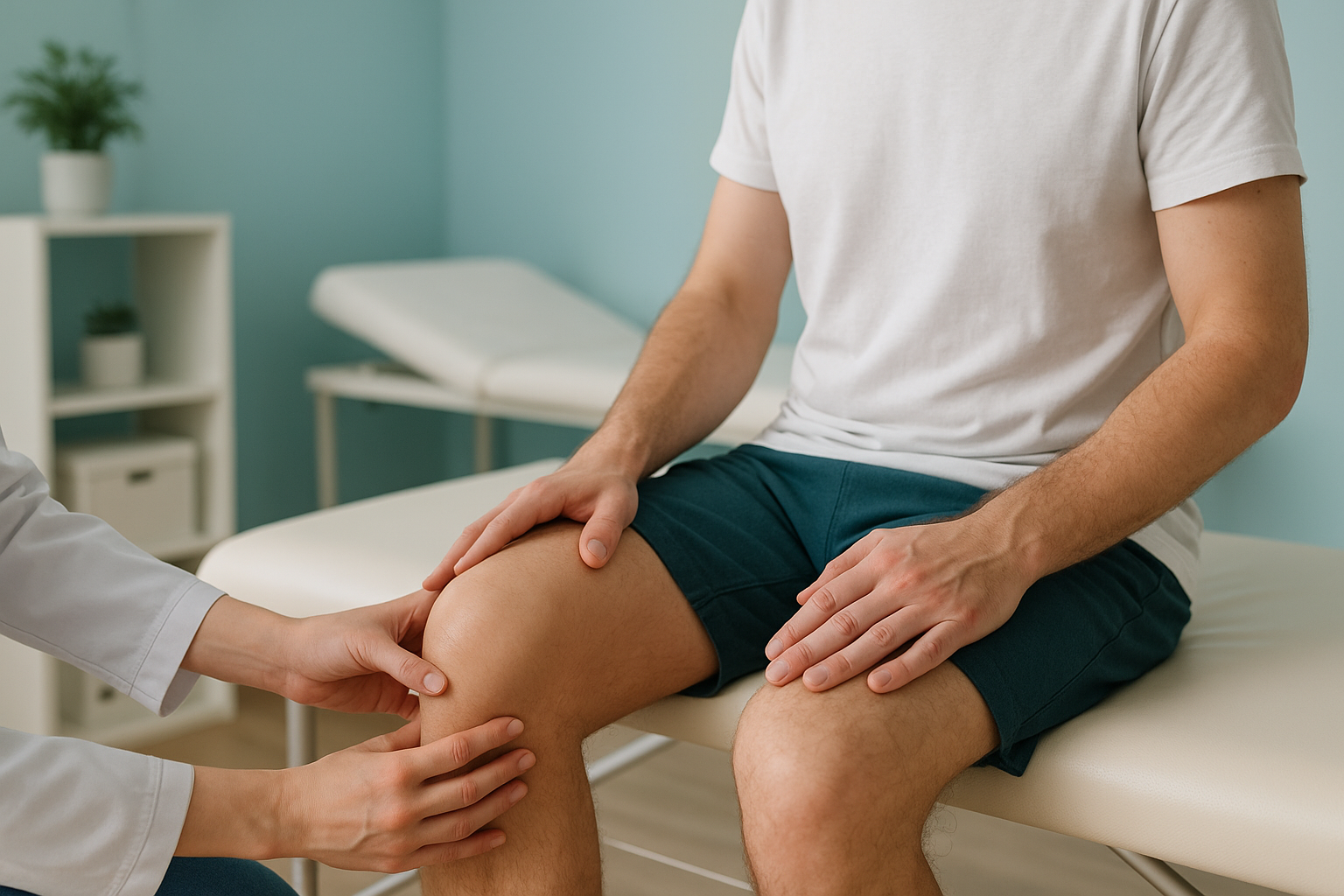
Why Is My Knee Swollen, and What Is the Fluid on My Knee?
A swollen knee usually means extra fluid has collected inside the joint. Doctors call this a knee effusion. It is also known as water on the knee. It is your body's response to irritation, injury or inflammation. Finding the underlying cause matters, because the swelling is a symptom, not a diagnosis in itself.
Key points
- Fluid on the knee is your body's protective response to irritation, injury or disease inside the joint.
- A swollen knee with no obvious injury can still have a structural or alignment cause.
- A hot, red or feverish knee needs urgent medical attention. Do not wait and see.
- Scans taken lying down can miss alignment problems that only become clear when you are standing and bearing weight.
- EOS whole-body standing imaging shows how knee alignment relates to the hip, ankle and overall posture.
What is fluid on the knee?
Fluid on the knee, or knee effusion, is an abnormal build-up of fluid inside the knee joint capsule. Every healthy knee has a small amount of synovial fluid. This fluid lubricates the joint and cushions the cartilage. When something irritates or damages the structures inside the knee, the lining of the joint (called the synovial membrane) makes extra fluid as a protective response.
The result is a puffy knee that feels tight. It may look clearly bigger than your other knee. Sometimes the swelling comes on quickly after an injury. At other times it builds up slowly over weeks. You may then wonder why your knee swelled up when you cannot remember hurting it.
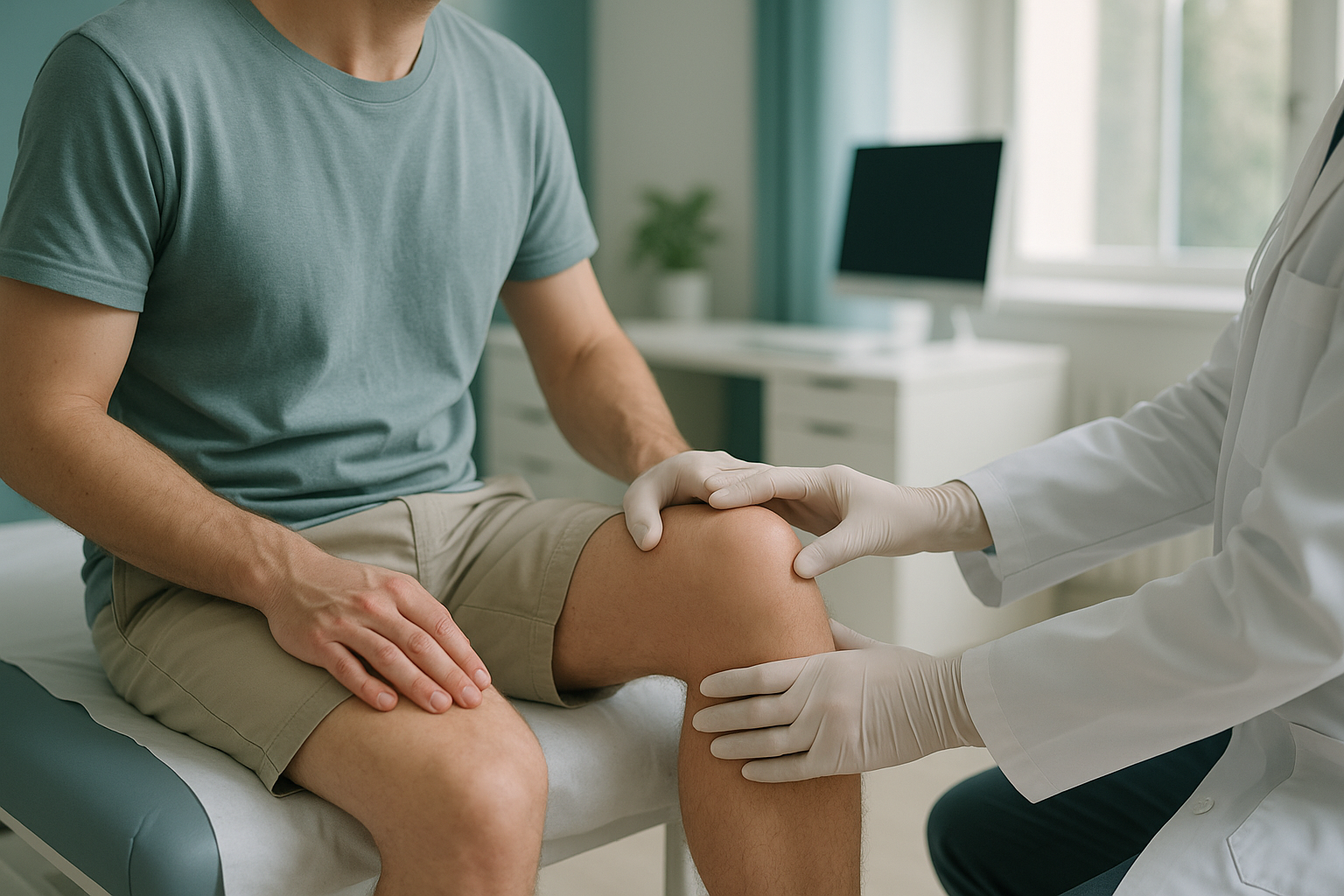
How do you know if there is fluid in your knee?
You can usually tell because the knee looks puffy, feels tight and does not move as freely as normal. These are the most common signs.
One knee looks clearly bigger or rounder than the other, especially around the kneecap.
The joint feels full and is harder to bend or straighten completely.
A dull ache that gets worse when you stand for long periods or climb stairs.
Difficulty squatting, kneeling or fully straightening the leg.
If fluid stays for a long time, the muscles around the knee can weaken. This can make the joint feel less stable. That is why swelling that does not go away is worth looking into, rather than just waiting for it to settle.
What causes a swollen knee with no injury?
Many people get a swollen knee without an obvious twist, fall or knock. This is more common than you might think. The underlying reason can be wear and tear, inflammation, or subtle alignment problems that put extra load on parts of the joint over time.
Slow wear of the cartilage irritates the synovial membrane, which makes excess fluid.
Inflammation of a bursa around the knee. Infrapatellar bursitis and pes anserine bursitis are common types.
Crystal deposits trigger sudden, intense inflammation and fast swelling.
A tilt in the hip or ankle puts uneven stress on one side of the knee, slowly irritating the joint.
You may also come across the term Baker's cyst. It is a pocket of fluid that forms at the back of the knee when excess joint fluid bulges into the soft tissue behind the joint. A Baker's cyst is usually a result of swelling inside the knee, rather than a cause in itself.
Sometimes routine tests look at the knee alone and miss the bigger picture. A slight inward angle of the leg, or an uneven pelvis, can quietly overload the knee for years before swelling appears. This is where whole-body alignment imaging becomes useful.
When is a swollen knee an emergency?
Most swollen knees are not dangerous, but a small number need urgent attention. If you notice any of the signs below, do not wait for a routine appointment.
Get urgent medical help (see your doctor the same day, or go to the emergency department) if you have:
- A knee that is hot, red and very painful, especially with a fever or feeling generally unwell. This could point to a septic (infected) joint, which needs same-day treatment.
- Sudden severe swelling after an injury, and you cannot put weight on the leg.
- Numbness, tingling or weakness in the lower leg along with knee swelling.
These signs do not always mean something serious, but they need to be ruled out quickly. Do not book a scan. See a doctor first.
How does a standing scan help find the cause of knee swelling?
A standing scan captures the bones and joints while your body is upright and carrying its own weight. This matters because when you lie down for a normal X-ray or MRI, gravity is taken away. Muscles relax. Alignment shifts. A subtle tilt, twist or uneven load on the leg is there all day when you walk and stand. On a lying-down image, it can flatten out and disappear.
EOS imaging captures your full skeleton from head to feet in a single standing exposure. It shows the true angle of your knee in relation to your hip, ankle and pelvis while you bear your real weight. If one part of the knee is being overloaded because of an alignment problem elsewhere in the chain, it becomes visible.
EOS uses about 90% less radiation than a standard X-ray, around ten times less. The scan takes only a few seconds and you do not need a referral from your doctor.
Normal X-rays and CT scans are often taken lying down, or show only the knee on its own. They are useful for spotting fractures or advanced arthritis. But they do not show how the rest of the body adds to the load on that knee.
Lying-down scans relax the muscles and remove gravity. This can hide alignment problems that are there all day long when you walk and stand.
Your body is a connected chain from your feet to your head. A problem at one level, such as a tilted pelvis or an uneven ankle, can make another area compensate. Pain and swelling often appear somewhere other than the original cause. This is why a whole-body approach matters.
When MRI is the better choice: EOS shows bones, joints and alignment. For soft tissue problems such as torn cartilage, ligament damage, disc problems or nerve irritation, MRI is usually the better tool. If your clinician suspects a soft-tissue injury behind the swelling, MRI is likely the right next step. The two types of scan work well together.
What can you do about a swollen knee?
The right approach depends entirely on the cause. That is why getting a clear picture of what is happening inside the joint, and how your alignment may be adding to it, is a useful place to start.
In the short term, many people find that rest, ice, gentle compression and raising the leg (sometimes called RICE) help to manage discomfort while they look for the cause. Keeping the muscles around the knee strong with suitable exercise is also important for long-term joint health.
If the swelling keeps coming back, or if it appeared without any obvious injury, it is worth thinking about when to see a specialist. Swelling that lasts or keeps returning often signals that something structural is irritating the joint. Finding that structure is the key to the right treatment plan.
Before you start treatment, or change the one you are on, it is worth getting a detailed diagnosis. Knowing whether the cause sits in the pelvis, the legs or the spine changes what will actually help.
Wondering whether alignment could be behind your knee swelling? ScanAlign offers whole-body standing imaging at 19 Harley Street, London. If you are thinking of travelling to London, you can book an assessment and talk through your symptoms in a free video consultation first, from home.
Book a free video consultationFrequently asked questions about a swollen knee
A knee can swell without an obvious injury because of osteoarthritis, bursitis, gout, or subtle alignment problems that slowly overload the joint. The cause is often structural, even when you cannot remember a specific event.
It usually feels tight, puffy and warm. You may notice the knee is harder to bend or straighten fully, and it can ache after standing or walking for a while.
Mild swelling from a minor irritation can settle with rest and ice. However, if the underlying cause remains, the fluid usually comes back. Swelling that lasts or keeps returning is worth looking into.
A knee effusion is excess fluid inside the joint capsule. A Baker's cyst is a bulge of that fluid into the soft tissue behind the knee. The cyst is usually a result of the effusion, not a separate problem.
If the knee is hot, red and very painful, or you have a fever along with the swelling, get urgent medical help. These signs could point to an infected joint, which needs same-day treatment. For swelling that comes on slowly and is not painful, your doctor is a good first step.
Yes. If the hip, ankle or pelvis is tilted, extra load can fall on one part of the knee joint. Over time this irritates the cartilage and synovial membrane, leading to swelling without a single obvious injury.
EOS captures the full skeleton from head to feet while you are standing. It shows how the knee lines up with the hip, ankle and pelvis while you bear your real weight. A standard X-ray usually shows only the knee on its own, often lying down, so the alignment picture is lost.
EOS uses about 90% less radiation than a standard X-ray, around ten times less. It is one of the lowest-dose X-ray technologies available.
No. ScanAlign is a private, self-pay clinic. You can refer yourself. The process starts with a free video consultation, where a specialist radiographer reviews your symptoms and confirms whether the scan is right for you.
The price for patients travelling from abroad is confirmed during the free video consultation, before you commit to anything.
Still wondering why your knee keeps swelling?
A free video consultation with a specialist radiographer can help you decide whether whole-body standing imaging is the right next step.
Book a free video consultationWritten by Abbas Dhami (Specialist Diagnostic Radiographer)
Sources
- NHS. "Swollen knee." nhs.uk. Accessed 2025.
- American Academy of Orthopaedic Surgeons (AAOS). "Knee Effusion." orthoinfo.aaos.org. Accessed 2025.
- Deschamps K, Staes F, et al. "Body mechanics and alignment assessment with EOS imaging: clinical applications." European Radiology, 2014.
This page is general information and not a diagnosis.
ScanAlign is the trading name of CoreMed Solutions Ltd and operates under The Harley Street Hospital's CQC licence.