
Knock Knees: What Causes Them in Adults and How Are They Assessed?
Knock knees (genu valgum) is a leg alignment where the knees angle inward while the ankles stay apart. In adults, it can strain the knees, hips and lower back. A standing, weight-bearing scan shows the true alignment under load. A lying-down scan can miss this. Knowing the true alignment means the right treatment plan can begin.
Key points
- Knock knees in adults are not just about looks. They change how force travels through the whole body.
- Common causes include an old injury, arthritis, obesity and muscle imbalance.
- Pain often appears in the knee, but the root cause may sit in the hip, ankle or pelvis.
- A standing whole-body scan captures alignment while your body is carrying its real weight.
- ScanAlign provides diagnostic imaging only. It does not treat or correct knock knees.
Most people have heard of knock knees in young children. In children, it is a normal stage of growth. But when the same alignment stays or develops in adults, it can cause real problems. Your knees sit at the centre of a chain that runs from your feet to your spine. When they angle inward, that chain is disturbed. Pain can then show up in places you would not expect.
What do knock knees look and feel like?
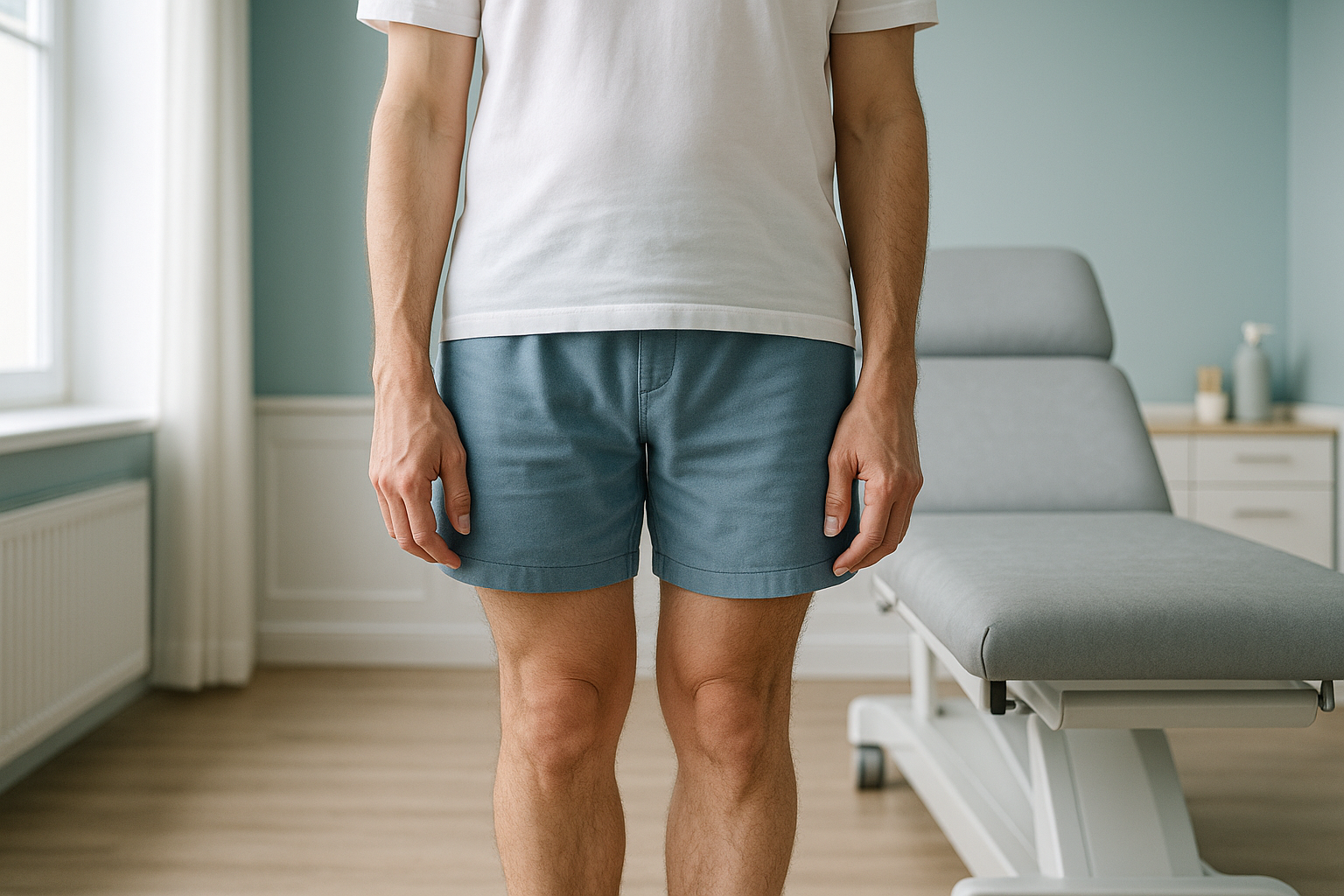
You can see knock knees when you stand with your legs straight and your knees touch or overlap, but your ankles stay apart. Beyond the visible angle, you may notice some effects in daily life.
The inward angle overloads the outer compartment and stretches the inner ligaments. This causes aching around the knee.
The pelvis tilts to make up for the knee angle. This can create stiffness or pain higher up in the chain.
The soles of your shoes may wear down more on the inner edge. This reflects how your weight shifts inward as you walk.
Running, squatting or climbing stairs may feel unstable or painful, because the joint is loaded unevenly.
What causes knock knees in adults?
In adults, knock knees usually develop because of a change in structure or in how the body moves, not because of normal growth. The most common causes are listed below.
Cartilage loss on one side of the knee changes the joint angle over time.
A break near the knee that heals at a slight angle can slowly shift alignment.
Extra body weight increases the inward force at the knee, making the valgus angle worse.
Weak outer hip muscles let the thigh rotate inward, pulling the knee with it.
Other possible causes include rickets (vitamin D deficiency affecting bone), rheumatoid arthritis and ligament damage. Sometimes more than one factor is involved.
How do knock knees affect the rest of your body?
Your body works as a connected chain from your feet to your head. When the knees angle inward, every joint above and below has to adjust. This is called compensation. It is why you might feel pain far from your knees.
The ankles may roll inward (over-pronation) to stay flat on the ground. The hips may rotate to keep you balanced. The pelvis can tilt, and the lower back curves differently to keep your head level. A scan of the knee alone might show no clear damage. Yet the real issue is how every joint works together under your full body weight.
Want to understand how your whole alignment connects? Read how standing imaging assesses the knee and leg.
How are knock knees assessed when standing up?
True leg alignment can only be seen when you are upright and carrying your weight. Lying-down imaging relaxes your muscles and can flatten out the angles that cause your symptoms. A standing, whole-body EOS scan captures your skeleton from head to toe in a single upright image. It shows the exact relationship between your feet, knees, hips, pelvis and spine under real-world load.
EOS uses about 90% less radiation than a standard X-ray, around ten times less. You simply stand still for about 20 seconds while the system produces a full-length image. Your clinician then receives a detailed picture of your alignment, not just one joint on its own.
When MRI is the better choice: EOS shows bones, joints and alignment clearly. For soft-tissue problems like cartilage tears, ligament damage or nerve issues, MRI is usually the better tool. Your clinician can advise which scan you need.
What are the general ways to manage knock knees?
Management depends entirely on the cause and how severe it is. This is why accurate imaging matters first. In general, clinicians may consider the following options.
- Physiotherapy and targeted exercises. Strengthening the muscles around the hip and knee can improve how the joint is held, especially when muscle imbalance is involved.
- Orthotic insoles. Custom insoles may help correct foot position, which in turn can reduce the inward force at the knee.
- Weight management. Reducing extra load on the knees can slow the worsening of alignment.
- Surgery. In more severe or worsening cases, a specialist may consider procedures such as osteotomy (realigning the bone) or knee replacement.
ScanAlign does not provide treatment or therapy. It provides the standing diagnostic imaging that helps your clinician or surgeon plan the right next step. For information on what to expect, visit the FAQs page. The price for patients travelling from abroad is confirmed during the free video consultation.
Before you start a treatment, or change the one you are on, it is worth getting a detailed diagnosis first. Knowing whether the cause sits in the pelvis, the legs or the spine changes what will actually help.
Knock knees may also affect hip alignment. Read more about how standing imaging assesses hip alignment.
When to seek urgent help
If you have sudden knee swelling, cannot bear weight, or have numbness, weakness in the leg, or loss of bladder or bowel control, seek urgent medical attention. Contact your doctor, call your local emergency number, or go to the nearest emergency department.
Frequently asked questions about knock knees
In adults, the most common causes are osteoarthritis, an old fracture or injury near the knee, obesity, muscle imbalance, and sometimes conditions like rheumatoid arthritis or vitamin D deficiency. Often several factors combine over time.
A slight inward angle is within the normal range for many adults. It becomes a concern when it causes pain, limits activity, or shows signs of getting worse. A standing alignment assessment helps show whether the angle is within normal limits or needs attention.
Targeted strengthening of the hip and thigh muscles can help improve how the knee is held, especially when muscle weakness is part of the cause. However, if the bone itself has changed shape, exercises alone may not fully correct the angle. A physiotherapist can guide a suitable programme once imaging has found the cause.
When you lie down, gravity no longer presses on your joints and your muscles relax. This can flatten out the inward angle and hide how far out of line the leg really is. A standing, weight-bearing scan captures alignment as it actually is when you are upright and loading your joints.
An EOS scan uses about 90% less radiation than a standard X-ray, around ten times less. This makes it a very low-dose option for full-body standing imaging.
No. ScanAlign is a private, self-pay clinic and you can self-refer. You start with a free video consultation to check the scan is suitable for you.
The price for patients travelling from abroad is confirmed during the free video consultation. For what to expect, please visit the FAQs page.
Yes. The inward knee angle changes how force travels up through the hips and pelvis. The lower back often adjusts its curve to keep you balanced. This compensation can create pain in areas that seem unrelated to the knees.
Knock knees (genu valgum) means the knees angle inward and the ankles sit apart. Bow legs (genu varum) is the opposite: the knees curve outward and the ankles touch. Each affects the alignment and loading of the joints in a different way.
You stand in the EOS scanner for about 20 seconds while it captures a full-length image of your skeleton from head to toe. There is no enclosed tunnel, and in most cases no need to change into a gown. Your results are then reviewed and a report is provided for you or your clinician.
Understand your alignment, not just your symptoms
A free video consultation with our team, from wherever you are, will help you decide whether a standing whole-body scan in London is the right next step.
Book a free video consultationLearn more about how EOS whole-body standing imaging works.
Sources
- NHS. "Knock knees." nhs.uk. Accessed 2024.
- Sharma L, Song J, Felson DT, et al. "The role of knee alignment in disease progression and functional decline in knee osteoarthritis." JAMA. 2001;286(2):188-195.
- Illés T, Somoskeöy S. "The EOS imaging system and its uses in daily orthopaedic practice." International Orthopaedics. 2012;36(7):1395-1402.
Written by Abbas Dhami (Specialist Diagnostic Radiographer)
This page is general information and not a diagnosis.
ScanAlign is the trading name of CoreMed Solutions Ltd and operates under The Harley Street Hospital's CQC licence.