
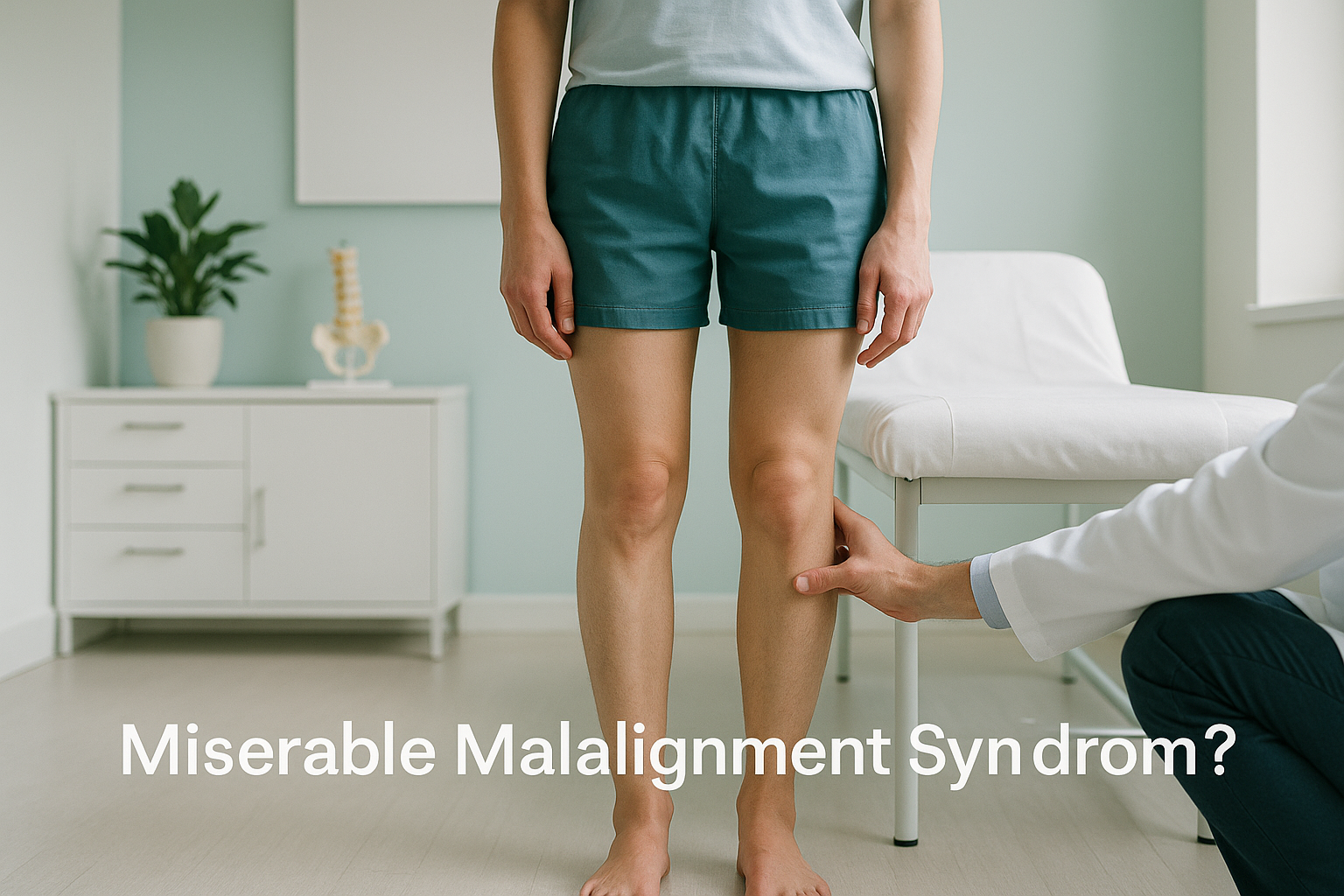
What Is Miserable Malalignment Syndrome and Why Does It Cause Knee Pain?
Miserable malalignment syndrome is a combined twisting (rotational) deformity of the legs. The thighbone twists inward (femoral anteversion). At the same time, the shinbone twists outward (external tibial torsion). Together, these twists push the kneecap off its normal track. They also put extra stress on the knee, hip and ankle. Because the problem is a twist, it only shows clearly on imaging that records the 3D position of the bones while you are standing.
Key takeaways
- The syndrome combines two twists, one at the hip and one at the shin. Together they overload the knee.
- It is a common but under-recognised cause of persistent pain at the front of the knee, especially in young women.
- "Squinting patellae" (kneecaps that point inward) is the classic visible sign.
- Standard X-rays and MRI often miss twisting problems because they do not measure twist accurately.
- A standing 3D scan can measure the twist along the whole leg in one image.
What are the signs of miserable malalignment syndrome?
The most common sign is persistent pain at the front of the knee that does not get better with rest or standard physiotherapy. The combined twist pulls the kneecap out of line. So you may also notice that your kneecaps seem to point inward when you stand. This look is called "squinting patellae."
You might also notice that your feet point outward when you walk, even though your knees point inward. This mixed pattern happens because the outward twist in the shin makes up for the inward twist at the hip. The result is a walk that looks slightly awkward. It puts each joint under strain it was not designed for.
What causes a combined twisting deformity in adults?
The combined twist usually develops as a child grows and stays into adulthood. In most people, the thighbone slowly loses its inward twist with growth. When it does not, the body makes up for it by twisting the shinbone outward, so the foot can still point forward. By adulthood, this double twist is fixed in the bone. Exercise alone cannot change it.
Because the cause is in the structure of the bones, people with this syndrome often spend years on treatments aimed at muscles or soft tissue, without lasting improvement. The twisting mismatch underneath, which is the real driver, goes unrecognised. This is because standard scans are not designed to measure twist. Understanding anteversion versus retroversion helps explain why the direction of the twist matters so much.
Why does a twist in the leg bones need a standing scan?
Twist in the leg bones is nearly invisible on a standard X-ray, because a flat image cannot show twist. A CT scan can measure the twist. But it needs high radiation, and it scans you lying down. Lying down removes the effect of gravity and body weight on your alignment.
A standing EOS scan captures your whole leg, from hip to ankle, while you carry your full body weight. It builds a 3D model of every bone in the leg. This shows exactly how much each bone is twisted and where the twist sits. The twist of the thighbone (femur) and shinbone (tibia) can be measured together in one low-dose image.
Because the EOS system uses about 90% less radiation than a standard X-ray, around ten times less, it is well suited to the full-leg imaging this condition needs.
When you lie on a table for CT or MRI, gravity no longer loads your joints. Your muscles relax, and the twisting stress on the knee is reduced. The scan may show joints that look normal in structure. Yet the real problem, the twist between them, causes significant pain once your legs are upright, carrying weight and moving.
This is one of the reasons miserable malalignment syndrome is missed so often. The imaging most people get is simply not designed to see it.
At ScanAlign, 3D standing skeletal imaging, we measure the full twist of both legs in a single standing scan. This gives your surgeon or physiotherapist the measurements they need to plan the right approach. That may be targeted rehabilitation or a discussion about surgery to correct the twist.
How does the twist affect the kneecap?
When the thighbone twists inward and the shinbone twists outward, the kneecap is caught between two opposing forces. The inward pull of the femur drags the kneecap towards the inner side. Meanwhile, the outward twist of the tibia pulls the patellar tendon towards the outer side. This is a key reason behind patellar maltracking.

The diagram above shows the key difference. On the left, the femur and tibia twist in opposite directions, and the kneecap is caught between competing forces. On the right, a normally aligned leg keeps the kneecap moving in a straight line. This is why treating only the kneecap, without measuring the full twist of the leg, often fails to solve the pain.
What can be done about miserable malalignment syndrome?
The first step is an accurate measurement of the twisting deformity. Without knowing how much twist there is, and exactly where it sits, no treatment plan can be properly targeted. A standing 3D scan provides that measurement.
Once the twist is clearly measured, your clinician can choose between two broad paths.
- Targeted physiotherapy and load management. If the twist is mild, strengthening the muscles around the hip and knee can help control symptoms. This works best when the physiotherapist knows the exact picture of the twist.
- Discussing surgery (derotation osteotomy). For a more significant twist that does not improve with rehabilitation, a surgeon may discuss an operation to correct the twist in the bone. This needs precise measurements before surgery, which is exactly what 3D standing imaging provides.
ScanAlign does not provide treatment. We provide the diagnostic imaging that helps you and your clinician make an informed decision.
Want to understand the twist in your legs? A standing 3D scan can measure the twist in both legs in a single visit.
Book a free video consultationWhen is MRI more useful? EOS shows bones, joints and alignment. If your clinician suspects cartilage damage, a torn meniscus or nerve involvement, MRI is usually the better tool. Many people with miserable malalignment syndrome benefit from both types of imaging.
Is a standing alignment scan right for you?
This scan is most useful when the problem lies in the structure and twist of the bones. It does not replace MRI or blood tests when soft-tissue or inflammatory conditions need to be ruled out.
- Persistent knee pain even though your MRI results were normal
- Squinting patellae or an in-toeing walk
- Repeated kneecap dislocations or partial dislocations (subluxations)
- Planning before surgery to correct a twist
- Earlier scans that did not explain your symptoms
- Sudden knee swelling after an injury (MRI first)
- Suspected ligament or meniscus tear
- Pain with numbness, weakness or bladder changes (seek urgent medical attention)
Before you start a treatment, or change the one you are on, it is worth getting a detailed diagnosis. Knowing whether the cause sits in the pelvis, the legs or the spine changes what will actually help you.
Frequently asked questions
Most people describe a deep, aching pain at the front of the knee. It gets worse with stairs, squatting or sitting for a long time. You may also feel discomfort in the hip or ankle, because the twist stresses the joints above and below the knee.
The name reflects both how persistent the pain is and the frustration patients feel after several normal scan results. The condition was named by the orthopaedic surgeon James Staheli, to highlight how disabling it can be when it is not diagnosed.
Squinting patellae means kneecaps that point inward, not straight ahead, when you stand with your feet together. It is a visible sign of femoral anteversion and one of the hallmarks of miserable malalignment syndrome.
The twist in the bones develops during childhood growth and stays into adulthood. Adults do not develop a new twisting deformity. But symptoms often appear or get worse in adulthood, as activity increases or the body's ways of compensating begin to fail.
MRI is excellent for soft tissue, but it is not designed to measure twist along the full length of the leg. The cartilage, ligaments and menisci may look perfectly healthy. Meanwhile, the twisting mismatch causing the pain is simply not visible on a standard MRI.
The EOS system uses about 90% less radiation than a standard X-ray, around ten times less. It is one of the lowest-dose medical imaging technologies available for full-body skeletal imaging.
No. You can refer yourself. The process starts with a free video consultation. A specialist radiographer reviews your history and confirms whether a standing alignment scan is suitable for you.
The price for patients travelling from abroad is confirmed during the free video consultation, which you can arrange on the book a rotation and alignment scan page.
Physiotherapy cannot change the shape of the bone. But it can strengthen the muscles around the hip and knee to manage symptoms. For milder deformities, targeted rehabilitation guided by accurate measurements of the twist can make a significant difference. For larger deformities, discussing surgery may be more appropriate.
A derotation osteotomy is an operation in which the bone is cut and rotated to correct the twist. It is usually considered when the twisting deformity is significant and non-surgical treatment has not helped. Precise 3D measurements before the operation are essential for planning this surgery.
Ready to see the full picture?
A standing 3D scan can measure the twist in both legs in a single visit. Start with a free video consultation to find out if it is right for you.
Book a free video consultationAuthor: Abbas Dhami (Specialist Diagnostic Radiographer)
Sources
- Staheli LT. Rotational problems in children. Journal of Bone and Joint Surgery, 1993.
- Teitge RA. The power of the transverse plane rotational alignment of the lower extremity. Operative Techniques in Sports Medicine, 2007;15(2):51-60.
- Illés T, Somoskeöy S. The EOS imaging system and its uses in daily orthopaedic practice. International Orthopaedics, 2012;36(7):1405-1411.
This page is general information and not a diagnosis.
ScanAlign is the trading name of CoreMed Solutions Ltd and operates under The Harley Street Hospital's CQC licence.