

Nerve Root Compression: What Causes It and How Do You Find Relief?
Nerve root compression happens when a spinal nerve is squeezed at the point where it leaves the spine. This can cause pain, tingling or weakness that travels into an arm or leg. Common causes include disc bulges, bony spurs and narrowing of the spine. Finding exactly where the compression happens is the key first step towards relief.
Key points
- A compressed nerve root can cause pain, numbness or weakness far away from the spine itself.
- Scans taken lying down can miss alignment problems that put extra pressure on nerves when your body is upright and carrying its weight.
- An EOS whole-body standing scan shows your skeleton under real weight-bearing load, which helps pinpoint the source.
- ScanAlign is a diagnostic imaging clinic. It does not treat nerve compression. It gives the detailed picture that guides treatment elsewhere.
Get urgent help if you notice: sudden loss of bladder or bowel control, numbness in the groin or saddle area, or weakness in both legs that is getting worse quickly. Contact your doctor or go to the nearest emergency department straight away. These could be signs of a serious condition that needs immediate attention.
Your spine is made of bones stacked on top of each other. Nerves branch out from it at every level. Each of these nerve roots carries signals between your brain and a specific part of your body. When something presses on one of these roots, the signals are disrupted. That is nerve root compression.
The tricky part is that the pain often shows up far from the real problem. A compressed nerve in your lower back might cause aching in your calf. One in your neck might send tingling into your fingertips. This is why finding the exact location matters so much.
What does a pinched nerve in the spine feel like?
A pinched nerve usually causes sharp or burning pain that follows a set path down an arm or leg, depending on which nerve is affected. You might also notice numbness, tingling or muscle weakness in the area that nerve supplies.
Sharp or burning pain that shoots down your arm or leg, often on one side only.
A pins-and-needles feeling, or patches of reduced feeling in your hand, foot or along an arm or leg.
Trouble gripping things, lifting your foot or doing movements that used to be easy.
Pain that flares up when you sit, stand, cough or turn your head a certain way.
When the compression is in the neck (cervical spine), symptoms tend to travel into the shoulder, arm and hand. When it is in the lower back (lumbar spine), symptoms follow the buttock and thigh and go down into the foot. This travelling pattern is sometimes called radiculopathy. When it affects the leg, it is more commonly called sciatica.
What causes nerve root compression?
Nerve root compression happens when something narrows the space where a nerve leaves the spine. This can be a disc that has bulged out of place, a bony spur that has grown over time, or a general narrowing of the spinal canal.
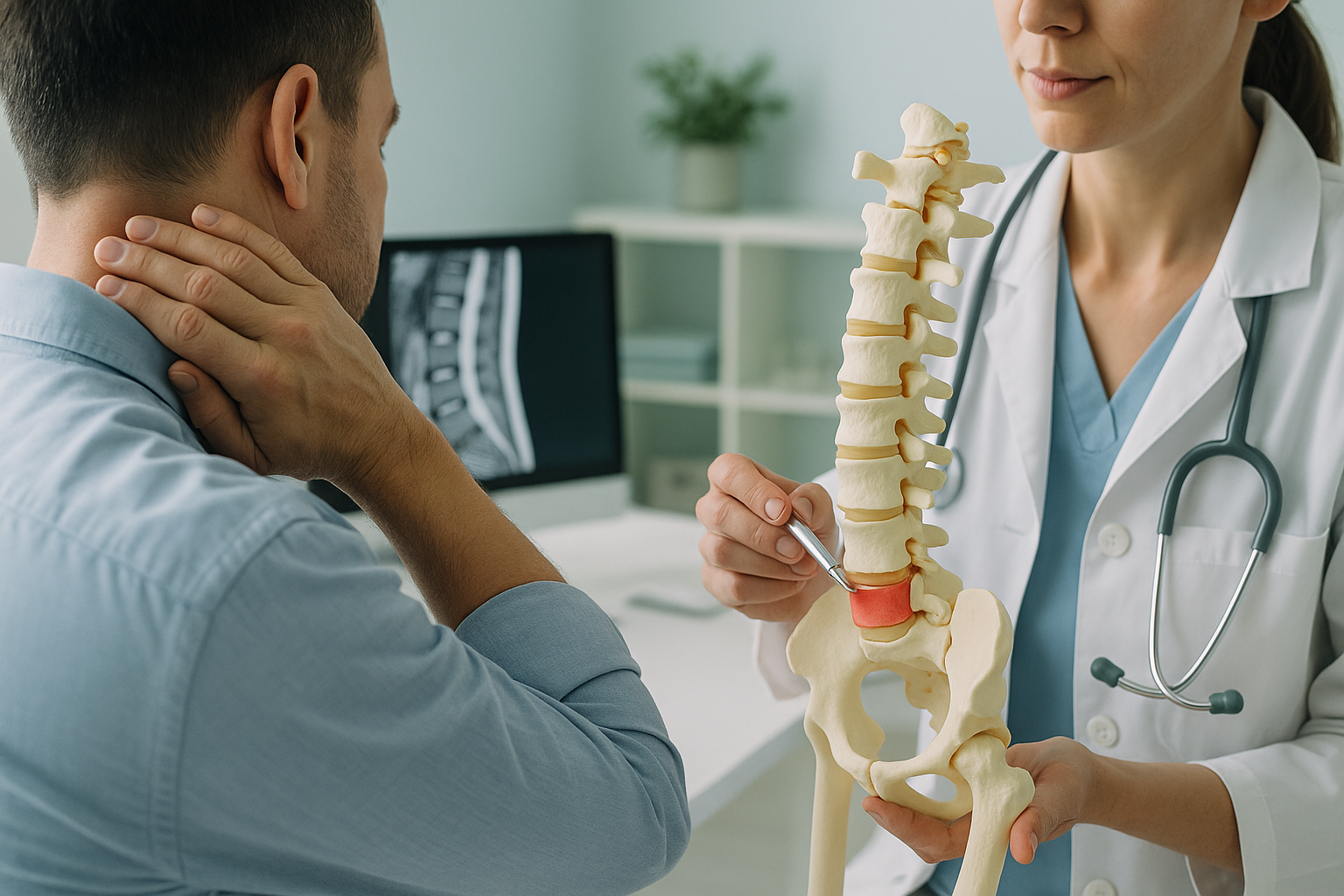
The soft centre of a spinal disc pushes outwards and presses on a nearby nerve root.
Extra bone growth, often from wear and tear, pushes into the channel where the nerve exits.
The canal or the exit tunnels slowly narrow, leaving less room for nerves to pass through.
An abnormal curve in the spine or a tilted pelvis shifts load unevenly. This increases pressure at certain nerve exits.
Your body works as one connected chain, from your feet to your head. If your pelvis is tilted or your spine curves unevenly, the load shifts. That extra pressure can narrow the gaps where nerves exit, even when each joint looks normal on its own. This is one reason why whole-body imaging matters.
Why does a standing scan help find nerve root compression?
A standing scan captures your skeleton under the same load it carries all day. It can show alignment problems and narrowing at nerve exits that scans taken lying down can miss. When you lie flat for a standard X-ray, CT scan or MRI, gravity no longer pulls on your spine. Your muscles relax. Disc bulges may shrink. The gaps between your vertebrae can open slightly. As a result, the very thing causing your nerve compression may look less severe, or disappear completely, on a scan taken lying down.
An EOS scan images your whole skeleton from head to feet while you stand. This means your spine, pelvis, hips, knees and ankles are all captured in one weight-bearing image. Your clinician can see how the whole chain of alignment fits together. They can also see whether a problem lower down, such as uneven leg length or a tilted pelvis, is adding to nerve compression higher up.
The EOS system also uses about 90% less radiation than a standard X-ray, around ten times less. That makes it a practical option if you need follow-up images over time.
Want to know whether a standing scan could help with your symptoms before you plan a trip to London?
Book a free video consultationWhen is MRI the better choice? EOS shows bones, joints and alignment clearly. For soft-tissue detail, such as the condition of a disc, inflammation around a nerve or problems with the spinal cord, MRI is usually the better tool. In many cases, both types of scan work together to give the fullest picture. Your clinician can advise which is right for you.
What helps with nerve root compression?
Most people with a compressed nerve get better over time. But how fast, and which approach works, depends on finding the underlying cause accurately. ScanAlign does not treat nerve compression. It provides detailed standing scans so that your treating clinician, whether a physiotherapist, pain specialist or surgeon, can plan the right next step.
General approaches that clinicians commonly consider include:
- Guided exercises and physiotherapy to take pressure off the nerve, strengthen the supporting muscles and improve posture.
- Pain management with medicines or injections, guided by imaging that shows exactly where the nerve is being squeezed.
- Posture and alignment correction, working on the wider chain of alignment rather than just the painful spot.
- Surgery, considered when conservative approaches have not given relief and imaging confirms a specific structural cause.
What these all have in common is that they work better when the clinician knows exactly where and why the compression is happening. That is where accurate, weight-bearing imaging fits in. You can learn more about how EOS imaging works on the ScanAlign homepage.
Before you start treatment, or change the one you are on, it is worth getting a detailed diagnosis. Knowing whether the cause sits in your pelvis, your legs or your spine changes what will actually help.
Frequently asked questions about nerve root compression
Nerve root compression is when a spinal nerve is squeezed where it leaves the spine. It can be caused by a bulging disc, a bony spur or narrowing of the spinal canal. It often causes pain, tingling or weakness that travels into an arm or leg.
It varies a lot, depending on the cause and how severe it is. Many people notice improvement within weeks to a few months with the right management. Some cases take longer, and a small number may need surgery if the nerve stays compressed.
A standard X-ray can show bony changes, such as spurs or narrowed disc spaces, that suggest compression. A standing EOS scan has the added advantage of showing your full alignment under weight. This helps identify structural causes that scans taken lying down may miss. For a direct view of the nerve and disc, MRI is usually needed.
Sciatica is a symptom, not a diagnosis. It describes pain travelling down the leg along the path of the sciatic nerve. Nerve root compression in the lower back is one of the most common causes of sciatica, but not the only one.
No. ScanAlign is a private, self-pay clinic. You can book directly, without a referral from your doctor or a consultant. The process starts with a free video consultation to check the scan is suitable for you.
The price for patients travelling from abroad is confirmed during the free video consultation, and you can find other answers on the ScanAlign FAQs page.
Yes. The EOS system uses about 90% less radiation than a standard X-ray, around ten times less. You can read more about safety on the FAQs page.
Yes. When your spine, pelvis or legs are out of alignment, load is spread unevenly. Over time, this can narrow the exit channels where nerves leave the spine and increase pressure on specific nerve roots. This is why a whole-body standing scan can be so useful.
Which exercises are recommended depends on which nerve is affected and the underlying cause. A physiotherapist can design a programme based on your scan findings. General advice often includes gentle nerve gliding movements and core strengthening, but exercises should always be guided by a qualified professional.
You stand inside the EOS machine in a natural position for about 20 seconds while a low-dose image is taken from head to feet. There is no tunnel and no need to lie down. The whole visit is quick and simple. More details are on the FAQs page.
Find out where the compression is coming from
A free video consultation with ScanAlign helps you understand whether a standing whole-body scan in London is the right next step for your symptoms.
Book a free video consultationSources
- NHS. "Slipped disc." nhs.uk, 2023. Overview of disc herniation, nerve root compression symptoms and management.
- National Institute for Health and Care Excellence (NICE). "Low back pain and sciatica in over 16s: assessment and management." NICE guideline NG59, 2016 (updated 2020).
- Illés, T. & Somoskeöy, S. "The EOS imaging system and its uses in daily orthopaedic practice." International Orthopaedics, 36(7), 1405-1411, 2012.
Written by Abbas Dhami (Specialist Diagnostic Radiographer)
This page is general information and not a diagnosis.
ScanAlign is the trading name of CoreMed Solutions Ltd and operates under The Harley Street Hospital's CQC licence.