
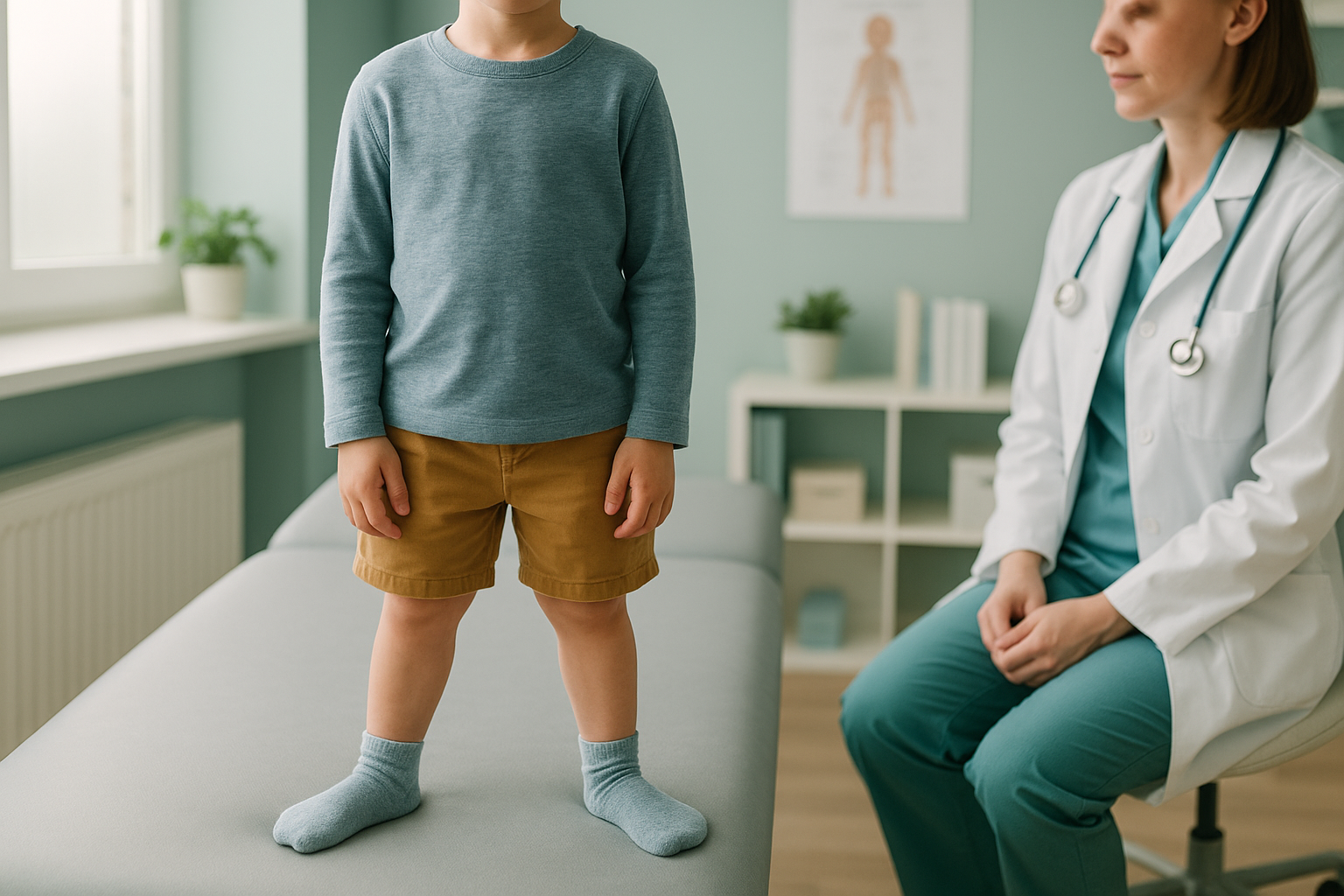
Should You Worry If Your Child Walks With Their Feet Turned Out?
Out-toeing in children means one or both feet point outwards when they walk. It is very common and usually harmless. Most children grow out of it naturally as their bones and muscles develop. Sometimes it carries on past a certain age or causes pain. In that case, a specialist assessment can help find the underlying cause and guide the next steps.
Key points
- Out-toeing is normal in many toddlers and young children, and often settles without treatment.
- Common causes include outward rotation at the hip, the shape of the thighbone, or the shinbone twisting outwards.
- Most children do not need any treatment. Watching and waiting is the standard approach.
- Out-toeing that persists, pain, limping, or signs on one side only are worth checking with a specialist.
- If an assessment is needed, standing, weight-bearing imaging can show alignment across the whole leg.
What is out-toeing in children?
Out-toeing is when one or both of a child's feet point outwards instead of straight ahead during walking or standing. You might hear it called "duck walking". It is a rotational variation. This means the bones of the leg are turned slightly outward compared to what you might expect.
The foot progression angle describes the direction each foot points compared with the direction the child is walking. A small outward angle is normal. Parents tend to notice and ask about a larger angle, especially if it is very easy to see or only on one side.

Out-toeing is different from in-toeing, where the feet point inwards ("pigeon-toed"). Both are rotational variations and both are common in childhood. The direction of the turn and its cause are different. But the reassurance is often the same: most children outgrow it.
How can you tell if your child has out-toeing?
You can usually spot out-toeing by watching your child walk on a flat surface. Watch their feet from behind as they walk away from you. If one or both feet clearly point outwards rather than straight ahead, that is out-toeing.
What causes a child's feet to turn outwards?
Out-toeing usually comes from the way the bones of the hip, thigh or shin are shaped or rotated. These are normal variations in how a child's skeleton develops. The three most common causes are below.
Less often, out-toeing can be linked to tight or loose ligaments, neurological conditions, or problems within the foot itself. These are uncommon, but a specialist can rule them out if there is any concern.
When does out-toeing get better on its own?
For most children, out-toeing improves slowly as they grow. How long it takes depends on the cause.
- Hip rotation tightness from the womb usually loosens during the first two years of life. This is the most common cause in babies and young toddlers.
- External tibial torsion often corrects or improves through childhood. The shinbone naturally adjusts its twist as the child grows and becomes more active.
- Femoral retroversion tends to be more stable. It may improve partly with growth, but in some people it can carry on into the teenage years or adulthood.
Watching and waiting is the standard approach for the vast majority of children. No special shoes, braces or exercises have been proven to speed this up. In most cases, the body simply grows into better alignment.
If your child's out-toeing does need attention, it helps to get a detailed diagnosis before starting treatment or changing the one they are on. Knowing whether the cause sits in the hip and pelvis, the legs or the spine changes what will actually help.
When should you see a specialist about out-toeing?
Most out-toeing is harmless and does not need medical attention. But in some situations it is worth speaking to your family doctor or a children's specialist.
- Both feet turn out evenly
- Child is under three years old
- No pain, limping or stiffness
- Walking and running develop normally
- It is slowly getting better over time
- Only one leg is affected
- Out-toeing is getting worse, not better
- Pain in the hip, knee or foot
- Limping or difficulty keeping up with other children
- Still clearly there past age eight
- Frequent tripping or falling
If your child develops sudden leg weakness or numbness, or cannot put weight on the leg, get urgent medical help from your doctor or the nearest emergency department. These are not typical of out-toeing and need to be checked quickly.
How is out-toeing assessed with standing imaging?
If a specialist wants to understand the structure behind your child's out-toeing, imaging can help. A standard X-ray taken lying down does not show how the leg lines up under the child's own body weight. When muscles relax in a lying position, rotational differences can be hidden.
An EOS scan captures the full leg from hip to foot while the child stands naturally. This shows the true alignment of the bones, including any rotation at the hip, thigh or shin, in a position that matches how the child actually walks. It uses about 90% less radiation than a standard X-ray, around ten times less, which matters for growing children.
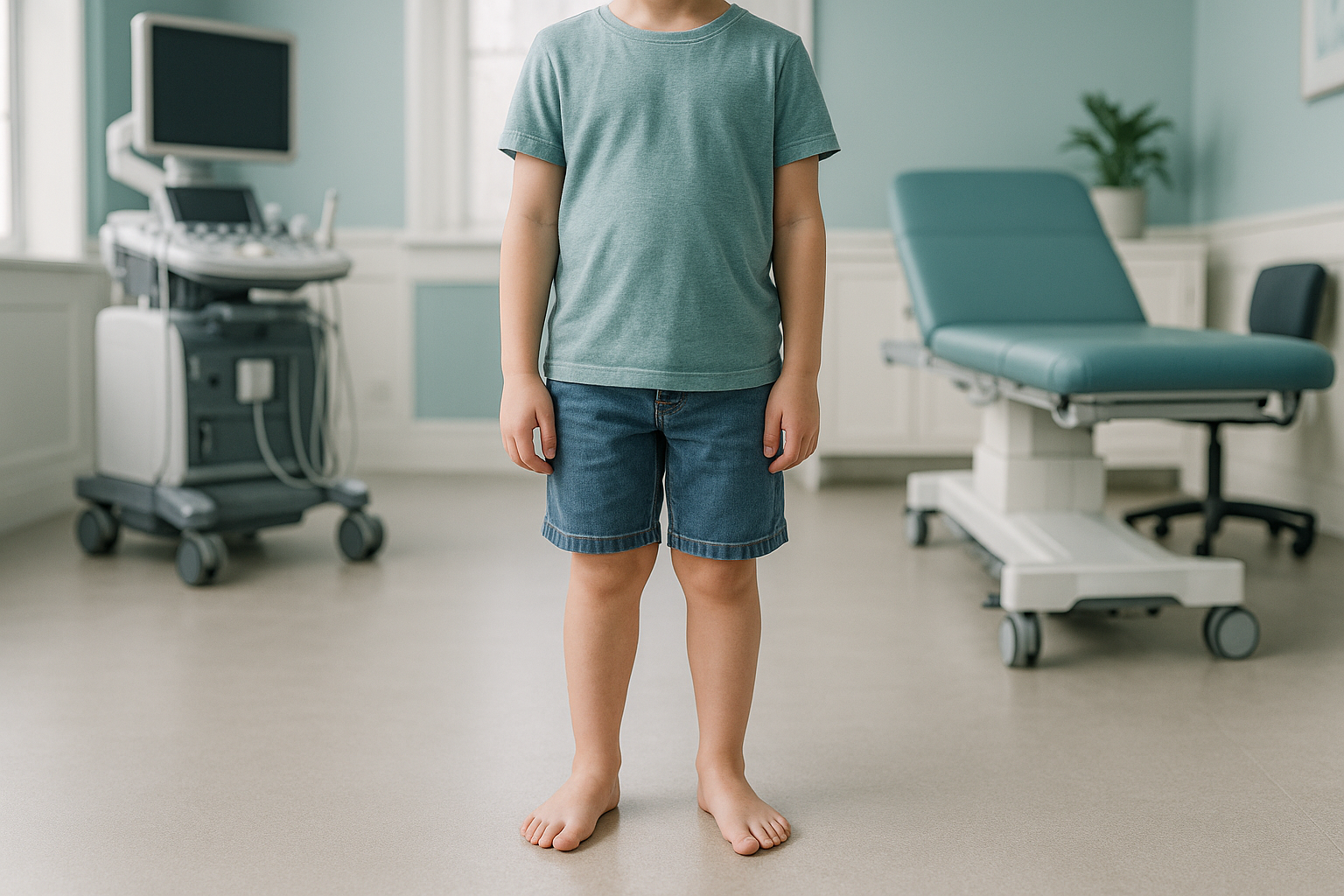
At ScanAlign, low dose standing imaging at 19 Harley Street, London, full-length standing views give specialists a clear picture of how the whole chain lines up, from hip to foot. This is especially helpful when out-toeing affects only one side, or when a child has pain as well as the rotation. Learn more about children's imaging at ScanAlign.
When is MRI more suitable? EOS is excellent for bones, joints and alignment. If a specialist suspects a soft-tissue problem or a nerve issue, or needs to look at the growth plates in detail, MRI is usually the better tool. Your child's treating specialist can advise which type of imaging suits your child's situation.
If your child's out-toeing has persisted, been painful or affected one side, a free video consultation can help you decide whether a scan in London is a useful next step.
Book a free video consultationFrequently asked questions about out-toeing in children
Yes. Out-toeing is very common in toddlers. It is often caused by hip tightness from their position in the womb. It usually gets better on its own within the first couple of years.
Out-toeing means the feet point outwards. In-toeing means they point inwards (pigeon-toed). Both are rotational variations in childhood and both usually settle naturally, though they have different structural causes.
Mild out-toeing rarely causes pain. If a child says they have pain in the hip, knee or foot along with noticeable out-toeing, it is worth having them assessed by a specialist to rule out any underlying issue.
There is no strong evidence that special shoes, insoles or braces change the natural course of out-toeing. Most children grow out of it anyway. A specialist can advise if any support is suitable for your child's own situation.
There is no single cut-off age. Out-toeing from the hip often settles by around age two. Tibial torsion may improve through mid-childhood. If out-toeing is still clearly there past age eight or is getting worse, a specialist review is sensible.
They can appear together. Flexible flat feet are very common in young children and, like out-toeing, usually improve with age. If your child has both and is comfortable, it is usually nothing to worry about.
Most children with simple out-toeing do not need imaging. If out-toeing persists, affects one side, is painful or comes with other symptoms, a standing X-ray or EOS scan can help a specialist see the alignment under real weight-bearing conditions.
An EOS scan uses about 90% less radiation than a standard X-ray, around ten times less. This low dose is especially valued for children, where limiting radiation exposure is important.
No. ScanAlign accepts self-referrals for children's assessments. You can book a free video consultation to discuss whether imaging is suitable before committing to anything.
For patients travelling from abroad, the price is confirmed during the free video consultation, which you can arrange from the book a children's assessment page.
Worried about the way your child walks?
A free video consultation with our specialist radiographer can help you understand whether imaging is a helpful next step, with no obligation.
Book a free video consultationWritten by Abbas Dhami (Specialist Diagnostic Radiographer)
Sources
- Staheli, L.T. "Rotational problems in children." Journal of Bone and Joint Surgery, 1993. A widely cited overview of torsional and rotational variations in the lower limb during childhood.
- NHS. "Flat feet." NHS.uk guidance on flat feet in children, often linked with out-toeing, and how they settle with age.
- American Academy of Orthopaedic Surgeons (AAOS). "In-toeing and Out-toeing." Patient information on rotational walking variations in children.
This page is general information and not a diagnosis.
ScanAlign is the trading name of CoreMed Solutions Ltd and operates under The Harley Street Hospital's CQC licence.