
What Exercises Actually Correct a Tilted Pelvis?
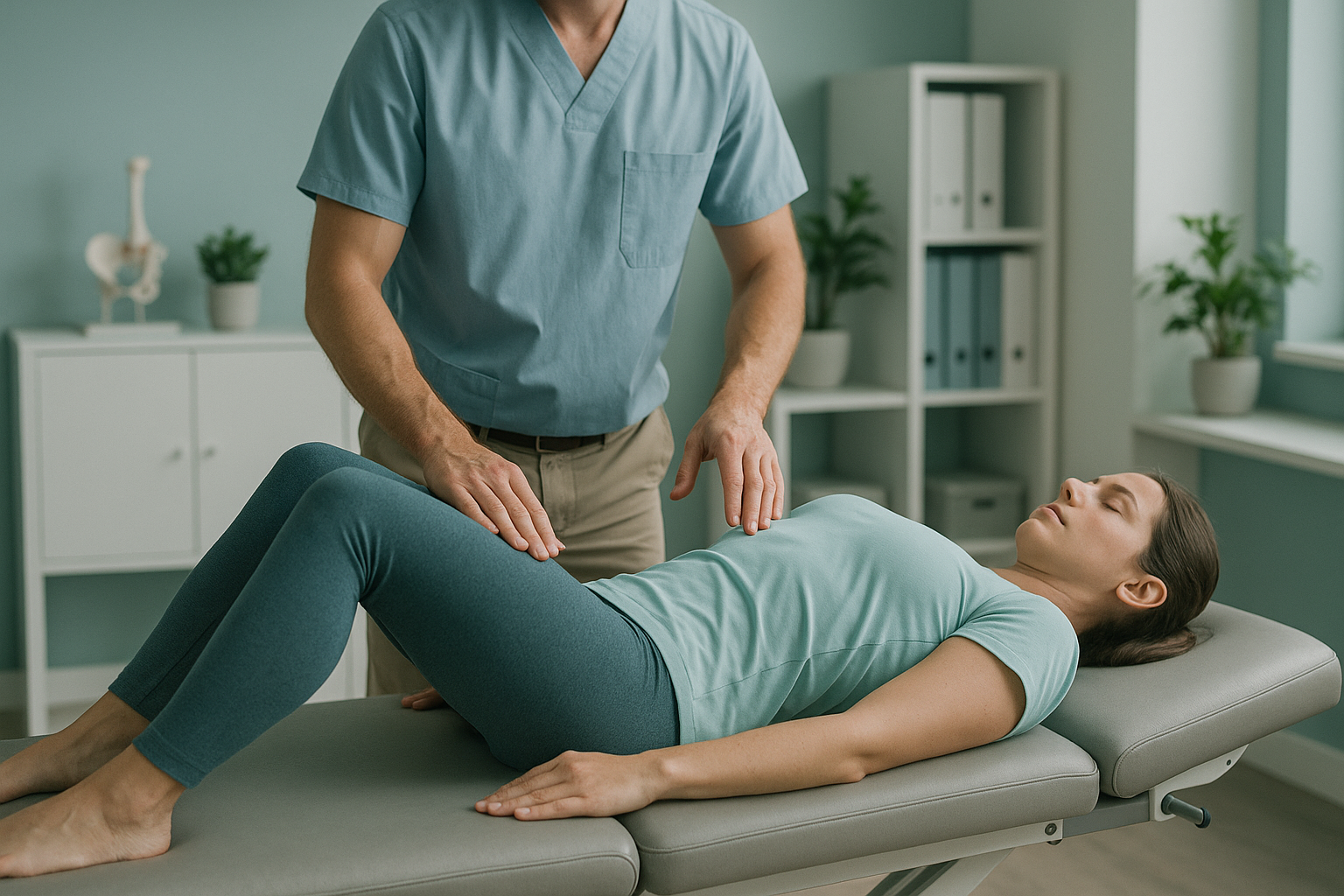
The right pelvic tilt exercise depends on which way your pelvis is tilted, and why. Anterior tilts respond best to hip flexor stretches and glute strengthening. Posterior tilts benefit from lengthening the hamstrings and retraining the core. Lateral tilts need targeted work on the weaker side. It is essential to know the type and cause of your tilt before you start.
Key takeaways
- There is no single "best" pelvic tilt exercise. The right routine depends on the direction and cause of your tilt.
- Exercising without knowing your type of tilt can make asymmetry worse.
- A standing, weight-bearing image of your whole alignment is the most reliable way to measure a pelvic tilt before you start.
- Exercises address muscle imbalances. They cannot change a structural problem in the bone or joint itself.
- Tracking progress with repeat imaging shows whether your routine is working.
Why should you measure a pelvic tilt before exercising?
You should measure it because exercising the wrong muscles can strengthen the very imbalance you are trying to fix. A tilt that tips forward (anterior) needs the opposite approach to one that tips backward (posterior) or drops to one side (lateral). If you do not know which type you have, you are guessing.
Many people follow general "fix your pelvic tilt" routines online. If the routine targets an anterior pelvic tilt but you actually have a posterior pelvic tilt, the stretches may pull you further out of balance.
It is also worth knowing that some tilts are structural. This means they come from how the bones or joints are shaped, not just from tight or weak muscles. Exercise alone cannot change bone shape. A clear image taken while you stand and bear weight shows whether the tilt is muscular (and likely to respond to exercise) or structural (and may need a different approach).
What exercises help an anterior pelvic tilt?
Exercises that lengthen tight hip flexors and strengthen weak glutes and abdominal muscles help reduce an anterior pelvic tilt. An anterior tilt means the front of the pelvis drops and the lower back arches more than it should. This pattern is common in people who sit for long periods.
Hold a half-kneeling lunge for 30 seconds on each side, two to three times. This lengthens the muscles at the front of the hip that pull the pelvis forward.
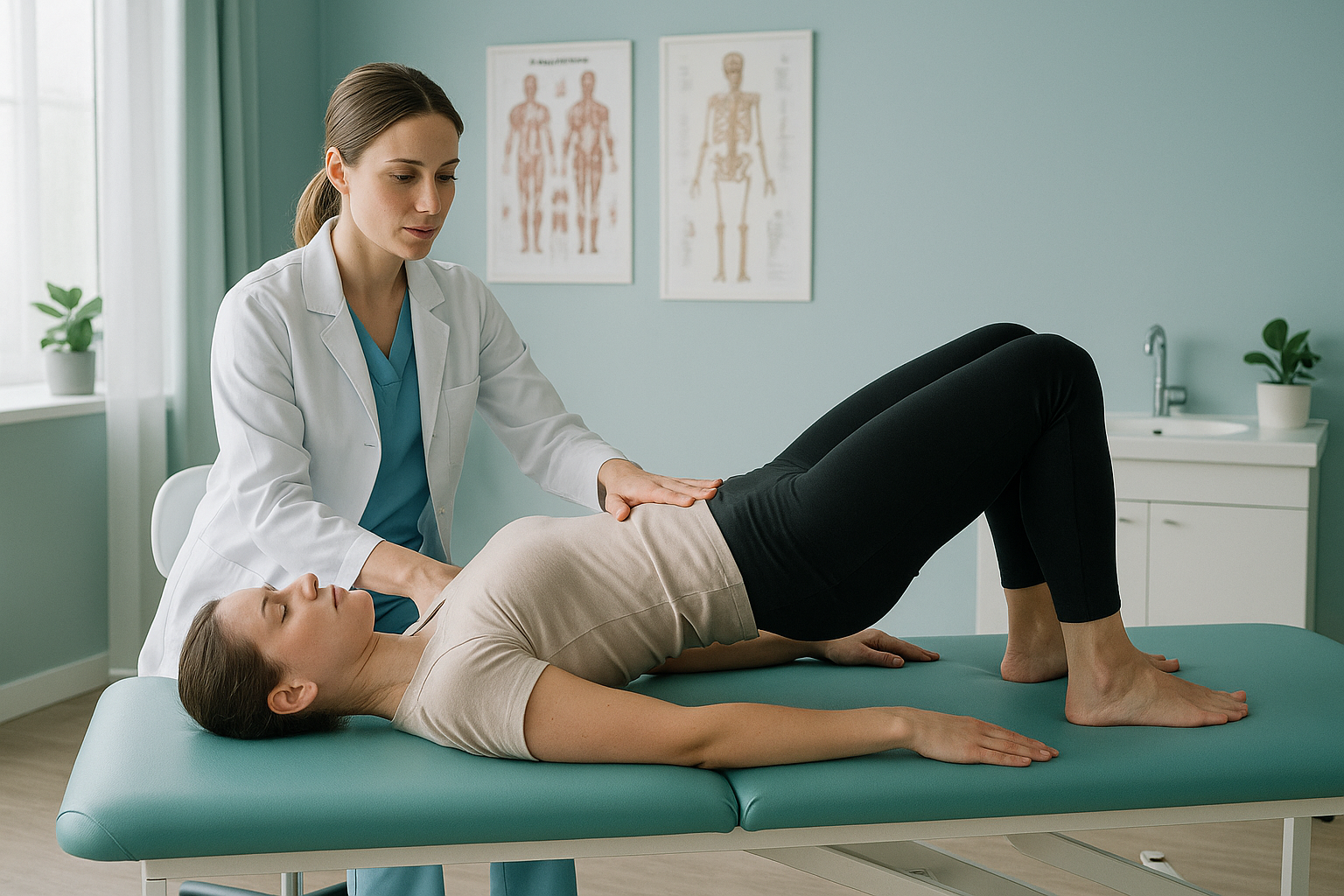
Lie on your back with your feet flat. Lift your hips by squeezing your glutes. Hold at the top for two seconds. Aim for 10 to 15 repetitions. This strengthens the muscles that pull the pelvis back to neutral.
Lying on your back, stretch out the opposite arm and leg while keeping your lower back flat on the floor. This teaches your deep core muscles to control the position of the pelvis while you move.
These three exercises address the usual muscle pattern behind an anterior tilt: short hip flexors, underactive glutes and poor core control. Doing them regularly matters more than doing them hard. Most physiotherapists recommend daily practice for at least six weeks before reassessing.
What exercises help a posterior pelvic tilt?
Exercises that stretch tight hamstrings and strengthen the hip flexors and lower back extensors help a posterior tilt. A posterior tilt means the bottom of the pelvis tucks under. This flattens the natural curve of the lower back. It can cause stiffness and make standing upright feel effortful.
- Standing hamstring stretch. Put one heel on a low step, keep your back straight and hinge forward from the hips. Hold for 30 seconds on each side.
- Prone back extension. Lie face down and gently lift your chest a few centimetres off the floor. This reactivates the muscles that maintain the lumbar curve.
- Hip flexor strengthening. Standing or sitting, lift one knee towards your chest against light resistance, 10 to 12 repetitions on each side. This offsets the dominance of the hamstrings and glutes that pull the pelvis into a tuck.
Notice that these exercises are the opposite of the anterior tilt routine. That is exactly why it is so important to know the direction of your tilt first.
What exercises help a lateral pelvic tilt?
A lateral tilt means one side of the pelvis sits higher than the other. This often relates to a difference in leg length, asymmetry in the hip joints or weakness on one side in the hip abductors (the muscles on the outside of the hip). Exercises alone work best when the cause is muscular.
- Single-leg glute bridge. Do it on the weaker side only, or do extra repetitions on that side, to build up the hip muscles that keep the pelvis level.
- Side-lying hip abduction. Lie with the weaker side facing up and lift the top leg slowly. Do 12 to 15 repetitions. This strengthens the gluteus medius, the main muscle that stops the pelvis from dropping.
- Side plank (modified). Resting on your forearm and knees, hold for 15 to 20 seconds. This works the core and hip stabilisers together on the weaker side.
If a lateral tilt is caused by a true structural difference in leg length, exercise will not change the length of the bones. In that case, a heel lift or orthotic may be needed. That decision is far easier once the exact asymmetry has been measured on a standing image.
So before you start a treatment, or change the one you are on, it is worth getting a detailed diagnosis. Knowing whether the cause sits in your pelvis, your legs or your spine changes what will actually help.
How does a standing scan help before starting pelvic tilt exercises?
A standing, weight-bearing scan captures your pelvis, spine and legs in the position they actually work in. Imaging done lying down (standard X-ray, CT or MRI) lets gravity and your muscles relax. This can hide or reduce the tilt you feel when you are upright.
Your body is a connected chain from your feet to your head. A tilt at the pelvis forces your spine, hips and knees to compensate. Pain often appears away from the real cause. A whole-body standing image, like the one produced by ScanAlign standing EOS imaging, shows the full picture so your exercise programme targets the right area. You can read more about how an EOS scan reveals pelvic tilt and rotation.
An EOS scan uses about 90% less radiation than a standard X-ray, around ten times less. It takes your image while you stand, so the measurements reflect your real-world posture and alignment.
Want to know exactly what type of tilt you have before choosing exercises? A standing alignment scan at our London clinic gives you a clear starting point.
Book a free video consultationWhen is MRI the better choice? EOS shows bones, joints and alignment clearly. If your treating specialist suspects a soft-tissue problem such as a disc issue, a labral tear or nerve involvement, MRI is usually the better tool. The two scans answer different questions and sometimes complement each other.
Frequently asked questions about pelvic tilt exercises
If the tilt is caused by muscle imbalance, targeted exercises can significantly improve it. If it is structural, meaning the bones or joints themselves are shaped differently, exercises can help manage symptoms but may not eliminate the tilt.
Most physiotherapists suggest at least six to twelve weeks of regular daily practice before you expect meaningful change. Results depend on how severe the tilt is, what causes it and how regularly you train.
A physiotherapist can do a clinical assessment. For a precise measurement, a standing X-ray or EOS scan captures the position of the pelvis under load, so there is no guesswork.
The exercises on this page are generally low-risk. However, if you have significant pain, numbness or weakness in your legs, or any loss of bladder or bowel control, stop and get urgent medical help from your doctor or the nearest emergency department.
Yes. Sitting for long periods shortens the hip flexors and weakens the glutes. This is a common driver of anterior pelvic tilt. Regular movement breaks and targeted stretches help counteract this.
No. ScanAlign is a self-referral clinic. You can book a pelvic alignment scan directly, without a referral letter from your doctor.
Yes. An EOS scan uses about 90% less radiation than a standard X-ray, around ten times less. It is one of the lowest-dose imaging options available.
A tilt is the pelvis tipping forward, backward or sideways. A rotation is one side of the pelvis twisting ahead of the other when seen from above. Many people have both. A standing whole-body image can identify each one.
Usually both. You stretch the muscles that are too tight and strengthen the ones that are too weak. The exact combination depends on whether your tilt is anterior, posterior or lateral.
ScanAlign is a private self-pay clinic. The price for patients travelling from abroad is confirmed during the free video consultation.
Find out exactly what your pelvis is doing
A free video consultation with our team explains how a standing alignment scan in London can guide your exercise plan. No referral needed.
Book a free video consultationWritten by Abbas Dhami (Specialist Diagnostic Radiographer)
Sources
- Kendall FP, McCreary EK, Provance PG et al. Muscles: Testing and Function with Posture and Pain. 5th ed. Lippincott Williams & Wilkins, 2005.
- NHS. Back pain: exercises and activities. nhs.uk (accessed 2024).
- Dubousset J et al. EOS stereo-radiography system: whole-body simultaneous frontal and lateral radiographs with 800% to 900% less irradiation. Revue de Chirurgie Orthopédique et Réparatrice de l'Appareil Moteur, 2005;91(5 Suppl):13-25.
This page is general information and not a diagnosis.
ScanAlign is the trading name of CoreMed Solutions Ltd and operates under The Harley Street Hospital's CQC licence.