
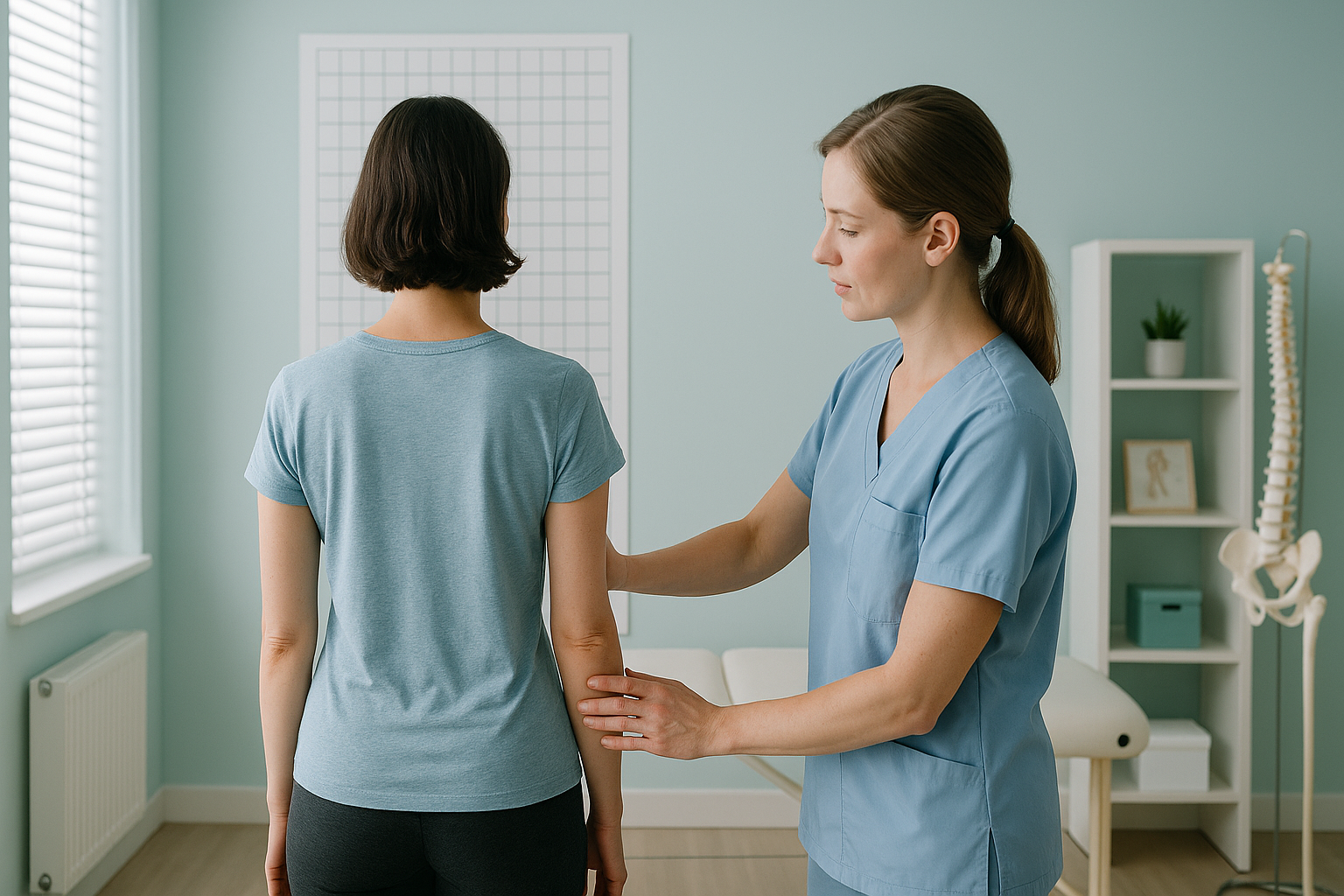
What Happens in a Proper Posture Assessment?
A proper posture assessment measures the alignment of your whole body while you stand upright and carry your own weight. It checks how your head, shoulders, spine, pelvis, knees and feet line up, from front to back and from side to side. The results give objective numbers. These help find the real source of pain or stiffness, even when it is far from where you feel it.
Key takeaways
- A thorough posture assessment is done standing. Lying down relaxes the muscles and can hide alignment problems.
- It measures your body from head to feet as one connected chain, not just the part that hurts.
- Objective measurements give your clinician clear data to plan treatment and track progress.
- An EOS standing x-ray captures the full picture in a single low-radiation image.
What is a posture assessment and why does it matter?
A posture assessment is a structured examination of how your skeleton and joints line up when you stand. It matters because poor alignment puts extra load on certain muscles, joints and discs. That extra load is often the hidden cause of persistent pain.
Many people with long-standing back, hip or knee problems have already had scans that came back "normal." This can happen when the scan is done lying down. Lying down removes gravity and lets your muscles relax into a neutral position. A standing posture assessment shows what really happens when your body supports its own weight.
What is included in a full posture assessment?
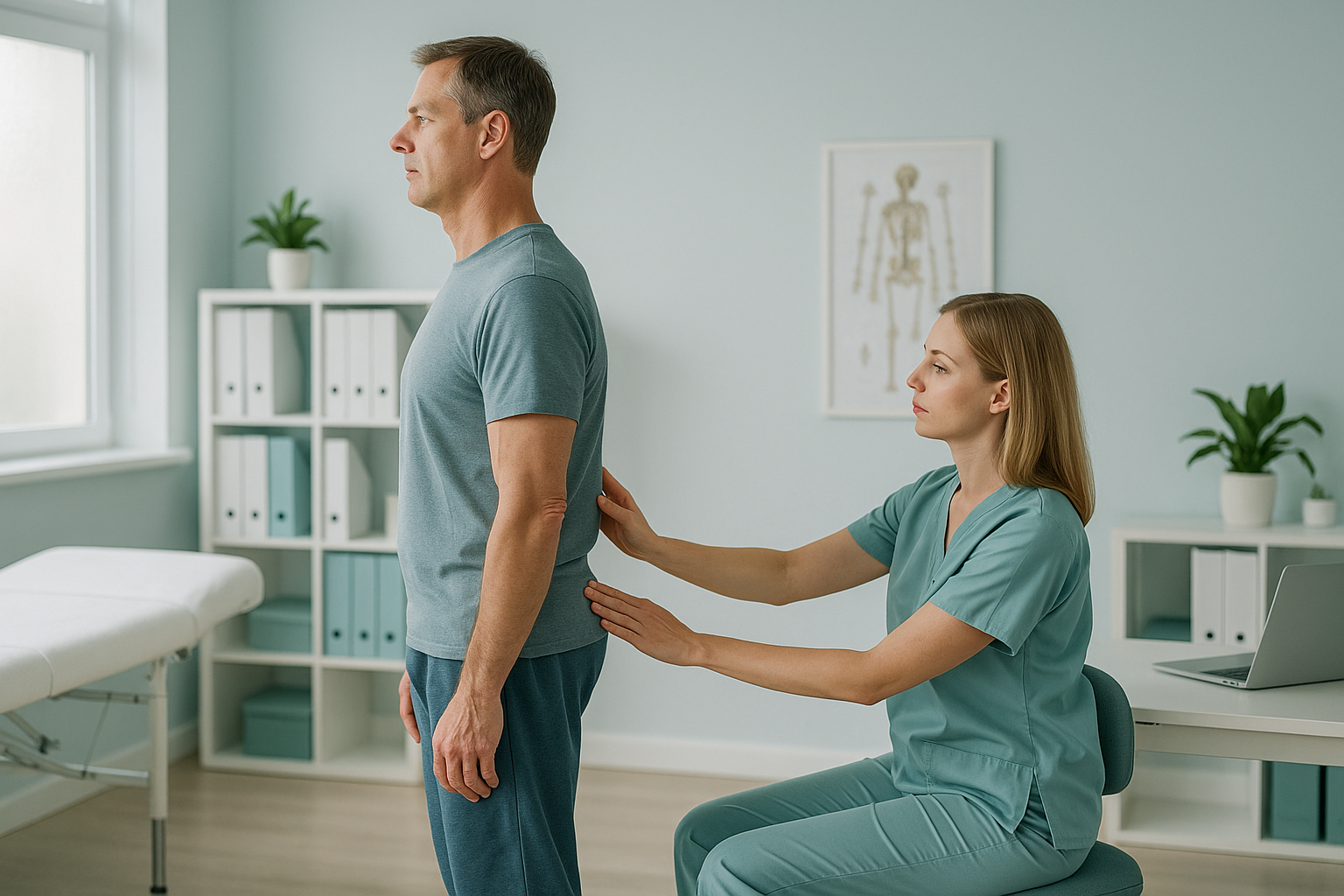
A full posture assessment examines your alignment from head to feet in two planes: the coronal plane (front view) and the sagittal plane (side view). Here is what is usually measured.
Is your head centred over your body, or shifted forward, backward or to one side?
Are your shoulders level, or does one sit higher than the other?
The natural curves of your neck, mid-back and lower back are checked for too much or too little curve.
A tilted or rotated pelvis can shift load through your whole spine and legs.
The angle of your knees and how your legs share your weight under gravity.
How your feet meet the ground, and whether they affect alignment further up the chain.
Together, these measurements make a complete map of your coronal balance (left-to-right symmetry) and sagittal balance (front-to-back curves). To learn more about these ideas, read our body alignment guide.
Why does a posture assessment need to be done standing up?
Standing is essential because gravity is what reveals alignment problems. When you lie down for a conventional X-ray, CT scan or MRI, your muscles relax and your joints decompress. A tilt or shift that causes you pain every day can disappear on the scan. The results can then look normal even when you do not feel normal.
Gravity is at work. Your muscles, ligaments and joints carry load exactly as they do in daily life. Any imbalance, compensation or abnormal curve can be seen and measured. This is why a standing posture assessment gives the most accurate picture of how your body really works.
Gravity is removed. Your spine lengthens, your pelvis settles into a neutral position, and compensations relax away. The scan may look reassuring, but it does not show what happens when you stand, walk or sit at your desk all day.
Your body is a connected chain from your feet to your head. A problem at one level, for example a pelvic tilt, can make your spine compensate above it and your knee compensate below it. Pain often shows up away from the true cause. A whole-body standing assessment captures the full chain in one go. Learn more about postural sway and how small shifts affect everyday movement.
How does a posture assessment work at ScanAlign?
At ScanAlign, standing EOS imaging in Harley Street, London, the process combines clinical expertise with advanced standing imaging. Here is what to expect.
Free video consultation
A specialist radiographer goes through your history, symptoms and any earlier scans. This helps decide whether a standing scan is the right next step for you, before you plan your trip.
Standing EOS scan
You stand naturally inside the EOS system while it captures a full-length image of your skeleton, head to feet, in about 20 seconds. The scan uses about 90% less radiation than a standard X-ray, around ten times less.
Analysis and report
Your images are analysed to give objective alignment measurements. The report maps your coronal and sagittal balance, your pelvic position and any compensations.
Next steps
Your report is shared with you and, if you choose, with your treating clinician. The same scan can be repeated later to track change over time, giving you a reliable baseline.
For a full walkthrough, see what to expect at an alignment assessment.
Who should consider a private posture assessment?
A standing posture assessment is most useful for adults with ongoing symptoms that earlier scans or examinations have not fully explained.
Good fit
- Persistent back, hip or knee pain with normal earlier scans
- Clear asymmetry, such as one shoulder higher or leaning to one side
- Planning for, or recovering from, joint or spine surgery
- You want objective baseline measurements to track over time
May not be the right fit
- You suspect a soft-tissue, disc or nerve problem (MRI is usually better for that)
- You have sudden severe pain, numbness, weakness, or loss of bladder or bowel control. Seek urgent medical help from your doctor or your nearest emergency department
- You need a quick diagnosis of a fracture or acute injury
A note on MRI. EOS shows bones, joints and alignment very clearly. For soft tissue, discs or nerves, MRI is usually the better tool. The two work well together. If your symptoms suggest a disc or nerve issue, your clinician may recommend MRI instead of, or alongside, a standing assessment.
Before you start treatment, or change the one you are on, it is worth getting a detailed diagnosis. Knowing whether the cause sits in your pelvis, your legs or your spine changes what will actually help.
Wondering if a posture assessment could explain your symptoms? Start with a free video consultation from home. A specialist radiographer will review your situation and tell you whether standing imaging is the right step, before you travel to London.
Book a free video consultationFrequently asked questions about posture assessments
It measures the alignment of your head, shoulders, spine, pelvis, knees and feet while you stand. The assessment checks your side-to-side balance (coronal) and your front-to-back curves (sagittal). This gives objective numbers your clinician can use.
No. ScanAlign is a private self-pay clinic, so you can refer yourself. You start with a free video consultation to check that standing imaging is suitable for your situation.
An EOS scan captures your full body in one standing image, from head to feet, using about 90% less radiation than a standard X-ray, around ten times less. A normal X-ray usually covers only one area and is often taken lying down. This removes the effect of gravity on your alignment.
Yes. The EOS system uses about 90% less radiation than a standard X-ray, around ten times less. It is one of the lowest-dose skeletal imaging systems available.
The scan itself takes about 20 seconds. Your full appointment is longer because it includes positioning and a review of your images.
The price for patients travelling from abroad is confirmed during the free video consultation, which you can arrange from the book a posture assessment page.
It can identify alignment issues that may be contributing to your pain. Because your body works as a connected chain, a problem at one level can cause symptoms elsewhere. A whole-body standing image helps join the dots that single-area scans can miss.
ScanAlign provides diagnostic imaging, not treatment recommendations. Your report gives objective measurements. Your surgeon, physiotherapist or other clinician can use them to guide decisions about treatment, including whether surgery is needed.
Yes. The scan gives precise, repeatable measurements, so it works well as a baseline. A follow-up scan months later can show whether your alignment has changed after treatment or rehabilitation.
Wear comfortable, close-fitting clothes without metal fastenings, such as zips or buckles. You may be asked to change into a gown if needed. Full details are in the guide on what to expect at an alignment assessment.
Ready to see the full picture?
A free video consultation is the easiest way to find out if a standing posture assessment is right for you, before you plan your visit to London. No referral needed, no obligation.
Book a free video consultationWritten by Abbas Dhami (Specialist Diagnostic Radiographer)
Sources
- Dubousset, J. et al. "EOS: A new imaging concept." European Spine Journal, 2010. Overview of low-dose standing biplanar imaging and its clinical uses.
- Glassman, S.D. et al. "The impact of positive sagittal balance in adult spinal deformity." Spine, 2005;30(18):2024-2029. Shows the link between standing sagittal balance and patient outcomes.
- NHS. "Back pain: causes, treatment, and when to get help." nhs.uk/conditions/back-pain. General UK guidance on back pain assessment and red-flag symptoms.
This page is general information and not a diagnosis.
ScanAlign is the trading name of CoreMed Solutions Ltd and operates under The Harley Street Hospital's CQC licence.