
Where Can You Get a Scoliosis Scan in London?
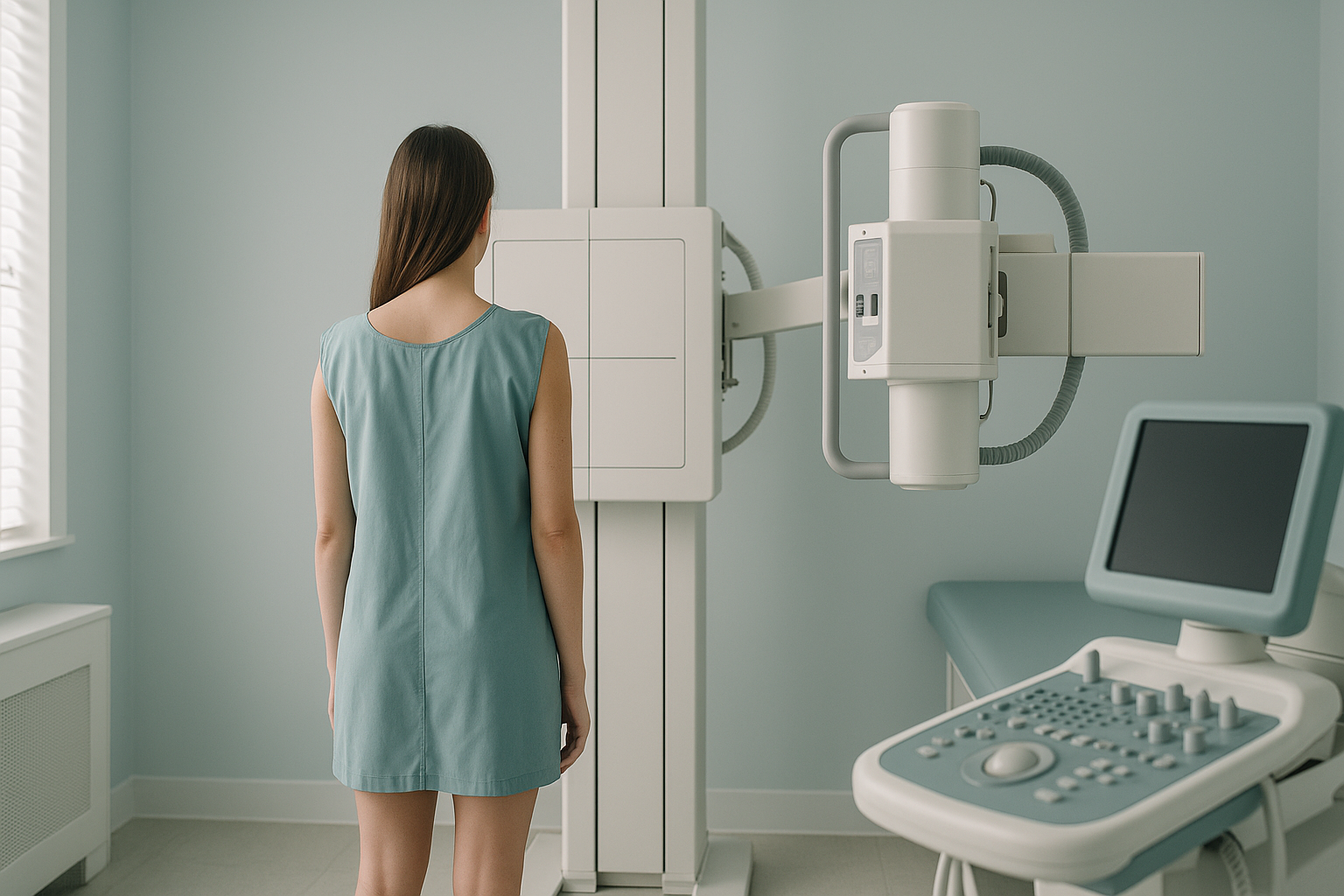
Several clinics in London offer scoliosis imaging, but most use ordinary X-rays taken lying down. ScanAlign at 19 Harley Street offers standing, whole-body EOS imaging with about 90% less radiation than a standard X-ray. A standing scan shows your spine while it carries your body weight. This gives a more accurate picture of your curve.
Key points
- A scoliosis scan is more accurate when it is done standing up, under your natural body weight.
- EOS imaging uses about 90% less radiation than a standard X-ray, around ten times less.
- ScanAlign is at 19 Harley Street, in central London. You do not need a referral from your doctor.
- The scan shows your whole body in one image, so compensations above and below the curve can be seen.
- ScanAlign is a diagnostic imaging clinic. It does not provide treatment.
If you are looking for a scoliosis clinic in London, you may have noticed that the choices vary. In the UK they range from NHS spine units with long waits to private orthopaedic practices that focus on treatment rather than imaging. A clear, accurate image of your scoliosis is the essential first step. The type of scan you choose makes a real difference to what your specialist can see.
Why does a standing scoliosis scan matter?
A standing scan shows your spine exactly as it behaves when you are upright, with gravity and your muscles shaping the curve. Lying-down X-rays, CT and MRI all relax the body. This can make a curve look smaller than it really is. It can also hide the way your pelvis, hips and shoulders compensate for the curve.
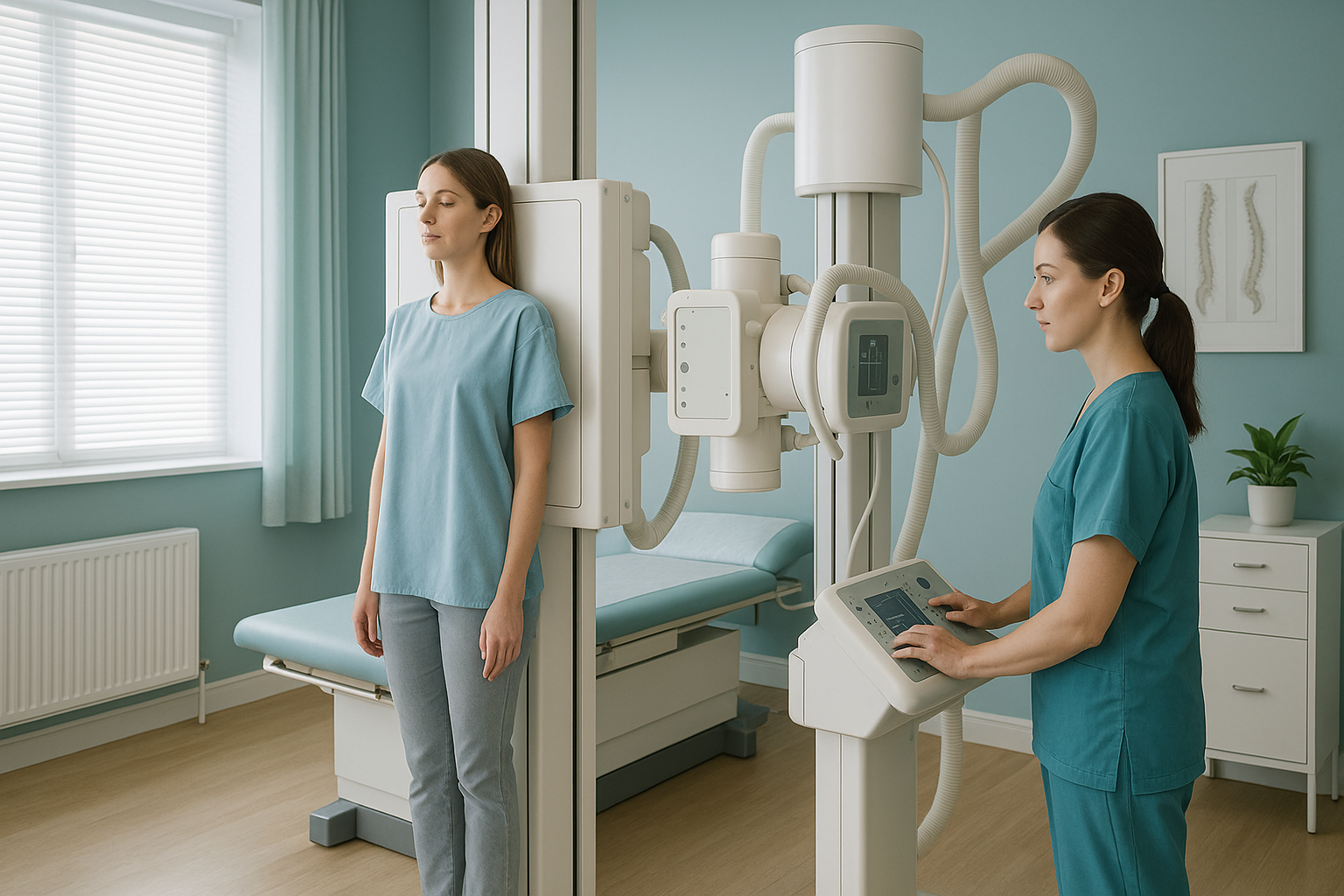
Your body is a connected chain. A curve in the spine does not exist on its own. It affects the tilt of your pelvis, the alignment of your hips and even how your knees take load. A whole-body standing image shows all of these links in one picture. To learn more, read about why standing imaging matters in scoliosis.
Weight-bearing. Your muscles are working and gravity is pulling on the curve, so its true shape shows.
Whole body. Head to feet in one image, so compensations are not hidden.
Low dose. About 90% less radiation than a standard X-ray, around ten times less.
No gravity. Muscles relax and the curve can look smaller than it really is.
Limited view. It usually shows only the spine, and misses how the rest of the body compensates.
Higher dose. A standard series of spine X-rays uses much more radiation.
What happens during a scoliosis assessment at ScanAlign?
You stand inside the EOS scanner in a natural, relaxed position. The machine captures your whole skeleton from head to feet in one low-dose sweep. There is no tunnel or closed space. The whole process is quick and simple.
Speak to us from home, before you plan your trip. We check whether an EOS scan is the right next step for you.
Come to our clinic in central London. No special preparation is needed.
You stand naturally while the scanner captures your whole body in one low-dose image.
A specialist radiologist reviews your images and writes a report with full Cobb angle measurement and alignment data. You can share it with any of your treating specialists, at home or abroad.
You do not need a referral from your doctor. You can book a private scoliosis assessment yourself.
Book a free video consultationWho should consider a private scoliosis scan in London?
Adults who want a clear, up-to-date picture of their spinal alignment. This is especially useful if you have been told you have a curve but have not had standing imaging, or if your symptoms have changed over time.
- Known scoliosis, and you want to check the current state of the curve
- Unexplained back pain with a visible imbalance in posture
- Getting ready for a specialist consultation or a surgical opinion
- Earlier lying-down imaging that did not explain your symptoms
- Suspected disc problem or nerve compression (MRI is usually better)
- Acute injury or recent trauma (see your doctor or go to an emergency department first)
- You need detail of the soft tissues rather than bony alignment
When is MRI the better choice? EOS is excellent at showing bones, joints and whole-body alignment. For soft tissue, discs or nerves, MRI is usually the better tool. If you are not sure which scan you need, our free video consultation will help you decide.
Red-flag symptoms. If you have sudden numbness, weakness, or loss of bladder or bowel control, please get urgent medical help. Contact your doctor, call your local emergency number, or go to the nearest emergency department. These symptoms need assessment straight away, not a routine scan booking.
Before you start treatment, or change the treatment you are on, it is worth getting a detailed diagnosis. Knowing whether the cause sits in the pelvis, the legs or the spine changes what will actually help.
Where is ScanAlign in London?
ScanAlign is at 19 Harley Street, London W1G 9QJ. It is inside The Harley Street Hospital, in the heart of London's Harley Street medical area. The nearest Underground stations are Oxford Circus, Regent's Park and Great Portland Street, all a short walk away.
19 Harley Street, W1G 9QJ
Book yourself as a private patient
The scan itself takes only a few moments
You can learn more about ScanAlign, standing EOS imaging in London on the homepage, or book a scoliosis scan directly.
Frequently asked questions about scoliosis scans in London
No. ScanAlign accepts patients who book themselves. You can book directly without a referral letter from your doctor.
The price for patients travelling from abroad is confirmed during the free video consultation.
Yes. The EOS system uses about 90% less radiation than a standard X-ray, around ten times less. This is especially helpful if you need repeat imaging to monitor a curve over time.
A standard X-ray is usually taken lying down and covers only part of the spine. An EOS scan images your whole body while you stand. It captures the true curve plus any compensations in your hips, pelvis and legs, all with much lower radiation.
No. ScanAlign is a diagnostic imaging clinic. We provide the images and report your specialist needs. We do not offer treatment, bracing or surgery.
The clinic is a short walk from Oxford Circus, Regent's Park or Great Portland Street Underground stations. Metered parking is available on nearby streets.
Yes. The radiologist's report includes full spinal alignment data that your treating specialist can use for clinical decisions.
It depends on what your treating specialist needs to see. EOS is ideal for bony alignment and measuring the curve. MRI is better for soft tissue, discs and nerves. Sometimes both are useful. Our free video consultation can help you work out which is right for you.
Yes. Your images and report are yours. You can share them with any consultant, physiotherapist, osteopath or surgeon, in a public or private hospital.
We aim to send your report promptly after your scan. Exact timings vary, so please ask during your consultation for current details.
Ready to get a clear picture of your scoliosis?
Start with a free video consultation from home. We will check whether an EOS scan is the right next step for you.
Book a free video consultationSources
- Ilharreborde B, Steffen JS, Nectoux E, et al. "Angle measurement reproducibility using EOS three-dimensional reconstructions in adolescent idiopathic scoliosis treated by posterior instrumentation." Spine, 2011;36(20):E1306-E1313.
- Deschênes S, Charron G, Beaudoin G, et al. "Diagnostic imaging of spinal deformities: reducing patients' radiation dose with a new slot-scanning X-ray imager." Spine, 2010;35(9):989-994.
- National Institute for Health and Care Excellence (NICE). "Spinal injury: assessment and initial management." NICE guideline NG41, 2016 (updated 2023).
Written by Abbas Dhami (Specialist Diagnostic Radiographer)
This page is general information and not a diagnosis.
ScanAlign is the trading name of CoreMed Solutions Ltd and operates under The Harley Street Hospital's CQC licence.