
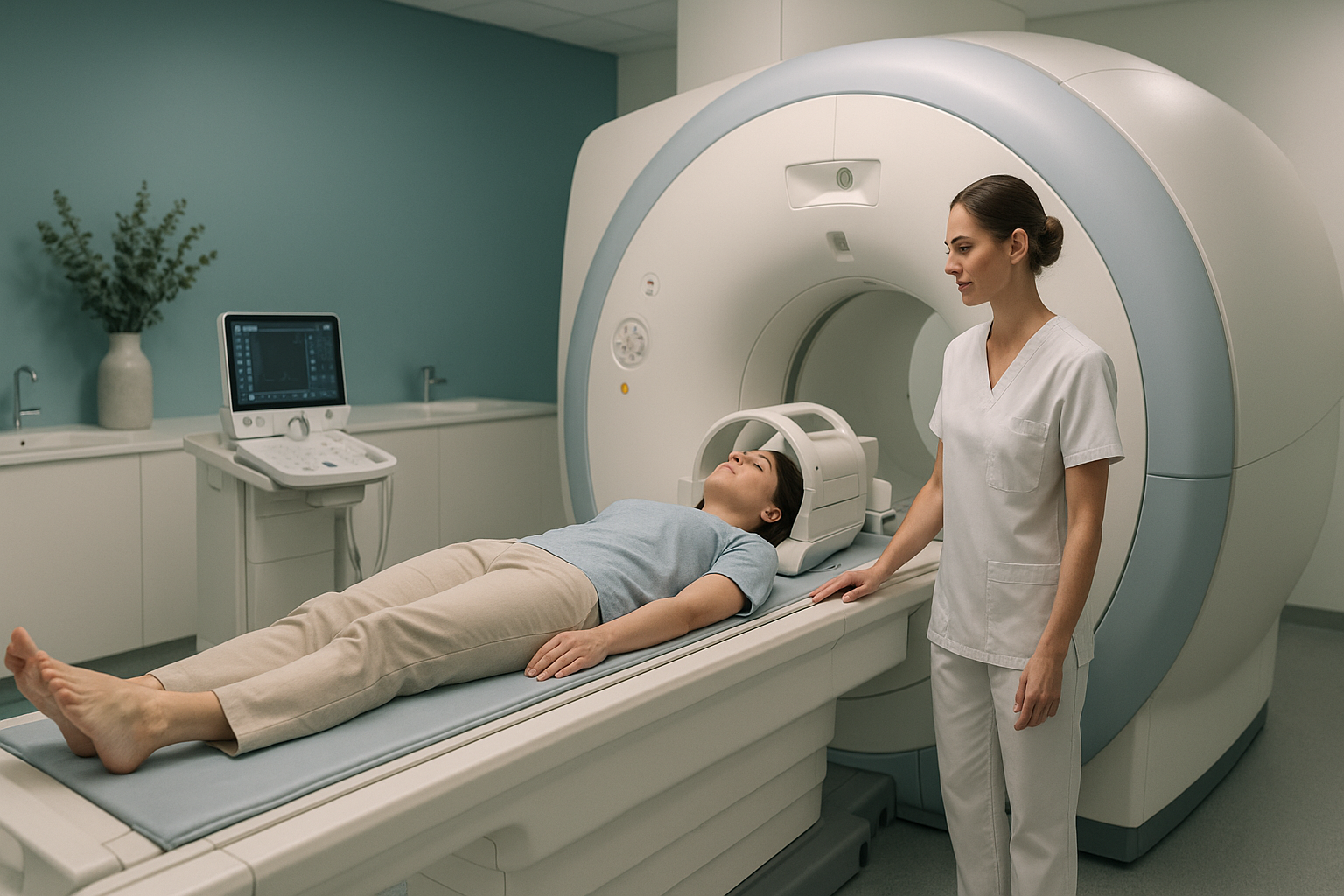
How Does Self-Pay Imaging Work?
A self-pay scan means you pay for your imaging directly. You do not need insurance or a referral from your doctor. At ScanAlign you book and pay online, come to your appointment at 19 Harley Street, London, and receive a full radiologist report and your images. The whole process is designed to be simple and clear.
Key points
- No doctor's referral or insurance needed. You refer yourself.
- The price for patients travelling from abroad is confirmed during the free video consultation. Payment is taken at booking.
- A specialist radiologist report and your images are included.
- You can share your results with your own doctor or specialist.
- EOS imaging uses about 90% less radiation than a standard X-ray, around ten times less.
Many people think you need a letter from a doctor or private health insurance to get diagnostic imaging. That is not always true. Self-pay imaging lets you take the direct route. You pay for your scan yourself and book when it suits you.
At ScanAlign, private standing imaging, we use EOS technology to take whole-body images while you stand. Because you stand upright and carry your own weight during the scan, it shows how your bones and joints really line up under gravity. Scans done lying down can miss this. This page explains exactly how the self-pay process works, what is included, and what happens after your scan.
What is included in a self-pay scan at ScanAlign?
Every self-pay scan at ScanAlign includes everything you need to understand your alignment and take the next step with your healthcare provider.
A specialist radiologist reviews your images and writes a detailed report on the findings.
You receive your EOS images digitally, so you can share them with any clinician who needs to see them.
Your scan captures your full posture and joint alignment while you stand, giving a weight-bearing picture of your whole body.
The price for patients travelling from abroad is confirmed during the free video consultation. See our EOS scan cost page.
How do you book and pay for a self-pay scan?
There are four simple steps. No paperwork, no waiting for approval, and no insurance forms to fill in.
Check your eligibility
First, check who our scan is suitable for. Our short screening checks that an EOS scan is right for your situation. This is a safety step required under IRMER regulations (the rules that govern medical radiation in the UK). It makes sure every scan is clinically justified.
Book and pay online
Once you are approved, you choose a date and time that suits you and pay securely online. Payment is taken at booking, so there are no surprises on the day. No insurance claim forms, no letters from your doctor.
Come for your scan
You come to 19 Harley Street, London. The scan itself is quick and simple. You stand in the EOS scanner fully clothed (metal-free clothing) while it takes your images. Read more about what to expect at an alignment assessment.
Receive your report and images
A specialist radiologist reviews your images and writes a detailed report. You receive both the report and the images digitally, ready to share with your doctor, specialist, physiotherapist or surgeon.
Is a self-pay EOS scan safe?
Yes. EOS imaging uses about 90% less radiation than a standard X-ray, around ten times less. It is a well-established technology used in hospitals and specialist clinics. Every scan at ScanAlign is carried out under strict UK regulations (IRMER) and within The Harley Street Hospital's CQC-registered framework.
Do I need a referral?
You do not need a referral letter from your doctor or a request from a specialist. You refer yourself. However, under IRMER a qualified practitioner still needs to justify every scan. At ScanAlign, this is done during your eligibility screening, so you can be confident your imaging is both safe and appropriate.
How much does it cost?
The price for patients travelling from abroad is confirmed during the free video consultation. Payment is taken at the time of booking. See our EOS scan cost page.
A note on MRI. EOS imaging is excellent for showing bones, joints and whole-body alignment under gravity. If your clinician suspects a soft-tissue problem, such as a disc injury, ligament tear or nerve compression, MRI is usually the better tool for that. The two types of imaging answer different questions, and sometimes both are helpful.
Can I share my self-pay scan results with my doctor?
Yes. Your report and images belong to you. You can share them with any healthcare professional, whether that is your doctor, an orthopaedic specialist, a physiotherapist or a surgeon. Many patients use their ScanAlign results to start a conversation with the healthcare team they already see, or to get a second opinion.
ScanAlign is a diagnostic imaging clinic, so we do not provide treatment. Your results give you and your clinician clear, objective information to guide the next step, whatever that may be.
Before you start a treatment, or change the one you are on, it is worth getting a detailed diagnosis first. Knowing whether the cause sits in your pelvis, your legs or your spine changes what will actually help.
Not sure if a standing scan is right for you? Start with a free video consultation to talk through your situation with our team.
Book a free video consultationFrequently asked questions about self-pay imaging
No. You refer yourself directly. During the eligibility screening, a qualified practitioner justifies the scan under IRMER regulations, so no letter from your doctor is needed.
No. Self-pay means you pay for the scan yourself, directly, when you book. No insurance paperwork is involved.
The price for patients travelling from abroad is confirmed during the free video consultation. See our EOS scan cost page.
Payment is taken securely online at the time of booking. There are no additional charges on the day of your scan or afterwards.
Yes. Every scan is justified by a qualified practitioner under IRMER, which is the UK law governing medical radiation. EOS also uses about 90% less radiation than a standard X-ray, around ten times less.
Your booking includes the EOS scan itself, a specialist radiologist report, and your images sent to you digitally. The price for patients travelling from abroad is confirmed during the free video consultation.
Yes. Your report and images are yours to share with any healthcare professional you choose.
When you lie down for a conventional scan, gravity is removed and your muscles relax. This can hide alignment problems that only show up when you are standing and weight-bearing. A standing EOS scan captures how your body actually works in real life.
The scan is designed for adults with long-standing or unexplained back, hip, knee or posture problems. Check who our scan is suitable for to confirm it is right for you.
You come to 19 Harley Street, London, change into metal-free clothing if needed, and stand in the EOS scanner. The process is quick. Read more about what to expect at an alignment assessment.
Ready to take the next step?
Book a free video consultation to talk about your symptoms and find out whether a standing alignment scan could help.
Book a free video consultationWritten by Abbas Dhami (Specialist Diagnostic Radiographer)
Sources
- Ionising Radiation (Medical Exposure) Regulations 2017 (IRMER). UK Government legislation governing the justification and safety of medical radiation exposures.
- NHS. "Getting a second opinion." NHS.uk guidance on getting a further medical opinion and self-referral pathways in the UK.
- Deschênes S, et al. "Diagnostic imaging of spinal deformities: reducing patients' radiation dose with a new slot-scanning X-ray imager." Spine, 2010; 35(9):989-994.
This page is general information and not a diagnosis.
ScanAlign is the trading name of CoreMed Solutions Ltd and operates under The Harley Street Hospital's CQC licence.