
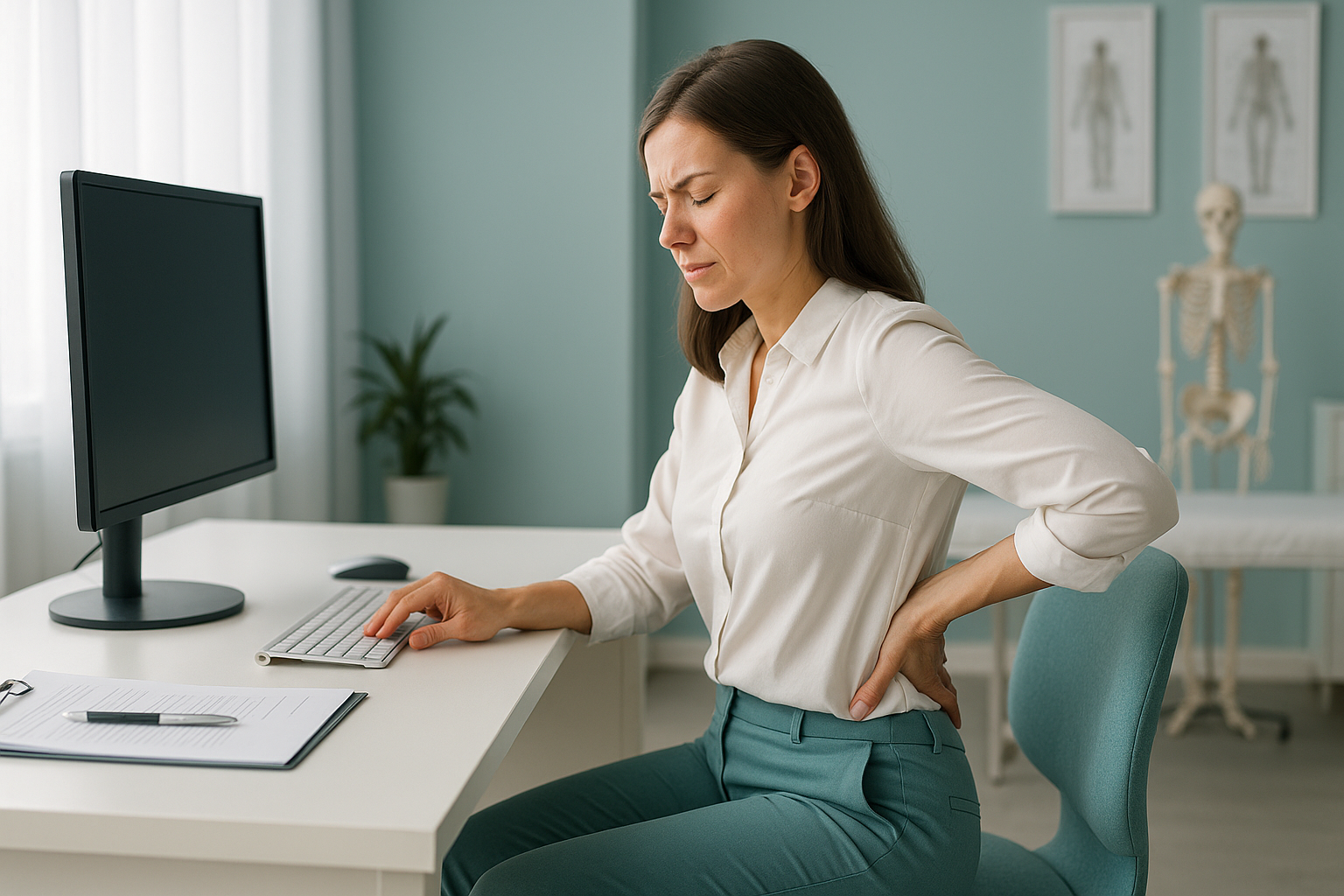
What Does Sitting for Eight Hours a Day Do to Your Body?
Sitting for long hours shortens the hip flexors, rounds the upper back and pushes the head forward. Over months and years, these small shifts add up. Your body makes up for them by loading the joints unevenly. That is why back pain from a desk job often comes on slowly, and in places you would not expect, such as the neck, hips or knees.
Key points
- Sitting for long periods shortens muscles, stiffens joints and changes the natural curves of your spine.
- Pain often shows up away from the real problem, because the body makes up for it along the whole chain.
- Lying-down scans relax the muscles and can miss alignment problems that only show when you are upright and bearing weight.
- A standing EOS scan captures your full posture under gravity, from head to feet, in one low-dose image.
- Movement breaks, strengthening and a proper assessment all help, but knowing your starting alignment comes first.
What does sitting all day actually do to your spine and joints?
Sitting puts more steady pressure on your lower spine than standing does. Over a normal working day, the curve of your lower back flattens, your hip flexors shorten and your upper back rounds forward. These are not sudden injuries. They are changes that build up over weeks, months and years of the same position.
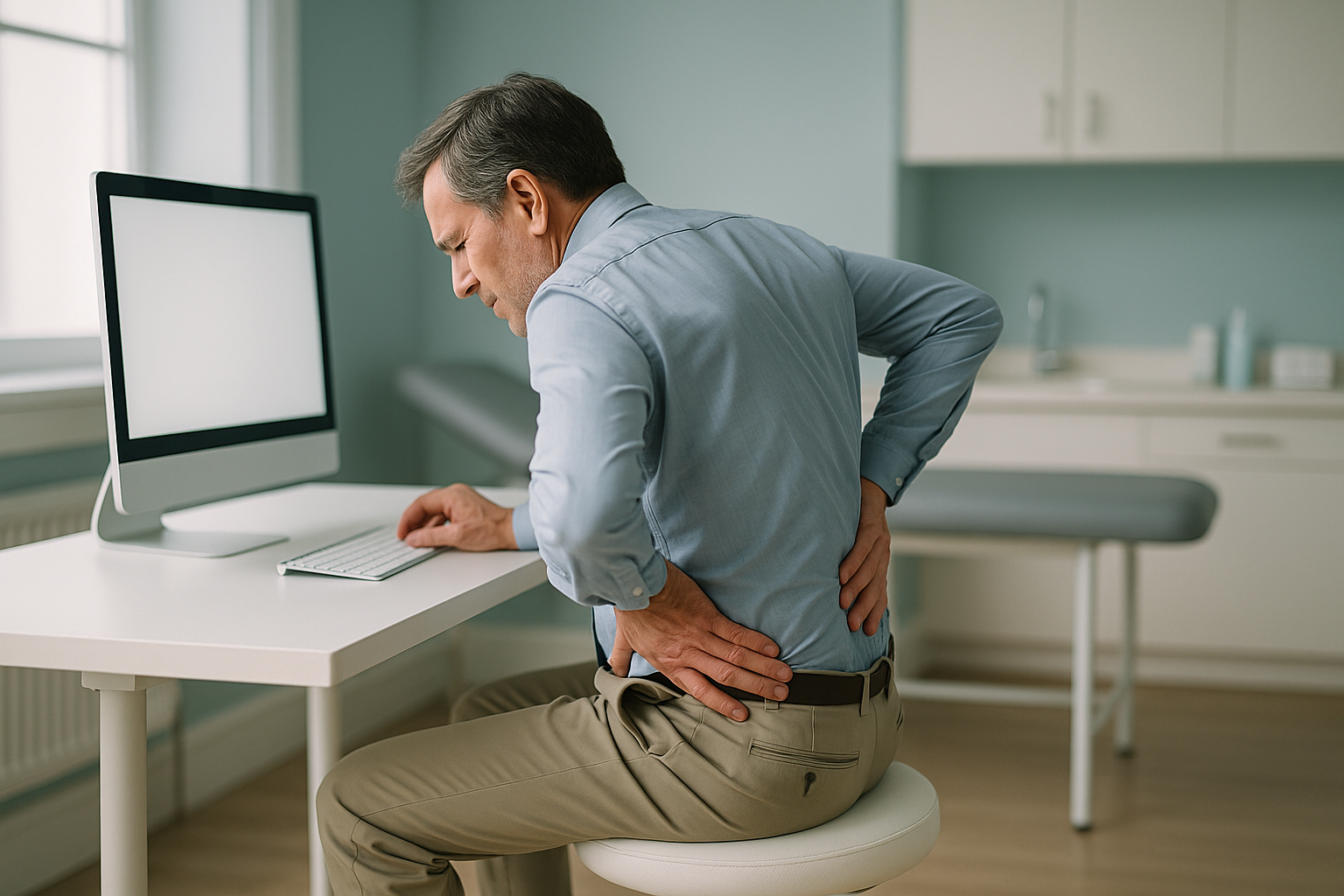
Your body is very good at adapting. But here, adapting means your muscles and connective tissue slowly reshape around the seated position. When you finally stand up, those shortened tissues pull your pelvis, spine and shoulders out of their natural alignment.
How do you know if sitting is causing your back pain?
Back pain from a desk job tends to creep in slowly rather than start suddenly. These are the patterns people describe most often.
A few seconds of tightness in your lower back or hips each time you get up from your chair.
A dull ache in the thoracic spine, usually worse in the afternoon.
Often linked to forward head posture, where the head sits in front of the shoulders.
A feeling of restriction at the front of the hip, especially when walking or climbing stairs.
A note on nerve symptoms. If you notice numbness, tingling, weakness in your legs, or any loss of bladder or bowel control, please get urgent medical help from your doctor or your nearest emergency department. These symptoms need assessment straight away, not a routine scan.
Why does sitting cause pain in places you would not expect?
Your body is a connected chain from your feet to your head. When one area is held shortened or rounded for hours each day, the areas above and below have to make up for it. A flattened lower back, for example, changes how your pelvis tilts. That changes how your hips and knees carry weight. This is why many people who work at a desk get knee pain, hip stiffness or neck problems, not just lower back pain.
This pattern also affects your postural sway, the small adjustments your body makes to keep you balanced. When the way you balance has been shaped around a seated posture, even walking or standing on a train can put more load on certain joints than it should.
The problem for imaging is that a standard scan of the painful area often looks normal. If someone with back pain from a desk job has a knee MRI, for example, it might show nothing unusual, because the real issue is the alignment pattern higher up. Without seeing the whole chain, the underlying cause can be missed completely.
How is posture from desk work assessed with standing imaging?
A standing EOS scan captures your whole skeleton, from head to feet, in a single image while you are upright and bearing weight. This matters because lying-down imaging relaxes your muscles and takes gravity out of the picture. That can hide the very alignment shifts that long hours of sitting have created.
Shows your real, everyday posture. Gravity pulls on your body the same way it does when you sit, stand and walk. Any tilt, rotation or shift in your spine, pelvis or legs can be seen, because your muscles are actively working to hold you up.
EOS uses about 90% less radiation than a standard X-ray, around ten times less. The scan takes seconds and you simply stand still inside the machine.
Muscles relax, and alignment changes disappear. When you lie flat on a scanning table, your spine and pelvis settle into a position they would never hold during your working day. A problem that only shows under load, the exact situation that causes your pain, can look completely normal on a lying-down image.
With ScanAlign standing EOS imaging, your clinician gets a full picture of how years of desk work have shaped your alignment. That information guides focused decisions about physiotherapy, changes to your workspace, or further tests.
When MRI is the better choice. EOS shows bones, joints and alignment clearly. For soft tissue, discs or nerves, MRI is usually the better tool. If your clinician suspects a disc problem or a pressed nerve, they may recommend MRI alongside or instead of an EOS scan.
What helps reduce the effects of sitting all day?
No single fix reverses years of steady loading. But a mix of good habits and professional guidance makes a measurable difference. ScanAlign is a diagnostic imaging clinic, so we do not provide treatment. What we can do is give you and your clinician a clear starting picture of your alignment, so that any plan is built on evidence, not guesswork.
Standing or walking for two minutes every 30 to 45 minutes reduces the steady load on your spine.
Hip flexor and upper back mobility work can counter the tightness that sitting creates. See our guide to stretches for lower back pain.
The right desk height, screen position and chair support reduce the strain your body takes each day.
Knowing exactly where your posture has shifted helps your physiotherapist or consultant focus on what matters most.
Before you start treatment, or change the one you are on, it is worth getting a detailed diagnosis. Knowing whether the cause sits in your pelvis, your legs or your spine changes what will actually help.
Not sure whether your back pain is a posture problem or something else? A free video consultation can help you decide if a standing scan is the right next step before you plan a trip to London.
Book a free video consultationFrequently asked questions
Over time, yes. Sitting for long stretches shortens the hip flexors, flattens the curve of the lower back and rounds the upper back. These changes build up, increase the load on certain joints and can lead to pain that grows slowly over months or years.
Yes. A good setup reduces strain, but it does not remove the effects of staying in one position for hours. The steady load on your spine and hips still builds up, especially if you rarely take movement breaks.
Your body is a connected chain. When your upper back rounds forward, your head drifts in front of your shoulders to keep your eyes level. This forward head position puts extra load on the neck muscles and cervical spine. It causes pain that feels separate from your back stiffness but has the same root cause.
It can. Many home setups use dining chairs, sofas or laptops on low tables. All of these encourage more rounding and leaning forward than a proper office chair and desk. Moving around less during the day, with no walk to the printer or meeting room, adds to the problem.
An EOS scan captures your full skeleton, from head to feet, in a single upright image while gravity is acting on your body. It uses about 90% less radiation than a standard X-ray, around ten times less. Because you are standing, the image shows your real, everyday alignment rather than the relaxed position a lying-down scan captures.
No. ScanAlign is a private, self-pay clinic. You can refer yourself. The process starts with a free video consultation, where a specialist reviews your concerns and confirms whether a standing scan is right for you.
The price for patients travelling from abroad is confirmed during the free video consultation.
Regular exercise helps, but research suggests it does not fully make up for long hours of sitting. A mix of exercise, frequent movement breaks during the day and focused stretching works better than any one habit alone.
Yes, in many cases. A standard X-ray usually images one area and may be taken lying down. A standing EOS scan captures the whole skeleton while you bear weight. This can reveal tilts, shifts and compensations that a lying-down image of one area would not show.
EOS uses about 90% less radiation than a standard X-ray, around ten times less. The dose is very low. We check that the scan is suitable for you during the free video consultation, before any scan is booked.
Ready to see how sitting has shaped your alignment?
A free video consultation with a specialist radiographer takes around 15 minutes, and you can join from home. No obligation, no referral needed.
Book a free video consultationSources
- Claus AP, Hides JA, Moseley GL, Hodges PW. "Is 'ideal' sitting posture real? Measurement of spinal curves in four sitting postures." Manual Therapy, 2009;14(4):404-408.
- Biswas A, Oh PI, Faulkner GE, et al. "Sedentary time and its association with risk for disease incidence, mortality, and hospitalization in adults." Annals of Internal Medicine, 2015;162(2):123-132.
- NHS. "Back pain: How to prevent it." nhs.uk, reviewed 2023.
Written by Abbas Dhami (Specialist Diagnostic Radiographer)
This page is general information and not a diagnosis.
ScanAlign is the trading name of CoreMed Solutions Ltd and operates under The Harley Street Hospital's CQC licence.