
At What Age Should Knock Knees in Children Correct Themselves?
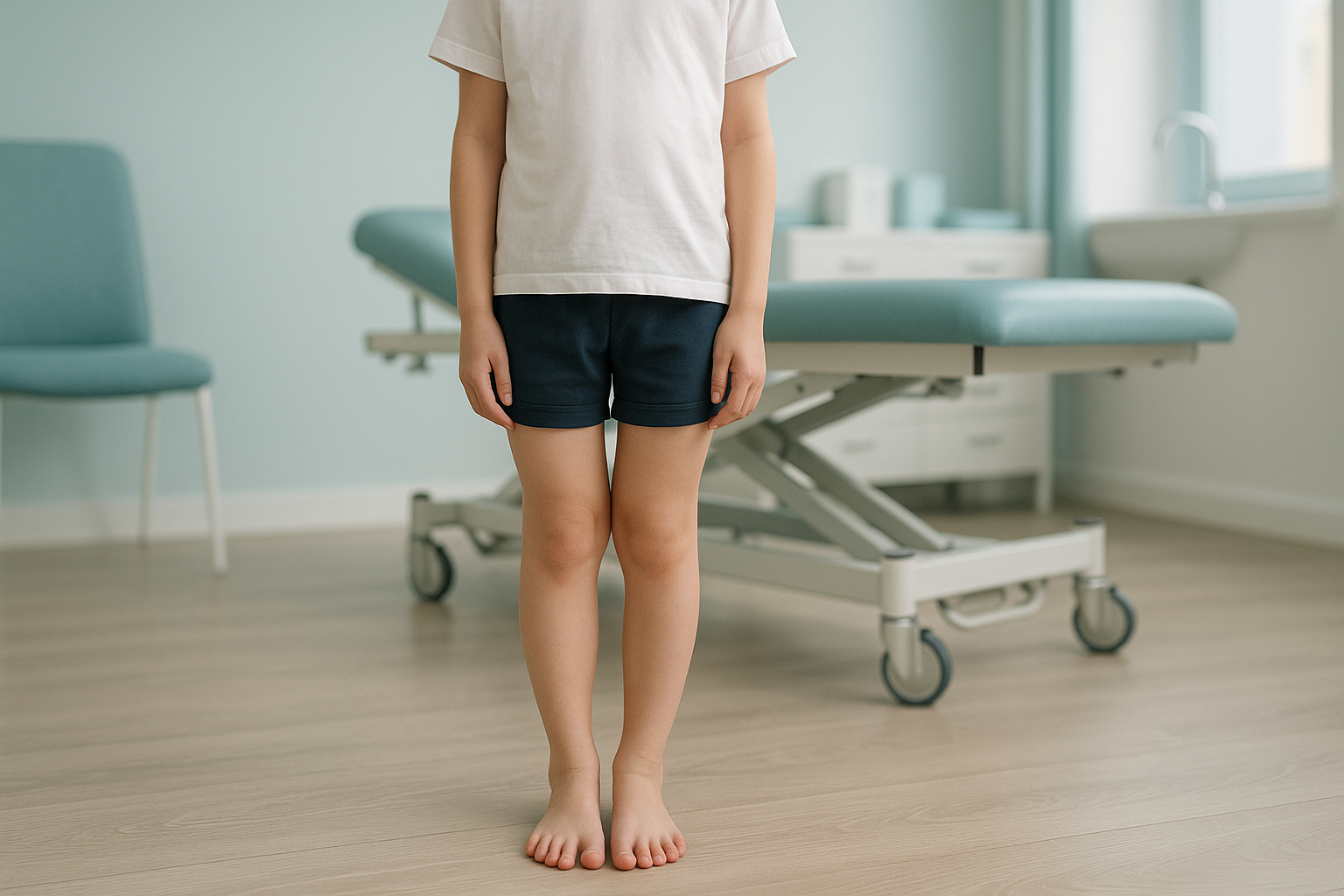
Knock knees (genu valgum) are a normal part of how a child's legs develop. They usually appear around age 2 to 3. They correct naturally by age 7 or 8. After this age, if your child's knees still touch with a wide gap between the ankles, or the angle is getting worse rather than better, a specialist assessment is a sensible next step.
Key points
- Knock knees are at their peak between ages 3 and 4. Then they slowly straighten.
- By age 7 to 8, most children's legs are straight or nearly straight.
- Knock knees that persist, get worse or affect one side may need investigation.
- A standing, weight-bearing image shows leg alignment as it really is, unlike a scan taken lying down.
- ScanAlign uses EOS imaging with about 90% less radiation than a standard X-ray, around ten times less.
What are knock knees in children?
Knock knees (the medical term is genu valgum) describes a leg position where the knees angle inward and touch, while the ankles stay apart. When your child stands up straight, the legs look like a wide "X" shape.
Almost every toddler goes through a knock-knee stage. It is part of the normal pattern of growth. Most babies are born with bowed legs, and the legs then move towards a straighter adult alignment.
When do knock knees correct in children?
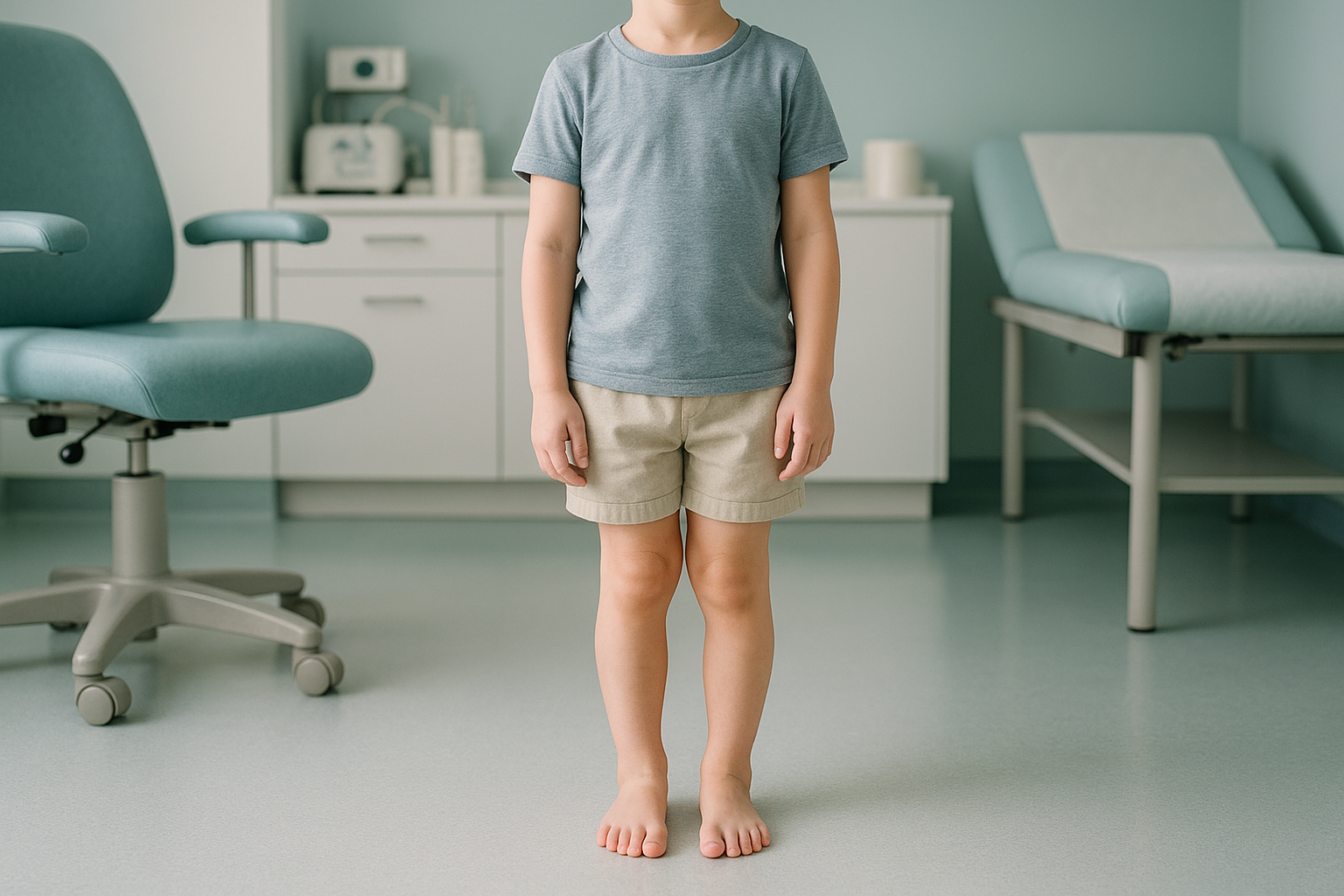
Most knock knees correct on their own by the time a child is 7 or 8 years old. During normal growth, they usually follow a predictable pattern.
Babies are usually slightly bow-legged. This is completely normal. It relates to the way they lay in the womb.
As a toddler grows, the legs move from bowed to a knock-knee position. This is called physiological valgus.
The inward angle is usually greatest around this age. The gap between the ankles (the intermalleolar distance) may look quite wide.
The legs slowly straighten into a slight adult valgus angle. If this correction does not happen, or the angle gets worse, a further assessment is worthwhile.
Every child grows at their own pace. A slight knock-knee position that is equal on both sides and slowly improving is usually nothing to worry about.
What signs suggest knock knees may not correct on their own?
Physiological knock knees rarely cause any problems. Still, some patterns are worth checking with a specialist.
Natural correction usually finishes by this age. Knock knees that persist beyond it may point to something other than normal growth.
If the gap between your child's ankles is getting wider over time rather than narrower, this is worth investigating.
When the knock knee is clearly more marked on one leg than the other, this may suggest a growth problem in one area.
Most children with normal knock knees do not have pain. If your child is limping, falling often or complaining of sore knees, it is worth a closer look.
What causes persistent knock knees in a child?
In most children, knock knees are simply part of normal bone development (physiological genu valgum). When the condition persists or is severe, possible causes include the following.
Uneven growth at the growth plates of the knee can keep the inward angle going.
Low vitamin D or rickets can soften bones and add to a persistent valgus angle.
Rare conditions that affect bone development can show up as knock knees. Finding them early matters.
A fracture near the growth plate of the knee, even one that healed well, can change the direction of growth.
How is a child's leg alignment properly assessed?
True leg alignment is best assessed while a child stands and bears weight. This matters because lying down for a normal X-ray or MRI relaxes the muscles. That can change how the angle at the knee appears. The body is a connected chain from the feet to the head. So a tilt in the pelvis or a flat foot can push the knee inward more than a lying-down image would show.
Children's imaging at ScanAlign uses an EOS system. EOS takes a full-length, standing image of both legs in a single exposure, with about 90% less radiation than a standard X-ray, around ten times less. It captures the whole leg from hip to ankle while your child stands naturally. This shows the true mechanical alignment, which an image of the knee alone would miss.
When is MRI more useful? EOS shows bones, joints and alignment clearly. If a specialist needs to look at the soft tissue around the knee, such as cartilage or ligaments, MRI is usually the better tool. Both types of imaging have their place.
Worried about your child's knock knees? Before planning a trip to London, a short video call with our team can help you decide whether imaging is the right next step.
Book a free video consultationWhat can be done about persistent knock knees in children?
Most children need no treatment at all. The knock-knee stage settles with normal growth. When the condition persists or is severe, a children's orthopaedic specialist may consider options. These depend on the child's age, how severe it is and the underlying cause.
Possible approaches range from monitoring and observation through to guided growth techniques in selected cases. All treatment decisions rest with the child's treating team. ScanAlign, low dose standing imaging provides the detailed alignment images that help specialists plan the best approach, but does not give treatment itself.
- Knock knees are still present after age 7 or 8
- The angle seems to be getting worse
- One side looks different from the other
- Your child has knee pain, limping or difficulty with activity
- A specialist has asked for a full-length standing leg image
- Your child is under 6 and the knock knees are mild and equal on both sides
- The angle is clearly improving over time
- There is no pain, limping or difficulty with movement
Before your child starts any treatment, or changes the one they are on, a detailed diagnosis is worth having. Knowing whether the cause lies in the pelvis, the legs or the spine changes what will actually help.
If you are not sure which group your child falls into, Book a free video consultation and we will give you an honest view.
Frequently asked questions about knock knees in children
In most children, knock knees correct naturally by age 7 or 8. The inward angle peaks around ages 3 to 4. Then it slowly straightens as the legs grow.
Yes. Knock knees in toddlers are a completely normal stage of leg development. After an early bow-legged stage, most children move into a knock-knee stage around age 2 to 3.
Think about seeking advice if the knock knees persist beyond age 7 or 8, are getting worse over time, look noticeably different on each side, or are causing pain, limping or frequent tripping.
Physiological knock knees rarely cause pain. If your child does have persistent knee pain, it is worth investigating. It may point to an underlying cause that needs attention.
Most children do not need any treatment. The condition corrects with growth. Persistent or severe cases may be assessed by a children's orthopaedic specialist, who can discuss the options.
A specialist looks at the gap between the ankles when the knees are touching (the intermalleolar distance) and the overall mechanical axis of the leg. A standing, full-length image gives the most accurate picture.
EOS uses about 90% less radiation than a standard X-ray, around ten times less. This makes it well suited for children, where keeping radiation as low as possible is especially important.
No. ScanAlign accepts self-referrals. You can book a children's assessment directly through a free video consultation.
For patients travelling from abroad, the price is confirmed during the free video consultation. You can also see our FAQs and cost page.
Lying down relaxes the muscles and can change the way the joints sit. A standing image captures the real, weight-bearing alignment. This keeps the clinical picture accurate and gives the specialist the most useful information.
Worried about your child's knock knees?
A short, free video consultation with our team, from wherever you are, will help you decide whether a standing alignment scan in London is the right next step.
Book a free video consultationSources
- Saraph V, et al. "Physiological Genu Valgum in Children." Journal of Pediatric Orthopaedics B, 2002.
- NHS. "Knock knees." NHS Health A to Z, nhs.uk (accessed 2024).
- Stevens PM. "Guided Growth for Angular Correction." Journal of Pediatric Orthopaedics, 2007; 27(3): 253–259.
Written by Abbas Dhami (Specialist Diagnostic Radiographer)
This page is general information and not a diagnosis.
ScanAlign is the trading name of CoreMed Solutions Ltd and operates under The Harley Street Hospital's CQC licence.