
What Is a Nerve Root Block, and When Is It Used?
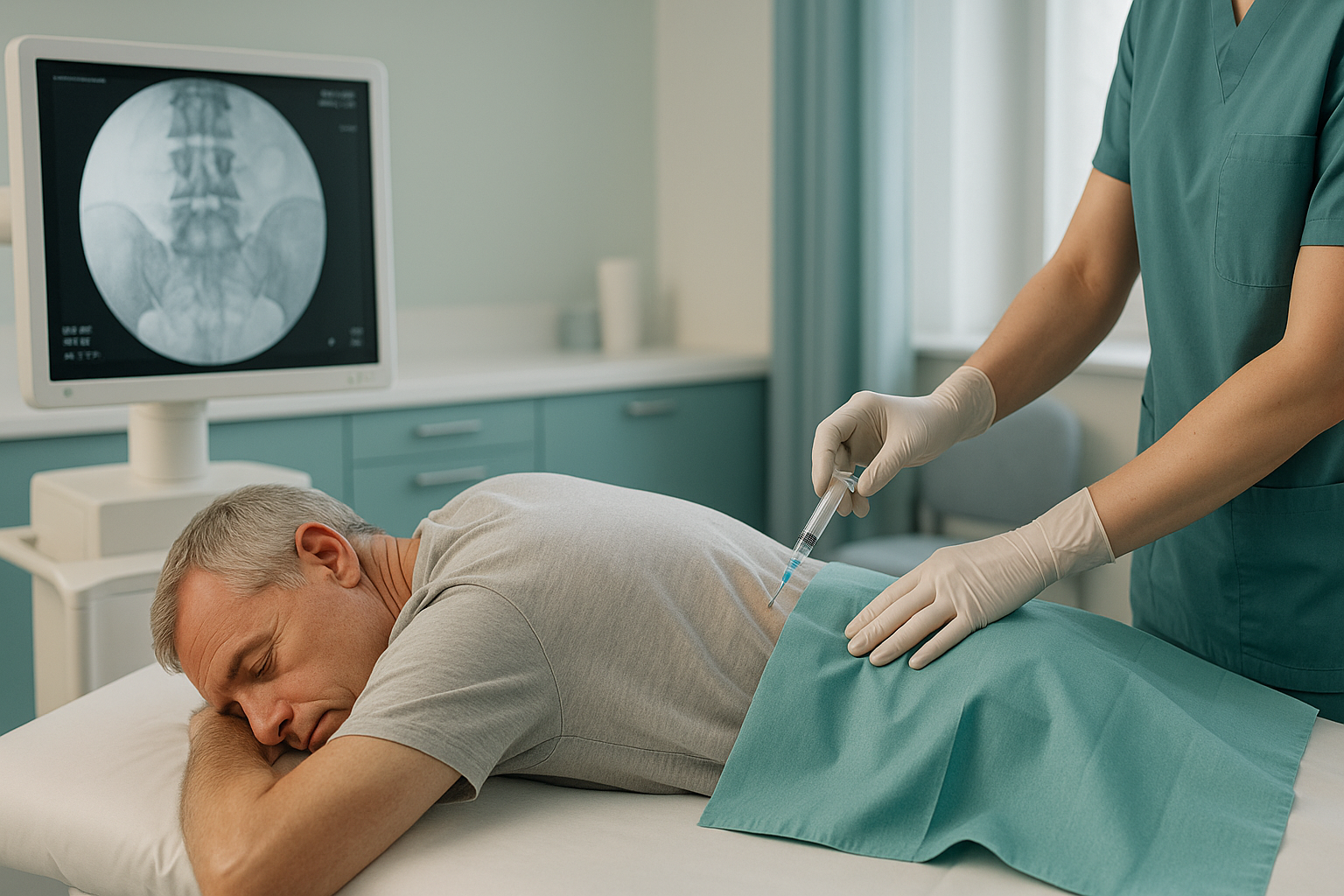
A nerve root block is a targeted injection of local anaesthetic and steroid around one specific spinal nerve root. It is used to ease pain from nerve root compression. Just as importantly, it helps confirm which nerve level is causing your symptoms. It is done as a day-case procedure under image guidance.
Key takeaways
- A selective nerve root block targets one specific nerve to reduce inflammation and pain.
- It has a valuable role in diagnosis. It helps clinicians confirm which nerve level is behind your symptoms.
- The procedure is usually done under X-ray or CT guidance as a day case.
- Relief is often temporary, lasting weeks to months, and the injection may be repeated.
- A standing whole-body scan can help pinpoint alignment problems that add to nerve irritation.
What exactly is a nerve root block?
A nerve root block is also called a selective nerve root block or a transforaminal injection. It is a precise injection given next to the point where a spinal nerve leaves the spine. The injection usually contains a local anaesthetic to numb the area and a corticosteroid to reduce inflammation around the nerve.
An epidural is broader. It bathes a wider area of the spinal canal. A selective nerve root block, by contrast, focuses on one single nerve. This precision is what makes it so useful, both for pain relief and for diagnosis.
When is a nerve root block used for sciatica or leg pain?
A nerve root block is most often used when a compressed or inflamed nerve is causing pain that travels into the arm or leg. In the lower back, this is often linked to lumbar radiculopathy. Here a disc bulge or bony narrowing presses on a nerve and sends pain, tingling or weakness down the leg.
A common example is L5 radiculopathy, where pain runs down the outer leg and into the foot. If an injection at that specific level relieves the pain, it confirms L5 as the source.
Get urgent medical help if you develop sudden numbness in both legs, loss of bladder or bowel control, or weakness that is quickly getting worse. Contact your doctor straight away or go to the nearest emergency department. These symptoms need immediate assessment, not a routine injection or scan.
Why is a nerve root block also a diagnostic test?
A selective nerve root block is not only about pain relief. It is one of the most reliable ways to confirm which nerve is causing your symptoms. This is its diagnostic value. It is often the main reason a specialist asks for the procedure.
Scans such as MRI might show disc problems or narrowing at several levels of the spine. The question then is: which one is actually causing the pain? The clinician injects anaesthetic at a single nerve and sees whether your symptoms go away, even for a short time. This lets them match your pain to a specific nerve level. This matters most when deciding on surgery, because operating at the wrong level would not help.
Understanding your spinal alignment before an injection can help your clinician see the full picture. A standing scan shows how your spine behaves under load.
Book a free video consultationWhat happens during a nerve root block procedure?
A nerve root block is done as a day case. This means you go home the same day. Here is what to expect in general terms.
You lie face down on a procedure table. The skin over the injection site is cleaned, and a local anaesthetic numbs the surface.
Using live X-ray (fluoroscopy) or CT guidance, the clinician guides a fine needle to the correct nerve root. A small amount of contrast dye may be used to confirm the needle is in the right place.
A mix of local anaesthetic and corticosteroid is injected around the nerve root. The anaesthetic gives quick, temporary relief. The steroid takes longer to work, but it aims to reduce inflammation over the following days.
You rest for a short time so staff can keep an eye on you. Most people leave within an hour or two.
How long does recovery from a nerve root injection take?
Most people can go back to light daily activities within a day or two. You will usually be advised not to drive for 24 hours after the procedure and to take it easy for a few days. Some temporary soreness at the injection site is normal.
How long does the pain relief last?
This varies. The local anaesthetic wears off within hours. If the steroid works, it usually gives relief that builds over a few days and may last weeks to months. For some people, one injection is enough. Others may need repeat injections, though there is usually a limit on how many can be given in a set period.
It is worth knowing that a nerve root block gives temporary relief. It does not fix the underlying cause. If the compression comes from a disc bulge or bony narrowing, further treatment such as physiotherapy or, in some cases, surgery may still be needed.
- Pain clearly travelling along one nerve path (arm or leg)
- Symptoms that have not settled with conservative care
- A need to confirm the exact nerve level before surgery
- Widespread, non-specific back pain without leg or arm symptoms
- Symptoms that suggest infection or a spinal tumour
- A bleeding disorder or an allergy to anything in the injection
How does standing imaging help before a nerve root block?
Standard scans such as MRI and CT are taken while you lie down. In that position, gravity is taken away and your muscles relax. Disc bulges may shrink. Alignment shifts that only appear under your full body weight can stay hidden.
A standing whole-body scan, such as an EOS scan, captures your spine, pelvis and legs while you are upright and bearing your weight. This can show alignment problems, such as a pelvic tilt or a subtle curve, that change how load is spread across the levels of your spine. If one level is being overloaded because of how you stand, that matters when deciding where to inject.
Your body works as a connected chain. A problem in the pelvis can shift load onto a nerve in the lower back. A standing image helps your specialist see the full picture, not just one segment on its own. ScanAlign standing EOS imaging uses about 90% less radiation than a standard X-ray, around ten times less, and captures your whole alignment in a single scan.
When is MRI the better choice? EOS shows bones, joints and overall alignment. For soft tissue detail, such as discs pressing on nerves or inflammation around a nerve root, MRI is usually the better tool. The two types of imaging work well together.
Before you start a treatment, or change the one you are on, it is worth getting a detailed diagnosis. Knowing whether the cause sits in your pelvis, your legs or your spine changes what will actually help.
Wondering whether a standing alignment scan in London could help make things clearer before your injection? We can talk through your situation in a free video call.
Book a free video consultationFrequently asked questions about nerve root blocks
No. An epidural delivers medicine into the wider epidural space, bathing several nerve levels at once. A selective nerve root block targets a single nerve root. Its precision is what gives it diagnostic value.
The anaesthetic wears off within hours. If the steroid works, relief usually lasts from a few weeks to several months. Some people get longer-lasting benefit, while for others the effect is shorter.
You may feel pressure or brief discomfort as the needle is placed. The skin is numbed with local anaesthetic first, and the procedure is guided by imaging to be as precise as possible. Most people tolerate it well.
A nerve root block can reduce pain and inflammation, but it does not remove the underlying cause of nerve compression. It is a tool for managing pain and for diagnosis, not a cure. Further treatment may still be needed, depending on the cause.
This depends on your own situation and your specialist's judgement. There is generally a limit on the number of steroid injections within a given period to keep side effects low. Your clinician will advise you based on your response and your overall plan.
Serious complications are uncommon. Possible risks include temporary numbness or weakness in the leg, a headache, soreness at the injection site, or, rarely, infection or bleeding. Your specialist will discuss specific risks with you beforehand.
Yes. A nerve root block is a medical procedure done by a pain specialist, an anaesthetist or a spinal surgeon. You will need a referral from a clinician who has assessed you and reviewed your scans. ScanAlign does not perform nerve root blocks. We provide standing alignment imaging that can support the assessment process.
A transforaminal injection is another name for a selective nerve root block. The term refers to the route the needle takes, through the foramen, which is the small opening where the nerve root leaves the spine.
Most clinics advise against driving for at least 24 hours after the procedure, because the anaesthetic can cause temporary numbness or weakness in the leg. You should arrange for someone to take you home.
A standing scan shows how your spine and pelvis line up under your full body weight. This can reveal load-bearing problems that lying-down scans miss. It helps the specialist understand why a particular nerve is under pressure and confirm the best level to target. You can book a standing spine scan to discuss this with our team.
Understand your alignment before your next step
A standing whole-body scan can show your specialist what lying-down imaging misses. Talk to us in a free video call to find out if it is right for you before you plan a trip to London.
Book a free video consultationWritten by Abbas Dhami (Specialist Diagnostic Radiographer)
Sources
- National Institute for Health and Care Excellence (NICE). Low back pain and sciatica in over 16s: assessment and management (NG59). 2016, updated 2020.
- British Pain Society. Spinal injections for the management of pain. Position statement. 2023.
- Pfirrmann CWA, Oberholzer PA, Zanetti M, et al. Selective nerve root blocks for the treatment of sciatica: evaluation of injection site and effectiveness. Radiology. 2001;221(3):704-711.
This page is general information and not a diagnosis.
ScanAlign is the trading name of CoreMed Solutions Ltd and operates under The Harley Street Hospital's CQC licence.