
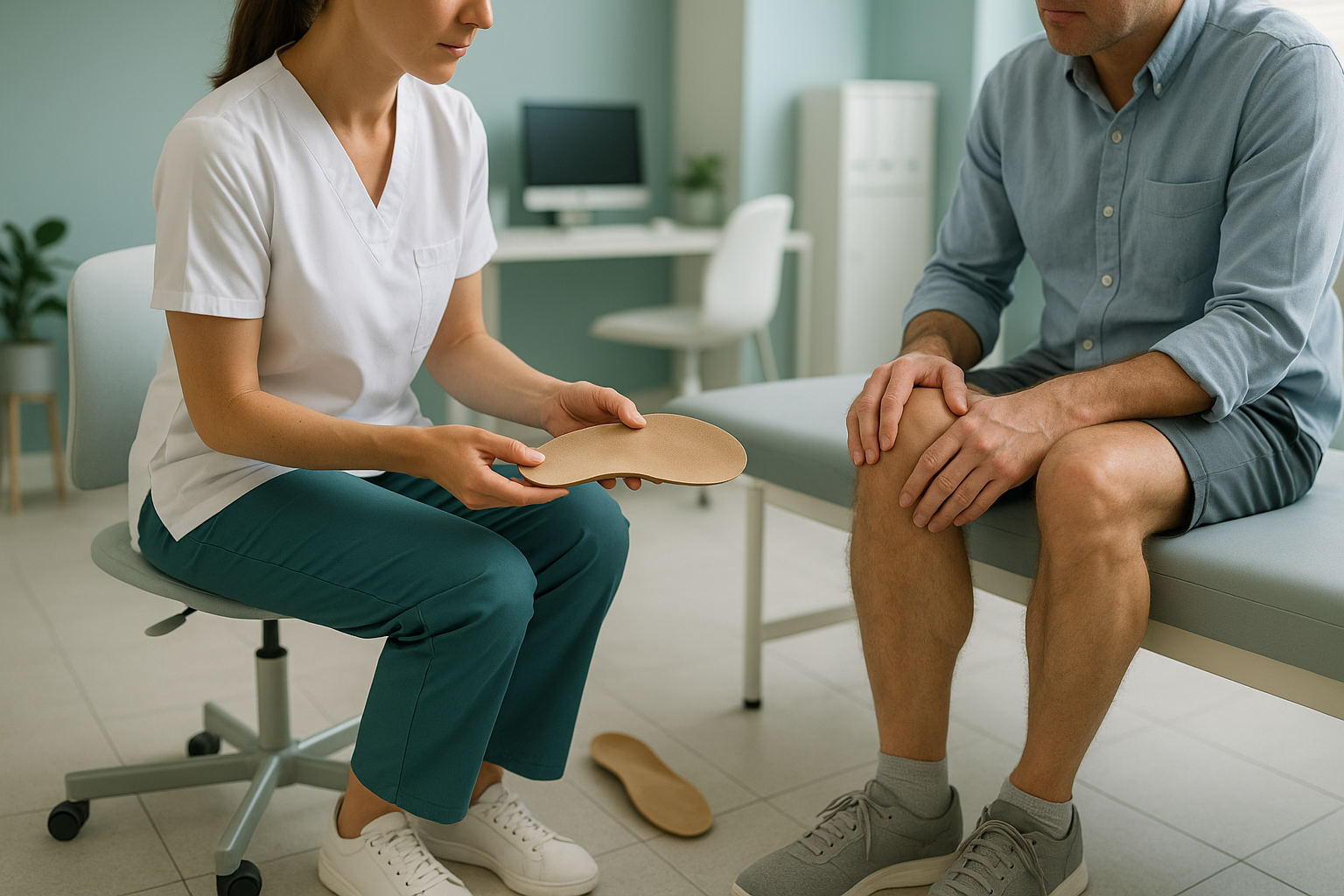
Can Orthotics Really Fix Knee Pain?
Orthotics can reduce some types of knee pain. They do this by changing how load travels up from the foot. They work best when the knee pain is linked to a foot or ankle alignment problem, such as overpronation or a leg-length difference. But they are not a fix for everyone. Understanding your alignment first is the key to knowing whether insoles will help you.
Key points
- Orthotics change the forces passing through your knee. But they only help if foot or lower-limb alignment is part of the problem.
- Lateral wedge insoles and arch supports target different problems. Choosing the right type depends on accurate measurement.
- The evidence is strongest when insoles are combined with targeted strengthening exercises.
- A standing, weight-bearing scan shows the full chain from foot to hip under real load. Lying-down imaging cannot show this.
- Orthotics are not a treatment on their own. They are one part of a plan built on clear diagnostic information.
How does foot alignment affect your knee?
Your foot is the base of the whole lower limb. Sometimes it rolls inward too far (overpronation) or sits at an unusual angle. When this happens, it changes the rotation of the shinbone (tibia). That change in tibial rotation shifts where pressure lands inside your knee joint. Over time, this can overload one compartment of the knee, irritate the kneecap tracking, or strain the tissues on the outer side of the leg.
This is the foot-to-knee chain. A tilt at the ankle can lead to knock knees, increased knee valgus, or uneven cartilage wear. If you have read about orthotics and overpronation before, you may already know how much the foot matters to the structures above it.
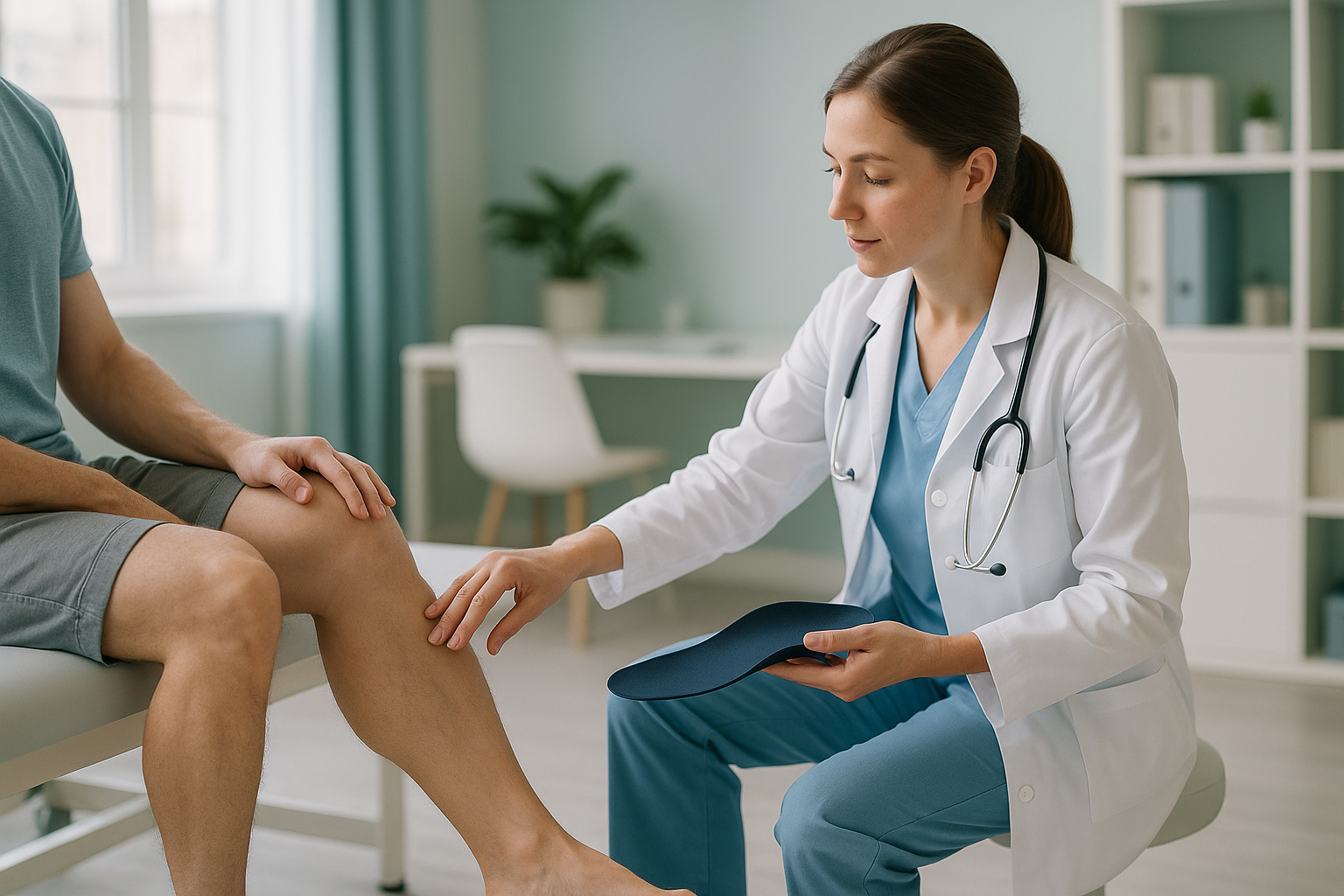
This chain effect is why treating the knee alone sometimes fails. If the foot position underneath is never addressed, the same abnormal forces keep coming back.
Which knee symptoms might be linked to foot alignment?
Not every sore knee has a cause in the foot. But some patterns suggest the foot-to-knee chain is involved.
Pain in the medial compartment when walking or using stairs. It is often worse after long periods on your feet.
A dull ache behind or around the kneecap, especially when squatting, kneeling, or sitting for a long time. This is common in patellofemoral pain syndrome.
A pulling or burning feeling on the outside of the knee. It sometimes extends up the thigh.
Your shoes wear down much faster on one side. This is a visible clue that load is not spread evenly.
Noticing these patterns does not guarantee that orthotics will solve the problem. But it does suggest that a careful look at your whole lower limb, from hip to foot, is worth doing before you commit to insoles.
What does the evidence say about orthotics for knee pain?
The evidence is mixed, and it is important to be honest about that. Research on lateral wedge insoles for medial knee osteoarthritis has shown modest short-term improvements in pain for some people. Long-term benefits are less clear. For runner's knee and patellofemoral pain, foot orthoses combined with strengthening exercises have done better than either approach used alone.
The finding that appears again and again across studies is this: orthotics work best when the person using them has a measurable alignment factor that the insole can address. Giving everyone the same off-the-shelf insole, whatever their actual alignment, gives inconsistent results.
This is where measurement comes in. Without knowing your own alignment under real load, prescribing orthotics is partly guesswork.
What types of orthotics are used for knee pain?
There are several common options. Each one addresses a different part of the mechanical chain.
Support the medial arch to reduce overpronation and limit inward tibial rotation.
A thin wedge under the outer edge of the foot tilts the ankle slightly outward. This reduces load on the medial compartment of the knee.
Made from a cast or scan of your foot. They offer more precise correction than off-the-shelf options but cost more.
A common reason orthotics disappoint is choosing between these options without first understanding your full alignment. An arch support will not help if the real driver is a leg-length difference at the hip. A lateral wedge insole will not help if your knee pain is caused by kneecap tracking rather than compartment loading.
Why does standing imaging matter before choosing orthotics?
Most scans you have had before, whether X-ray, CT or MRI, were probably taken while you were lying down. When you lie flat, gravity is taken away. Your muscles relax. Joints decompress. The alignment your body actually works under disappears from the picture.
A standing EOS scan captures your skeleton from head to foot in one upright image. It shows the real angles at your ankle, knee and hip under your full body weight. Any tilt, rotation or leg-length difference that changes how load passes through your knee can be seen. This is the information that makes orthotic prescriptions accurate rather than approximate.
Lying-down imaging takes gravity out of the picture. A subtle overpronation or knee valgus that only appears under load will look normal on a supine scan. This is one reason people try orthotics, see no improvement, and assume insoles simply do not work for them.
ScanAlign standing EOS imaging uses about 90% less radiation than a standard X-ray, around ten times less. That low dose means the full-length image can be taken safely as a single exposure.
When MRI is the better choice: EOS shows bones, joints and alignment clearly. For soft-tissue problems in the knee, such as cartilage tears, ligament injuries, or nerve involvement, MRI is usually the better tool. Your treating specialist can advise which scan suits your situation.
What works best alongside orthotics for knee pain?
Research consistently shows that orthotics alone are rarely enough. The strongest results come from combining insoles with targeted strengthening. This is particularly true for the muscles around the hip and thigh that control how the knee tracks during movement.
A sensible approach usually looks like this:
- Measure first. Understand the actual alignment of your lower limb under weight-bearing load.
- Match the insole to the finding. Choose the orthotic type that addresses your own mechanical problem, not a generic insert.
- Combine with strengthening. Work with a physiotherapist to build the muscle control that supports what the orthotic is doing.
- Review. Try the orthotic for an agreed period, then reassess. Not every insole works the first time.
ScanAlign is a diagnostic imaging clinic. We do not prescribe orthotics or give treatment. What we provide is detailed alignment data. This allows your treating specialist, physiotherapist or podiatrist to make a well-informed decision about whether insoles are right for you, and if so, which type.
Before you start treatment, or change the one you are on, it is worth getting a detailed diagnosis. Knowing whether the cause sits in the pelvis, the legs or the spine changes what will actually help.
Wondering whether foot alignment plays a part in your knee pain? A standing whole-body scan can show the full picture.
Book a free video consultationFrequently asked questions
They can, particularly when overpronation or poor foot mechanics are contributing to abnormal kneecap tracking. Research suggests that foot orthoses combined with hip and quadriceps strengthening give better outcomes for runner's knee than insoles or exercise alone.
Custom orthotics are shaped to your foot and can address specific alignment problems more precisely. However, many people with mild pronation see good results from well-chosen off-the-shelf arch supports. The key is matching the insole to the actual problem, and that requires accurate measurement.
A lateral wedge insole is thicker on the outer edge. It gently tilts the ankle outward, which can reduce the load on the inner (medial) compartment of the knee. It is usually considered for people with medial knee osteoarthritis where imaging confirms uneven compartment loading.
Most treating specialists suggest a trial period of at least six to eight weeks. Your body needs time to adapt to the changed mechanics. If there is no improvement after a reasonable trial, looking again at the underlying alignment data is a sensible next step.
Flat feet, or low arches, can increase pronation. This alters tibial rotation and changes knee loading. Not everyone with flat feet develops knee pain. But when the two appear together, foot alignment is worth investigating as a contributing factor.
No. ScanAlign is a private self-pay service and you can refer yourself. You start with a free video consultation, where a specialist radiographer reviews your situation and confirms whether a scan is appropriate.
Yes. The EOS system uses about 90% less radiation than a standard X-ray, around ten times less. It captures the full image in a single low-dose exposure while you stand naturally.
For patients travelling from abroad, the price is confirmed during the free video consultation. You can see what is included on the book a leg alignment scan page.
Poorly fitted or wrongly chosen orthotics can shift load in an unhelpful direction and increase discomfort. This is why it matters to get an accurate picture of your alignment before choosing an insole. If your insoles feel worse after a settling-in period, speak to the specialist who prescribed them.
A standard X-ray usually captures one joint at a time, often while lying down. An EOS scan images your full skeleton from head to foot in a single standing exposure. It shows how every joint relates to the ones above and below it under real weight-bearing conditions.
See your alignment before choosing insoles
A free video consultation with a specialist radiographer can help you decide whether a standing alignment scan in London is the right next step.
Book a free video consultationWritten by Abbas Dhami (Specialist Diagnostic Radiographer)
Sources
- Barton CJ, Munteanu SE, Menz HB, Crossley KM. The efficacy of foot orthoses in the treatment of individuals with patellofemoral pain syndrome: a systematic review. Sports Medicine. 2010;40(5):377-395.
- Parkes MJ, Maricar N, Lunt M, et al. Lateral wedge insoles as a conservative treatment for pain in patients with medial knee osteoarthritis: a meta-analysis. JAMA. 2013;310(7):722-730.
- National Institute for Health and Care Excellence (NICE). Osteoarthritis: care and management. Clinical guideline CG177. 2014 (updated 2022).
This page is general information and not a diagnosis.
ScanAlign is the trading name of CoreMed Solutions Ltd and operates under The Harley Street Hospital's CQC licence.