

How Often Should Scoliosis Be Scanned and Monitored?
Most adults with scoliosis benefit from a follow-up scan every one to two years, or sooner if their symptoms change. Regular scoliosis monitoring compares your curve over time. It uses consistent, weight-bearing scans. This helps your specialist decide whether your curve is stable or whether your treatment plan needs to change.
Key points
- How often you need a scan depends on the size of your curve, your symptoms and whether the curve has changed before.
- A standing scan shows your spine under real weight-bearing load. This gives a true picture of how your curve behaves.
- EOS uses about 90% less radiation than a standard X-ray, around ten times less. This matters when repeat scans are needed.
- Scans from the same system each time make comparison between scans far more reliable.
- ScanAlign provides a detailed report that your specialist can use to guide your care.
Why does scoliosis need ongoing monitoring?
Scoliosis curves can change over time, even in adults. Sometimes the curve gets worse so slowly that you do not notice it until your symptoms get worse. Regular scoliosis monitoring picks up these changes early, before they start to affect your comfort, balance or daily activities.
Without repeat scans, your specialist has no objective way to tell whether your curve is stable. A single scan only shows the curve at that moment. When two or more scans are compared side by side, patterns become clear. Your specialist can then decide with confidence whether to keep watching, adjust a brace or exercise programme, or consider other options.
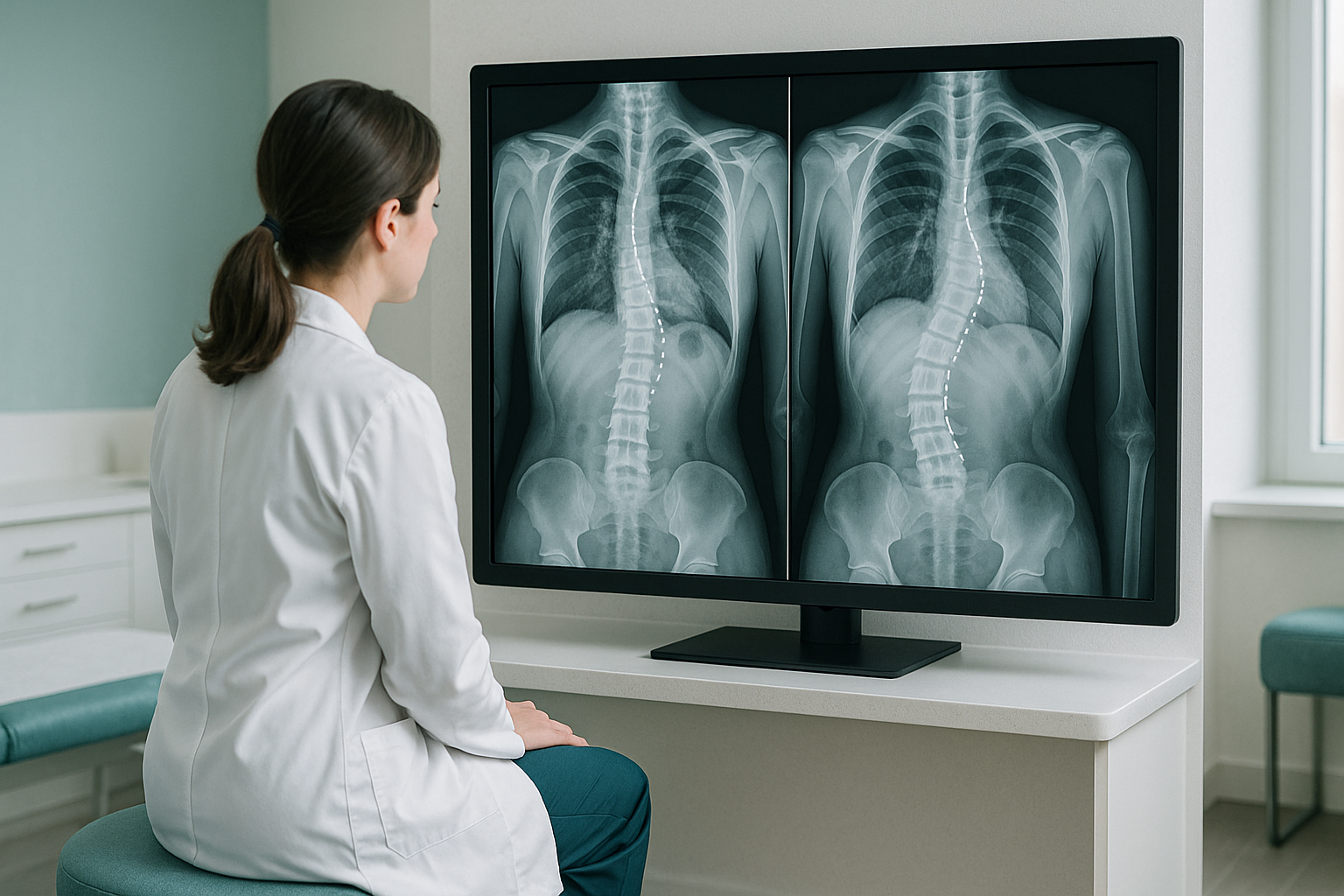
How often should you have a follow-up X-ray for scoliosis?
There is no single answer that fits everyone. The right gap between scans depends on your curve, your symptoms and your specialist's judgement. The table below gives a general guide based on common clinical practice.
| Situation | Usual gap between scans | Why |
|---|---|---|
| Stable curve, no new symptoms | Every 1 to 2 years | Confirms the curve has not got worse |
| Curve that has got worse before | Every 6 to 12 months | Closer tracking to catch further change early |
| New or worsening symptoms | As soon as practical | Shows whether the symptoms relate to a change in the curve |
| After surgery (spinal fusion) | As your surgeon advises | Checks the fusion is holding and checks the nearby segments |
Your specialist may change these intervals. What matters is that monitoring is planned and consistent, not left to chance. A Cobb angle measurement taken from each scan gives an objective number to track over time.
Why does a standing scan matter for scoliosis monitoring?
A standing scan shows your spine under the real load of gravity, exactly as it behaves in your daily life. When you lie down for a traditional X-ray, CT scan or MRI, your muscles relax and the curve can look smaller than it really is. That can give a falsely reassuring picture.
At ScanAlign, low dose standing imaging, we use the EOS system. You stand naturally inside the scanner. A full-length image of your spine, pelvis and legs is taken in a single pass. Because the image is taken while you bear your own weight, it shows the true state of your curve.
Your curve is measured exactly as it takes load when you stand and walk.
About 90% less radiation than a standard X-ray, around ten times less. That matters when scans are repeated.
Using the same system and the same position each time makes side-by-side comparison reliable.
The total radiation you build up is a real concern when scans are repeated over many years. The very low dose from each EOS scan means you can monitor your curve at sensible intervals without worrying about building up unnecessary exposure.
When is MRI more suitable? EOS is excellent at showing bones, joints and overall alignment. If your specialist needs to check soft tissue, spinal discs or nerve compression, MRI is usually the better tool. In many cases, both types of scan work together to give a complete picture.
What is included in a scoliosis monitoring scan at ScanAlign?
Every monitoring appointment follows the same careful process. This keeps your results consistent and comparable with any previous scans.
Free video consultation
We review your history and previous scans to confirm that an EOS scan is the right next step for you, before you plan your trip to London.
Standing EOS scan
A full-length, weight-bearing image taken in under a minute at our clinic at 19 Harley Street, London.
Detailed report
Your images are analysed and a clear report is written. Learn more about how EOS scan results are reported.
Share with your specialist
The report and images are yours to take back home to your consultant, physiotherapist or surgeon to guide your ongoing care.
Ready to plan your next monitoring scan? Start with a free video consultation to check if EOS is right for you.
Book a free video consultationHow do you book a scoliosis monitoring scan?
You can book a monitoring scan directly. You do not need a referral from your doctor. Adults who refer themselves are welcome. If you already have previous scans or a letter from your specialist, bring them with you so we can compare.
- Known scoliosis that needs regular follow-up
- Previous scans you want to compare against
- Check after surgery (with your surgeon's guidance)
- Concern about the total radiation from repeated X-rays
- Sudden numbness, weakness or loss of bladder or bowel control. Seek urgent medical help from your doctor or the nearest emergency department.
- Suspected disc or nerve problems. MRI is usually better for soft tissue.
Before you start treatment, or change the one you are on, it is worth getting a detailed diagnosis. Knowing whether the cause sits in the pelvis, the legs or the spine changes what will actually help you.
Frequently asked questions about scoliosis monitoring
Most adults with a stable curve are advised to have a scan every one to two years. If your curve has been getting worse or your symptoms have changed, your specialist may recommend scans more often.
The total radiation you build up is a valid concern with traditional X-rays. The EOS system uses about 90% less radiation than a standard X-ray, around ten times less. This makes regular monitoring much safer over the long term.
No. ScanAlign accepts adults who refer themselves. You can book directly without a referral letter.
When you lie down, your muscles relax and your curve can look smaller. A standing scan shows your spine under the real load of gravity. This gives a truer measurement that matches your everyday posture.
Your curve is assessed using a standard measurement taken from the image. The report describes the curve in plain language and includes the technical detail your specialist needs. You can read more about Cobb angle measurement on our dedicated page.
Yes. Bring any previous scans and reports. The most reliable comparison comes from images taken on the same system in the same position. Even so, your previous scans still give useful background.
The price for patients travelling from abroad is confirmed during your free video consultation.
ScanAlign is a diagnostic imaging clinic. We provide the scan and the report. If the curve has got worse, you take the results to your consultant or specialist, who will advise on the next steps.
The scan itself takes under a minute. Allow a little extra time for positioning and any questions. Most people are in and out within a short visit to our clinic at 19 Harley Street, London.
Bring any previous scans (CDs, printed films or digital files) and any reports from your specialist. This helps us give you the best possible comparison.
Stay ahead of changes in your curve
A short free video consultation is the first step. We will review your history and confirm whether EOS monitoring is right for you.
Book a free video consultationWritten by Abbas Dhami (Specialist Diagnostic Radiographer)
Sources
This page is general information and not a diagnosis.
ScanAlign is the trading name of CoreMed Solutions Ltd and operates under The Harley Street Hospital's CQC licence.