
How Does Vitamin D Deficiency Cause Bone and Back Pain?
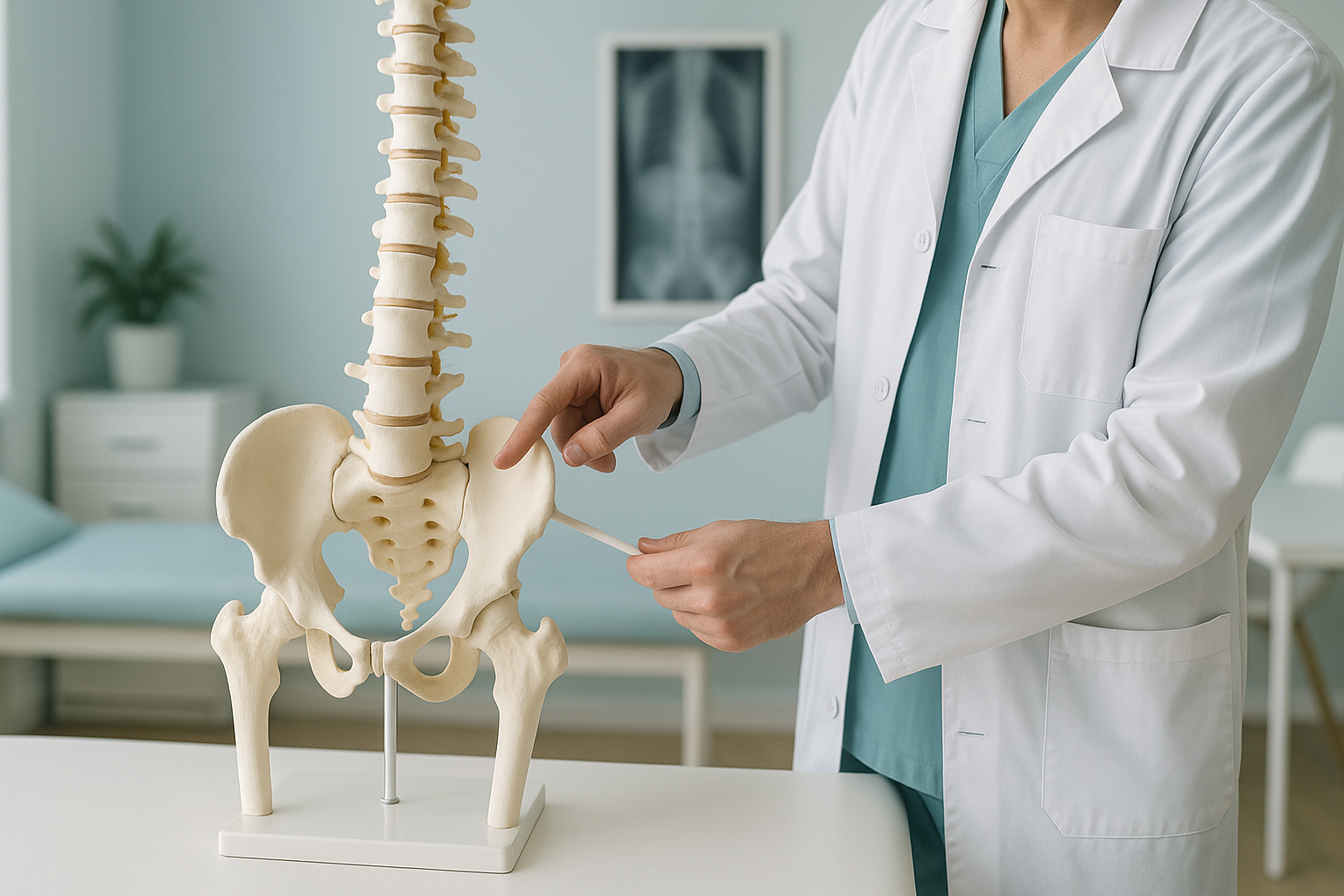
Vitamin D helps your body absorb calcium, which keeps bones strong. When levels are too low, bones can soften and ache, especially in the spine, pelvis and ribs. Muscle weakness often follows. In the UK, low sunlight from October to March makes deficiency surprisingly common. A simple blood test confirms it.
Key points
- Vitamin D deficiency weakens bones by limiting calcium absorption. This causes deep, aching bone pain.
- The spine, pelvis and lower back are the areas most commonly affected.
- In the UK, most adults do not get enough sunlight between October and March to keep healthy levels.
- A blood test arranged by your doctor is the only reliable way to confirm your vitamin D level.
- If back pain continues after your levels are corrected, standing whole-body imaging can check for structural or alignment problems that may also be contributing.
How does vitamin D affect your bones?
Vitamin D controls how well your gut absorbs calcium from food. Without enough vitamin D, your body cannot move calcium into your bones efficiently. Over time, bones lose mineral density and become softer. The medical term for this in adults is osteomalacia.
Your body makes vitamin D when ultraviolet B (UVB) rays from sunlight reach your skin. The liver and kidneys then convert it into its active form (cholecalciferol). When this chain is disrupted, whether by low sunlight, diet or other factors, the whole process of bone mineralisation slows down.
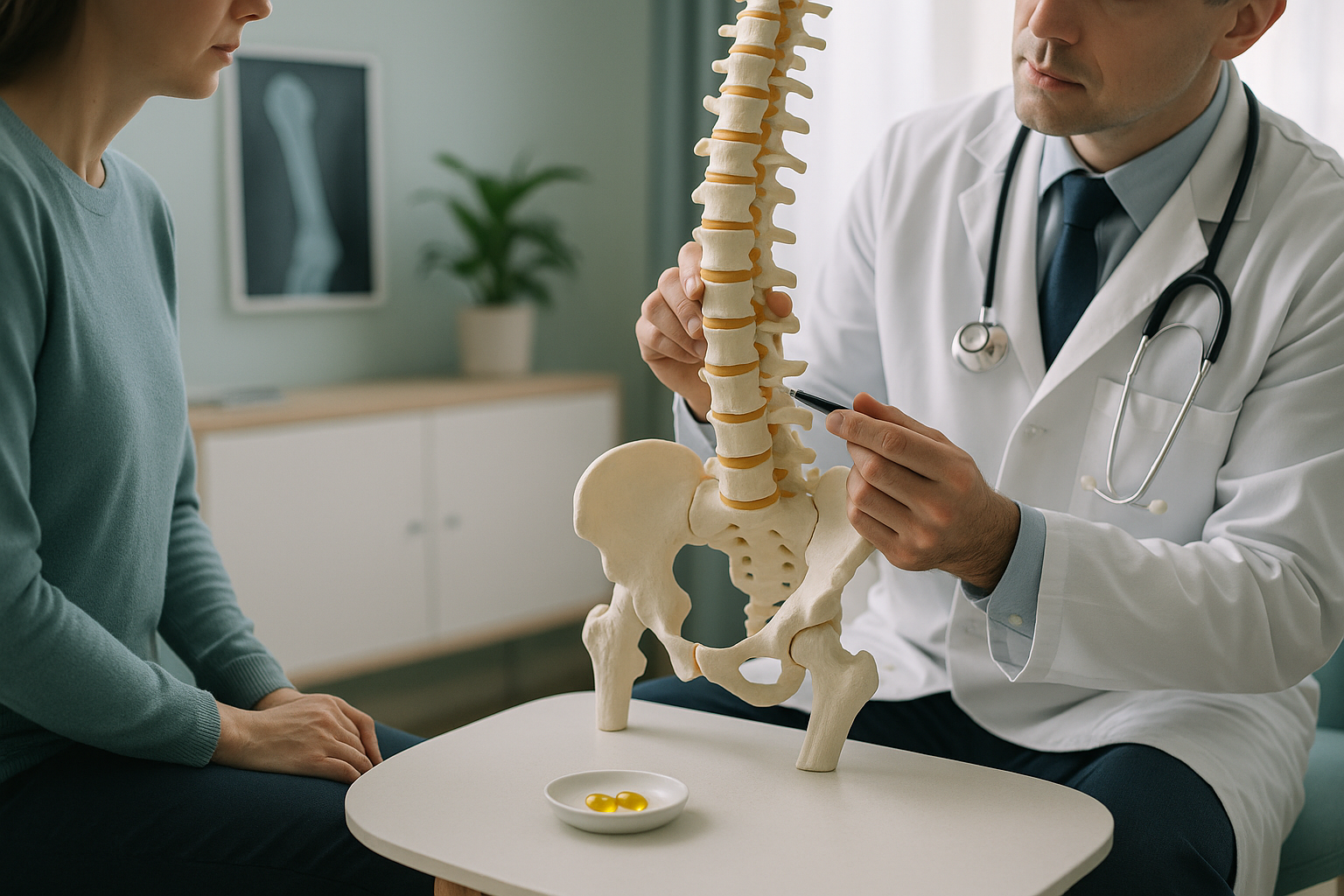
This is why bone pain from vitamin D deficiency tends to be deep and spread out rather than sharp. It is the bone itself that is weakened, not a single nerve or disc. People often describe it as a constant, dull ache that does not seem to have a clear trigger.
What are the symptoms of vitamin D deficiency?
The symptoms are often vague and easy to ignore. Many people live with them for months before linking them to low vitamin D. The most common signs are bone pain, muscle pain and general tiredness.
Often felt in the lower back, pelvis, shins or ribs. Pressing on the breastbone or shin may feel tender.
Difficulty getting up from a chair or climbing stairs. Muscles may feel heavy or slow to respond.
Feeling unusually tired, particularly in autumn and winter months when sunlight is limited.
Aching in several areas, sometimes confused with fibromyalgia or general wear and tear.
Important. If you develop sudden weakness in your legs, numbness, or any loss of bladder or bowel control along with back pain, seek urgent medical attention. Contact your doctor straight away or go to the nearest emergency department.
Why is vitamin D deficiency so common in the UK?
The UK lies at a high latitude. From October to March, UVB rays from the sun there are too weak to trigger vitamin D production in the skin. For this reason, NHS guidance states that everyone in the UK should consider a supplement during the winter months.
UK winters give very little UVB exposure, even on clear days.
Office work and little time outdoors reduce the skin's exposure to sunlight all year round.
Higher melanin levels mean the skin needs more sun exposure to make the same amount of vitamin D.
Older adults make vitamin D less efficiently and often spend more time indoors.
Other risk factors include covering most of your skin for cultural or personal reasons, digestive conditions that affect fat absorption (vitamin D is fat-soluble), and certain medicines. Your doctor can advise whether you fall into a higher-risk group.
Can a standing scan help if vitamin D treatment hasn't fixed my back pain?
Yes, it can. If you have corrected your vitamin D levels and the bone pain has improved but your back still hurts, the pain may also have a structural or alignment part. This is where ScanAlign standing EOS imaging is useful.
Standard lying-down scans relax your muscles and briefly remove the effect of gravity on your skeleton. That can hide problems like subtle pelvic tilts, leg-length differences or spinal imbalances that only appear when you stand. An EOS scan captures your entire skeleton in a single standing image, using about 90% less radiation than a standard X-ray, around ten times less. This gives your clinician a clear view of how your bones and joints actually line up under load.
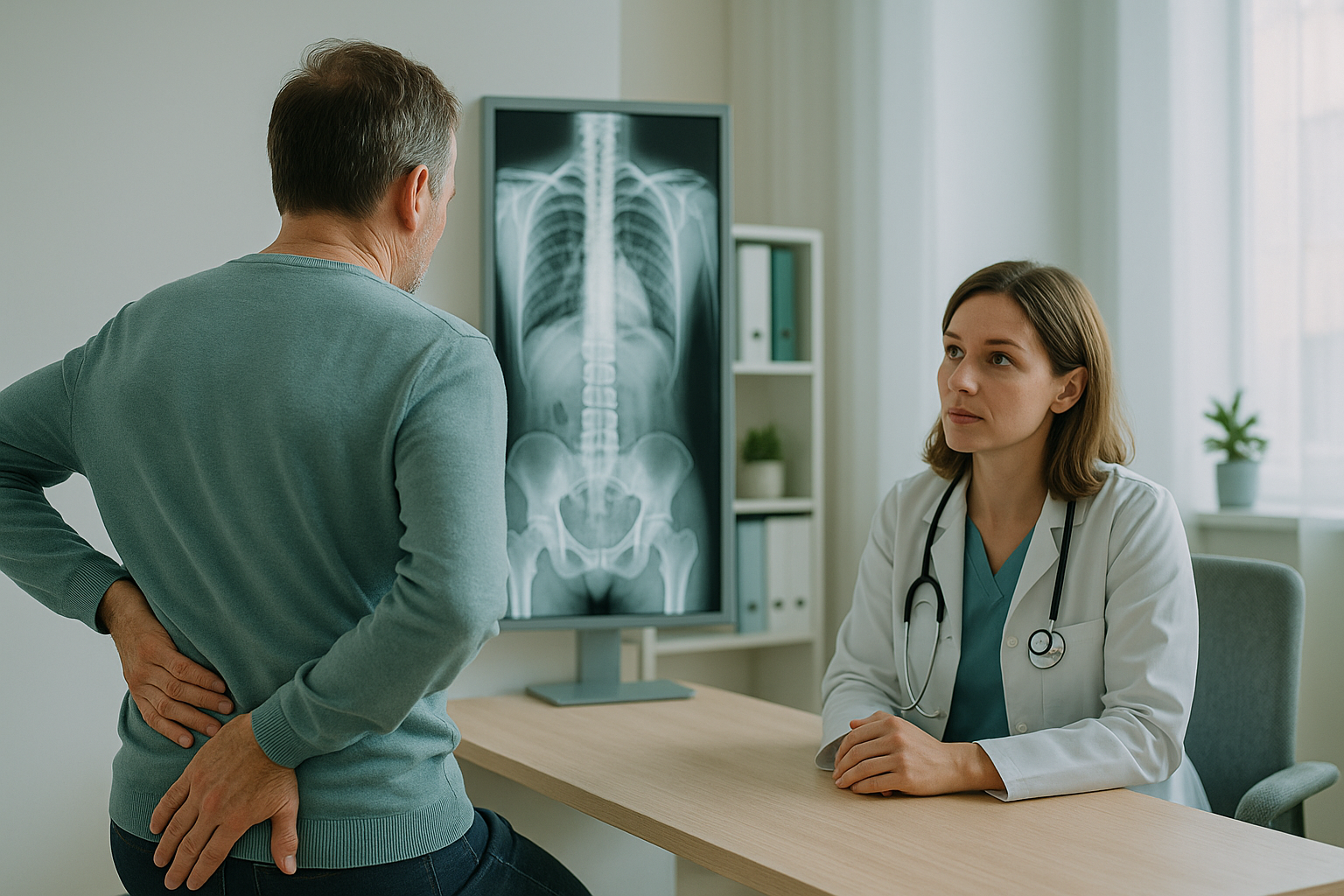
Your body is a connected chain from your feet to your head. A tilt in the pelvis or a slight difference in leg length can cause your spine to compensate. This can lead to persistent lower back pain that has nothing to do with vitamin D. A standing scan helps separate a nutritional problem from a mechanical one.
When MRI is the better choice. EOS shows bones, joints and whole-body alignment. If your clinician suspects disc problems, nerve compression or soft-tissue issues, MRI is usually the more suitable test. The two tests complement each other well.
How can you raise your vitamin D levels?
The most reliable first step is to see your doctor for a blood test. This confirms whether your levels are really low and how low they are. From there, your doctor can recommend the right course of action for you.
NHS guidance suggests that all adults in the UK consider taking a vitamin D supplement during autumn and winter. Some people, especially those with darker skin, limited sun exposure or existing health conditions, may benefit from taking a supplement all year round. We do not recommend specific doses here. Your doctor is best placed to advise on the amount that is right for you, based on your blood results.
Food sources include oily fish (salmon, sardines, mackerel), egg yolks and fortified foods such as some cereals and plant milks. However, it is difficult to get enough vitamin D from food alone, which is why sunlight and supplements are important.
Before you start treatment for back pain, or change the one you are on, it is worth getting a detailed diagnosis. Knowing whether the cause sits in the pelvis, the legs or the spine changes what will actually help.
Still in pain after correcting your vitamin D? If your levels are back to normal but your back still hurts, a standing whole-body assessment can check whether alignment or structural factors are also playing a part.
Book a free video consultationFrequently asked questions
Yes. When vitamin D is too low, bones lose mineral density and soften. The lower back and pelvis are common areas for this deep, aching pain because they bear the most weight.
A simple blood test arranged by your doctor is the only reliable way to check. Symptoms like bone pain, tiredness and muscle weakness can suggest it, but they overlap with many other conditions.
Vitamin D deficiency is the underlying cause. Osteomalacia is the result, a condition where bones become soft due to poor mineralisation. Not everyone with low vitamin D develops osteomalacia, but long-lasting deficiency increases the risk.
Because of the UK's latitude, UVB sunlight there is too weak from October to March to make enough vitamin D in the skin. Indoor lifestyles and cloudy weather make it harder still.
Yes. Vitamin D receptors are found in muscle tissue. Low levels are linked to muscle aching, weakness and cramps. This is separate from the bone pain but often happens alongside it.
It varies. Some people notice an improvement within a few weeks of taking supplements, but it can take several months for bone pain to settle fully. Your doctor can monitor your levels with follow-up blood tests.
If your levels are healthy but the pain continues, it is worth looking into structural causes. A standing whole-body scan can reveal alignment problems, such as a pelvic tilt or leg-length difference, that lying-down imaging may miss.
You stand still inside the scanner for about 15 to 20 seconds. It captures your full skeleton in one image using about 90% less radiation than a standard X-ray, around ten times less. There is no injection or preparation required.
No. You can book yourself. The process starts with a free video consultation, where a specialist talks through your symptoms and whether a standing scan is the right next step for you.
The price for patients travelling from abroad is confirmed during the free video consultation. You can read what is included on our book a standing assessment page.
Still in pain after correcting your vitamin D?
A free video consultation, held before you travel, can help you work out whether a standing whole-body scan in London is a sensible next step.
Book a free video consultationWritten by Abbas Dhami (Specialist Diagnostic Radiographer)
Sources
- NHS. "Vitamin D." nhs.uk. Accessed 2024. https://www.nhs.uk/conditions/vitamins-and-minerals/vitamin-d/
- Holick, M.F. "Vitamin D Deficiency." New England Journal of Medicine, 2007; 357(3): 266-281.
- Scientific Advisory Committee on Nutrition (SACN). "Vitamin D and Health." Public Health England, 2016.
This page is general information and not a diagnosis.
ScanAlign is the trading name of CoreMed Solutions Ltd and operates under The Harley Street Hospital's CQC licence.