

How Does Corporate Health Screening Work for Employers?
Corporate health screening gives employers a structured way to check the musculoskeletal health of their workforce. At ScanAlign, standing EOS imaging in London, employees are scanned upright so that spinal and lower-limb alignment is assessed under real weight-bearing conditions. The employer receives aggregate, anonymised data. Each employee receives their own confidential report.
Key takeaways
- Standing whole-body imaging reveals alignment issues that lying-down scans can miss.
- Every employee gives individual, informed consent before being scanned.
- Employers receive anonymised, aggregate reports only, never individual results.
- EOS uses about 90% less radiation than a standard X-ray, around ten times less.
- Screening is best suited to roles with physical demands or prolonged sitting.
What is included in a corporate EOS screening programme?
A corporate screening programme at ScanAlign includes a full standing EOS scan for each participating employee, a specialist radiographer-led assessment, and a detailed alignment report. The scan captures the whole body from head to feet in a single upright image, giving a complete picture of spinal curvature, pelvic balance, hip geometry and lower-limb alignment.
If the scan highlights a concern, the employee can be guided towards the right specialist. ScanAlign is a diagnostic imaging clinic, so we do not provide treatment ourselves.
Why does standing imaging matter for workplace health checks?
Standing imaging matters because the body behaves differently under gravity. When someone lies down for a conventional X-ray, CT or MRI, gravity is removed and the muscles relax. This can mask alignment problems that are obvious when the person stands and carries their own weight.
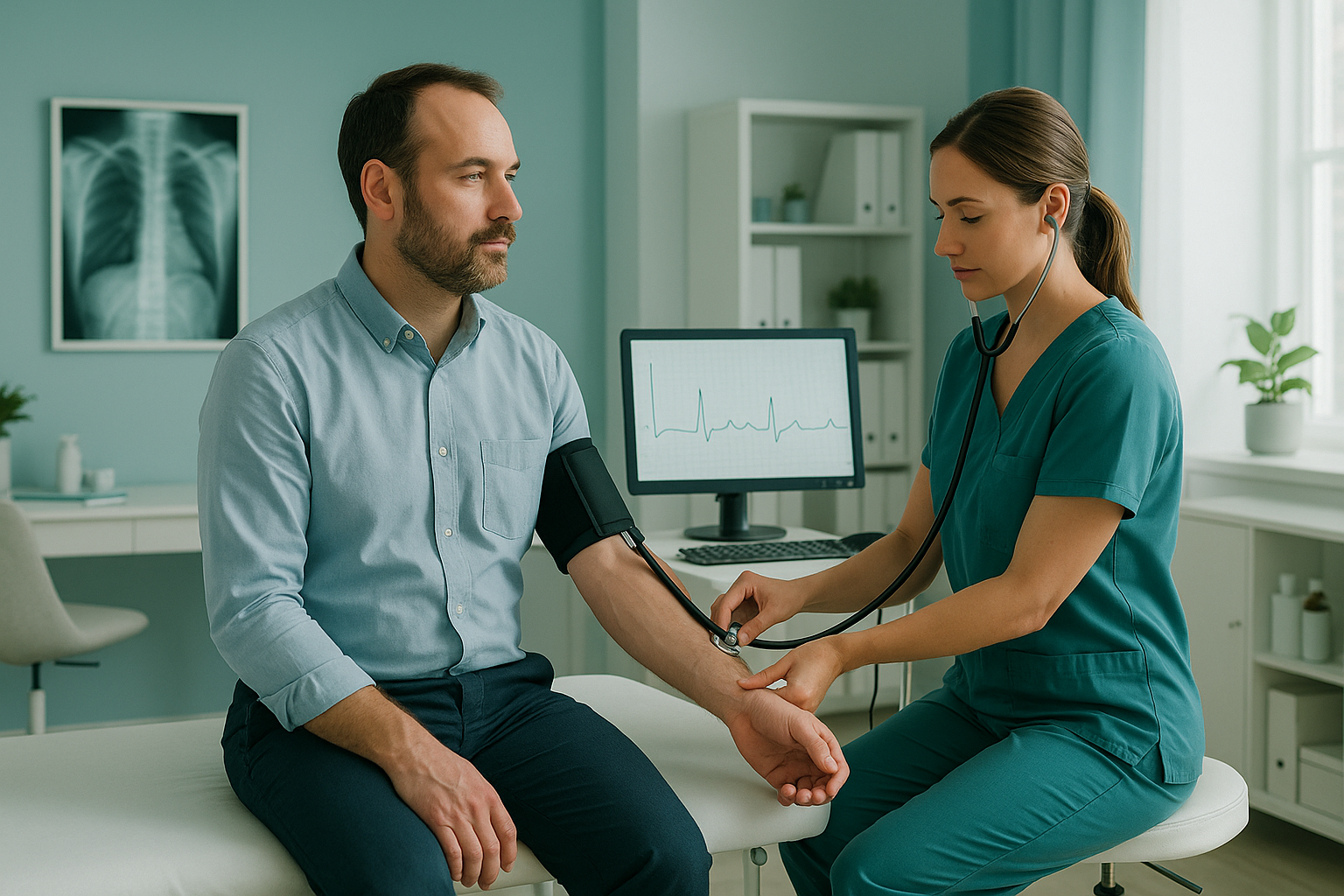
The body is a connected chain from feet to head. A tilt at the pelvis can shift the spine, change how the knees track and alter how someone stands and moves. In a workplace context, these hidden imbalances can contribute to chronic musculoskeletal pain, increased absence and reduced productivity. A standing scan shows the whole picture in one image.
How do employers book corporate health screening with ScanAlign?
Employers can set up a screening programme in four straightforward steps. If you manage a team or an occupational health programme, you can register as a referring organisation to get started.
Contact us to discuss your workforce size, roles and screening goals. We will explain what EOS imaging covers and help you decide if it suits your needs.
We agree the number of scans, the scheduling window and the reporting format. Costs are discussed at this stage. Group bookings are managed centrally so your team does not have to coordinate individually.
Each employee gives informed, individual consent before their scan. Scans take place at our clinic at 19 Harley Street, London. The scan itself is quick, painless and non-invasive.
Each employee receives their own confidential report. The employer receives an aggregate, anonymised summary covering trends across the group.
How are employee consent and data privacy handled?
Employee consent and data privacy are central to every corporate screening programme. Because EOS uses ionising radiation (although about 90% less than a standard X-ray, around ten times less), every scan must be clinically justified under IRMER (the Ionising Radiation (Medical Exposure) Regulations). Employees are never pressured to take part. Participation is always voluntary.
- Full explanation of the scan before consenting
- Their own confidential alignment report
- Guidance on next steps if a concern is found
- The right to decline without consequence
- Individual scan images
- Named health data for any employee
- Information about who declined
- Any data that could identify individuals
Aggregate reporting shows workforce-level patterns, such as the proportion of participants with notable alignment findings, without identifying anyone. This helps employers shape wellbeing programmes, ergonomic interventions or occupational health referrals without breaching confidentiality.
Note: Justification and data privacy wording for your specific programme will be reviewed and signed off before any scans take place.
Which employers benefit most from musculoskeletal screening?
Any employer with a duty of care for physical wellbeing can benefit, but the strongest case is in industries where musculoskeletal absence has a measurable impact. Manual handling roles, warehouse and logistics teams, construction crews and professional sports organisations all see high rates of back, hip and knee complaints. So do companies with large desk-based workforces where prolonged sitting contributes to postural strain.
Corporate health screening can also support return-to-work programmes by giving a clear baseline of alignment before and after an absence. It helps occupational health teams make informed referral decisions based on objective imaging rather than symptoms alone. Check who our scan is suitable for to understand general eligibility.
When MRI might be the better tool: EOS excels at showing bones, joints and whole-body alignment under load. If your screening programme needs to assess soft tissue, spinal discs or nerve compression, MRI is usually the better option. We are happy to advise which approach suits your workforce goals.
How does EOS compare with other employee screening methods?
EOS is not the only imaging option, but it offers a combination of low radiation, weight-bearing positioning and whole-body coverage that standard approaches do not match.
| Feature | EOS (standing) | Standard X-ray | MRI |
|---|---|---|---|
| Position | Standing, weight-bearing | Usually standing (single area) | Lying down |
| Coverage | Head to feet in one capture | One region per exposure | One region per session |
| Radiation | About 90% less than standard X-ray | Standard dose | None (magnetic field) |
| Best for | Alignment, posture, joint geometry | Fractures, single-joint checks | Soft tissue, discs, nerves |
| Scan time | Quick, single standing capture | Quick | Longer (often 20-40 minutes) |
Frequently asked questions about corporate health screening
Yes. Participation is always voluntary. Employees must give informed consent before any scan. No one should be pressured to take part, and the employer will not be told who declined.
No. Employers receive only anonymised, aggregate data. Each employee receives their own confidential report directly.
EOS uses about 90% less radiation than a standard X-ray, around ten times less. This makes it well suited to screening healthy employees.
IRMER stands for the Ionising Radiation (Medical Exposure) Regulations. It requires that every medical exposure to radiation is clinically justified. For corporate screening, this means there must be a valid reason for scanning each participant. We handle this as part of the programme design.
All scans take place at our clinic at 19 Harley Street, London. EOS is a fixed installation, so on-site scanning at your workplace is not currently available.
No GP referral is needed. Employers can arrange screening directly. Each employee still goes through an individual consent and eligibility check before being scanned.
This depends on the size of the group and the scheduling arrangement. We will agree a realistic schedule during programme design to minimise disruption to your team.
The employee receives their findings in a confidential report with guidance on next steps, which may include seeing their GP or a specialist. ScanAlign provides diagnostic imaging only, not treatment.
Costs depend on the number of employees and the scope of the programme. Please enquire about corporate screening for a tailored discussion.
EOS is designed for bones, joints and whole-body alignment. For soft-tissue concerns such as disc herniations or nerve compression, MRI is usually the better tool. We can advise on the right approach for your programme.
Ready to explore screening for your team?
Talk to us about how standing EOS imaging could support your corporate wellbeing programme. No obligation, no pressure.
Enquire about corporate screeningWritten by Abbas Dhami (Specialist Diagnostic Radiographer)
Sources
- Health and Safety Executive (HSE). Work-related musculoskeletal disorders statistics in Great Britain, 2023. hse.gov.uk
- Ionising Radiation (Medical Exposure) Regulations 2017 (IRMER). UK Statutory Instruments. legislation.gov.uk
- Deschênes S, et al. EOS imaging system: a systematic review of the literature. European Journal of Radiology, 2010;73(2):382-390.
This page is general information and not a diagnosis.
ScanAlign is the trading name of CoreMed Solutions Ltd and operates under The Harley Street Hospital's CQC licence.