
For referrers

Refer patients for EOS imaging

See the whole skeletal picture. Refer with greater confidence.

ScanAlign provides advanced standing EOS imaging for adults and children at 19 Harley Street, London.

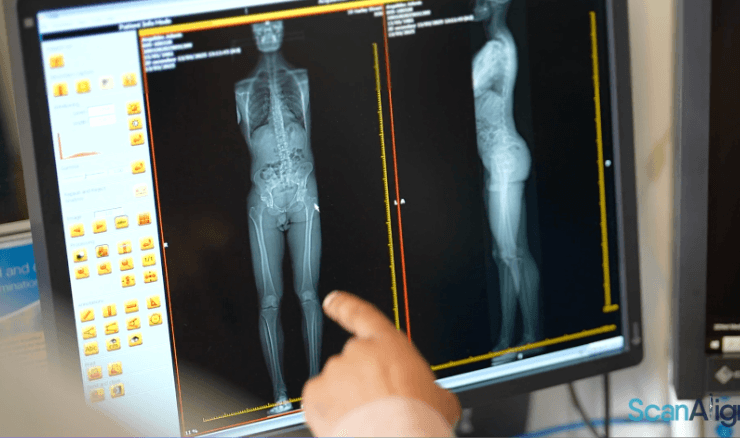
EOS captures the spine, pelvis and lower limbs while the patient is standing naturally under weight-bearing conditions.

This allows skeletal alignment to be assessed as one connected system, rather than looking only at the area where the patient is experiencing symptoms.

Anonymised EOS scan report analysis
  • Adult and paediatric referrals
  • Standing, weight-bearing imaging
  • Consultant Radiologist reporting
  • Detailed 2D and 3D skeletal assessments
  • Low-dose EOS technology

Contact us to get a sample report

See the level of imaging, measurement and reporting available before referring your first patient.

Option 1

Complete a short form

Tell us about your profession, the patients you treat and the type of EOS report you would like to review.

Your request will be sent directly to our Referrals Team, who will provide a relevant, fully anonymised sample report.

Sample report requests are responded to immediately during our opening hours.

Option 2

Call our Referrals Team

Speak directly with our team about:

  • The different EOS scans available
  • Adult and paediatric referrals
  • Which scan may be appropriate for your patient
  • How to complete a referral
  • How ScanAlign reports are provided
  • Whether you may be eligible to refer through the ScanAlign pathway
Call 020 7935 0001

Our Referrals Team is available from 9am to 6pm.

Referral eligibility

HCPC professionals can refer through the ScanAlign pathway

You may still be able to refer without holding a separate IR(ME)R referral certificate

Eligible HCPC and other registered healthcare professionals may be able to refer adults and children through ScanAlign’s supported referral pathway, provided the required conditions are met.

This pathway has been developed to make EOS imaging accessible to appropriate healthcare professionals while ensuring referrals contain the clinical information required for the exposure to be properly reviewed and justified.

Adult referralsPaediatric referrals

The pathway may be available to

  • Physiotherapists
  • Chiropractors
  • Osteopaths
  • Podiatrists
  • Orthotists
  • Prosthetists
  • Other eligible registered healthcare professionals

Referral acceptance depends on

  • Professional registration
  • Professional scope of practice
  • The reason for the referral
  • The clinical information provided
  • The patient meeting the relevant adult or paediatric criteria
  • The professional being accepted within ScanAlign’s referral procedures
  • Independent justification by an appropriately entitled IR(ME)R practitioner

Every radiation exposure must be clinically justified before imaging takes place.

Clinician support

MDT support as you begin using EOS

Understand the findings in greater detail

As you begin referring patients for EOS imaging, ScanAlign can arrange a multidisciplinary team meeting with our Senior Radiologist.

This can help you become more confident when reviewing EOS findings and discussing the results with your patients.

Our Senior Radiologist can help you understand

  • How the images should be reviewed
  • What the different measurements mean
  • How the spine, pelvis and lower limbs relate to each other
  • How compensatory patterns may appear
  • Which findings are most clinically significant
  • How the Consultant Radiologist Report relates to the four EOS assessments

EOS scans and assessments

Choose the imaging most appropriate for your patient. ScanAlign provides several EOS imaging options depending on the clinical question and the areas that need to be assessed.

Comprehensive standing full-body EOS scan

The comprehensive scan assesses the spine, pelvis and lower limbs together while the patient is standing naturally. It includes four detailed assessments and a Consultant Radiologist Report.

Postural Assessment

Examines the patient’s overall standing posture and skeletal balance.

  • Head and shoulder balance
  • Spinal positioning
  • Pelvic positioning
  • Hip height
  • Knee positioning
  • Overall body alignment
  • Side-to-side asymmetry
Get a sample report →

3D Spinal Assessment

Provides detailed information about the shape, alignment and balance of the spine.

  • Spinal curvature
  • Scoliosis measurements
  • Kyphosis and lordosis
  • Vertebral rotation
  • Coronal balance
  • Sagittal balance
  • The relationship between the spine and pelvis
Get a sample report →

3D Pelvic Assessment

Examines the position and orientation of the pelvis and how it relates to the spine and lower limbs.

  • Pelvic tilt
  • Pelvic rotation
  • Pelvic alignment
  • Hip positioning
  • Pelvic asymmetry
  • Spinopelvic relationships
Get a sample report →

3D Lower Limb Assessment

Assesses alignment from the hips through the knees to the ankles.

  • Mechanical leg alignment
  • Hip-knee-ankle angles
  • Varus or valgus alignment
  • Femoral and tibial positioning
  • Limb-length measurements
  • Knee alignment
  • Lower-limb asymmetry
Get a sample report →

Whole-spine EOS scan

Standing front and side imaging of the entire spine. This may support the assessment of:

  • Scoliosis
  • Kyphosis
  • Lordosis
  • Spinal balance
  • Vertebral rotation
  • Postural asymmetry
  • The relationship between the spine and pelvis
Get a whole-spine sample report →

Lower-limb alignment EOS scan

Standing, weight-bearing imaging from the hips through the knees to the ankles. This may support the assessment of:

  • Mechanical leg alignment
  • Varus or valgus alignment
  • Limb-length discrepancy
  • Hip-knee-ankle alignment
  • Lower-limb asymmetry
  • Pre-operative planning
  • Post-operative assessment
  • Orthotic planning
  • Rehabilitation planning
Get a lower-limb sample report →
Paediatric pathway

Paediatric EOS imaging

ScanAlign provides a dedicated EOS pathway for clinically appropriate children and adolescents. EOS may be considered for:

  • Known or suspected scoliosis
  • Scoliosis monitoring
  • Uneven shoulders
  • Pelvic asymmetry
  • Suspected limb-length discrepancy
  • Growth-related alignment concerns
  • Lower-limb deformity
  • Pre-operative assessment
  • Post-operative monitoring

The low-dose nature of EOS may be particularly valuable where clinically appropriate repeat skeletal imaging is required during growth.

Speak to us about a paediatric referral →

Why referrers consider EOS a major breakthrough

The area of pain is not always where the underlying alignment problem begins

A patient may present with knee pain while compensating for pelvic imbalance.

Hip symptoms may be influenced by a limb-length difference or lower-limb alignment.

Persistent back pain may involve the relationship between the spine, pelvis and legs.

EOS allows these areas to be viewed together while the patient is standing naturally.

Standing and weight-bearing

The patient is assessed in the position in which they stand, walk and experience normal daily loading.

Whole-body skeletal context

The spine, pelvis and lower limbs can be examined as one connected skeletal system.

Objective measurements

EOS assessments provide detailed measurements that can support clinical understanding, treatment planning and monitoring.

Detailed 3D assessments

EOS can provide clinically guided 3D assessments of the spine, pelvis and lower limbs.

Low-dose imaging

EOS uses low-dose imaging technology, which may be particularly valuable where clinically appropriate repeat skeletal monitoring is required.

Clearer patient explanations

Visual images and measurements can help clinicians explain skeletal alignment and asymmetry more clearly to patients.

More informed treatment planning

EOS findings can help healthcare professionals better understand structural alignment when planning rehabilitation, treatment, orthotics or onward care.

Healthcare professionals who use ScanAlign

ScanAlign works with healthcare professionals across a range of disciplines, including:

Orthopaedic ConsultantsSpinal ConsultantsPaediatric ConsultantsPaediatric SurgeonsSports and Exercise Medicine ConsultantsGeneral PractitionersPain SpecialistsPhysiotherapistsChiropractorsOsteopathsPodiatristsOrthotistsProsthetistsRehabilitation SpecialistsOccupational Health ProfessionalsScoliosis SpecialistsPostural SpecialistsSports ClinicsPrivate Hospitals and Clinics

What referrers value about EOS

Healthcare professionals use EOS to:

  • Assess the patient beyond the immediate area of pain
  • Examine alignment under natural weight-bearing conditions
  • Understand how the spine, pelvis and lower limbs interact
  • Identify compensatory skeletal patterns
  • Obtain objective measurements
  • Support treatment and rehabilitation planning
  • Review changes over time
  • Explain findings more clearly to patients
  • Support orthotic planning
  • Assist with pre-operative and post-operative assessment
  • Improve communication between members of a multidisciplinary team

Why our referrers describe EOS as exceptional

Healthcare professionals across several disciplines have found EOS valuable because it provides a connected view of the patient’s skeletal alignment while standing.

EOS can reveal relationships between different areas of the skeleton that may not be clear from physical examination or isolated imaging alone.

Approved referrer testimonials to be inserted from the homepage.

Common reasons to refer

Spine and posture

EOS may be appropriate where the clinical question relates to:

  • Known or suspected scoliosis
  • Kyphosis
  • Lordosis
  • Coronal imbalance
  • Sagittal imbalance
  • Vertebral rotation
  • Visible postural asymmetry
  • Uneven shoulders
  • Spinal alignment
  • Persistent spinal symptoms where skeletal alignment may be relevant
  • Pre-operative spinal assessment
  • Post-operative spinal assessment
  • Monitoring spinal alignment over time

Pelvis and hips

EOS may support the assessment of:

  • Pelvic tilt
  • Pelvic rotation
  • Pelvic asymmetry
  • Uneven hip height
  • Hip-spine relationships
  • Suspected skeletal limb-length discrepancy
  • Hip alignment
  • Pre-operative hip assessment
  • Post-operative hip assessment
  • Persistent symptoms where wider skeletal alignment may be relevant

Knees and lower limbs

EOS may support the assessment of:

  • Varus alignment
  • Valgus alignment
  • Mechanical leg alignment
  • Hip-knee-ankle relationships
  • Knee alignment
  • Limb-length discrepancy
  • Lower-limb asymmetry
  • Femoral positioning
  • Tibial positioning
  • Orthotic planning
  • Rehabilitation planning
  • Pre-operative lower-limb assessment
  • Post-operative lower-limb assessment

Children and adolescents

Common paediatric referral reasons may include:

  • Known or suspected scoliosis
  • Monitoring scoliosis progression
  • Uneven shoulders
  • Uneven hips
  • Pelvic asymmetry
  • Suspected limb-length discrepancy
  • Lower-limb deformity
  • Growth-related alignment concerns
  • Pre-operative orthopaedic assessment
  • Post-operative orthopaedic monitoring

What EOS does and does not assess

EOS is designed to assess skeletal alignment.

EOS is particularly useful for

  • Bones
  • Posture
  • Spinal alignment
  • Pelvic alignment
  • Lower-limb alignment
  • Limb length
  • Weight-bearing skeletal relationships

EOS is not designed to provide detailed assessment of

  • Discs
  • Nerves
  • Muscles
  • Ligaments
  • Tendons
  • Internal organs
  • Soft tissue abnormalities
  • Tumours
  • Inflammatory conditions

MRI, CT, ultrasound or another investigation may still be required depending on the patient’s symptoms and clinical presentation.

EOS should be used where the main clinical question relates to skeletal structure, posture or alignment.

What the patient and referrer receive

The exact outputs provided depend on the type of EOS scan requested.

Comprehensive standing full-body EOS scan

  • Front and side standing EOS images
  • Postural Assessment
  • 3D Spinal Assessment
  • 3D Pelvic Assessment
  • 3D Lower Limb Assessment
  • Consultant Radiologist Report

Whole-spine EOS scan

  • Front and side standing whole-spine EOS images
  • Relevant spinal measurements
  • Consultant Radiologist Report

Lower-limb alignment EOS scan

  • Standing lower-limb EOS images
  • Relevant lower-limb measurements
  • Consultant Radiologist Report

Paediatric EOS imaging

The outputs provided depend on the area scanned and the clinical reason for the referral. These may include:

  • Relevant standing EOS images
  • Relevant spinal, pelvic or lower-limb measurements
  • Relevant 3D assessments
  • Consultant Radiologist Report
Secure delivery

Secure access to images and reports

Images and reports are delivered securely through IEP or through Medicai, our secure online PACS.

Referrers receive their own secure portal login, giving them access to the relevant imaging and reports. Patients receive direct access to their images.

IEP delivery

Secure image exchange between providers.

Medicai

ScanAlign’s secure online PACS pathway.

Referrer portal login

Your own login for referred patients.

Direct patient access

Patients can access their own images.

Immediate image availability

EOS images are available immediately after the scan.

DICOM and PDF

Images in DICOM format. Assessments and Consultant Radiologist Reports as PDF documents.

How to refer a patient

  1. 1

    Register as a referrer

    Complete the short professional registration form. You will be asked to provide information about your profession, registration and clinical practice.

  2. 2

    Submit the referral

    Provide the patient’s relevant history, symptoms, previous imaging and the clinical question you would like EOS to address.

  3. 3

    Referral review and justification

    The referral will be reviewed to ensure sufficient clinical information has been provided. The exposure must then be independently justified by an appropriately entitled IR(ME)R practitioner.

  4. 4

    Patient appointment

    Once the referral has been accepted, the patient can arrange their EOS appointment at 19 Harley Street.

  5. 5

    Imaging and reporting

    The EOS scan is completed and the images are available immediately. The relevant assessments and Consultant Radiologist Report are then prepared and delivered securely through IEP or Medicai.

  6. 6

    MDT support

    As you begin using EOS, an MDT meeting can be arranged with our Senior Radiologist to explain the findings in greater detail.

Sample reports

See the level of detail before referring your first patient

Request a fully anonymised example of:

  • Comprehensive Full-Body EOS imaging
  • Postural Assessment
  • 3D Spinal Assessment
  • 3D Pelvic Assessment
  • 3D Lower Limb Assessment
  • Consultant Radiologist Report
  • Whole-Spine EOS imaging and reporting
  • Lower-Limb Alignment EOS imaging and reporting

Our Referrals Team is available from 9am to 6pm and responds to sample report requests immediately during opening hours.

Request your sample report

Your details

Your clinical work

Your details are used only to respond to this request.

Referral FAQs

Frequently asked questions

Information for healthcare professionals on who may refer, what to include, what EOS can assess and how results are delivered.

Still unsure whether EOS is right for your patient? Call the Referrals Team on 020 7935 0001.

Start referring patients for EOS imaging

Give your patients access to advanced standing skeletal imaging that assesses the spine, pelvis and lower limbs as one connected system.

See the reporting before referring your first patient, speak to our Referrals Team or register today.

Our Referrals Team is available from 9am to 6pm.

ScanAlign
19 Harley Street
London
W1G 9QJ
Call usSample report