
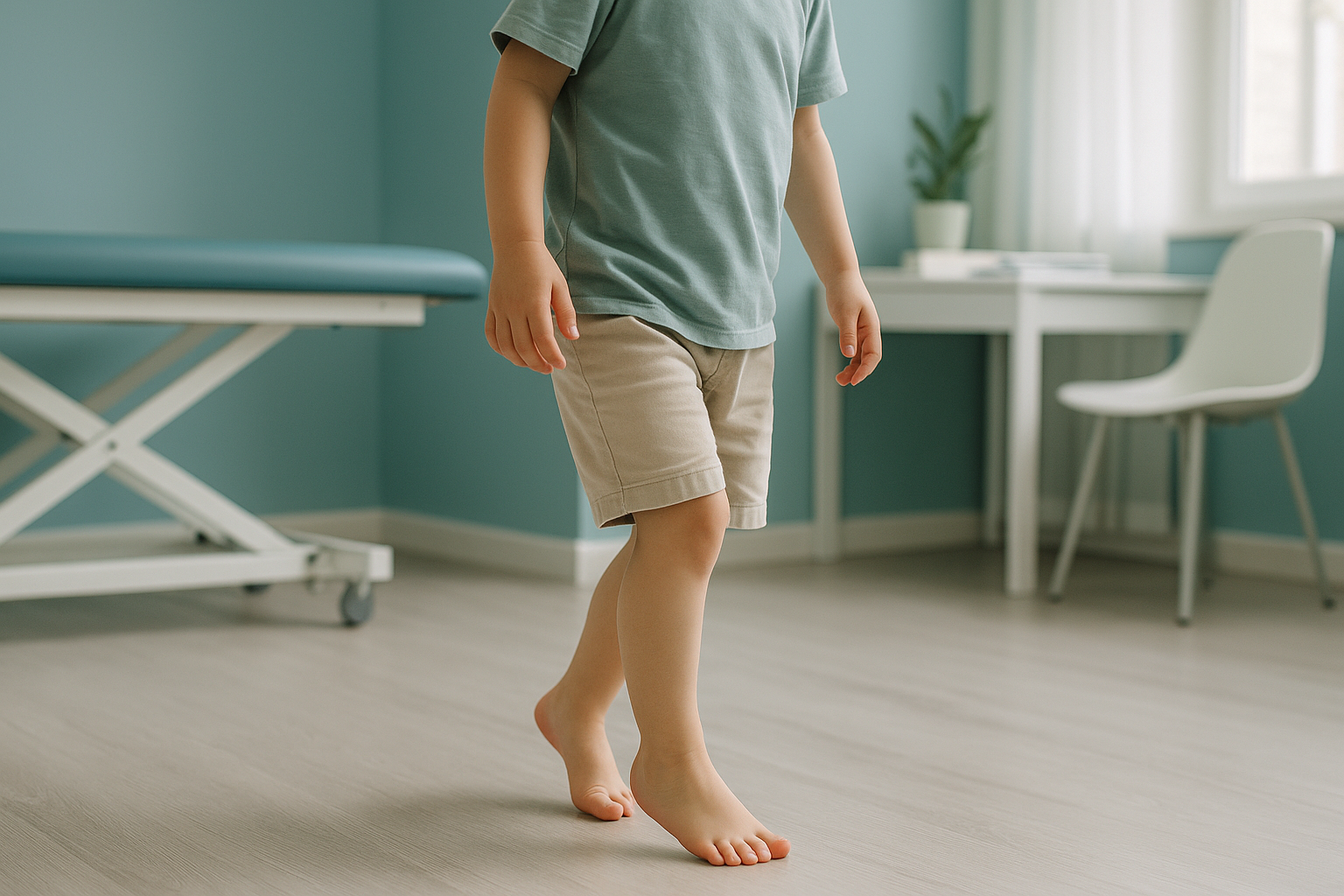
Toe Walking in Children: Why Is Your Child Walking on Tiptoes?
Toe walking is common in toddlers who are learning to walk and usually resolves on its own by age two to three. If your child still walks on tiptoes beyond that age, or only does so on one side, it is worth having them assessed. Most cases are idiopathic, meaning there is no underlying medical cause, but persistent toe walking can sometimes point to tight calf muscles or a neurological condition that benefits from early support.
Key takeaways
- Most toddlers toe walk as part of normal development. It often stops by age two to three.
- Persistent toe walking after age three is called idiopathic toe walking when no cause is found.
- Tight calf muscles, sensory preferences and, rarely, neurological conditions can contribute.
- A specialist assessment helps rule out anything that needs attention early.
- Standing, weight-bearing imaging can show how the feet, ankles and legs align under real load.
What is toe walking in children?
Toe walking is a pattern where a child walks on the balls of their feet instead of landing heel first. It is extremely common in children under two who are still developing their balance and coordination. The brain and muscles are experimenting with different movement patterns, and walking on tiptoes is one of them.
When a child continues to toe walk beyond age two to three without any known medical reason, clinicians call it idiopathic toe walking. "Idiopathic" simply means the cause is not clear. Most of the time, it is a habit rather than a sign of something serious.

What does toe walking look like?
Toe walking can be obvious or quite subtle. Here are the signs parents most commonly notice.
The heels rarely or never touch the ground during walking.
The Achilles tendon or calf feels noticeably stiff, and the ankle is hard to bend upwards.
The child seems to bounce when they walk and may trip more often than expected.
Toe walking on one foot only, which is less common and worth checking promptly.
What causes a child to walk on tiptoes?
The most common cause is simply habit, with no underlying medical problem. In a smaller number of children, toe walking has a physical or neurological reason.
The child walks on tiptoes out of habit. This is by far the most common explanation, especially under age three.
Shortened calf muscles or a tight Achilles tendon can limit how far the ankle bends upward (dorsiflexion).
Some children dislike certain textures underfoot or prefer the sensory feedback of walking on their toes.
Conditions such as cerebral palsy or muscular dystrophy can cause increased muscle tone, leading to toe walking. These are less common.
Autism spectrum conditions are sometimes linked to persistent toe walking, though the connection is not fully understood. If toe walking appears alongside other developmental differences, your GP or paediatrician can arrange a broader developmental screening.
When should you worry about toe walking?
Most toe walking is harmless and resolves without any intervention. You should speak to your GP or health visitor if any of the following apply.
- Child is under two years old
- Can walk flat-footed when asked or reminded
- Both sides affected equally
- No stiffness in the ankles or calves
- Meeting other developmental milestones
- Still toe walking after age three
- Cannot get heels to the ground at all
- One-sided toe walking
- Stiff or very tight calves
- Frequent falls or balance problems
- Other developmental concerns
A note on imaging. EOS standing X-ray shows bones, joints and alignment under real weight-bearing load. For soft tissue detail, such as nerves, muscles or tendons, MRI is usually the better tool. Your child's clinician will recommend the right type of imaging based on what they need to see.
Seek urgent medical attention if your child develops sudden weakness in one or both legs, loses the ability to walk after previously walking normally, or has numbness or loss of bladder or bowel control. Contact your GP, call 111, or go to A&E.
How is toe walking assessed?
Assessment usually starts with a clinical examination by a paediatrician or paediatric physiotherapist. They will watch your child walk, check the range of motion at the ankle, and review developmental milestones. If the pattern persists and the cause is unclear, further investigations may include a gait analysis or imaging.
Standard X-rays are taken lying down, which relaxes the muscles and can hide alignment problems that only appear when standing. A weight-bearing image captures the feet, ankles and legs under the real forces of gravity. This can show whether joint alignment or bone position contributes to the walking pattern. Paediatric imaging at ScanAlign uses EOS technology, which delivers about 90% less radiation than a standard X-ray, around ten times less.

The body works as a connected chain from feet to head. A problem at the ankle can change how the knee, hip or spine compensates. Pain or stiffness sometimes shows up in a different area from the real cause. Standing imaging captures this full picture in one scan.
What helps with persistent toe walking?
Management depends entirely on the cause and severity. Your child's clinician will recommend the right approach after a proper assessment. Common options may include the following.
- Observation. If the child is young and developing normally, the clinician may simply monitor the pattern over time.
- Stretching and physiotherapy. Gentle calf stretches and exercises to encourage heel contact during walking.
- Serial casting. In some cases, a series of plaster casts gently stretch the calf and Achilles tendon over several weeks.
- Specialist referral. If a neurological or developmental condition is suspected, your GP can refer to a paediatric neurologist or developmental paediatrician.
ScanAlign is a diagnostic imaging clinic. It does not provide treatment. It provides the imaging that helps clinicians plan the right next steps for your child.
If your child has been toe walking beyond age three and you want to understand what is happening structurally, a low-dose standing scan can help. Book a paediatric assessment or speak to us first with a free video consultation.
Book a free video consultationFrequently asked questions about toe walking
Yes. Toe walking is very common in children under two and is usually just part of learning to walk. Most children grow out of it without any intervention.
Most children walk with a normal heel-to-toe pattern by age two to three. If your child still toe walks regularly after age three, it is worth speaking to your GP or health visitor.
Toe walking can be associated with autism spectrum conditions, but it is not a reliable indicator on its own. Many children who toe walk have no developmental differences at all. If you have broader concerns, your GP can arrange a developmental screening.
Idiopathic toe walking means the child walks on tiptoes and no medical cause has been found. It is the most common diagnosis when toe walking persists beyond the toddler years.
Yes. A shortened or tight calf muscle, or a tight Achilles tendon, can limit ankle dorsiflexion (the ability to bend the foot upward). This makes it physically harder for the child to get their heels to the ground. Physiotherapy and stretching are often recommended in these cases.
Not always. Many cases are assessed clinically. If the clinician needs to see how the bones and joints are aligned under load, a standing weight-bearing image can be helpful. ScanAlign, low dose standing imaging uses EOS technology with about 90% less radiation than a standard X-ray.
A lying-down scan relaxes the muscles and removes the effect of gravity. This can hide alignment problems that only show when the child is upright and weight bearing. A standing EOS scan captures the skeleton under real-world forces, giving a truer picture of how joints line up.
EOS uses about 90% less radiation than a standard X-ray, around ten times less. This makes it well suited for children who may need repeat imaging over time. You can find more details on our frequently asked questions page.
No referral is needed. ScanAlign is a private self-pay clinic. You can book directly. We always recommend a free video consultation first so we can check whether imaging is appropriate for your child's situation.
We do not list prices on individual pages. You can find up-to-date pricing information on our frequently asked questions page, or ask during your free video consultation.
Concerned about your child's walking pattern?
Talk to our specialist radiographer in a free video consultation. No referral needed, no obligation.
Book a free video consultationWritten by Abbas Dhami (Specialist Diagnostic Radiographer)
Sources
- NHS. "Toe walking in children." NHS Health A to Z. nhs.uk
- Engström P, Tedroff K. "Idiopathic toe-walking: prevalence and natural history." Acta Paediatrica, 2018;107(2):348-353.
- American Academy of Orthopaedic Surgeons (AAOS). "Toe Walking." OrthoInfo patient education. orthoinfo.aaos.org
This page is general information and not a diagnosis.
ScanAlign is the trading name of CoreMed Solutions Ltd and operates under The Harley Street Hospital's CQC licence.