
Gait Analysis: How the Way You Walk Affects Your Joints
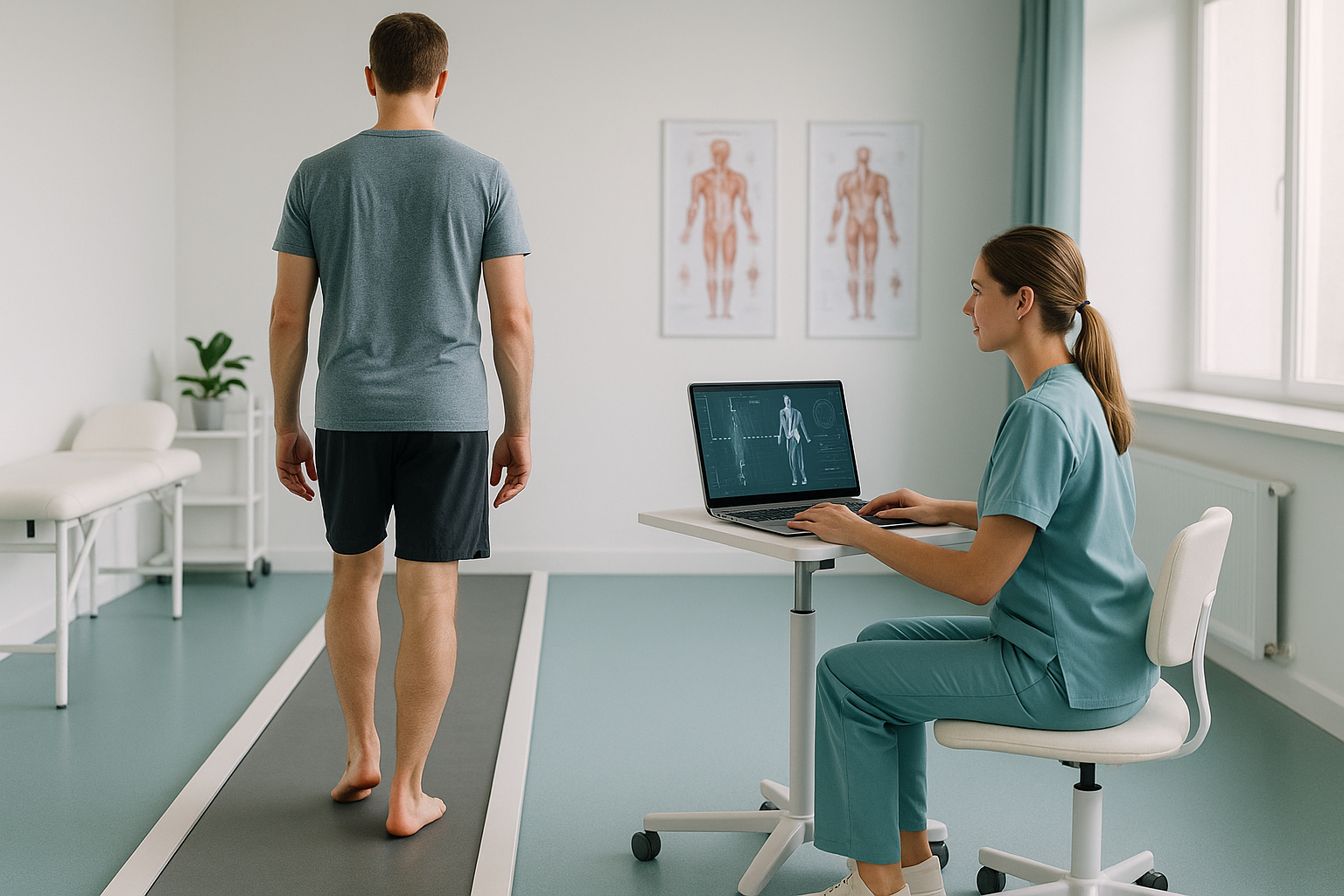
Gait analysis is the study of how you walk and move. It looks at the timing, posture and forces in every step. When your gait is off, the extra stress does not stay in one place. It spreads through your knees, hips and spine, often causing pain far from the original problem. A full standing assessment can reveal what single-area scans miss.
Key takeaways
- Your gait is a whole-body pattern. A problem at one level affects joints above and below.
- Lying-down scans relax the muscles and can hide alignment faults that appear only when you stand and walk.
- EOS whole-body standing imaging captures your skeleton under real weight-bearing load, with about 90% less radiation than a standard X-ray.
- ScanAlign provides diagnostic imaging only. Treatment decisions are made by your clinician.
What is gait analysis and why does it matter?
Gait analysis is a structured way of observing and measuring how you walk. Clinicians look at your stride length, how long each foot stays on the ground, the angle of your joints at each phase, and how your body distributes force. It matters because walking is the most repeated load your skeleton handles. Even a small imbalance, repeated thousands of times a day, can lead to wear, pain and compensatory problems elsewhere.
Most people never think about the way they walk until something hurts. By that point, the body has often been compensating for months or years, and the site of pain may be far from the original cause.
What are the signs of a gait problem?
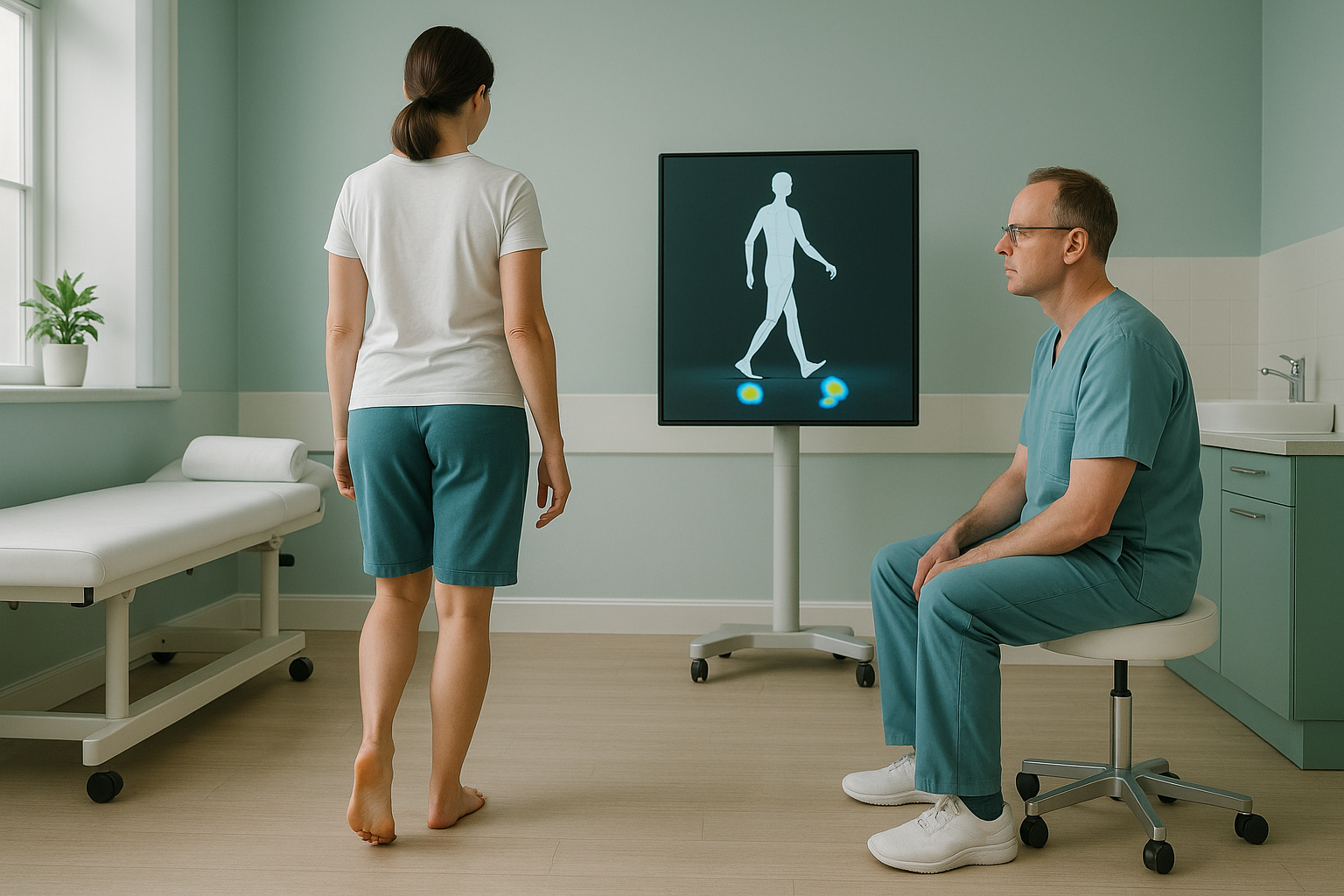
A gait problem does not always feel like a walking problem. It often shows up as joint pain, fatigue or uneven shoe wear. Here are common signs that your gait may be contributing to your symptoms.
One shoe sole wears down faster than the other, suggesting uneven weight distribution.
Pain that only affects one knee or hip may point to a gait imbalance rather than a joint-only issue.
Discomfort in your lower back that worsens with distance can result from how force travels up through your pelvis.
Even a slight limp changes how your entire skeleton absorbs impact with every step.
Important. If you experience sudden leg weakness, numbness, or loss of bladder or bowel control alongside gait changes, seek urgent medical attention through your GP, 111 or A&E. These may indicate a serious neurological condition that needs immediate assessment.
What causes an abnormal gait?
An abnormal gait can develop from a structural issue, an injury, wear and tear over time, or a combination of all three. Your body is a connected chain from your feet up to your head. When one link changes, the others adjust to keep you moving. That adjustment is called compensation, and it is where many unexplained aches begin.
Even a small difference can tilt the pelvis and alter your stride on every step.
Stiffness in a hip or knee reduces range of motion and forces other joints to take extra load.
A tilted pelvis shifts your centre of gravity and changes how weight flows through each leg.
Old injuries to the foot, ankle or knee can leave lasting changes in how you bear weight.
The challenge is that compensation is usually invisible. You do not notice you are doing it. And when pain appears in a knee or a hip, the instinct is to scan that one joint. But if the underlying cause is a pelvic tilt or a leg-length difference, a single-area scan will not show it.
How is gait analysed with a standing whole-body scan?
Gait analysis starts with understanding the structure underneath. A standing whole-body EOS scan captures your entire skeleton, from your ankles to the top of your spine, in a single upright image while your muscles and joints bear your full weight. This is the position your body is actually in when you walk.
Lying-down imaging, such as a standard X-ray, CT or MRI, relaxes your muscles and lets your joints settle into a resting position. That can hide alignment problems that only appear when gravity is doing its work. Think of it this way: checking alignment while lying down is like trying to assess a building's lean when it is flat on the ground.
An EOS scan uses about 90% less radiation than a standard X-ray, around ten times less. It shows the relationship between every major joint in a single view, so a radiologist can see whether your pelvis is level, whether your legs are the same length, and how your spine responds to any imbalance below.
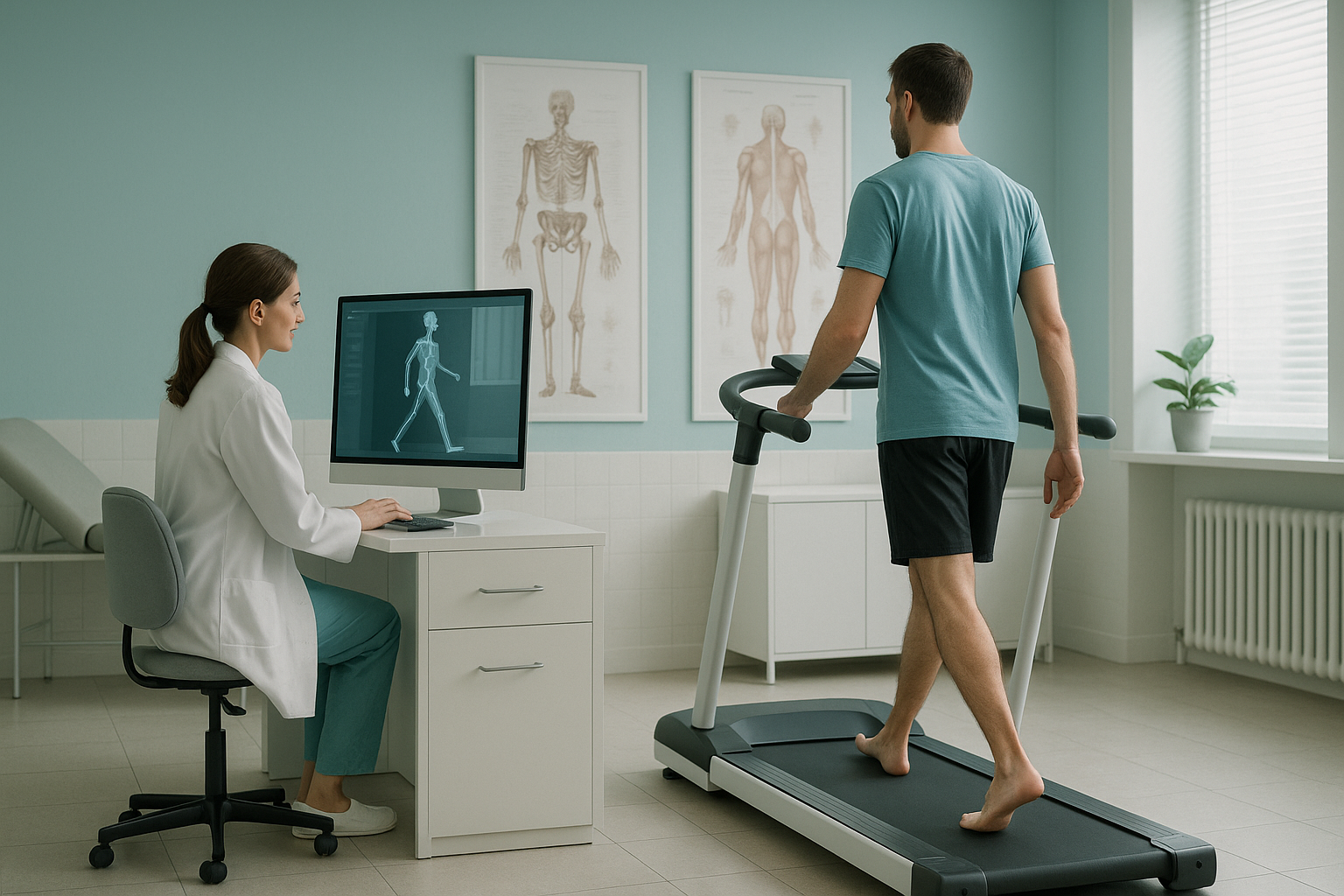
This whole-body view gives your clinician the context they need to connect your gait pattern to the structural cause. If you are referred for physiotherapy, orthotics or surgery, the imaging provides a clear baseline to plan from.
Want to find out whether a standing alignment scan could explain your symptoms?
Book a free video consultationWhen is MRI the better choice? EOS imaging shows bones, joints and overall alignment brilliantly. But if your clinician suspects soft-tissue damage, disc problems or nerve compression, MRI is usually the better tool. In many cases, both types of imaging work together to give a complete picture.
What helps once a gait problem is identified?
Once the underlying structural cause is clear, your clinician can decide on the right approach. ScanAlign provides the diagnostic imaging only. Treatment decisions are made by your referring clinician or specialist. Common next steps might include physiotherapy, orthotics, targeted exercises, or in some cases surgical review.
The key point is that effective management depends on understanding the full picture first. A scan of one joint shows that joint. A whole-body standing image shows how that joint fits into the chain, and where the real problem may sit. That distinction can change the course of your care.
Frequently asked questions about gait analysis
Gait analysis is used to understand how you walk, identify imbalances and find the structural causes of joint pain. It is helpful for people with knee, hip or back pain, and for runners or walkers with recurring injuries.
Yes. If your gait shifts extra load onto one knee, that knee absorbs more force with every step. Over time, this can lead to pain, inflammation or accelerated wear, even when the knee itself is structurally sound.
No. ScanAlign accepts self-referrals. You can book a free video consultation to discuss your symptoms and find out whether an EOS standing scan is appropriate for you.
Pricing details are on the ScanAlign FAQs and pricing page.
EOS uses about 90% less radiation than a standard X-ray, around ten times less. It is a very low-dose imaging system designed for whole-body standing views.
A traditional gait analysis observes your movement pattern. A standing EOS X-ray captures the structural alignment underneath. Together, they reveal both how you move and why your body moves that way.
Yes. Your spine sits on top of your pelvis. If a gait imbalance tilts your pelvis or shifts your weight unevenly, your lower back compensates. This is a common and often overlooked cause of chronic back pain.
Very useful. Running multiplies the force on each joint. A small structural imbalance that causes no issues when walking can produce significant pain at running loads. Standing alignment imaging can help identify the source.
When you lie down, gravity is no longer pushing through your joints. Muscles relax, the pelvis levels out, and alignment faults can disappear. Standing imaging captures your skeleton under real load, the way it works when you walk.
You stand still inside the EOS unit for a few seconds while it captures a full-length image. It is quick, painless and does not require any preparation. Full details are on the what to expect page.
Find out what your gait is really doing to your joints
A free video consultation with our team can help you understand whether a standing alignment scan is the right next step.
Book a free video consultationRelated pages
Sources
- Perry, J. & Burnfield, J.M. Gait Analysis: Normal and Pathological Function, 2nd ed. SLACK Incorporated, 2010.
- Illés, T. & Somoskeöy, S. "The EOS imaging system and its uses in daily orthopaedic practice." International Orthopaedics, 36(7), 2012, pp. 1469–1475.
- NHS. "Overview: Joint pain." NHS.uk. Available at: https://www.nhs.uk/conditions/joint-pain/
Written by Abbas Dhami (Specialist Diagnostic Radiographer)
This page is general information and not a diagnosis.
ScanAlign is the trading name of CoreMed Solutions Ltd and operates under The Harley Street Hospital's CQC licence.