
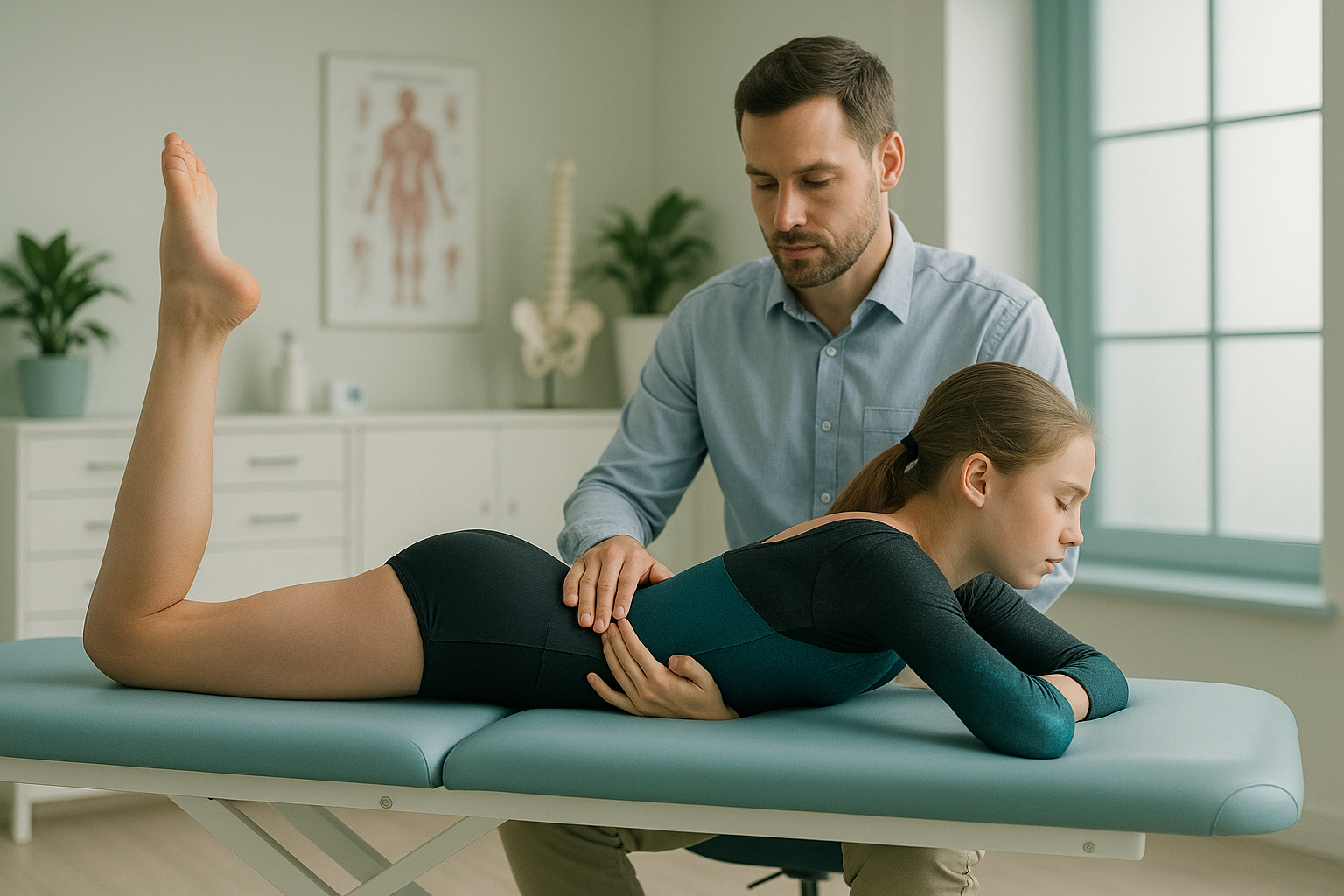
Why Do Young Gymnasts Get Back Injuries?
Gymnastics back injuries in young athletes happen because the sport demands repeated hyperextension of the spine while the skeleton is still growing. Growth plates and developing bone are less resistant to stress, so high training hours can lead to stress reactions or fractures in the lower back, most commonly spondylolysis.
Key takeaways
- Repeated back bends stress the part of the vertebra called the pars interarticularis, which is weaker in a growing spine.
- MRI is the first-line investigation for a suspected acute stress reaction in a young athlete.
- A standing, weight-bearing scan can reveal alignment issues that lying-down imaging may miss.
- Early recognition and training modification are the most effective ways to prevent serious damage.
- Pain during or after training is a warning sign, not something to push through.
Why does gymnastics put the spine at risk?
Gymnastics is one of the most demanding sports for the lower back. Every back walkover, tumbling pass and dismount forces the lumbar spine into deep extension. In an adult skeleton, these forces are spread across strong, fully formed bone. In a young athlete whose skeleton is still maturing, the growth plates and developing bone absorb less force before they start to break down.
The part of the vertebra most affected is called the pars interarticularis, a thin bridge of bone at the back of each lumbar vertebra. When this area is loaded over and over again without enough recovery time, it develops a stress reaction. If training continues, that reaction can progress to a stress fracture known as spondylolysis.

What are the signs of a gymnastics back injury?
The most common sign is a dull ache in the lower back that gets worse during or after training, particularly with backward bending or landing from a height. It may start as mild stiffness and build over weeks.
Aching or sharp pain when arching the back, especially during walkovers or back handsprings.
The back feels stiff first thing in the morning or after sitting for a long time.
Pain that is concentrated on one side of the lower back rather than across the whole area.
Noticeable loss of flexibility or reluctance to perform skills that previously felt comfortable.
Seek urgent medical attention if there is any numbness, tingling, weakness in the legs, or any loss of bladder or bowel control. Contact your GP, call 111, or go to A&E straight away.
What causes stress fractures in young gymnasts?
Stress fractures in young gymnasts are caused by a combination of biological vulnerability and training load. No single factor is usually responsible. It is the overlap of several risk factors that tips the balance.
More hours of repetitive loading means less recovery time for developing bone.
Rapid growth makes bones temporarily weaker and muscles tighter, increasing stress on the spine.
Back walkovers, flips and dismounts force the pars interarticularis into compression over and over.
Without sufficient rest days, bone remodelling cannot keep pace with the micro-damage caused by training.
Coach awareness and parent guidance are critical. A young athlete who reports persistent lower back pain during training should be assessed, not encouraged to train through it. Early identification of a stress reaction allows training modification before a full fracture develops.
How is a gymnastics back injury diagnosed?
MRI is the first-line investigation when an acute pars stress reaction is suspected in a young athlete. MRI is excellent at detecting early bone stress, bone marrow oedema and soft-tissue changes before a fracture becomes visible on a standard X-ray. If your child's doctor suspects a stress reaction, MRI should be the initial scan requested.
A note on MRI. EOS shows bones, joints and whole-body alignment with about 90% less radiation than a standard X-ray, around ten times less. However, for soft tissue, discs, nerves and early bone stress reactions, MRI is usually the better tool. Your clinician will recommend the right imaging based on the clinical picture.
Standard X-rays may not show a stress reaction in its early stages. They are more useful once a fracture line has formed or when checking overall spinal alignment over time. CT scanning gives detailed bone images but involves higher radiation, which is an important consideration in younger patients.
How does a standing scan help after a gymnastics back injury?
Once an acute stress reaction has been ruled out or has healed, standing, weight-bearing imaging plays a valuable role. Standard scans are taken lying down. When you lie flat, gravity is removed and the muscles relax. This can hide the alignment problems that only appear under the load of standing upright.
The body works as a connected chain from feet to head. A subtle tilt at the pelvis, an asymmetry in leg length, or an increased curve in the lower back can all shift stress onto the pars interarticularis. These compensations often only become visible when the body is upright and bearing its own weight.
ScanAlign, low dose standing imaging, captures the full skeleton from head to feet in a single upright exposure. This whole-chain view helps clinicians understand why certain areas of the spine are being overloaded, not just what is damaged. That information is especially useful for guiding a safe return to sport and for identifying alignment factors that may increase the risk of re-injury.

Concerned about a young gymnast's back? Explore paediatric imaging at ScanAlign or speak with our team first.
Book a free video consultationWhat helps a young gymnast recover from a back injury?
Recovery is guided by the clinical team looking after the athlete. ScanAlign is a diagnostic imaging clinic and does not provide treatment. However, imaging plays a key role in guiding the decisions that clinicians and coaches make.
In general, management typically involves a period of modified training to allow bone healing, followed by a gradual, supervised return to full activity. Understanding the underlying alignment picture helps clinicians decide when it is safe to progress and what adjustments might reduce the risk of the injury coming back.
For parents and coaches, the most important step is to take lower back pain seriously in any young gymnast. Persistent pain during training that lasts more than a couple of weeks deserves a proper clinical assessment, not a rest week and a return to the same load.
Frequently asked questions about gymnastics back injuries
The most common serious back injury in gymnastics is a stress fracture of the pars interarticularis, known as spondylolysis. It is caused by repeated hyperextension of the lumbar spine during skills such as back walkovers and tumbling.
Young athletes have growing skeletons. Growth plates and developing bone are less resistant to repetitive loading than mature bone, making stress reactions more likely during high training volumes.
MRI is the recommended first-line investigation for a suspected acute pars stress reaction. It can detect bone stress and swelling before a fracture line appears on X-ray, allowing earlier intervention.
A standing EOS scan is most useful once an acute stress reaction has been addressed. It reveals whole-body alignment under load, helping clinicians identify compensations that may be overloading the lower back and guiding a safer return to sport.
An EOS scan uses about 90% less radiation than a standard X-ray, around ten times less. This is particularly important for younger patients who may need imaging over time.
No. ScanAlign is a private, self-pay clinic. You can self-refer without a GP letter. We recommend starting with a free video consultation so we can check imaging is appropriate for your situation.
Yes. A full-body standing image can reveal asymmetries such as a pelvic tilt or a subtle difference in leg length that shifts load onto one side of the spine. These compensations are often invisible on lying-down scans.
Healing timelines vary depending on the severity of the injury and the individual. Your clinical team will guide the return-to-sport plan. Imaging at key stages helps them check progress and decide when it is safe to increase load.
For details on pricing and what is included, please visit our frequently asked questions page.
Imaging is not a substitute for good coaching, appropriate training loads and rest. However, a baseline alignment assessment can highlight risk factors, such as excessive lumbar curvature or pelvic asymmetry, that a coach or physiotherapist can address before an injury develops.
Worried about a young gymnast's back?
Start with a free video consultation. Our team will help you understand whether imaging is the right next step.
Book a free video consultationWritten by Abbas Dhami (Specialist Diagnostic Radiographer)
Sources
- Selhorst M, Fischer A, MacDonald J. Prevalence of spondylolysis in symptomatic adolescent athletes. Clinical Journal of Sport Medicine, 2019;29(5):421-426.
- Caine D, Maffulli N, Caine C. Epidemiology of injury in child and adolescent sports: Injury rates, risk factors, and prevention. Clinics in Sports Medicine, 2008;27(1):19-50.
- British Gymnastics. Injury prevention and management guidance for coaches and parents. britishgymnastics.org.
This page is general information and not a diagnosis.
ScanAlign is the trading name of CoreMed Solutions Ltd and operates under The Harley Street Hospital's CQC licence.