
What Happens If a Scan Shows Something Unexpected?
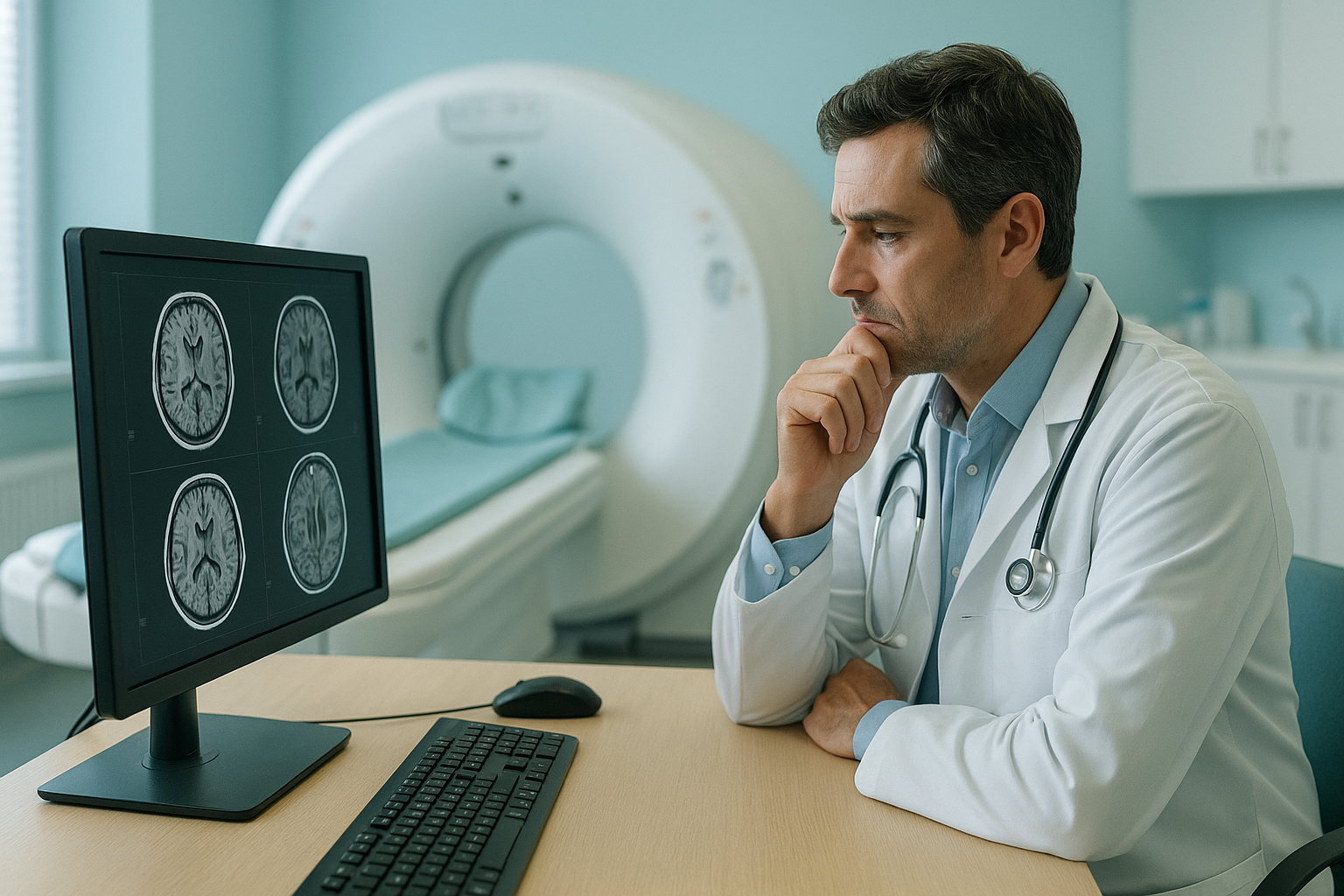
An incidental finding is something a scan picks up that was not the reason you were scanned. At ScanAlign, every image is reviewed by a specialist radiologist. If an unexpected finding appears, we have a clear escalation pathway to make sure you are informed promptly and guided towards the right next step, whether that is reassurance, your GP, or a specialist.
Key takeaways
- Incidental findings are common in medical imaging and are usually harmless.
- ScanAlign has a formal escalation pathway so nothing significant is missed or ignored.
- You will always be told if something unexpected is seen on your scan.
- Your GP or a relevant specialist is contacted when a finding needs further investigation.
- You are never left without guidance on what to do next.
What are incidental findings on a scan?
Incidental findings are abnormalities or variations spotted on a scan that were not the reason the scan was requested. They are sometimes called incidentalomas. For example, you might have an EOS scan to assess your spinal alignment, and the radiologist notices an unusual area in a rib or pelvis that has nothing to do with your original concern.
These findings are very common across all types of imaging. Research suggests that incidental findings appear in a significant proportion of diagnostic scans, regardless of the modality used. Most turn out to be entirely harmless, such as benign bone islands, old healed fractures, or normal anatomical variants that simply look a little different from the textbook.
However, a small number of incidental findings do need further investigation. That is why every responsible imaging service needs a clear, documented process for handling them.
How does ScanAlign handle an unexpected scan result?
We follow a formal clinical governance pathway for every incidental finding. This means there is a documented, step-by-step process rather than ad hoc decisions. Here is exactly what happens.
Radiologist review
Every EOS scan is reported by a specialist radiologist. They assess the images for your primary concern and for anything else visible in the field of view. Learn more about how EOS scan results are reported.
Finding documented
If the radiologist identifies an incidental finding, it is clearly documented in your written report alongside your primary results. Nothing is left out or glossed over.
You are informed
Our team contacts you to explain what has been found, in plain language. If you have questions or feel anxious, our patient support team is there to help.
GP or specialist notification
When a finding needs further investigation, we send your report and a recommendation directly to your GP or the relevant specialist. We can also advise you on when to see a specialist. You are never left to chase this up yourself.
This pathway is part of our duty of care. It applies whether you self-referred or were sent by a clinician. It also applies regardless of what the finding turns out to be.
Important. If you ever experience sudden severe pain, numbness, weakness, or loss of bladder or bowel control, do not wait for a scan. Contact your GP, call 111, or go to A&E immediately.
What kinds of incidental findings can appear on a scan?
Incidental findings range from completely harmless to clinically significant. Most fall into one of three broad categories.
Normal variants
Anatomical features that look unusual on an image but are completely normal for you. These need no action at all.
Benign findings
Things like small bone islands, old healed fractures, or mild wear and tear. Usually noted for your records but rarely need treatment.
Significant findings
Less common, but sometimes a finding needs prompt attention. This might be an unusual bone lesion or a structural issue that warrants further imaging or a specialist opinion.
The vast majority of incidental findings fall into the first two categories. When something significant does appear, having a clear escalation pathway means it is caught early and acted on quickly.
A note on EOS and soft tissue. EOS imaging excels at showing bones, joints, and whole-body alignment. For soft-tissue concerns such as discs, ligaments, or nerves, MRI is usually the better tool. If an incidental finding suggests a soft-tissue problem, we will recommend the appropriate next step, which may include an MRI referral.
What should you expect if your scan finds something else?
It is completely natural to feel anxious if you are told your scan showed something unexpected. Most people do. Here is what we want you to know.
- You will not be left in the dark. We explain findings in plain, everyday language.
- Most findings are not serious. The majority of incidentalomas turn out to be benign or simply a normal variant.
- We handle the next steps for you. If your GP or a specialist needs to be involved, we make the referral. You do not have to navigate the system alone.
- Your consent matters. Before your scan, we let you know that incidental findings are a possibility and explain how we handle them. There are no surprises about the process.
At ScanAlign, standing EOS imaging in London, we believe that honest, prompt communication is the foundation of good patient care. An unexpected finding handled well can be genuinely reassuring, even if the initial news feels unsettling.
Frequently asked questions about incidental findings
Incidental findings are very common across all types of medical imaging. Research shows they appear in a significant proportion of scans. The vast majority are harmless, but each one is reviewed carefully by the reporting radiologist.
Yes. At ScanAlign, every finding is documented in your report. If an incidental finding is identified, we contact you to explain it in plain language and advise on any next steps.
We follow a formal escalation pathway. Your report and the radiologist's recommendation are sent directly to your GP or a relevant specialist. We also contact you to explain what has been found and what happens next.
No. You can self-refer. Our incidental findings pathway applies to every patient, whether you were referred by a clinician or booked directly yourself.
An incidentaloma is a mass or lesion found unexpectedly on imaging that was performed for a different reason. The term is most often used in radiology. Most incidentalomas are benign and need only monitoring or no action at all.
EOS uses about 90% less radiation than a standard X-ray, around ten times less. It is very low dose. However, depending on the nature of the finding, the radiologist may recommend a different type of imaging such as MRI or CT for the follow-up.
If an incidental finding requires further investigation, we send your report and recommendation to your GP directly. For routine results, you receive your report and can share it with any clinician you choose.
Yes, and this is the most common outcome. Many incidental findings are normal anatomical variants or old, healed injuries that need no action. The radiologist will make this clear in the report.
Anxiety is a completely normal response. Our team explains findings in plain language and is available to answer your questions. If you need ongoing support, we can guide you towards the right next step.
We aim to report results promptly, but we do not quote a specific turnaround guarantee. If a finding is clinically urgent, it is escalated as a priority. You can book your scan knowing that every report is handled with care.
Have questions before your scan?
Speak with our team in a free, no-obligation video consultation. We will explain the process, answer your questions, and make sure you feel confident about what to expect.
Book a free video consultationSources
- The Royal College of Radiologists. Standards for the communication of radiological reports and fail-safe alert notification. RCR, 2016.
- O'Sullivan JW et al. "Prevalence and outcomes of incidental imaging findings: umbrella review." BMJ, 2018; 361:k2387.
- NHS England. Diagnostic Imaging Dataset guidance. NHS England, 2023.
Written by Abbas Dhami (Specialist Diagnostic Radiographer)
This page is general information and not a diagnosis.
ScanAlign is the trading name of CoreMed Solutions Ltd and operates under The Harley Street Hospital's CQC licence.