
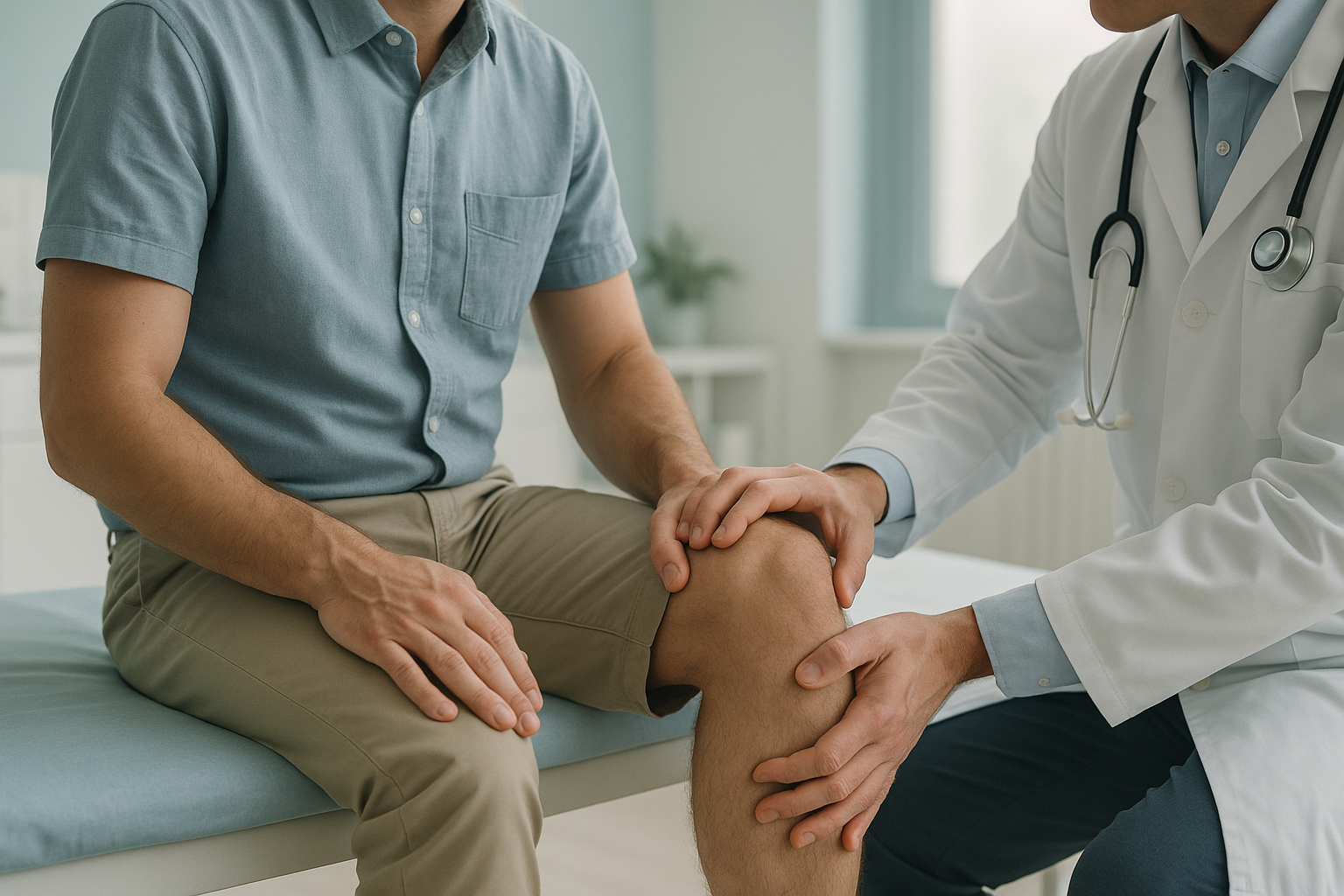
Why Does My Knee Click and Pop, and Should I Worry?
Most knee clicking is completely harmless. It is usually caused by tiny gas bubbles popping in the joint fluid or tendons sliding over bone. If the clicking happens without pain, swelling or locking, it rarely needs any investigation. When knee popping comes with pain or the joint feels unstable, it is worth looking into.
Key takeaways
- Painless knee clicking is very common and usually nothing to worry about.
- The medical term for joint noise is crepitus.
- Pain, swelling or locking alongside clicking may point to a cartilage or tracking issue.
- A standing, weight-bearing image can show alignment problems that lying-down scans miss.
- Most people with clicking knees need reassurance, not surgery.
What is crepitus in the knee?
Crepitus is the medical name for any grinding, cracking or popping sound that comes from a joint. In the knee it is extremely common. You might hear a single loud pop when you stand up, or a quiet grinding noise as you walk downstairs. Both can be completely normal.
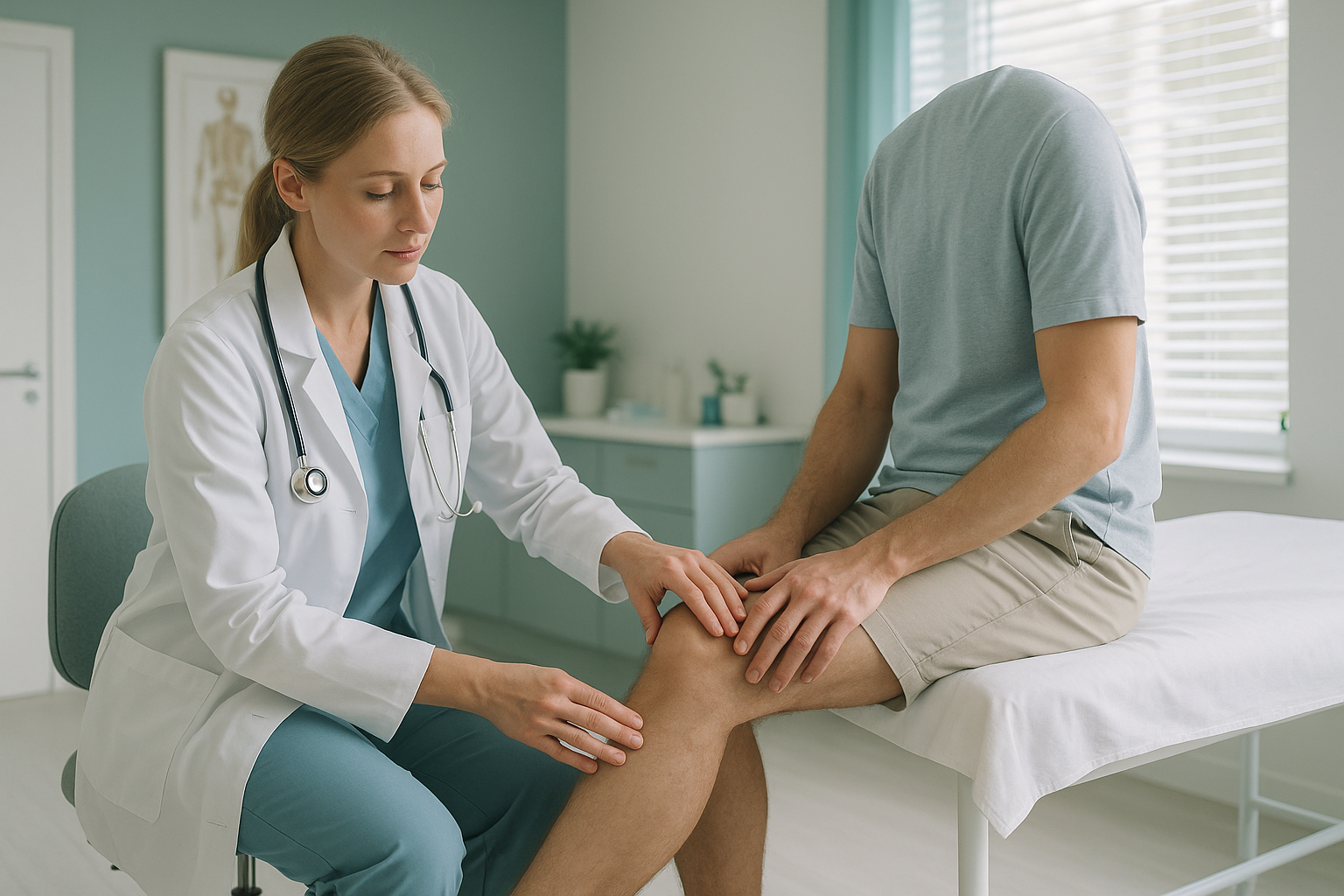
Your knee joint is surrounded by a capsule filled with fluid. Small gas bubbles form naturally in this fluid. When the joint moves, the bubbles collapse, creating a popping sound. This is the same mechanism behind cracking your knuckles, and it is not harmful.
Tendons and ligaments can also snap lightly over bony ridges as you bend or straighten the knee. Again, this is usually painless and nothing to worry about.
What causes knee clicking and popping sounds?
Several things can make a knee noisy. Most are harmless, but a few deserve attention.
Tiny bubbles in the joint fluid collapse with a pop. Painless and normal.
A tendon slides over a bony bump. You feel or hear a snap, usually without pain.
Roughening of the cartilage surface can cause a grinding feeling when the knee bends, known as chondromalacia patella.
If the kneecap does not glide smoothly in its groove, it can click or grind. This is called patellar maltracking.
Less commonly, a loud pop during sport followed by swelling may suggest a ligament injury. A catching or locking sensation can point to a loose fragment or meniscus tear. Both of these usually come with obvious pain and swelling.
When should you worry about a clicking knee?
Most of the time, you should not worry at all. A clicking knee with no pain, no swelling and full range of movement is very likely normal. The sounds alone are not a sign of damage.
- Clicking with no pain
- The sound comes and goes
- Full movement, no swelling
- Both knees make similar noises
- Pain alongside the clicking
- Swelling after activity
- The knee locks or gives way
- A single loud pop during an injury
- Grinding that worsens over weeks
If your knee clicks and also feels unstable, locks in one position, or is visibly swollen, it is sensible to find out why. Our guide on when to see a specialist can help you decide your next step.
Urgent note. If your knee suddenly gives way with severe pain, or you experience numbness or weakness in the leg, seek urgent medical attention. Contact your GP, call 111, or go to A&E.
How does standing imaging help with knee crepitus?
A standing, weight-bearing image shows your knee the way it actually works, under your full body weight. This matters because alignment problems that contribute to noisy, uncomfortable knees can be invisible when you lie down for a standard scan.
When you stand, gravity loads the joint and your muscles hold everything in its natural position. An EOS scan captures the full leg, from hip to ankle, in one image. This reveals how the kneecap tracks, whether the leg is straight or angled, and how the hip and ankle alignment above and below may be affecting the knee.
Lying on a table relaxes the muscles and takes the load off the joint. The kneecap sits differently, and small alignment shifts that cause clicking under weight disappear. A standard X-ray or CT taken lying down may show nothing wrong, even when there is a real tracking or alignment issue.
Your body works as a connected chain. A slight twist at the hip or a flat arch in the foot can change how the kneecap sits in its groove. Pain, or noise, often shows up away from the real cause. A whole-body standing image at ScanAlign can map this chain in one visit, using about 90% less radiation than a standard X-ray, around ten times less.
When MRI is the better choice. EOS shows bones, joints and alignment. If your clinician suspects a meniscus tear, ligament damage, or other soft-tissue problem, MRI is usually the better tool. The two are complementary, not competitors.
What helps reduce knee clicking?
For painless clicking, no treatment is needed. The noise itself is not causing harm. If the clicking is linked to discomfort, a few general approaches are often recommended by clinicians.
- Strengthening exercises. Building the muscles around the knee, especially the quadriceps, helps the kneecap track more smoothly.
- Activity modification. Reducing deep squats or heavy loaded knee bends can ease grinding sensations while you work on strength.
- Understanding alignment. If there is an underlying alignment or tracking problem, identifying it with proper imaging helps a physiotherapist or surgeon plan the right approach.
ScanAlign is a diagnostic imaging clinic. We do not provide treatment, but we give you and your clinician the detailed alignment picture that helps guide the right plan.
If your knee clicking comes with pain, swelling or a feeling of instability, a free video consultation can help you understand whether imaging is the right next step.
Book a free video consultationFrequently asked questions about knee clicking
Yes. Most adults experience some knee clicking or popping, especially when standing up from a chair, squatting or walking stairs. If there is no pain and the joint moves freely, the sound is almost always harmless.
Crepitus can feel like a light crackling under the kneecap or a deeper grinding sensation as the knee bends. Some people hear it, others just feel it. It ranges from barely noticeable to quite loud, but volume alone does not indicate severity.
Not usually. If the clicking is painless, continuing to exercise is generally fine and even helpful. Strengthening the muscles around the knee often reduces noisy joints over time. If the clicking is accompanied by pain or swelling, speak with a clinician before pushing through.
It can be, but clicking alone is not enough to diagnose arthritis. Many people with noisy knees have no arthritis at all. If the grinding is worsening, or if you have stiffness and aching alongside the noise, imaging can help clarify what is happening inside the joint.
Clicking is a noise or sensation during movement. Locking means the knee gets stuck in one position and you cannot straighten or bend it fully. Locking is more concerning and may suggest a loose body or meniscus tear that needs investigation.
When you bend your knee, pressure changes inside the joint cause gas bubbles to form and then pop. Tendons can also flick over bony ridges as the knee flexes. Both produce an audible crack that sounds alarming but is usually normal.
No referral is needed. ScanAlign is a private, self-pay clinic. You can book a knee assessment directly. The process starts with a free video consultation to check that imaging is appropriate for your situation.
Yes. An EOS scan uses about 90% less radiation than a standard X-ray, around ten times less. It captures the image while you stand, with no need for contrast dye or injections.
Pricing details are on our cost and FAQs page. The initial video consultation is free and there is no obligation to book a scan afterwards.
Yes. If the leg is slightly rotated or angled, the kneecap may not sit centrally in its groove. This can cause clicking, grinding or discomfort, particularly under load. A standing, whole-body image can show whether alignment higher up at the hip or lower down at the ankle is contributing.
Still unsure about your clicking knee?
A free video consultation helps you understand whether imaging would add useful information, with no pressure and no obligation.
Book a free video consultationSources
- Song SJ, Park CH, Liang H, Kim SJ. Noise around the knee. Clinics in Orthopedic Surgery. 2018;10(1):1-8.
- NHS. Knee pain and clicking. nhs.uk. Accessed 2025.
- de Oliveira Silva D, Barton CJ, Crossley KM, et al. Implications of patellofemoral crepitus for diagnosis and management. British Journal of Sports Medicine. 2018;52(22):1445-1446.
Written by Abbas Dhami (Specialist Diagnostic Radiographer)
This page is general information and not a diagnosis.
ScanAlign is the trading name of CoreMed Solutions Ltd and operates under The Harley Street Hospital's CQC licence.