
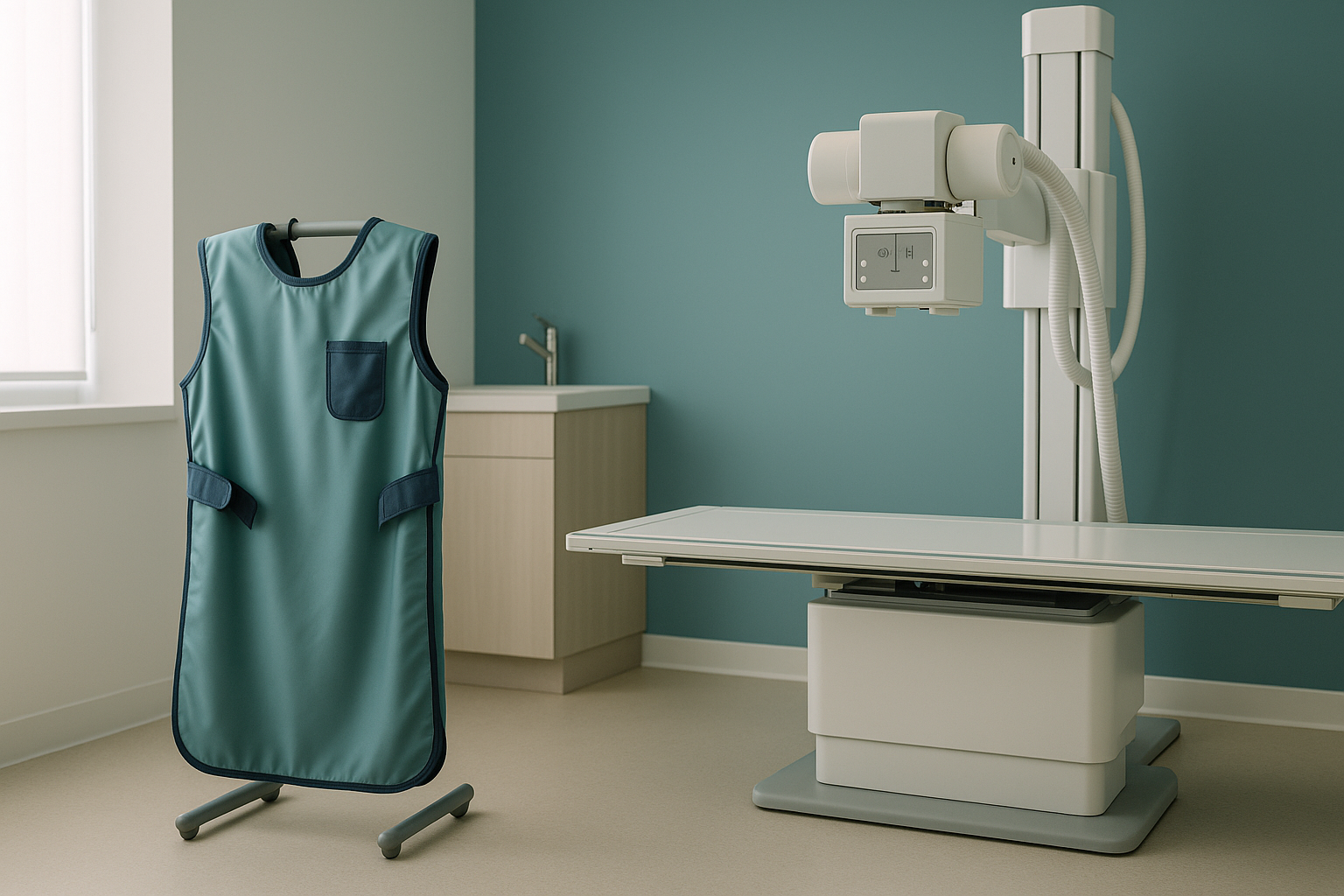
Do You Need a Lead Apron for a Modern Low-Dose Scan?
In most cases, no. Professional guidance in the UK now recommends against routine lead apron shielding for patients during X-rays. Modern systems use such low doses, and lead aprons can actually obscure important anatomy or trigger repeat exposures. At ScanAlign, our EOS system delivers about 90% less radiation than a standard X-ray, so patient shielding is not used.
Key takeaways
- UK professional bodies now advise against routine patient lead apron use during X-rays.
- Lead shielding can hide anatomy, leading to repeat scans and more radiation, not less.
- Tight collimation and dose optimisation protect you far more effectively than a lead apron.
- EOS technology uses about 90% less radiation than a standard X-ray, around ten times less.
- If you are or may be pregnant, always tell your radiographer before any imaging.
What does current UK guidance say about lead aprons for X-rays?
The British Institute of Radiology (BIR), together with the Society and College of Radiographers and the Royal College of Radiologists, published joint guidance in 2020 titled Guidance on Using Shielding on Patients for Diagnostic Radiology Applications. It recommended that routine use of patient contact shielding, including lead aprons and gonad shields, should be discontinued for standard diagnostic X-ray examinations.
This was not a fringe opinion. It aligned with guidance from the American Association of Physicists in Medicine (AAPM), which issued a similar position statement in 2019, and with the National Council on Radiation Protection and Measurements (NCRP) Commentary No. 29.
The message is clear. For the vast majority of diagnostic imaging, lead aprons for patients do more harm than good.
Why did they stop using lead aprons on patients?
The change happened because the science caught up with the habit. Lead aprons were introduced decades ago when X-ray equipment delivered far higher doses and detectors were less sensitive. Three main problems emerged with routine shielding.
A misplaced apron or gonad shield can cover the area the radiographer needs to see. This means the image has to be repeated, doubling the dose.
Modern X-ray systems use automatic exposure control. If dense lead sits in the beam, the machine may increase the dose to compensate, exposing the patient to more radiation.
With well-collimated modern equipment, the amount of scatter radiation reaching organs outside the beam is already extremely small. A lead apron adds almost no measurable benefit.
In short, a lead apron often created a false sense of protection while introducing real risks of obscured images and repeat exposures.
What protects patients now instead of lead shielding?
Better technology and better technique. The focus has shifted from blocking radiation after it is produced to reducing the radiation in the first place. Here is what modern radiation protection for patients actually looks like.
The X-ray beam is shaped precisely to cover only the body part being imaged. Nothing outside the beam is exposed.
Modern systems, especially EOS, use the lowest possible dose to produce a clear image. The exposure itself is minimised at source.
Modern detectors capture a clear image from far less radiation than older film-based systems needed.
These three factors together mean the radiation reaching areas outside the X-ray beam is negligible. Adding a lead apron on top of them does not provide meaningful extra protection.
How does EOS imaging keep radiation so low without shielding?
The EOS system uses slot-scanning technology, which means a very narrow fan-shaped beam sweeps through the body rather than flooding a wide area with radiation all at once. This design inherently limits scatter. Combined with ultra-sensitive detectors, the result is about 90% less radiation than a standard X-ray, around ten times less.
Because the beam is already so tightly controlled, there is no clinical benefit to draping a lead apron over you during an EOS scan. The dose is already at an extremely low level, and the system's own design is your protection.
Learn more about how the system works and what the dose means for you in our guide to EOS scan safety and radiation.
At ScanAlign, low dose standing imaging, we follow the BIR 2020 guidance. We do not routinely use lead aprons on patients. Instead, we rely on tight collimation, the inherently low dose of the EOS system, and skilled radiographer technique to keep your exposure as low as reasonably practicable.
Do you need a lead apron for an X-ray if you are pregnant?
If you are or think you might be pregnant, you must always tell your radiographer before any imaging takes place. This is not about lead aprons. It is about whether the scan should go ahead at all, and if so, how best to manage it safely.
In most cases, if the area being scanned is well away from the abdomen and the clinical need is justified, the scan can proceed safely without a lead apron. The BIR 2020 guidance applies to pregnancy too. The risk from a misplaced apron (obscured anatomy, repeat scans, increased dose from automatic exposure control) does not go away just because the patient is pregnant.
The decision is always made on a case-by-case basis by a qualified practitioner, weighing the clinical benefit against any risk. Your radiographer will talk you through it openly.
When MRI is the better choice. EOS and X-ray show bones, joints and alignment brilliantly. For soft tissue, discs, nerves or internal organs, MRI is usually the better tool, and it uses no ionising radiation at all. If your clinical question is about soft tissue, MRI may be recommended instead.
Common questions about lead aprons and X-ray shielding
Not routinely. Since 2020, UK professional guidance from the BIR, SCoR and RCR recommends against routine patient lead apron use for diagnostic X-rays. Individual clinics may still offer one for reassurance, but it is no longer considered best practice.
Older X-ray equipment delivered higher doses and had less precise beams. Lead aprons helped shield nearby organs, especially the gonads, from scatter radiation. With modern low-dose systems and tight collimation, that scatter is now negligible.
Yes. If a lead apron or gonad shield sits inside the X-ray beam, it can obscure the anatomy the radiographer needs to see. This may require a repeat exposure, which doubles the dose and defeats the purpose of shielding.
No. The BIR 2020 guidance specifically recommends discontinuing routine gonad shielding. The risk of obscuring anatomy and triggering repeat exposures outweighs the minimal dose reduction a gonad shield provides with modern equipment.
Not routinely. If you are pregnant, always inform your radiographer. They will assess whether the scan is clinically justified and manage protection through beam limitation and technique, not by draping a lead apron. The same guidance applies.
An EOS scan uses about 90% less radiation than a standard X-ray, around ten times less. This ultra-low dose is achieved through slot-scanning technology and highly sensitive detectors.
No. We follow the BIR 2020 guidance and do not routinely use lead aprons. The EOS system's inherently low dose and precise collimation provide your radiation protection. If you have questions, your radiographer will explain before the scan.
We follow the 2020 BIR/SCoR/RCR joint guidance on patient shielding, the Ionising Radiation (Medical Exposure) Regulations 2017 (IR(ME)R), and the ALARP principle, keeping all exposures as low as reasonably practicable.
No. You can self-refer. We start with a free video consultation to understand your symptoms and make sure the scan is right for you before you commit to anything.
We do not list prices on individual pages. You can find up-to-date cost information on our FAQs page.
Interested in an ultra-low-dose scan?
Our free video consultation lets you ask questions, understand the process, and decide if an EOS scan is right for you. No referral needed, no pressure.
Book a free video consultationWritten by Abbas Dhami (Specialist Diagnostic Radiographer)
Sources
- British Institute of Radiology, Society and College of Radiographers, Royal College of Radiologists. Guidance on Using Shielding on Patients for Diagnostic Radiology Applications. BIR, 2020.
- American Association of Physicists in Medicine. AAPM Position Statement on the Use of Patient Gonadal and Fetal Shielding. AAPM PP 32-A, 2019.
- Marsh RM, Silosky M. Patient Shielding in Diagnostic Imaging: Discontinuing a Legacy Practice. American Journal of Roentgenology. 2019;212(4):755-757.
This page is general information and not a diagnosis.
ScanAlign is the trading name of CoreMed Solutions Ltd and operates under The Harley Street Hospital's CQC licence.