
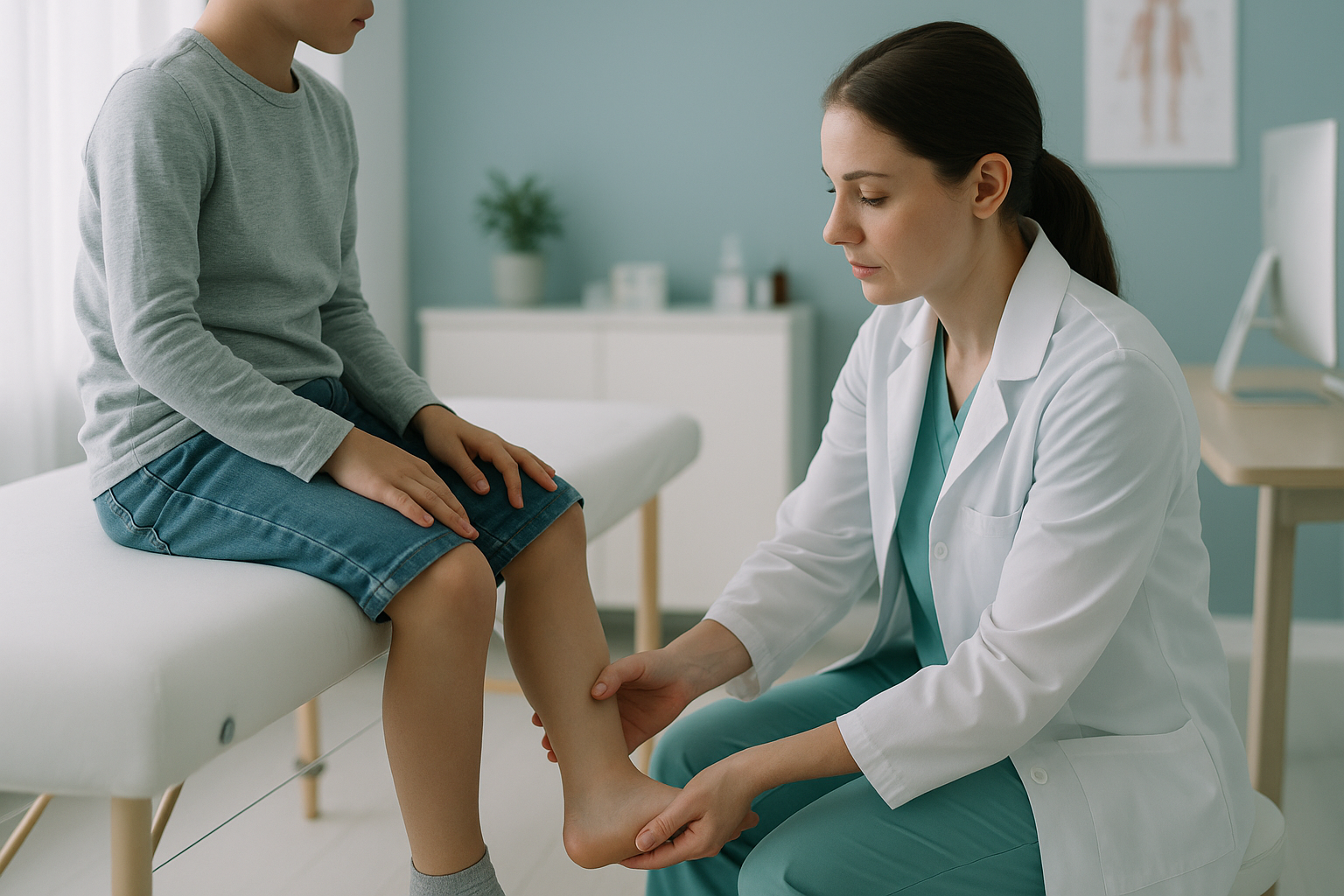
What Is Sever's Disease, and Why Does My Child's Heel Hurt?
Sever's disease, or calcaneal apophysitis, is a common cause of heel pain in growing children. It happens when the growth plate at the back of the heel becomes irritated, usually during a growth spurt. It is not a true "disease." It is a temporary, self-limiting condition that almost always resolves once the growth plate closes.
Key takeaways
- Sever's disease is the most common cause of heel pain in children aged roughly 8 to 14.
- It is caused by stress on the heel's growth plate, often triggered by sport or a growth spurt.
- It is self-limiting. With the right management, children return to full activity.
- Standing imaging can check alignment and rule out other causes of heel pain.
- No surgery is needed. Simple changes to activity and footwear usually help.
If your child limps after football, complains of sore heels during running, or walks on their toes to avoid pain, Sever's disease is one of the first things a clinician will consider. It is extremely common, particularly in active children, and the good news is that it does not cause lasting damage.
What does Sever's disease feel like?
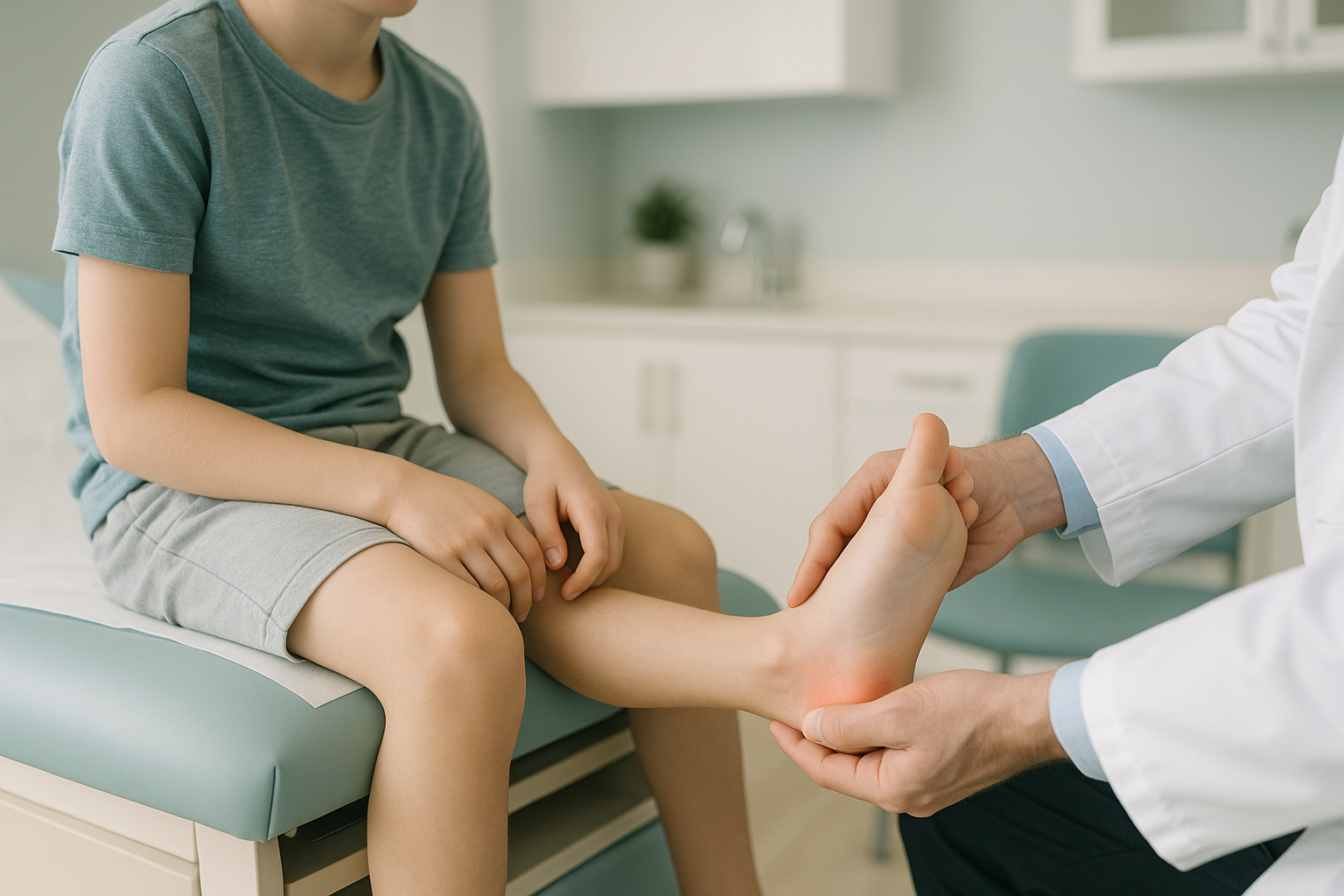
Children with calcaneal apophysitis usually describe pain at the back or underside of one or both heels. The pain typically gets worse with running or jumping and improves with rest.
Aching or sharp pain at the heel during or after running, jumping, or other impact activities.
Walking on tiptoes to keep pressure off the heel, especially after activity.
Up to 60% of children with Sever's disease have pain in both heels, not just one.
Symptoms often flare when the child is growing quickly, then settle down again.
The heel may feel tender when squeezed from the sides. Swelling is usually mild or absent. If your child has redness, fever, or pain that does not improve with rest, see a GP promptly, as these can suggest something else.
What causes Sever's disease in children?
Sever's disease is caused by repetitive stress on the growth plate (apophysis) at the back of the heel bone. During a growth spurt, the bone grows faster than the calf muscle and Achilles tendon can stretch, putting extra pull on that growth plate.
Bone lengthens faster than soft tissue can adapt, increasing tension on the growth plate.
Running, football, gymnastics and other activities on hard surfaces increase repetitive heel loading.
A tight Achilles tendon or calf places more pulling force on the heel bone.
Poor foot alignment can change how force is distributed through the heel, adding stress to the growth plate.
Footwear matters too. Shoes with very little cushioning or no heel support, such as some football boots or plimsolls, can make symptoms worse. If overpronation is part of the picture, orthotics and overpronation are worth understanding.
How is Sever's disease diagnosed, and does my child need imaging?
Sever's disease is usually diagnosed clinically. A physiotherapist or doctor will squeeze the heel, ask about activity patterns, and check for calf tightness. In many cases, no imaging is needed at all.
Imaging becomes useful when symptoms do not settle as expected, when only one heel is involved, or when the clinician wants to rule out other causes such as a stress fracture or bone cyst. A standing X-ray is particularly helpful because it shows the heel bone under the child's actual body weight, revealing alignment issues that a lying-down image can miss.
Paediatric imaging at ScanAlign uses EOS technology, which delivers about 90% less radiation than a standard X-ray, around ten times less. For a growing child, keeping radiation as low as possible is especially important. The scan takes seconds and the child simply stands still.
Because the body works as a connected chain, a tilt in the pelvis or a difference in leg length can change how force reaches the heel. A whole-body standing image captures this full picture, from the spine down to the feet, in a single scan. That context can be just as valuable as seeing the heel itself.
When is MRI more appropriate? EOS shows bones, joints and alignment clearly. If the clinician suspects a soft-tissue problem, such as a tendon tear or a deeper bone issue, MRI is usually the better tool. Your clinician will advise which type of imaging suits your child best.
What helps with Sever's disease, and how long does it last?
Sever's disease is self-limiting. It resolves once the growth plate in the heel closes, which typically happens around age 14 to 16. Most children find that symptoms improve well before then with some straightforward changes.
Reducing training volume or swapping high-impact sessions for lower-impact ones while the heel settles.
Gentle, regular stretches for the calf and Achilles tendon to reduce tension on the heel.
Shoes with good heel cushioning. Heel raises or insoles can reduce stress on the growth plate.
Applying ice for 10 to 15 minutes after sport can ease discomfort.
Complete rest is rarely needed, and most children can stay active at a reduced level. A physiotherapist can put together a return-to-sport plan. The important thing to remember is that Sever's disease does not cause permanent damage. With patience and the right guidance, children get back to doing everything they enjoy.
Wondering whether imaging might help your child? A short video call with our team can help you decide.
Book a free video consultationFrequently asked questions about Sever's disease
Sever's disease most commonly affects children between about 8 and 14 years old. It tends to appear during growth spurts, when the heel bone is growing rapidly.
No. Despite the name, it is not a disease. It is a temporary, self-limiting condition. It does not cause lasting damage to the bone or heel.
It varies. Some children feel better within a few weeks of adjusting activity, while others have episodes that come and go over months. It fully resolves once the heel's growth plate closes, usually by the mid-teens.
Usually, yes. Complete rest is rarely needed. Reducing training intensity, wearing supportive shoes, and stretching the calf often allow children to keep playing. A physiotherapist can help guide a return-to-sport plan.
Not always. Most cases are diagnosed clinically. Imaging is helpful when symptoms do not settle, when only one heel is affected, or when the clinician wants to rule out other conditions such as a stress fracture.
EOS is a standing X-ray system that captures the whole body in a single upright scan. It uses about 90% less radiation than a standard X-ray, around ten times less. For children, keeping the dose as low as possible is especially important. Learn more about ScanAlign, low dose standing imaging.
When a child lies down for a standard X-ray, body weight is removed from the equation. A standing image shows how the bones line up under real load, and whether alignment issues elsewhere, such as a leg-length difference, may be contributing to the heel stress.
No referral is needed. You can book a paediatric assessment directly. A free video consultation with our team is the first step, so we can check imaging is appropriate for your child.
Yes. Other possibilities include a stress fracture, plantar fascia irritation, or a bone cyst, though these are less common. If there is redness, swelling, fever, or the pain does not improve with rest, see a GP or visit A&E for urgent assessment.
Pricing details are available on our website. You can start with a free video consultation, and our team will explain everything, including costs, before you commit.
Concerned about your child's heel pain?
A short video call with our specialist radiographer can help you understand whether imaging is the right next step.
Book a free video consultationSources
- James AM, Williams CM, Haines TP. "Sever's disease: a systematic review of prevalence and management." Journal of Foot and Ankle Research, 2013;6:14.
- NHS. "Heel pain in children (Sever's disease)." NHS inform guidance.
- Micheli LJ, Ireland ML. "Prevention and management of calcaneal apophysitis in children." Journal of Pediatric Orthopaedics, 1987;7(1):34-38.
Written by Abbas Dhami (Specialist Diagnostic Radiographer)
This page is general information and not a diagnosis.
ScanAlign is the trading name of CoreMed Solutions Ltd and operates under The Harley Street Hospital's CQC licence.