
Slipped Upper Femoral Epiphysis: What Is SUFE and Why Does It Need Urgent Attention?
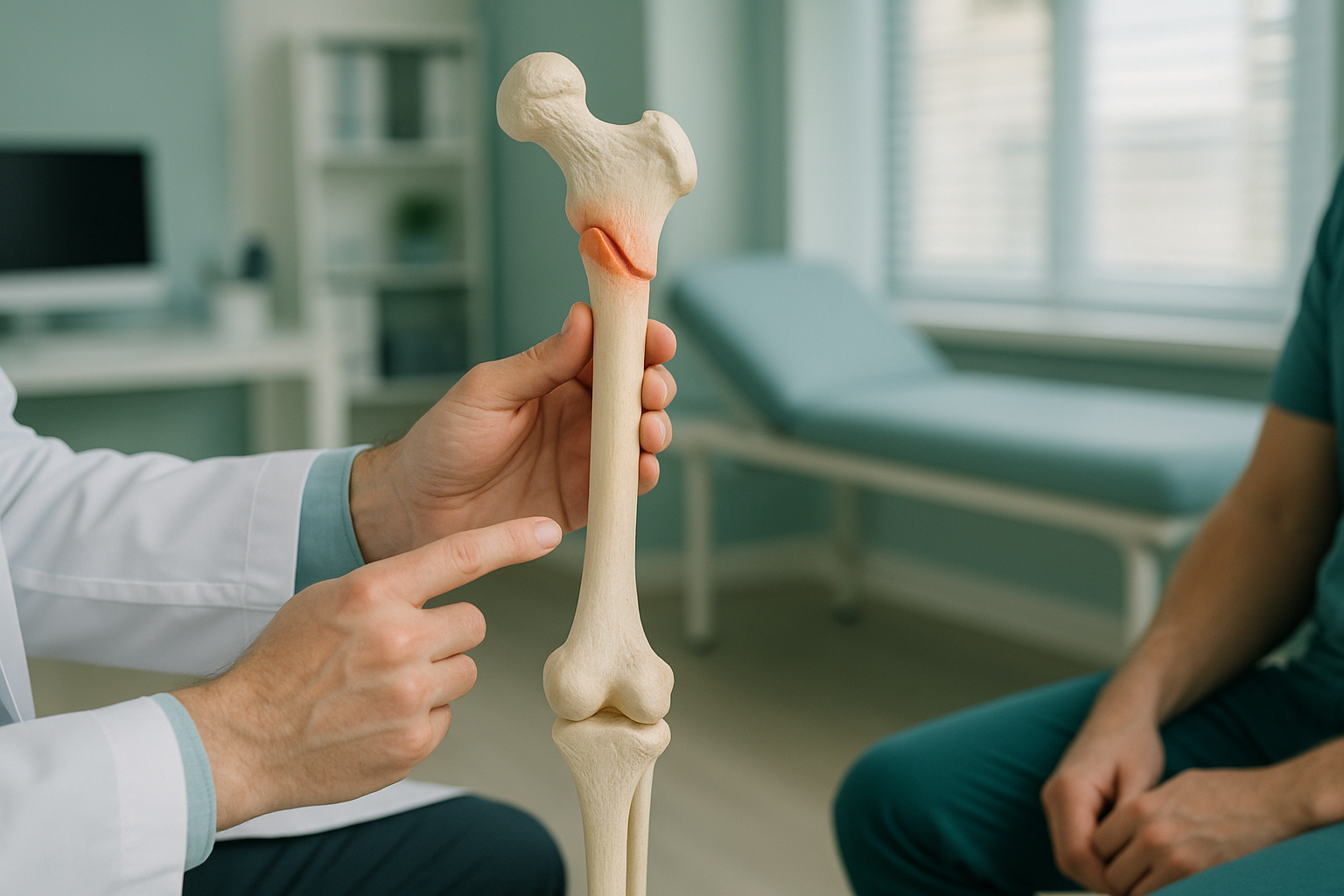
A slipped upper femoral epiphysis (SUFE) happens when the ball at the top of the thigh bone shifts backward on the growth plate. It mainly affects teenagers during growth spurts. SUFE causes hip, groin or knee pain and a limp. It is classed as an orthopaedic emergency because a delay in diagnosis raises the risk of serious complications.
Key takeaways
- SUFE is a growth-plate injury where the femoral head slips out of position.
- It typically occurs during adolescence, often linked to rapid growth or higher body weight.
- Pain can appear in the hip, groin or knee, so knee pain alone should never rule SUFE out.
- Early diagnosis and urgent surgical stabilisation give the best outcomes.
- Standing, weight-bearing imaging can reveal alignment problems that lying-down scans may miss.
SUFE (also called SCFE, slipped capital femoral epiphysis) is the most common adolescent hip disorder. The growth plate at the top of the femur weakens and the ball of the hip joint slips backward and downward. If it is not recognised quickly, the blood supply to the femoral head can be damaged, leading to a condition called avascular necrosis, where the bone tissue begins to die.
Because the pain sometimes only shows up in the knee or thigh rather than the hip itself, SUFE is one of the most commonly delayed diagnoses in adolescent orthopaedics. Understanding the signs matters.
What are the symptoms of a slipped upper femoral epiphysis?
The most common symptoms are a limp, hip or groin pain, and sometimes pain felt only in the knee or thigh. Because the pain can be "referred" away from the hip, teenagers are sometimes investigated for a knee problem while the real issue at the hip goes unrecognised.
A limp that worsens over weeks, or appears suddenly after a minor fall or twist.
Aching or stiffness in the hip or groin. Knee or thigh pain alone is a well-known "trap."
The affected leg often rotates outward when walking or when the hip is bent. This is a key clinical sign.
Difficulty turning the hip inward, bending it fully, or sitting cross-legged.
Urgent advice: If your child has sudden, severe hip pain and cannot put weight on the leg, this may be an acute or unstable slip. Seek urgent medical attention through your GP, 111 or A&E straight away. Do not wait for an outpatient scan.
What causes a slipped upper femoral epiphysis?
The growth plate weakens during rapid growth, and the combination of body weight and mechanical stress causes the femoral head to slip. The exact trigger is not always clear, but several factors increase the risk.
Growth spurts during adolescence temporarily weaken the growth plate.
Obesity is a recognised risk factor, increasing the mechanical load on the growth plate.
Some endocrine conditions (such as hypothyroidism) can weaken the growth plate further.
SUFE most commonly appears between the ages of 10 and 16. It is more frequent in boys than girls. Importantly, there is a bilateral risk: after a slip on one side, there is a meaningful chance of the other hip being affected too, so both sides are usually monitored.
How is a slipped upper femoral epiphysis diagnosed?
SUFE is diagnosed with a combination of clinical examination and imaging. A doctor will check hip movement, looking for the hallmark sign of the leg rotating outward when the hip is bent. X-rays of both hips, including a specific lateral view, confirm the slip.
Early and mild slips can be subtle on a standard front-on X-ray alone, which is one reason a lateral view is so important. If the clinical suspicion is high but X-rays appear normal, an MRI may be used to detect a very early, "pre-slip" stage.
When MRI is the better tool: EOS and X-ray are excellent for showing bone position and alignment. For looking at the blood supply to the femoral head, cartilage damage or very early pre-slip changes, MRI is usually the better choice. The two types of imaging work best together.
Delayed diagnosis is a well-documented problem with SUFE. Studies show that the average time from first symptoms to diagnosis can be many weeks, especially when the pain is felt only in the knee. Any adolescent with an unexplained limp, hip stiffness, or knee pain without a clear knee injury should have their hips checked.
How is SUFE treated?
SUFE is treated surgically. The standard procedure is urgent pinning (in-situ fixation), where a screw is placed across the growth plate to stop the slip getting worse and to allow healing. The goal is to stabilise the hip before any further displacement occurs.
The urgency depends on how the slip is classified. An "unstable" slip, where the teenager cannot bear weight at all, is treated as an emergency. A "stable" slip, where they can still walk with pain, is still treated promptly, usually within days.
After surgery, the orthopaedic team monitors both hips over time. Because of the bilateral risk, the other hip may also be pinned preventatively in some cases. Long-term follow-up watches for complications such as avascular necrosis or early wear of the joint.
ScanAlign does not provide treatment. It is a diagnostic imaging service. If SUFE is suspected, the priority is always the treating surgical team. Imaging can play a supporting role in follow-up, assessing alignment and recovery over time.
How does standing imaging help after SUFE?
Standing, weight-bearing imaging captures the skeleton under real-life loading conditions. When you lie down for a conventional X-ray, CT or MRI, gravity is removed and muscles relax. This can mask alignment differences that only appear when standing.
After SUFE treatment, understanding how the hip sits in relation to the pelvis, spine and legs while standing gives a more complete picture. A slip on one side can cause the pelvis to tilt, the spine to compensate, and the opposite leg to bear load differently. These knock-on effects are part of the body's connected chain from feet to head, and they only show up under weight-bearing conditions.
EOS imaging uses about 90% less radiation than a standard X-ray, around ten times less. For young patients who may need repeated imaging over years of follow-up, keeping the radiation dose as low as possible is especially important.
At ScanAlign, low dose standing imaging, the EOS system captures a full-length view of the skeleton in one standing exposure, allowing clinicians to see the whole alignment picture rather than focusing on just the hip in isolation. Learn more about paediatric imaging at ScanAlign.
If your child has been treated for SUFE and you want a clear picture of their whole-body alignment during recovery, we can help.
Book a free video consultationIs SUFE linked to other hip conditions?
SUFE is a separate condition from developmental dysplasia of the hip (DDH), which involves the hip socket being too shallow. However, both conditions affect hip alignment during growth and can have long-term consequences for joint mechanics if not managed well. They are diagnosed and treated differently, but the principle of checking whole-body alignment applies to both.
Frequently asked questions about SUFE
SUFE is a condition where the ball at the top of the thigh bone (femoral head) slips backward on the growth plate. It typically affects adolescents during growth spurts and requires urgent surgical treatment to prevent further damage.
They are the same condition. SUFE stands for slipped upper femoral epiphysis, the term commonly used in the UK. SCFE stands for slipped capital femoral epiphysis, which is the term more widely used in North America. Both describe the same growth-plate slip at the top of the thigh bone.
The hip and knee share some of the same nerve supply. When the hip joint is irritated, pain signals can be "referred" along those nerves and felt in the knee or thigh. This is why any adolescent with unexplained knee pain and a limp should also have their hips examined.
Yes. There is a recognised bilateral risk. After a slip on one side, the other hip is monitored closely and may be pinned preventatively. Both hips are usually X-rayed at diagnosis and followed up over time.
Without prompt treatment, the slip can worsen and the blood supply to the femoral head may be disrupted, leading to avascular necrosis. This can cause lasting damage to the joint and may eventually require more complex surgery.
EOS uses about 90% less radiation than a standard X-ray, around ten times less. This makes it a particularly low-dose option for younger patients who may need repeated imaging during follow-up.
No. ScanAlign accepts self-referrals. You can book directly by starting with a free video consultation, where a specialist radiographer reviews your situation before any scan takes place.
Full pricing details are available on the ScanAlign FAQs and cost page.
A standard X-ray usually images one area at a time, often while lying down. EOS captures a full-length standing image from head to feet in a single pass, showing how the whole skeleton is aligned under natural weight-bearing conditions. It also uses significantly less radiation.
ScanAlign is a diagnostic imaging clinic, not a treatment centre. If SUFE is suspected or has been treated, ScanAlign can provide standing alignment imaging to support ongoing care. Diagnosis and surgical treatment are carried out by the treating orthopaedic team.
Want a clearer picture of hip alignment?
A free video consultation with a specialist radiographer is the first step. No referral needed.
Book a free video consultationWritten by Abbas Dhami (Specialist Diagnostic Radiographer)
Sources
- Loder RT, Skopelja EN. The epidemiology and demographics of slipped capital femoral epiphysis. ISRN Orthopedics. 2011;2011:486512.
- NHS. Slipped upper femoral epiphysis (SUFE). NHS Conditions. Available at: nhs.uk.
- British Orthopaedic Association. BOAST Guidelines: The Management of Children with Acute and Acutely Displaced SUFE. BOA/BSCOS, 2018.
This page is general information and not a diagnosis.
ScanAlign is the trading name of CoreMed Solutions Ltd and operates under The Harley Street Hospital's CQC licence.