
What Is Cauda Equina Syndrome, and When Is Back Pain an Emergency?
If you have sudden back pain with any of these symptoms, go to A&E or call 999 now:
Numbness between your legs (saddle area), loss of bladder or bowel control, sudden weakness in both legs. This is a medical emergency. Do not wait, do not book a scan. Get emergency help immediately.
Cauda equina syndrome is a rare but serious condition where the bundle of nerves at the base of the spine becomes compressed. It can cause loss of bladder or bowel control, numbness between the legs, and weakness in both legs. It needs emergency hospital treatment, usually within hours. It is not something to manage with a routine scan or appointment.
Key takeaways
- Cauda equina syndrome is a medical emergency. Go to A&E, not a clinic.
- Red flag symptoms include saddle numbness, bladder or bowel changes, and bilateral leg weakness.
- An urgent MRI at hospital is the standard way to diagnose it.
- After the emergency has been treated, standing imaging can help assess longer-term spinal alignment.
- Most back pain is not cauda equina syndrome, but knowing the warning signs could save your nerve function.
What is cauda equina syndrome?
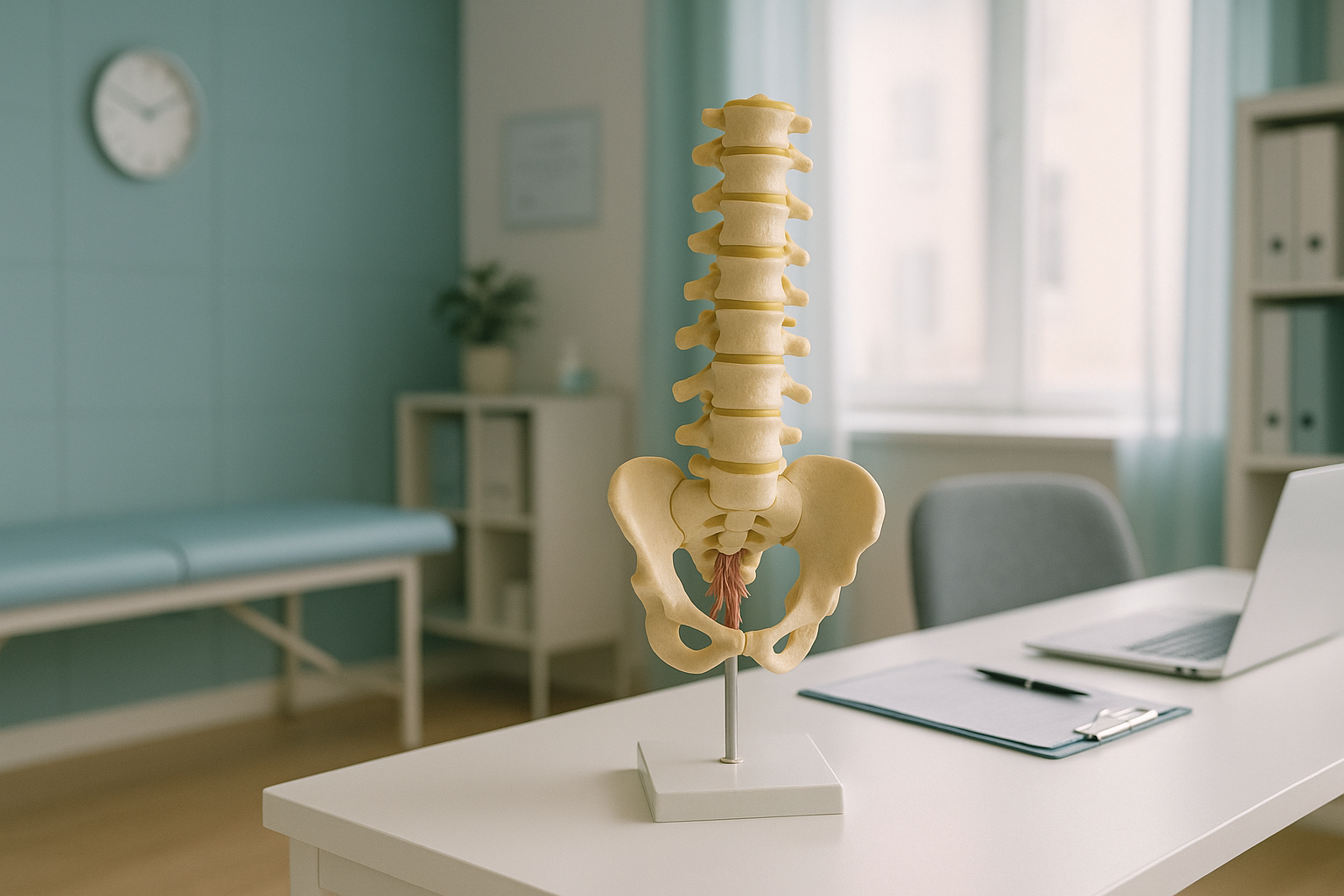
Cauda equina syndrome (CES) happens when the cauda equina, a bundle of nerve roots at the bottom of the spinal cord, is squeezed or damaged. "Cauda equina" is Latin for "horse's tail," which describes how these nerves fan out at the base of the spine. These nerves control sensation in the saddle area (between your legs), bladder and bowel function, and movement in your legs.
When something presses on this nerve bundle hard enough, the signals travelling along those nerves are disrupted. Without prompt treatment, the damage can become permanent. That is why CES is treated as one of the most time-critical conditions in spinal medicine.
What are the red flag symptoms of cauda equina syndrome?
The red flag symptoms are specific warning signs that set cauda equina syndrome apart from ordinary back pain. If you experience any combination of the following, treat it as an emergency.
Loss of feeling in the area that would sit on a saddle: inner thighs, buttocks, genitals, and the area around the back passage.
Difficulty starting or stopping urination, not knowing when your bladder is full, or loss of bowel control.
Weakness or heaviness in both legs, difficulty walking, or feet dragging on the ground.
Sudden loss of sensation or function. This can develop alongside the other symptoms.
These symptoms can appear alongside severe lower back pain, or sometimes even when the back pain itself is relatively mild. The key point is the combination of nerve-related changes, not the severity of the pain.
If you are unsure, call NHS 111 or go to your nearest A&E. It is always better to be checked and reassured than to wait and risk permanent nerve damage.
What causes cauda equina syndrome?
The most common cause is a large lumbar disc prolapse, where the soft centre of a disc in the lower back pushes out and presses directly on the nerve bundle. Other causes include:
A large disc herniation in the lower back that compresses the nerve roots.
Severe narrowing of the spinal canal in the lower back.
A growth or abscess pressing on the nerves. Rarer, but important to rule out.
A fracture or injury to the lower spine, for example from a fall or accident.
In some cases, nerve root compression from a smaller disc problem affects only one nerve and is not CES. The critical difference is that CES involves multiple nerve roots at once, which is why the symptoms affect both sides of the body and involve bladder or bowel function.
How is cauda equina syndrome diagnosed?
An urgent MRI scan at hospital is the standard way to diagnose cauda equina syndrome. MRI is the best tool here because it shows the soft tissues in detail, including the discs, the nerve roots, and any swelling or compression around them.
When a patient arrives at A&E with suspected CES, the medical team will carry out a clinical examination and, if CES is considered likely, arrange an emergency MRI. This needs to happen quickly. Treatment, usually decompression surgery to relieve the pressure on the nerves, is time-critical. The sooner the pressure is removed, the better the chance of preserving nerve function.
Why MRI, not an EOS scan? EOS imaging shows bones, joints, and whole-body alignment beautifully, but for a suspected cauda equina emergency, MRI is the right tool. MRI shows the soft tissues, discs, and nerves that are at the centre of this condition. An EOS scan is not a substitute for emergency MRI and is not the right first step if you have red flag symptoms.
Can a standing scan help after cauda equina syndrome treatment?
Yes, but only after the emergency has been fully managed and you are in the recovery or follow-up phase. Once you have been treated in hospital and discharged, you may be left with questions about your spinal alignment, ongoing lower back pain, or how your posture has changed.
This is where standing, weight-bearing imaging can add value. Standard lying-down scans relax the muscles and can hide alignment problems that only appear when you are upright and your spine is loaded by gravity. Your body is a connected chain from feet to head, and a problem in one area can make another area compensate. A whole-body standing scan captures the full picture of how your spine, pelvis, hips, and legs are working together under load.
If you are recovering from CES and want to understand your longer-term spinal alignment, you can check whether a scan is right for you through a free video consultation. This is only appropriate once your emergency treatment is complete and your specialist is happy for you to proceed.
You may also find it helpful to read about when to see a specialist for ongoing spinal concerns, or to find out who our scan is suitable for.
Frequently asked questions about cauda equina syndrome
CES is treated as a surgical emergency. The goal is to relieve the pressure on the nerves as soon as possible, ideally within hours of symptoms starting. Delays increase the risk of permanent damage to bladder, bowel, and leg function.
No. A disc prolapse (sometimes called a slipped disc) is the most common cause of CES, but most disc prolapses do not lead to CES. CES only occurs when a very large disc herniation, or another cause, compresses the entire nerve bundle at the base of the spine.
Saddle numbness is a loss of sensation in the area that would touch a saddle if you were sitting on a horse. It covers the inner thighs, buttocks, perineum, and genitals. You might notice you cannot feel toilet paper properly, or that the area feels "dead" or strange.
It is unusual but possible. Some people develop the nerve-related symptoms (numbness, bladder changes, leg weakness) with only mild or no back pain. The nerve symptoms are the key warning signs, not the pain level itself.
Go to A&E directly or call 999. Do not wait for a GP appointment. CES is time-critical and hospitals have the facilities for emergency MRI and surgery.
No. An EOS scan is not the right tool for suspected CES. Emergency MRI at hospital is the standard investigation because it shows the soft tissues, nerves, and discs in the detail needed. EOS imaging may be helpful later, during recovery, to assess spinal alignment and posture.
Without prompt treatment, the nerve damage can become permanent. This may mean long-term problems with bladder and bowel control, sexual function, and weakness or numbness in the legs. Early treatment gives the best chance of recovery.
CES is rare. It affects a small number of people with lower back problems. However, because the consequences of missing it are so serious, it is one of the most important diagnoses for healthcare professionals to rule out when someone presents with back pain and nerve symptoms.
Recurrence is uncommon but possible, for example if another disc prolapses at the same or a different level. After surgery, your specialist will usually monitor your recovery and advise on how to reduce the risk.
Once the emergency has been treated, a standing whole-body scan can show how your spine, pelvis, and legs are aligned under gravity. This may help your specialist understand ongoing pain, posture changes, or compensation patterns that a lying-down scan might miss. It is only relevant after the acute phase, not as an emergency investigation.
Recovering from a spinal emergency?
If your emergency treatment is complete and you want to understand your spinal alignment going forward, we can help with a standing whole-body assessment.
Book a free video consultationWritten by Abbas Dhami (Specialist Diagnostic Radiographer), ScanAlign, 19 Harley Street, London.
Sources
- NHS. Cauda equina syndrome. nhs.uk. Accessed 2024.
- British Association of Spine Surgeons (BASS). Cauda equina syndrome: patient information. spinesurgeons.ac.uk. Accessed 2024.
- Todd NV. Cauda equina syndrome: the timing of surgery probably does matter. British Journal of Neurosurgery, 2005;19(4):301-306.
This page is general information and not a diagnosis.
ScanAlign is the trading name of CoreMed Solutions Ltd and operates under The Harley Street Hospital's CQC licence.