
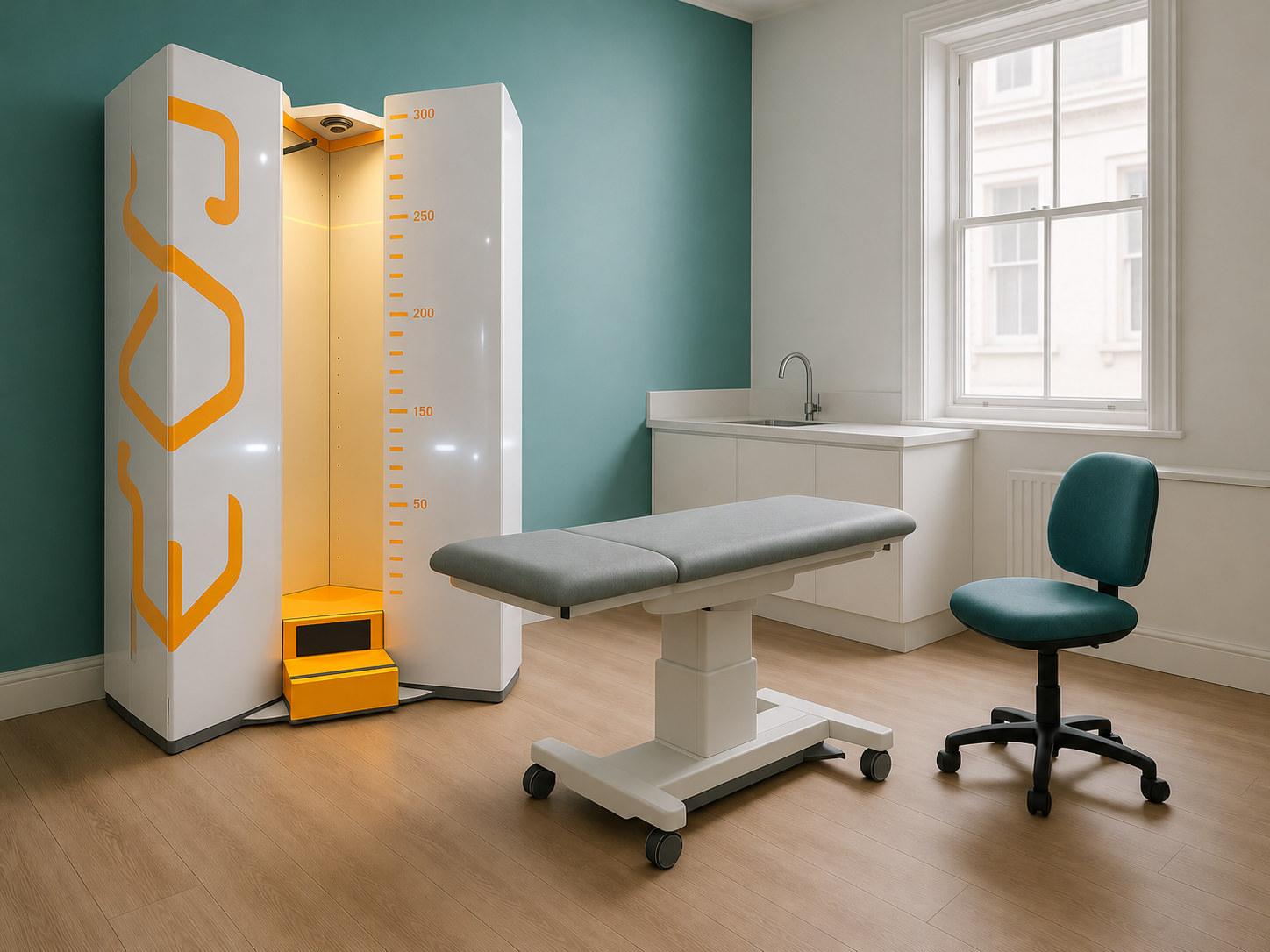
Where Can You Get an EOS Scan in London?
ScanAlign offers private, self-pay EOS imaging at 19 Harley Street in central London. EOS scans you standing up, capturing your full body in one image with about 90% less radiation than a standard X-ray. No GP referral is needed, and you can book directly.
Key takeaways
- EOS imaging is uncommon in the UK, but available privately in London at ScanAlign on Harley Street.
- The scan is done standing up, so it shows how your skeleton truly loads under gravity.
- About 90% less radiation than a standard X-ray, around ten times less.
- Self-referral is welcome. No GP letter required.
- A free video consultation helps confirm the scan is right for you before you commit.
If you have been searching for an EOS scan in London, you have probably noticed how few clinics offer this technology. EOS imaging is still uncommon across the UK, which means finding a clinic can take some research. This page explains exactly what ScanAlign provides, where to find us, and how to get started.
Why does a standing EOS scan show more than lying-down imaging?
A standing scan captures your skeleton the way it actually works, under the full force of gravity. When you lie down for a conventional X-ray, CT or MRI, your muscles relax and your joints settle into a resting position. That can mask alignment problems that only appear when your body is upright and weight-bearing.
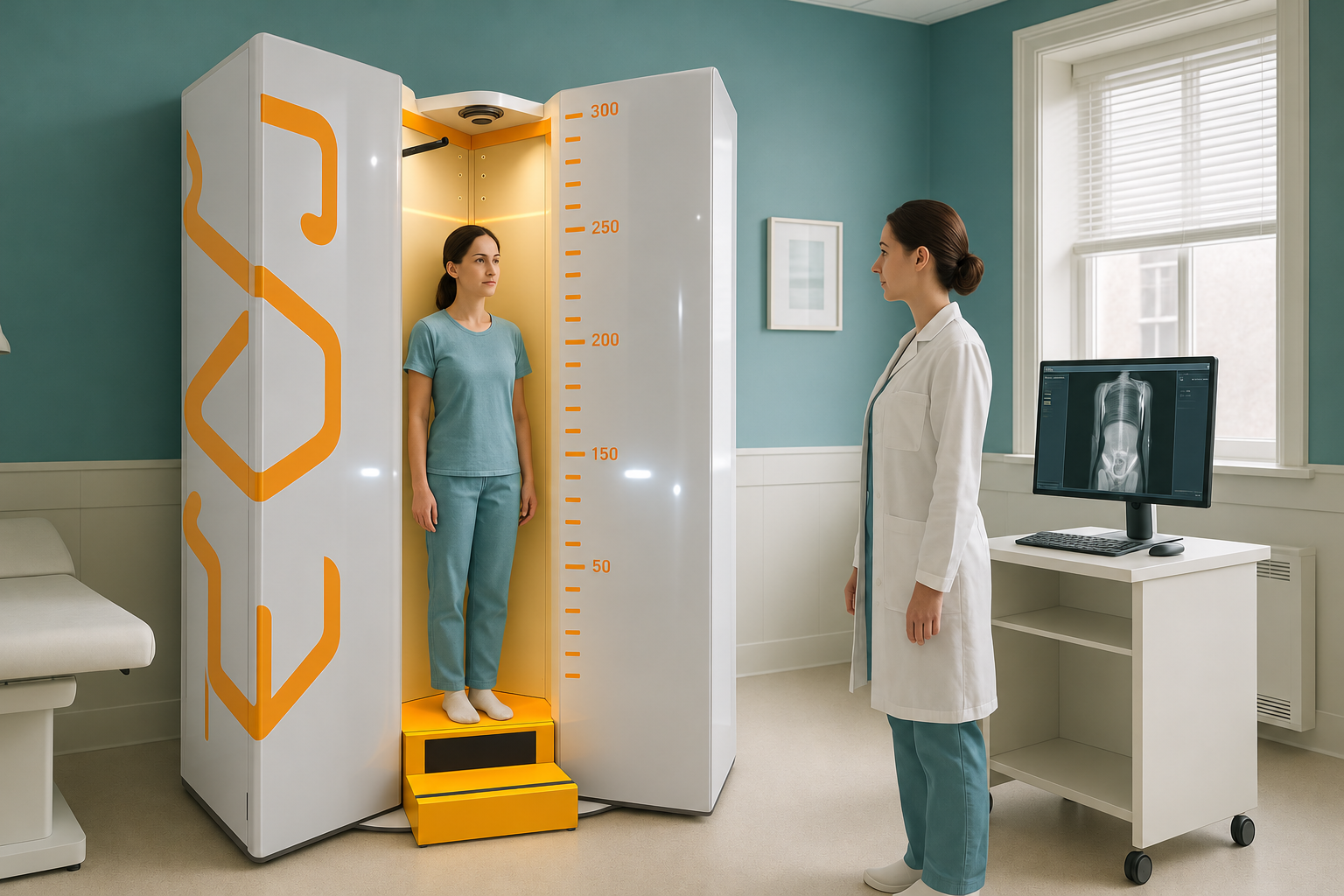
Your body works as a connected chain, from your feet up through your knees, hips, spine and head. A tilt or shift in one area forces another area to compensate. That compensation is often where the pain shows up, not where the problem started. An EOS standing x-ray reveals these whole-body relationships in a single image, which is something a focused lying-down scan of just one joint simply cannot do.
Where is ScanAlign located in London?
ScanAlign is based at 19 Harley Street, London, W1G 9QJ. This is in the heart of London's medical district, a short walk from several Tube stations and well served by bus routes.
Learn more about ScanAlign and why we chose Harley Street as the base for standing alignment imaging.
How does booking an EOS scan in London work?
The process is straightforward. You do not need a GP letter, a consultant referral or private health insurance. ScanAlign is a self-pay clinic, and you can refer yourself.
Free video consultation
A short call to discuss your symptoms and confirm an EOS scan is the right next step. This is free and without obligation.
Attend 19 Harley Street
You walk into the EOS scanner and stand naturally. The scan captures your full skeleton from head to feet in seconds.
Specialist analysis
Your images are analysed for whole-body alignment, identifying any asymmetry or compensation pattern across your joints and spine.
Your report
You receive a detailed report you can share with your GP, physiotherapist, osteopath, surgeon or any treating clinician.
For details on pricing, visit the EOS scan cost page.
Ready to find out if an EOS scan is right for you?
Book a free video consultationWho should consider an EOS scan in London?
An EOS scan is particularly useful if you have had pain or a structural concern that has not been fully explained by previous imaging. Because it captures your whole body standing up, it often reveals what single-area scans miss.
- Chronic back, hip or knee pain without a clear diagnosis
- Uneven posture, a leg length difference or pelvic tilt
- Pre-operative planning for spinal, hip or knee surgery
- Post-operative follow-up to check alignment after a joint replacement
- Scoliosis monitoring in adults
- Soft-tissue injuries such as ligament or tendon tears
- Disc herniations or nerve compression (MRI is usually better)
- Acute fractures requiring emergency imaging
When MRI is the better choice: EOS is excellent for bones, joints and whole-body alignment. For soft tissue, discs or nerves, MRI is usually the better tool. If you are unsure which you need, the free video consultation will help you decide.
Explore our EOS scan service for a full overview of what the technology captures and how the images are used.
What makes an EOS scan different from a normal X-ray?
A standard X-ray focuses on one small area and is usually taken while you are lying down. EOS captures your full body from head to feet in a single standing exposure, using about 90% less radiation than a standard X-ray, around ten times less. This combination of low dose, standing position and whole-body coverage is what makes EOS so useful for alignment assessment.
The whole-body view lets the specialist see how every joint relates to every other. If your pelvis is tilted, for example, the image shows exactly how your spine and knees have adapted. That chain of compensation is invisible on a scan of just one area.
Read more about ScanAlign, standing EOS imaging in London and why the standing position matters for diagnosis.
Frequently asked questions about EOS scans in London
No. ScanAlign is a self-referral clinic. You can book directly without a GP letter or consultant referral.
Visit the EOS scan cost page for current pricing information. ScanAlign is a self-pay clinic.
Yes. EOS uses about 90% less radiation than a standard X-ray, around ten times less. It is one of the lowest-dose skeletal imaging technologies available.
The scan itself takes seconds. Your total appointment, including positioning and any questions, is a short visit.
Wear comfortable clothing without metal fastenings such as zips or buckles. You may be asked to change into a gown depending on the scan area.
As with any X-ray based imaging, EOS is generally not recommended during pregnancy. Please let the team know if you are or might be pregnant before booking.
No. EOS technology is uncommon in the UK, but other clinics also offer it, including elsewhere on Harley Street. ScanAlign specialises in standing whole-body alignment assessment using EOS.
Absolutely. Your report is yours. You can share it with your GP, physiotherapist, osteopath, surgeon or any treating clinician.
EOS shows bones, joints and whole-body alignment in a standing position. MRI is better for soft tissue, discs and nerves. They answer different clinical questions, and sometimes you need both.
The nearest Tube stations are Oxford Circus (Bakerloo, Central, Victoria lines), Regent's Park (Bakerloo line) and Great Portland Street (Circle, Hammersmith & City, Metropolitan lines). Several bus routes also serve the area.
Ready to book your London EOS scan?
Start with a free, no-obligation video call to discuss your symptoms and find out whether a standing EOS scan is the right next step.
Book a free video consultationSources
- Deschênes S, et al. "Diagnostic imaging of spinal deformities: reducing patients' radiation dose with a new slot-scanning X-ray imager." Spine, 2010;35(9):989-994. PubMed.
- Illés T, Somoskeöy S. "The EOS imaging system and its uses in daily orthopaedic practice." International Orthopaedics, 2012;36(7):1405-1411. PubMed.
- NHS. "X-ray: How it is performed." NHS website, accessed 2024.
Author: Abbas Dhami (Specialist Diagnostic Radiographer)
This page is general information and not a diagnosis.
ScanAlign is the trading name of CoreMed Solutions Ltd and operates under The Harley Street Hospital's CQC licence.