
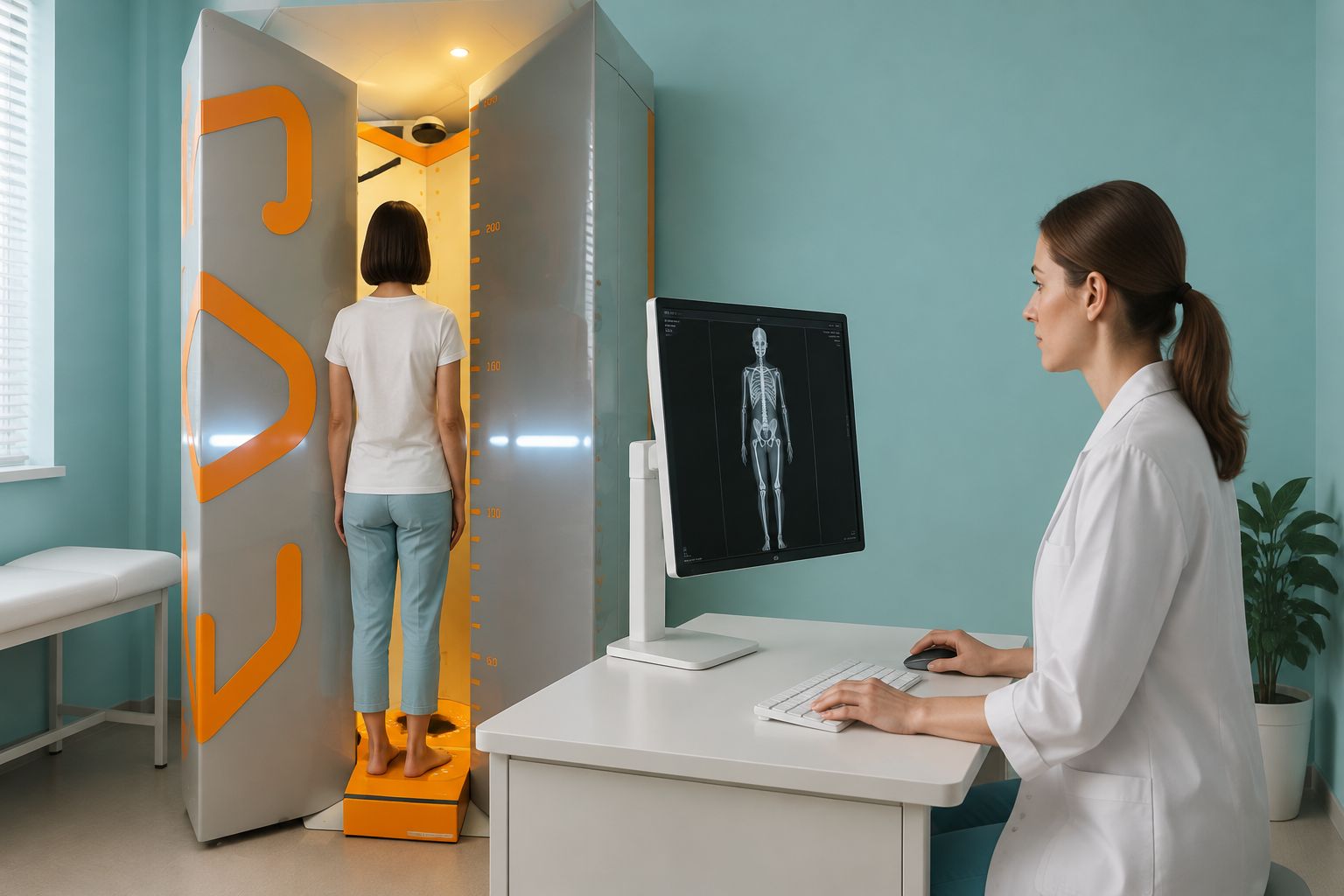
EOS Low-Dose Standing X-ray: What Is It and Why Does It Matter?
An EOS standing X-ray captures your entire skeleton, from head to feet, in a single upright image using about 90% less radiation than a standard X-ray, around ten times less. Because you are standing and weight-bearing, it shows how your bones and joints truly align under gravity, something lying-down scans cannot do.
Key takeaways
- EOS scans you standing up, capturing your whole body in one low-dose image.
- It uses about 90% less radiation than a standard X-ray, around ten times less.
- Standing imaging reveals alignment problems that lying-down scans can miss.
- Pain often appears away from its true cause. EOS helps trace the full chain.
- No referral is needed. ScanAlign is a private, self-pay clinic at 19 Harley Street.
What is an EOS scan and how does it work?
An EOS scan is a type of X-ray that photographs your whole skeleton in one pass while you stand naturally inside an open booth. Two very fine X-ray beams sweep from head to toe simultaneously, one from the front and one from the side, producing a detailed full-length image in under a minute.
The technology was developed from Nobel Prize-winning physics research. Its detectors are extremely sensitive, so they need far less radiation to produce a clear image. The result is about 90% less radiation than a standard X-ray, around ten times less.
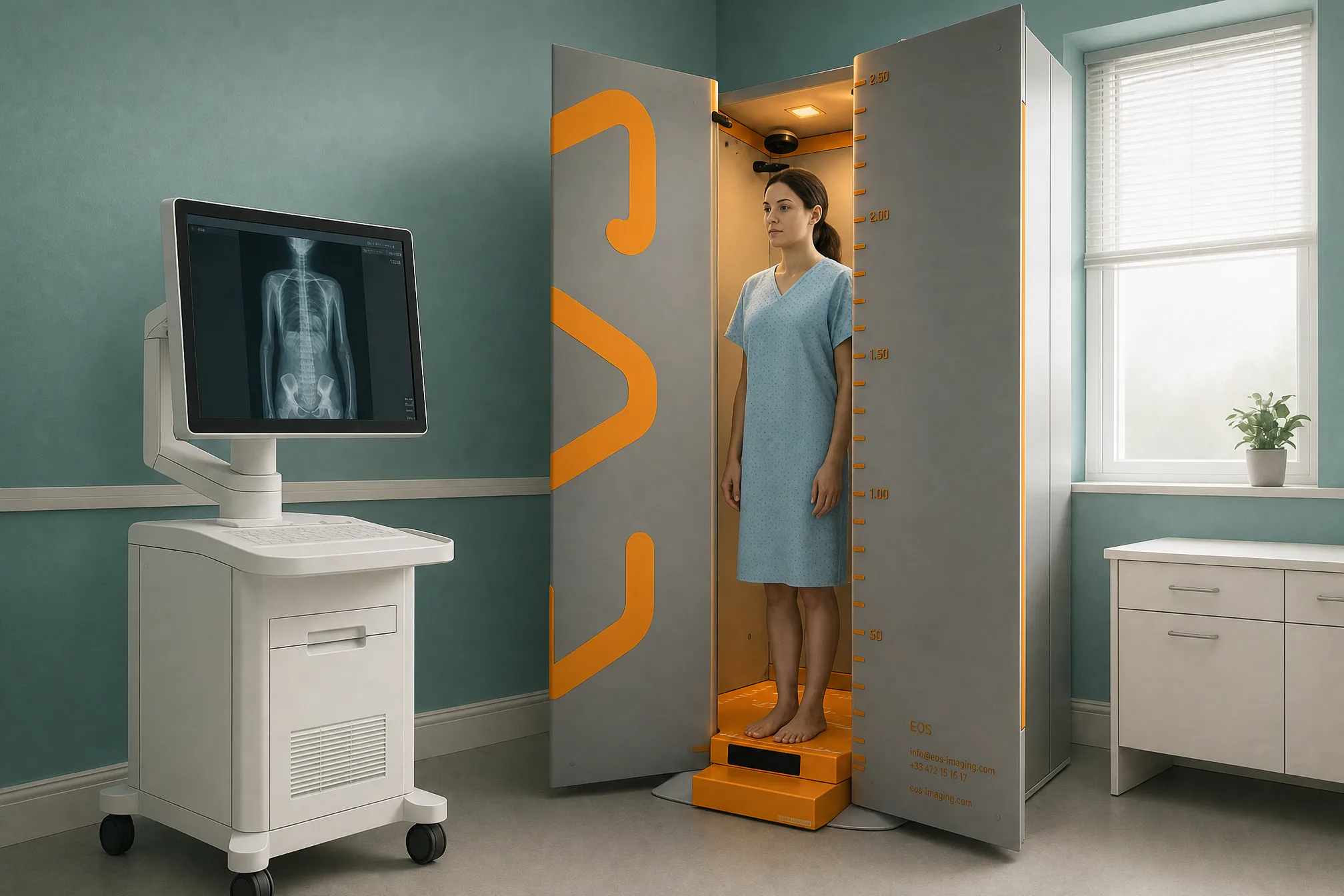
Unlike a CT scanner, the EOS booth is open and spacious. There is no tunnel or enclosed space, so it is comfortable even if you feel uneasy in tight spaces.
Why does standing up during an X-ray make a difference?
Standing up changes everything. When you lie down for a conventional X-ray, CT or MRI, gravity is no longer pressing through your skeleton. Your muscles relax, your curves flatten, and your joints shift into a position they are never in during daily life. The image may look reassuring, but it is not showing how your body actually works.
An EOS standing X-ray captures you weight-bearing, exactly as you walk, stand and sit. It reveals the true angles of your spine, the real tilt of your pelvis, and how your knees and hips line up under load. Problems that vanish when you lie flat, such as a subtle leg-length difference or a pelvis that drops to one side, become visible.
Want to understand how standing imaging could help your specific problem?
Book a free video consultationWhat does an EOS scan show that other imaging misses?
An EOS scan shows the full mechanical chain of your skeleton in one image. That means your specialist can see how a problem in one area affects everywhere else. Your body is a connected system from your feet to your head. A shift at the ankle can tilt the knee, rotate the hip, curve the spine and tip the shoulders. Pain often appears far from where the problem started.
See every curve in your spine while gravity and your muscles hold it in its natural position.
Detect a pelvic tilt or rotation that only shows when you are upright and weight-bearing.
Measure how your knees track over your feet and spot leg-length differences under load.
Trace how a shift in one joint forces other joints to compensate, revealing the real source.
Single-area imaging, such as an X-ray of just your knee, only shows that one joint in isolation. It cannot reveal that the knee pain might be driven by a hip rotation above or a flat foot below. EOS gives the complete picture.
When is MRI the better choice? EOS is excellent for bones, joints and alignment. For soft-tissue problems, such as disc injuries, torn ligaments or nerve compression, MRI is usually the better tool. Your specialist can advise which scan you need, or whether you might benefit from both.
Is an EOS X-ray safe and how much radiation is involved?
Yes. An EOS scan uses about 90% less radiation than a standard X-ray, around ten times less. That makes it one of the lowest-dose skeletal imaging options available. The scan is quick, painless and non-invasive.
The low dose also means it is practical for follow-up imaging if your clinician needs to monitor changes over time, without building up unnecessary exposure.
What happens during an EOS scan at ScanAlign?
The process is straightforward. Here is what a typical visit looks like.
Free video consultation
You speak with a specialist radiographer who listens to your symptoms, reviews your history and confirms whether an EOS scan is the right next step.
Arrive at 19 Harley Street
You arrive at the clinic in central London. There is no preparation needed. You can eat and drink as normal beforehand.
Stand in the scanner
You step into the open EOS booth and stand still for a short time while the two beams scan from head to toe. No tunnel, no noise, no injections.
Receive your report
Your images are reviewed by a specialist. You receive a detailed report that you can share with your consultant, surgeon or physiotherapist.
No GP referral is required. ScanAlign is a private, self-pay clinic. For details about cost, visit the FAQs and pricing page.
Who should consider an EOS standing X-ray?
An EOS scan is most useful for adults with long-standing or unexplained problems in the back, hip, knee or posture that have not been fully explained by other scans. It is a diagnostic imaging tool, not a treatment, but it often provides the missing piece that guides better treatment decisions elsewhere.
- Persistent back, hip or knee pain without a clear diagnosis
- A posture concern or visible asymmetry
- Previous imaging that showed "nothing wrong" but you still have symptoms
- A planned joint replacement or spinal procedure needing alignment data
- A need for low-dose follow-up imaging over time
- Soft-tissue injuries such as disc tears, ligament damage or nerve problems (MRI is better)
- Acute fractures or trauma (go to A&E)
- Internal organ conditions unrelated to the skeleton
If you are experiencing sudden numbness, weakness, or loss of bladder or bowel control, please seek urgent medical attention through your GP, 111 or A&E rather than booking a scan.
What areas of the body can EOS imaging assess?
Because EOS captures your full skeleton in one standing image, it is useful across a range of musculoskeletal concerns. Below are the areas where alignment imaging adds the most value.
Scoliosis, lordosis, kyphosis and posture problems assessed under natural weight-bearing.
Learn more → Hip Hip alignment and pelvic tiltHip position, pelvic balance and pre- or post-surgical alignment checks.
Learn more → Knee Knee and leg alignmentMechanical axis measurement, knock knees, bow legs and pre-replacement planning.
Learn more →Frequently asked questions about EOS standing X-rays
An EOS scan is used to capture a full-length, weight-bearing image of your skeleton. It is particularly useful for assessing spinal alignment, pelvic balance, and leg or knee positioning, helping clinicians understand how your whole body works together under gravity.
An EOS scan uses about 90% less radiation than a standard X-ray, around ten times less. This makes it one of the lowest-dose skeletal imaging methods available.
No. ScanAlign is a private, self-pay clinic. You can refer yourself directly without needing a letter from your GP.
A normal X-ray usually images one body part at a time, often while you are lying down. An EOS scan captures your entire skeleton in one standing image with far less radiation, so it reveals how your bones and joints align under your own body weight.
They answer different questions. EOS is excellent for bones, joints and whole-body alignment. MRI is usually the better tool for soft-tissue problems such as disc injuries, ligament tears or nerve compression. In some cases, both scans together give the most complete picture.
The scan itself takes under a minute. Your total visit, including positioning and any questions, is typically quite brief. No special preparation is needed.
For current pricing details, please visit the FAQs and pricing page.
When you lie down, gravity is no longer pressing through your skeleton. Your muscles relax, curves flatten and joint positions change. A standing X-ray captures how your body actually carries load, revealing alignment problems that lying-down scans can miss entirely.
No. The EOS booth is open and spacious, nothing like an MRI tunnel. You simply stand inside for the duration of the scan. Most people find it very comfortable.
ScanAlign is at 19 Harley Street, London, within The Harley Street Hospital. It is easily accessible by public transport, with several underground stations nearby.
Ready to see the full picture?
Speak with a specialist radiographer in a free video consultation. No referral needed, no obligation.
Book a free video consultationSources
- Deschênes S, et al. "Diagnostic imaging of spinal deformities: reducing patients' radiation dose with a new slot-scanning X-ray imager." Spine, 2010. Published by Lippincott Williams & Wilkins.
- Melhem E, et al. "EOS biplanar X-ray imaging: concept, developments, benefits, and limitations." Journal of Children's Orthopaedics, 2016;10(1):1-14.
- NHS. "X-ray: How it is performed." NHS.uk. Available at: nhs.uk/conditions/x-ray.
Written by Abbas Dhami (Specialist Diagnostic Radiographer)
This page is general information and not a diagnosis.
ScanAlign is the trading name of CoreMed Solutions Ltd and operates under The Harley Street Hospital's CQC licence.