
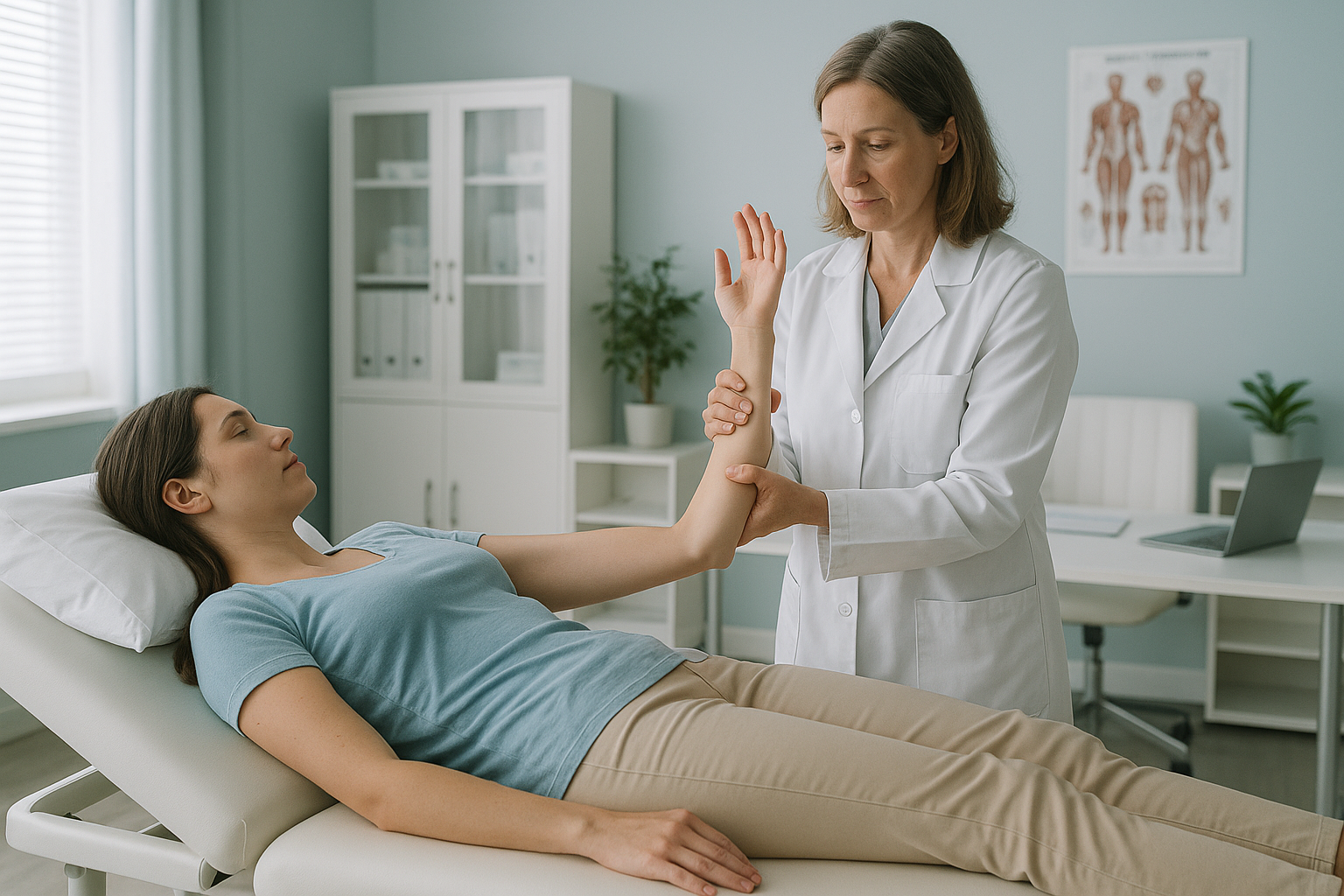
Hypermobile EDS (hEDS): What You Need to Know
Hypermobile EDS (hEDS) is a genetic connective tissue condition that causes joints to move beyond the normal range. It leads to widespread pain, fatigue, and joint instability. Because the connective tissue is stretchy throughout the body, problems often appear far from their root cause, making whole-body alignment assessment important.
Key takeaways
- hEDS is the most common type of Ehlers-Danlos syndrome and is inherited genetically.
- Symptoms go well beyond "being flexible", often including chronic pain, fatigue, and frequent joint subluxations.
- Diagnosis follows specific clinical criteria. There is no single blood test for hEDS.
- Loose connective tissue affects alignment from head to toe, so problems in one joint can cause pain elsewhere.
- Standing, weight-bearing imaging can reveal alignment issues that lying-down scans miss.
If you have been told you are "just hypermobile" but continue to experience pain, instability, or fatigue, you may have hypermobile Ehlers-Danlos syndrome. This page explains what hEDS is, how it is diagnosed, and how whole-body standing imaging can help you and your clinicians understand what is happening in your body.
If you experience sudden weakness, numbness, or loss of bladder or bowel control, seek urgent medical attention from your GP, 111, or A&E rather than booking a scan.
What are the main symptoms of hypermobile EDS?
The main symptoms of hEDS are joint hypermobility, chronic widespread pain, and repeated joint dislocations or subluxations (partial dislocations). But the condition affects far more than your joints alone.
Widespread, persistent pain in joints and muscles, often without an obvious injury.
Joints that slip, pop, or partially dislocate during everyday activities.
Deep, persistent tiredness that rest does not fully relieve.
Soft, stretchy skin that bruises easily and heals slowly.
Bloating, reflux, and other gut symptoms are common alongside hEDS.
Lightheadedness or a racing heart when you stand up, sometimes linked to dysautonomia.
Many people with hEDS are told their pain is "unexplained" because individual scans of a single joint often come back normal. The real picture only becomes clear when the whole body is assessed together, in the position where symptoms actually occur: standing up.
Is hypermobile EDS genetic?
Yes, hEDS is a genetic condition. It runs in families and follows an autosomal dominant pattern, which means you only need to inherit one copy of the affected gene from one parent to develop it. However, the specific gene responsible for hEDS has not yet been identified, which is one reason a genetic blood test is not available for this type.
The underlying problem is in your connective tissue, the "scaffolding" that holds your joints, skin, blood vessels, and organs together. In hEDS, this connective tissue is stretchier and less supportive than usual. That is why the condition affects so many different body systems at once.

Because connective tissue is everywhere, hEDS is truly a whole-body condition. A problem at the spine can shift load to the hips and knees. Loose ligaments in the ankle can change how your pelvis sits. Your body compensates in a chain reaction, and the place you feel pain may not be the place where the problem starts.
How is hypermobile Ehlers-Danlos syndrome diagnosed?
hEDS is diagnosed using a set of clinical criteria published in 2017. There is no single blood test for it. The criteria have three parts:
- Generalised joint hypermobility, typically assessed using the Beighton score, a simple set of physical tests your clinician performs.
- Two or more additional features from a list that includes skin involvement, family history, and musculoskeletal complications such as chronic pain or repeated dislocations.
- Exclusion of other conditions that could explain the symptoms, including other types of Ehlers-Danlos syndrome and autoimmune or inflammatory conditions.
Diagnosis can be a long road. Many people see several specialists over many years before getting answers. One reason is that standard imaging, like an X-ray or MRI of a single joint, often looks normal. It does not show how your body behaves as a whole when you are upright and bearing weight.
What is the difference between hEDS and hypermobility spectrum disorder?
Hypermobility spectrum disorder (HSD) is diagnosed when you have symptomatic joint hypermobility but do not meet the full 2017 criteria for hEDS. It is not a lesser diagnosis. HSD can be just as painful and disabling as hEDS.
- Meets all three 2017 diagnostic criteria
- Systemic connective tissue features present
- Often includes skin, cardiac, or digestive involvement
- Positive family history common
- Symptomatic hypermobility present
- Does not meet full hEDS criteria
- Can be equally painful and limiting
- Managed with the same approaches as hEDS
Whether you have hEDS or HSD, the key point is the same. Your connective tissue does not support your joints the way it should. This affects your whole-body alignment. And the best way to see that alignment is while you are standing.
How does standing imaging help with hypermobile EDS?
Standing, weight-bearing imaging captures your skeleton the way it actually works, upright and under the load of gravity. For someone with hEDS, this is especially important. When you lie down for a standard X-ray, CT, or MRI, your muscles relax and your loose joints settle into a position that may look fine. The moment you stand up, your alignment can shift significantly because your connective tissue is not holding everything in place the way it should.
An EOS scan takes a full-length, standing image of your body from head to toe in one pass. It uses about 90% less radiation than a standard X-ray, around ten times less. The result is a complete picture of how your spine, pelvis, hips, knees, and ankles line up when you are weight-bearing. This helps clinicians see the compensation patterns that hEDS creates, where your body is overloading one joint to protect another.
ScanAlign provides this type of whole-body standing EOS assessment at 19 Harley Street. You do not need a GP referral to book. Many people with hEDS find that a full alignment picture gives their treatment team, whether that is a physiotherapist, rheumatologist, or orthopaedic surgeon, the information they need to plan more targeted support.
When is MRI the better choice? EOS shows bones, joints, and alignment beautifully. For soft tissue problems like disc herniations, nerve compression, or ligament tears, MRI is usually the better tool. Many people with hEDS benefit from both types of imaging for a complete picture.
What helps when you are living with hypermobile EDS?
There is no cure for hEDS, but understanding how your body is aligned is a powerful first step. Most management strategies focus on supporting the joints, reducing pain, and building strength in a controlled way. Common approaches include specialist physiotherapy, pacing daily activities, and working with clinicians who understand connective tissue conditions.
Imaging plays a diagnostic role in this process. ScanAlign does not provide treatment, but the detailed alignment information from a standing EOS scan gives your clinical team a clear, whole-body map to work from. That can mean more precise physiotherapy targets and better-informed decisions about bracing or surgical planning if needed.
Wondering about cost, preparation, or what to expect on the day? Visit the frequently asked questions page for details.
Frequently asked questions about hypermobile EDS
Hypermobile EDS (hEDS) is a genetic connective tissue condition that causes joints to move beyond the normal range. It leads to chronic pain, fatigue, joint instability, and a range of other symptoms throughout the body.
No. Being flexible or "double-jointed" is common and usually harmless. hEDS involves hypermobility plus chronic pain, tissue fragility, fatigue, and often other systemic features. It is a medical condition, not simply being bendy.
Diagnosis follows the 2017 international criteria. A clinician assesses your joint mobility, checks for systemic features like skin involvement and family history, and rules out other conditions. It is a clinical diagnosis based on examination and history.
HSD is diagnosed when you have symptomatic hypermobility but do not meet all the criteria for hEDS. Both conditions can be equally painful and limiting, and both benefit from the same management approaches.
No. hEDS is diagnosed clinically, not by imaging. However, a standing EOS scan shows how hEDS affects your alignment under weight-bearing, revealing compensation patterns that help guide treatment planning.
When you lie down, your muscles relax and gravity is removed. In someone with loose connective tissue, this means the joints settle into a position that can appear normal. Standing imaging captures your skeleton as it actually functions, under load and gravity.
Yes. The scan uses about 90% less radiation than a standard X-ray, around ten times less. You simply stand still for a few seconds. It is safe and non-invasive. Visit the FAQs page for more on safety and what to expect.
No. ScanAlign accepts self-referrals. You can book a free video consultation directly to discuss whether a scan is appropriate for you.
Pricing details are available on the FAQs and cost page. ScanAlign is a private, self-pay clinic.
Yes. Loose connective tissue affects the ligaments that support your spine, which can lead to postural changes, increased spinal curves, and instability. A full standing image from head to toe shows exactly how your spine alignment is affected.
See your whole-body alignment, standing up
If you have hEDS or suspect you might, a standing EOS scan can show your clinicians the full picture. No referral needed.
Book a free video consultationWritten by Abbas Dhami (Specialist Diagnostic Radiographer)
Sources
- Malfait F, Francomano C, Byers P, et al. The 2017 international classification of the Ehlers-Danlos syndromes. American Journal of Medical Genetics Part C: Seminars in Medical Genetics. 2017;175(1):8-26.
- The Ehlers-Danlos Society. What is hEDS? ehlers-danlos.com
- NHS. Joint hypermobility. nhs.uk
This page is general information and not a diagnosis.
ScanAlign is the trading name of CoreMed Solutions Ltd and operates under The Harley Street Hospital's CQC licence.