
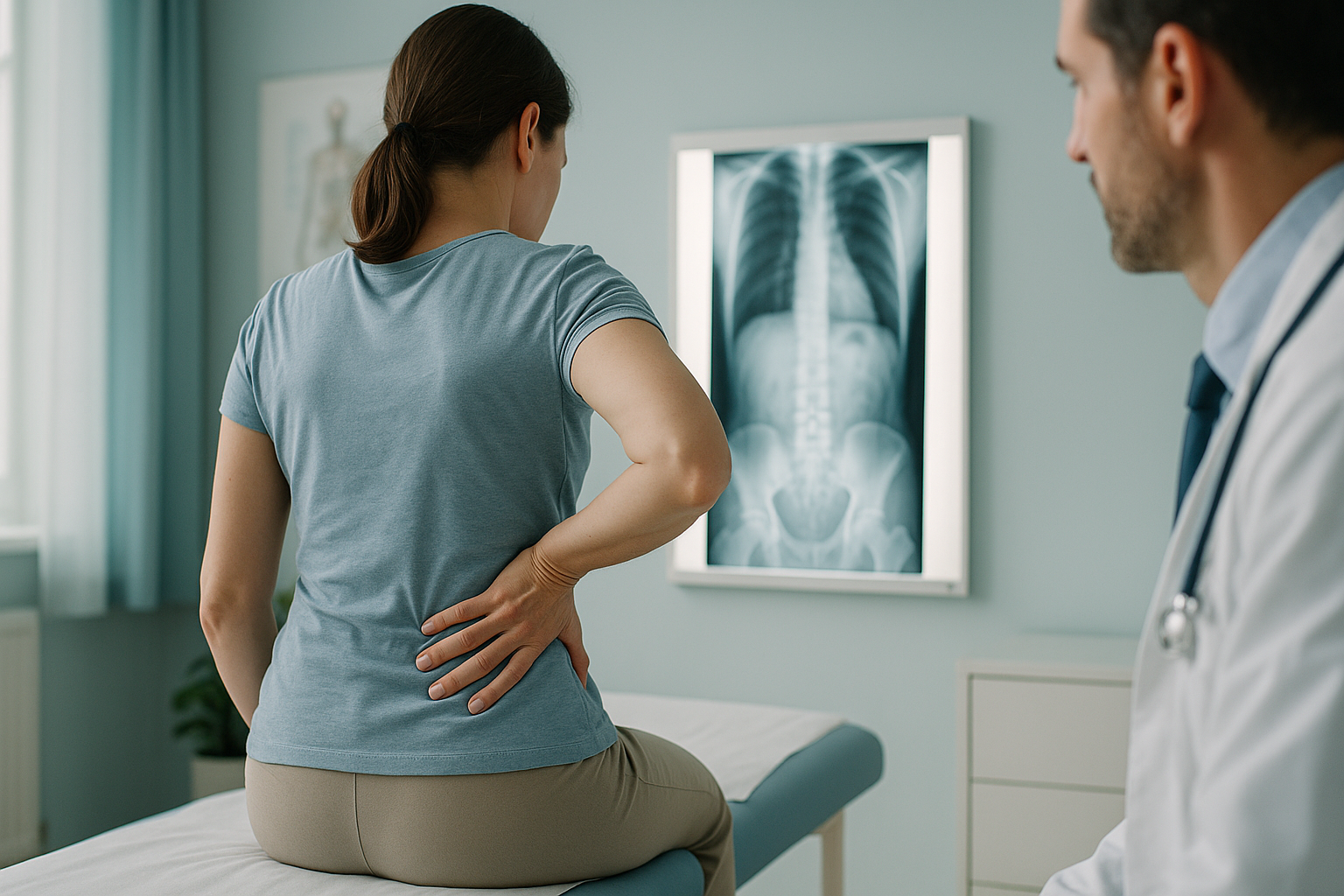
What Happens If You Ignore an Alignment Problem?
It depends. Many untreated alignment problems stay stable for years and never cause symptoms. Others gradually change how your joints share load, leading to uneven wear, stiffness or pain that develops far from the original issue. The honest answer is that some need monitoring, some need action, and some need nothing at all.
Key takeaways
- Not every alignment finding needs treatment. Many are harmless and stay that way.
- When alignment does matter, the body compensates elsewhere, so pain often appears in a different area from the cause.
- Lying-down scans can miss alignment issues that only show up under your full body weight.
- A standing baseline image lets you and your clinician compare over time and decide whether to act or simply watch.
- If you have sudden weakness, numbness, or loss of bladder or bowel control, seek urgent medical help first.
What does "alignment problem" actually mean?
An alignment problem means your skeleton is not stacking evenly from your feet to your head. It could be a spinal curve such as scoliosis, a tilted pelvis, a leg length discrepancy, or uneven loading through one knee or hip. These are common findings. Many adults have mild versions without ever knowing.
Here is the important part: a finding on an image is not the same as a problem that needs fixing. Research consistently shows that plenty of people with visible curves, tilts or asymmetries live comfortably and never develop symptoms. Whether an alignment issue matters depends on its size, its direction, whether it is changing over time, and how your body responds to it.

How does the body compensate for poor alignment?
Your body compensates by shifting load away from the problem area. If your pelvis tilts, your spine curves to keep your head level. If one leg is slightly shorter, your hip, knee or ankle on the other side absorbs more force with every step. These adjustments are clever, and they often work well for years.
Over time, though, the areas doing the extra work may begin to wear unevenly. Cartilage on one side of a joint can thin faster. Muscles on one side may tighten while their opposites weaken. This is why someone with a hip alignment issue might first notice pain in their lower back or knee, not in the hip itself.
This chain reaction is one of the main reasons that imaging a single painful area sometimes misses the full picture. The pain is real, but its root cause may be somewhere else entirely.
What are the signs that an alignment issue may be progressing?
Progression is not guaranteed, but certain patterns suggest an alignment problem may be changing rather than staying stable.
Discomfort that starts in one area and gradually appears in another may signal the body is shifting its compensation pattern.
Joints that were once flexible may gradually stiffen if they have been loaded unevenly for a long time.
One shoe sole wearing faster than the other, or trousers sitting unevenly, can be a visible clue to unequal loading.
If you repeatedly strain the same hip, knee or ankle, an underlying alignment imbalance may be part of the reason.
Urgent warning signs. If you develop sudden numbness, weakness in your legs, or any loss of bladder or bowel control, these are not alignment issues to monitor at home. Contact your GP, call 111, or go to A&E straight away.
Does every alignment finding need treatment?
No. This is one of the most important points on this page. Many alignment findings are incidental, meaning they show up on imaging but cause no symptoms and never will. A mild spinal curve that has been the same for decades is a good example. So is a small leg length difference that your body has already adapted to.
- Pain that is getting worse or spreading
- A curve or tilt that seems to be changing
- Failed previous treatment with no clear diagnosis
- Planning surgery and needing a full alignment picture
- Mild asymmetry with no symptoms
- Stable findings that have not changed in years
- A small difference your body has already adapted to
- Alignment that falls within normal human variation
The research is clear: human bodies are not perfectly symmetrical, and that is normal. The goal of assessment is not to chase perfection. It is to find out whether something is contributing to your symptoms or is likely to change over time, and then decide on a sensible plan. Sometimes that plan is simply "recheck in a year."
When MRI is the better choice. EOS excels at showing bone alignment and joint spacing while you stand. For soft-tissue injuries, disc problems or nerve compression, MRI is usually the more appropriate tool. Your clinician can advise which imaging you need.
How does standing imaging reveal problems that lying down misses?
Standard X-rays, CT and MRI are usually taken while you lie flat. In that position, gravity is not pulling on your skeleton, your muscles are relaxed, and many alignment shifts disappear. You get a clear image of anatomy, but not of how your body behaves under its own weight.
When you lie on a scan table, gravity no longer compresses your joints or loads your spine. A pelvic tilt may flatten out. A spinal curve may look smaller than it truly is. The image looks normal, even though you feel pain every time you stand or walk.
A standing whole-body image captures your skeleton exactly as it works in real life, with full weight bearing. Tilts, shifts and compensations become visible because gravity is doing what it always does. This gives your clinician a more realistic picture to base decisions on.
ScanAlign standing EOS imaging captures your full skeleton from head to foot in a single standing scan, using about 90% less radiation than a standard X-ray, around ten times less. It creates a weight-bearing baseline that can be compared over time, so you and your clinician can see whether something is stable or changing.
Wondering whether your alignment needs monitoring? A short video call with our team can help you decide if a baseline scan is the right next step.
Book a free video consultationFrequently asked questions
Not necessarily. Many adult spinal curves remain stable for decades. Some progress slowly, particularly after the age of 50 when disc and joint changes speed up. A baseline standing image gives you a reference point so any change can be measured objectively over time.
Posture habits alone rarely cause structural damage. However, if your skeleton is already misaligned, sustained poor posture can increase uneven loading on joints and soft tissues, potentially accelerating wear. The key factor is usually the underlying alignment, not the posture on its own.
Small differences are very common and usually harmless. Larger ones can lead to uneven loading through the pelvis, hips and knees over time. Whether yours needs addressing depends on the size of the difference and whether it is causing symptoms. You can read more about leg length discrepancy and how it is assessed.
Yes. This is one of the most common patterns. A hip alignment issue can present as lower back pain. A pelvic tilt can cause knee strain on the opposite side. The body redistributes load, and the area doing the extra work often becomes the painful one.
The most reliable method is to compare images taken at different time points. A standing baseline scan gives a clear reference. If a follow-up scan a year or two later shows no meaningful change, that is good evidence of stability.
EOS uses about 90% less radiation than a standard X-ray, around ten times less. It captures your full body in one pass, which means fewer separate exposures than conventional imaging would require for the same coverage.
No. ScanAlign accepts self-referrals. You can book a baseline scan directly or start with a free video consultation to discuss whether imaging is the right step for you.
A standing whole-body EOS image shows every major bone and joint from head to foot, all in one image, under your natural body weight. It reveals curves, tilts, rotation, joint spacing and how your body distributes load. It does not show soft tissues like discs, ligaments or nerves, which is where MRI comes in.
ScanAlign is a private, self-pay clinic. Pricing details are available on the frequently asked questions page.
If you have no pain and no concerns, there is usually no reason to scan. Imaging is most useful when you have symptoms that have not been explained, previous findings that need monitoring, or when you are planning a procedure and your surgeon needs a full alignment picture.
Not sure whether your alignment needs attention?
A short, free video consultation lets you talk through your situation with our specialist team. No pressure, no obligation.
Book a free video consultationWritten by Abbas Dhami (Specialist Diagnostic Radiographer)
Sources
- Glassman SD, Bridwell K, Dimar JR, et al. The impact of positive sagittal balance in adult spinal deformity. Spine. 2005;30(18):2024-2029.
- National Institute for Health and Care Excellence (NICE). Low back pain and sciatica in over 16s: assessment and management. NICE guideline [NG59], updated 2020.
- Illés T, Somoskeöy S. The EOS imaging system and its uses in daily orthopaedic practice. International Orthopaedics. 2012;36(7):1405-1411.
This page is general information and not a diagnosis.
ScanAlign is the trading name of CoreMed Solutions Ltd and operates under The Harley Street Hospital's CQC licence.