
Imaging Referral Criteria: What Can and Cannot Be Scanned at ScanAlign?
ScanAlign offers standing, weight-bearing EOS imaging for adults who can stand still for about 20 seconds. The scan is suitable for spinal, hip, knee and whole-body alignment questions. It is not appropriate for pregnant patients, acute trauma requiring emergency care, or clinical questions that need soft-tissue detail from MRI.
Key takeaways
- Adults who can stand unaided for around 20 seconds are generally suitable.
- Pregnancy is an absolute exclusion. No ionising imaging is performed on pregnant patients.
- EOS uses about 90% less radiation than a standard X-ray, around ten times less.
- Soft-tissue, disc or nerve questions are better served by MRI, not EOS.
- No GP referral is needed. Self-referred patients and clinician referrals are both accepted.
Who is suitable for a standing EOS scan?
Most adults with a musculoskeletal alignment question are suitable. The scan captures the full skeleton, head to foot, while you stand in your natural posture. This makes it especially useful when a clinician needs to see how the whole chain of bones and joints lines up under gravity.
- Chronic back, hip or knee pain without clear diagnosis
- Pre-operative planning for joint replacement or spinal surgery
- Post-operative follow-up of implants or fusion
- Scoliosis or kyphosis monitoring in adults
- Leg-length discrepancy assessment
- Unexplained posture or gait problems
- Second-opinion alignment imaging
- Pregnant patients (absolute exclusion)
- Patients who cannot stand still for about 20 seconds
- Acute trauma needing emergency imaging
- Questions about discs, nerves or soft tissue (MRI is better)
- Patients under 18 (ScanAlign is an adults-only service)
You can check who our scan is suitable for on our dedicated eligibility page, which covers the same criteria from a patient perspective.
What are the exclusion criteria for an EOS scan?
The main exclusion criteria relate to pregnancy, the ability to stand, and whether the clinical question actually requires weight-bearing bony imaging rather than another modality.
Absolute exclusion. Even though EOS delivers very low radiation, no ionising imaging is performed on a pregnant patient. If pregnancy is possible, it must be excluded before scanning.
The scan requires the patient to stand unaided for about 20 seconds. If severe pain, balance impairment or a neurological condition makes this impossible, EOS is not appropriate.
If the patient has suffered a recent fracture or acute injury, emergency imaging at A&E is the correct pathway. ScanAlign is a planned, elective imaging service.
EOS shows bones, joints and alignment. If the clinical question concerns discs, ligaments, tendons or nerves, MRI is usually the better tool.
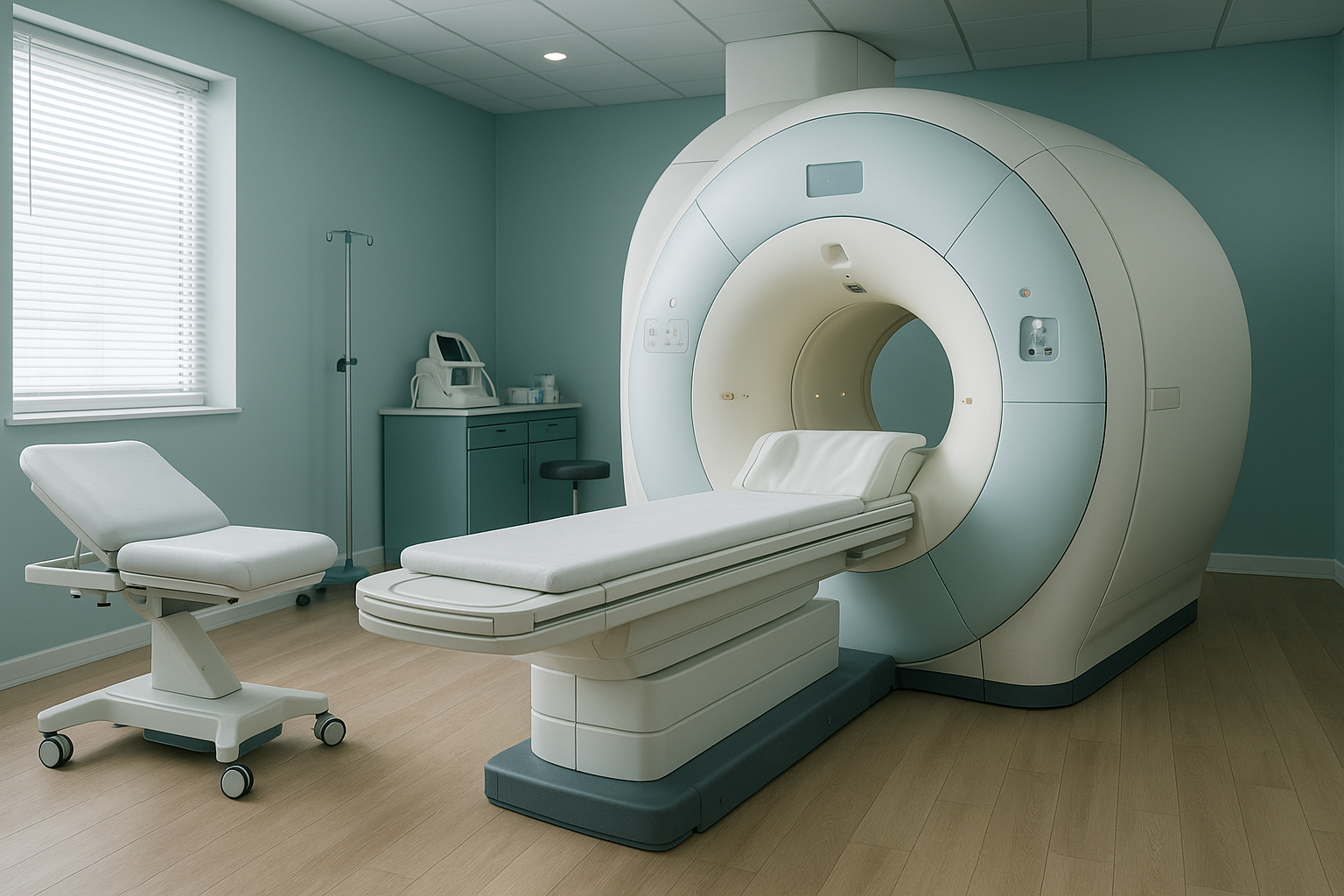
A note on MRI. EOS excels at showing the skeleton under load. It reveals how bones, joints and the whole kinetic chain align when standing. For soft-tissue detail, disc herniations, nerve compression or inflammatory conditions, MRI remains the appropriate investigation. The two modalities are complementary, not competing.
Why does standing imaging change the referral decision?
Standard X-ray, CT and MRI are performed lying down. In that position, gravity is removed, muscles relax, and the skeleton settles into a shape that may look quite different from the patient's upright posture. Alignment problems, pelvic tilts, leg-length differences and compensatory curves can be invisible on supine imaging.
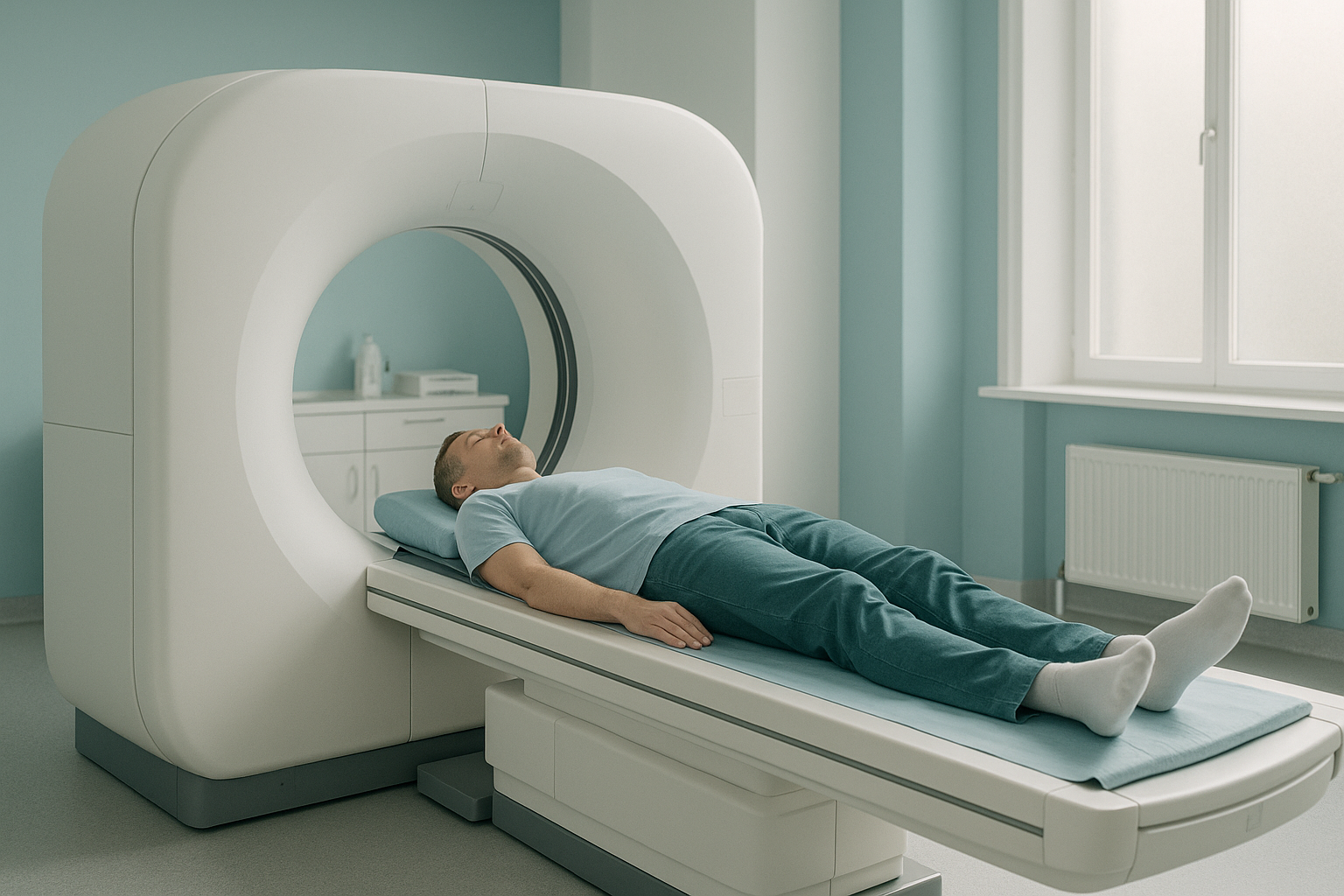
When you refer a patient for standing EOS imaging, you are asking a fundamentally different clinical question: "How does this person's skeleton actually behave under load?" This is why the imaging referral criteria differ from standard radiology pathways. The patient must be able to stand, and the question must be about bony alignment or joint geometry rather than soft tissue.
The body works as a connected chain. A subtle pelvic tilt can cause the spine to compensate, which can then produce symptoms in the neck or shoulder. Pain often shows up away from its cause. Whole-body standing imaging captures the entire chain in a single exposure, giving clinicians a far more complete picture than imaging one region in isolation.
For more detail on radiation levels and scan safety, see EOS scan safety and radiation.
When should you refer for MRI instead of EOS?
MRI is the better choice when the clinical question involves soft tissue. Disc bulges, nerve root compression, ligament tears, cartilage damage, inflammatory arthropathy and tumour characterisation all require the soft-tissue contrast that MRI provides. EOS does not image soft tissue.
In many cases, the two investigations are complementary. A patient with back pain might benefit from MRI to assess disc pathology and EOS to assess overall spinal alignment and pelvic balance. One does not replace the other.
How do I refer a patient to ScanAlign?
Referral is straightforward. No GP letter is required for self-paying patients, and clinician referrals are also welcome. Here is what the pathway looks like.
The patient, or the referring clinician, books a short video call. This confirms the clinical question is appropriate for standing EOS imaging and checks suitability.
Every scan must be clinically justified. If EOS is not the right investigation, we will say so and, where possible, suggest an alternative pathway.
The appointment takes place at ScanAlign, standing EOS imaging, inside The Harley Street Hospital. Read about what to expect at an alignment assessment.
A specialist radiologist reports the images. The report and images are shared with the patient and, if requested, the referring clinician.
Not sure whether EOS is the right investigation for your patient? You can discuss a referral with our team before booking.
What about red-flag symptoms?
If a patient presents with sudden severe pain, numbness, weakness, or loss of bladder or bowel control, this is not an elective imaging question. Please direct them to seek urgent medical attention through their GP, NHS 111, or A&E. ScanAlign is a planned diagnostic service and is not set up for emergency presentations.
Frequently asked questions about imaging referral criteria
No. ScanAlign accepts self-referred adults as well as referrals from consultants, GPs, physiotherapists and other clinicians. Every scan still requires clinical justification, which is confirmed during the free video consultation.
No. Pregnancy is an absolute exclusion for any ionising imaging at ScanAlign, regardless of trimester. If there is any possibility of pregnancy, it must be excluded before the scan.
EOS uses about 90% less radiation than a standard X-ray, around ten times less. This makes it one of the lowest-dose options for full-body skeletal imaging.
The scan requires the patient to stand unaided and relatively still for about 20 seconds. If pain, balance problems or a neurological condition prevents this, EOS is not the right investigation. We will discuss this at the video consultation stage.
No. EOS images bones and joints. For disc herniations, nerve compression or other soft-tissue questions, MRI is the appropriate modality. The two scans complement each other well when both bony alignment and soft-tissue detail are needed.
No. ScanAlign is an adults-only service. We do not scan patients under 18.
The EOS system has a weight limit, which we confirm during the video consultation. If there is any doubt, we check before booking a scan appointment.
Yes. Unlike MRI, EOS uses X-ray technology, so metal implants, joint replacements and spinal hardware are not a contraindication. In fact, post-operative assessment of implant alignment is one of the most common reasons for referral.
ScanAlign is a self-pay service. Pricing is covered during the free video consultation and is also available on our website.
We will tell you. If the clinical question is better answered by MRI, CT or another modality, we will say so at the video consultation stage and, where possible, suggest an alternative pathway. We do not scan patients when EOS is not the right tool.
Unsure whether EOS is right for your patient?
Book a free video consultation. We will confirm suitability, explain the process and answer any clinical questions.
Book a free video consultationSources
- Deschênes S, Charron G, Beaudoin G, et al. "Diagnostic imaging of spinal deformities: reducing patients' radiation dose with a new slot-scanning X-ray imager." Spine, 2010;35(9):989-994.
- The Royal College of Radiologists. iRefer: Making the best use of clinical radiology. RCR guidelines on appropriate imaging referral criteria.
- Ionising Radiation (Medical Exposure) Regulations 2017 (IR(ME)R). UK statutory instrument governing clinical justification of medical exposures.
Written by Abbas Dhami (Specialist Diagnostic Radiographer).
This page is general information and not a diagnosis.
ScanAlign is the trading name of CoreMed Solutions Ltd and operates under The Harley Street Hospital's CQC licence.