

What to Expect at a Posture and Alignment Assessment?
A posture and alignment assessment at ScanAlign uses standing, weight-bearing EOS imaging to capture your entire skeleton in one scan, from head to feet. You stand naturally while the scan is taken, so your muscles, joints and balance are shown exactly as they work in real life. It takes only a few minutes, uses about 90% less radiation than a standard X-ray, and no referral is needed.
Key takeaways
- You stand upright for the scan, so alignment is captured under real weight-bearing conditions.
- The EOS system images your whole body in one pass, revealing how each region connects.
- Radiation exposure is about 90% less than a standard X-ray, around ten times less.
- No GP referral is needed. You can self-refer as a private patient.
- Your results are reviewed by a specialist and shared with you and your clinician.
What is a posture and alignment assessment?
A posture and alignment assessment is a structured way of looking at how your skeleton is balanced when you are standing upright. Unlike standard imaging, which typically focuses on one joint or one part of the spine, a whole-body assessment considers the entire chain, from your feet and ankles through your knees, hips, pelvis, spine and up to your head.
At ScanAlign, the assessment uses EOS standing imaging technology. The EOS system takes a full-length image of your skeleton while you stand naturally. This is important because your body behaves very differently when it is upright and bearing weight compared with when you are lying flat on a table.
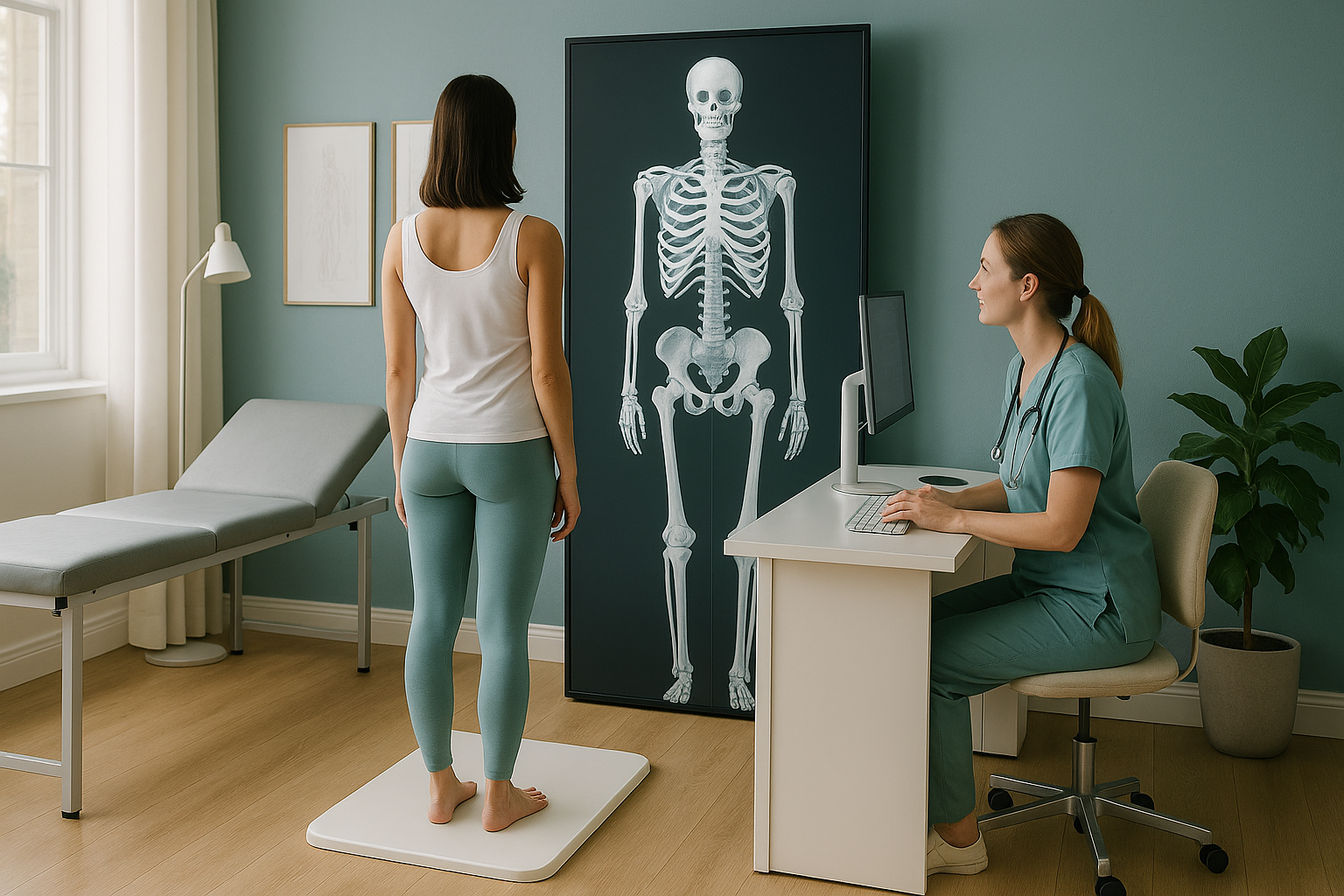
When you lie down for a conventional X-ray, CT or MRI, gravity is no longer loading your spine and joints. Your muscles relax. A tilt in your pelvis may flatten out. A curve in your spine may look milder than it truly is. A standing scan captures how your body actually holds itself throughout the day.
How do you know if you need a posture assessment?
You may benefit from a whole-body alignment assessment if you have ongoing symptoms that haven't been fully explained by previous scans. Common reasons people come to ScanAlign include the following.
Pain that keeps returning despite treatment, especially if scans of a single area have been normal.
You have had X-rays or MRI scans but the results did not match the level of pain you feel.
Uneven shoulders, a tilted pelvis, or a sense that your body leans to one side.
Your surgeon wants whole-body alignment data before a joint replacement or spinal procedure.
Why does a standing scan show more than lying down?
A standing scan captures your skeleton under the same forces it faces all day, gravity and muscle load. When you lie flat, those forces are removed. The body is a connected chain from your feet to your head. A small shift in one area, such as the pelvis tilting forward, can make your lower back arch more, your mid-back round to compensate, and your neck push forward. Pain often appears away from its true cause.
Conventional imaging looks at one region at a time. It might show a normal-looking spine, but miss that the spine is compensating for a problem in the hip or the leg below. The EOS system captures the full picture in one standing image so these compensation patterns become visible.
When is MRI the better choice? EOS shows bones, joints and alignment clearly. For soft tissue detail such as discs, ligaments or nerves, MRI is usually the better tool. Your specialist will advise which type of imaging suits your situation. In many cases, EOS and MRI work well together.
What happens step by step during the assessment?
The process at ScanAlign is straightforward. Here is what to expect from start to finish.
You start with a no-obligation video call. A specialist radiographer reviews your history, explains what the scan involves, and confirms whether whole-body imaging is appropriate for you.
On the day, you arrive at the clinic in central London. There is no special preparation. Wear comfortable clothing without metal fastenings if possible, though the team will guide you on the day.
You stand naturally inside the EOS unit while the scan is taken. The machine moves around you. It captures your full skeleton from the front and side in a single pass. The scan itself lasts just a few minutes. The radiation dose is about 90% less than a standard X-ray, around ten times less.
Your images are reviewed by a specialist. The report details your alignment from head to feet, highlighting any imbalances or compensations. This report can then be shared with your treating clinician, surgeon or physiotherapist to guide your care.
Ready to find out if an alignment assessment is right for you?
Book a free video consultationWho benefits most from a whole-body alignment assessment?
A standing alignment assessment is most useful for people whose symptoms have not been fully explained by conventional imaging, or who need a broader picture before treatment.
- Long-standing back or spinal pain with no clear cause
- Recurring hip pain or suspected pelvic tilt
- Pre-operative planning for knee or hip surgery
- Visible posture imbalance affecting daily life
- Post-surgical follow-up to check alignment
- Suspected soft tissue injury (disc herniation, ligament tear) where MRI is usually better
- Acute fracture or trauma requiring urgent care
- Numbness, weakness, or loss of bladder or bowel control, which need urgent medical attention (contact your GP, call 111 or go to A&E)
Frequently asked questions
No. ScanAlign is a private self-pay clinic, so you can book directly without a referral. Many people self-refer after struggling to get answers through other routes.
The scan itself takes just a few minutes. Your full appointment, including positioning and any questions, is a short visit.
Yes. The EOS system uses about 90% less radiation than a standard X-ray, around ten times less. You can find more detail on the safety and FAQs page.
Comfortable clothing without metal zips, buttons or underwiring is ideal. The team will advise you when you book, and changing facilities are available at the clinic.
Pricing details are available on the cost and FAQs page. The free video consultation is a good place to discuss what is included.
Yes, with your consent. Your alignment report and images can be sent directly to your referring clinician, surgeon or physiotherapist.
They answer different questions. EOS excels at showing bones, joints and full-body alignment under weight-bearing conditions. MRI is better for soft tissues like discs, nerves and ligaments. Your clinician may recommend both for a complete picture.
Yes. You stand naturally inside the EOS unit. This is exactly the point. Standing captures how your body balances and compensates under gravity, which lying-down scans cannot show.
The system can image your entire skeleton, from head to feet, in a single pass. This includes the spine, pelvis, hips, knees, ankles and feet, so alignment relationships between all these areas are visible at once.
ScanAlign is at 19 Harley Street, London, within The Harley Street Hospital. The clinic is easily accessible by public transport, with several tube stations nearby.
See the full picture of how your body is aligned
Start with a free, no-obligation video consultation to discuss your symptoms and find out whether a standing alignment assessment is right for you.
Book a free video consultationSources
- Illés, T. and Somoskeöy, S. (2012). The EOS imaging system and its uses in daily orthopaedic practice. International Orthopaedics, 36(7), pp.1327–1331.
- Dubousset, J. et al. (2010). EOS: A new imaging system with low-dose radiation in standing position for spine and bone. Journal of Musculoskeletal Research, 13(1), pp.1–12.
- NHS (2024). Back pain: causes, treatment and when to see a GP. NHS.uk. Available at: https://www.nhs.uk/conditions/back-pain/
Written by Abbas Dhami (Specialist Diagnostic Radiographer)
This page is general information and not a diagnosis.
ScanAlign is the trading name of CoreMed Solutions Ltd and operates under The Harley Street Hospital's CQC licence.