

How Do You Get a Second Opinion on a Scan?
You can get a second opinion on a scan by asking another radiologist to review the same images, or by having completely new imaging done. In the UK you do not need a GP referral for a private second opinion. You simply share your existing images or book a fresh scan at a clinic of your choice.
Key takeaways
- You have the right to seek a second opinion on any scan report.
- Options include re-reporting existing images or getting entirely new imaging.
- A standing scan can reveal alignment problems that lying-down imaging may miss.
- No GP referral is needed for a private second opinion in the UK.
- A second opinion is not about proving someone wrong. It is about asking a different clinical question.
What are your options for a second opinion on a scan?
There are two main routes. The first is asking a different radiologist to re-read the images you already have. The second is booking new imaging that may answer a different question entirely. Both are valid, and the right choice depends on your situation.
A sub-specialist radiologist reviews your existing images and writes a fresh report. No new radiation, no new appointment at a scanner.
A completely new scan, sometimes a different type or position, that may capture information the original imaging did not.
A specialist reviews your images alongside your history, symptoms and clinical questions before recommending next steps.
Should you get your scan re-reported or have a new scan?
Re-reporting works well when you want a fresh pair of eyes on images that were already taken. A sub-specialist radiologist, someone with deep experience in the relevant body area, may notice details that a general radiologist might describe differently.
New imaging makes more sense when the original scan may not have captured what matters. For example, most MRI and CT scans are done with you lying down. If your problem is posture or alignment related, a lying-down scan relaxes the muscles and lets gravity work differently. The image may look normal even when your symptoms are real.
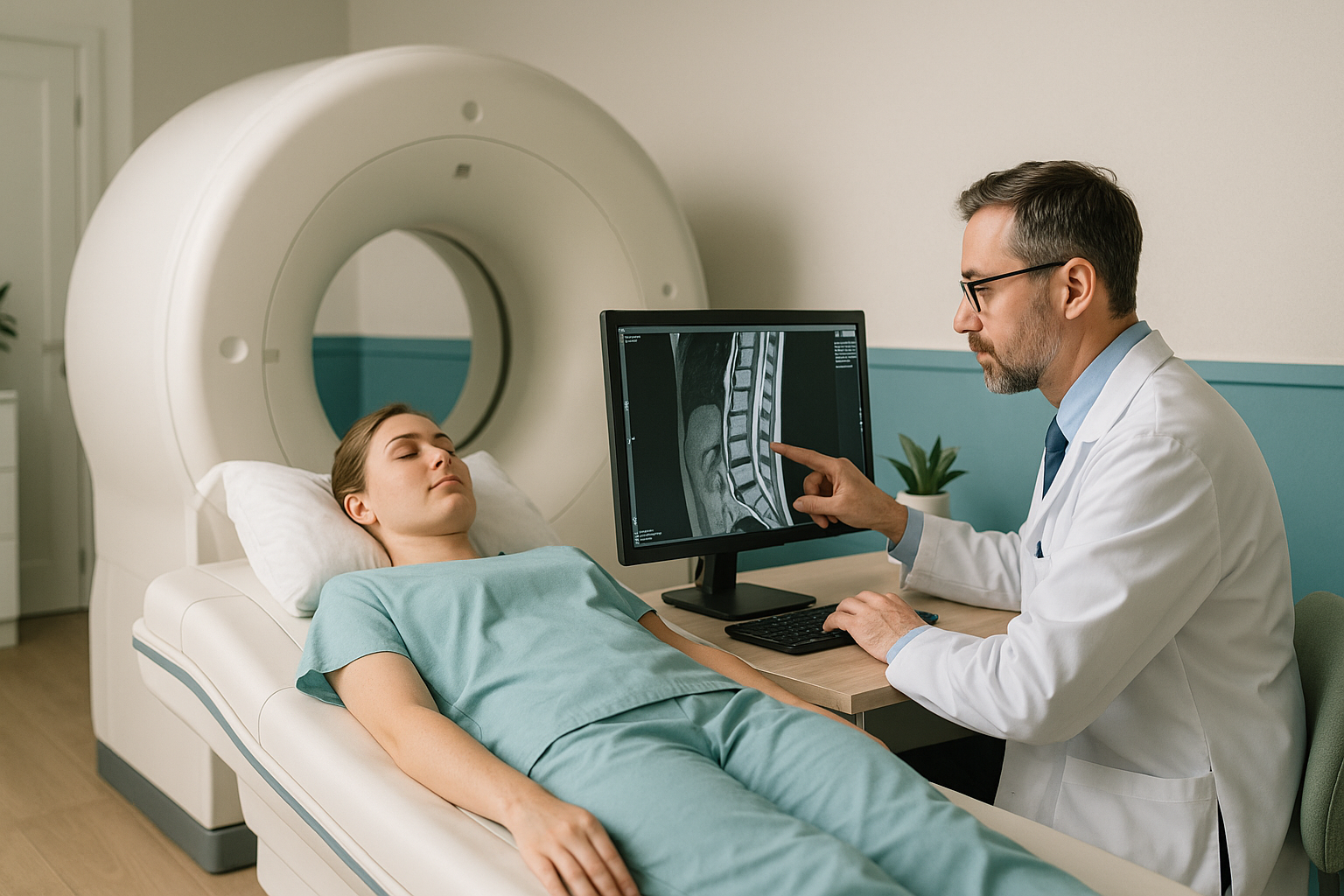
This is not about the original report being wrong. It is about whether the original scan was the right tool for the question you are now asking. Learn more about how EOS scan results are reported.
Why does standing imaging matter for a second opinion?
Standing imaging captures your skeleton under real weight-bearing conditions. When you stand, gravity compresses your joints and reveals how your body actually aligns from head to feet. A tilt in your pelvis, a curve in your spine, or a shift at the knee may only appear when you are upright.
Your body works as a connected chain. A problem in one area often causes another area to compensate. Pain can show up far from its true cause. A lying-down scan may see the painful spot but miss the mechanical reason behind it.
At ScanAlign, private standing imaging, EOS technology captures a full-length image of your skeleton in one pass, using about 90% less radiation than a standard X-ray, around ten times less. This gives your clinician a complete picture of your alignment, not just a snapshot of a single joint.
When MRI is the better tool: EOS shows bones, joints and alignment. For soft tissue, discs or nerves, MRI is usually the better choice. If your second opinion question is about a disc bulge or nerve compression, MRI may be what you need. Your clinician can help you decide.
How do you book a second opinion scan at ScanAlign?
You do not need a GP referral to book privately. Here is what the process looks like.
Free video consultation
You speak with a specialist radiographer who listens to your history and symptoms, reviews any existing reports you share, and helps decide whether standing imaging is the right next step.
Share your existing images
If you have previous scans on CD, DICOM or a hospital image-sharing portal, you can bring them along. This helps the team compare old and new findings.
Standing EOS scan
A quick, low-dose full-body X-ray taken while you stand naturally. No enclosed tunnel, no need to change position. The scan itself takes under a minute.
Independent report
Your images are reported by a specialist. The report is yours. You can take it to any consultant, surgeon or physiotherapist. Find out what an EOS scan report shows.
Have questions before booking? Our patient support team can help, or learn more about ScanAlign.
Frequently asked questions
No. You can self-refer for a private second opinion. No GP letter is required to book at ScanAlign.
Yes. Many private radiology services offer re-reporting. You share your images on CD or through a hospital image-sharing system, and a sub-specialist radiologist writes a new report. ScanAlign focuses on standing EOS imaging rather than re-reporting lying-down scans, but our free consultation can help you decide which route suits your question.
Re-reporting means a different radiologist reviews the same images. A new scan captures fresh data, potentially in a different position or with a different technology. If the original scan was done lying down and your problem is posture or alignment related, new standing imaging may answer a question the original images could not.
Yes. An EOS standing scan uses about 90% less radiation than a standard X-ray, around ten times less. It is one of the lowest-dose skeletal imaging options available.
You can find current pricing and what is included on our arrange an independent assessment page.
Bring any previous scan reports and images you have, whether on CD, USB, or through a hospital image-sharing link. Also bring a list of your symptoms and any clinical letters. This helps the team build a full picture.
Absolutely. A scan report is one specialist's interpretation of the images. It is entirely reasonable to seek another view, especially if your symptoms do not match the findings or if you feel a different question needs asking.
Lying down relaxes the muscles and removes the effect of gravity. Alignment shifts, joint compression and compensatory patterns only appear when you are weight-bearing. A standing EOS scan captures how your skeleton actually behaves when you are upright.
No. A second opinion is not about proving someone wrong. It is about asking a different question or looking from a different angle. Standing imaging answers questions about alignment that lying-down imaging was never designed to address.
Your images are reported by a specialist with experience in musculoskeletal and alignment assessment. The report is yours to share with any clinician.
Ready for a different perspective?
Talk to a specialist radiographer about whether standing imaging could answer the question your previous scan left open.
Book a free video consultationSources
- The Royal College of Radiologists. Standards for interpretation and reporting of imaging investigations (2nd edition, 2018).
- NHS England. Patient choice: your right to a second opinion. nhs.uk.
- Deschênes S et al. "EOS low-dose imaging system: a systematic review of the literature." European Journal of Radiology, 2010; 76(2): 211–218.
Written by Abbas Dhami (Specialist Diagnostic Radiographer).
This page is general information and not a diagnosis.
ScanAlign is the trading name of CoreMed Solutions Ltd and operates under The Harley Street Hospital's CQC licence.