
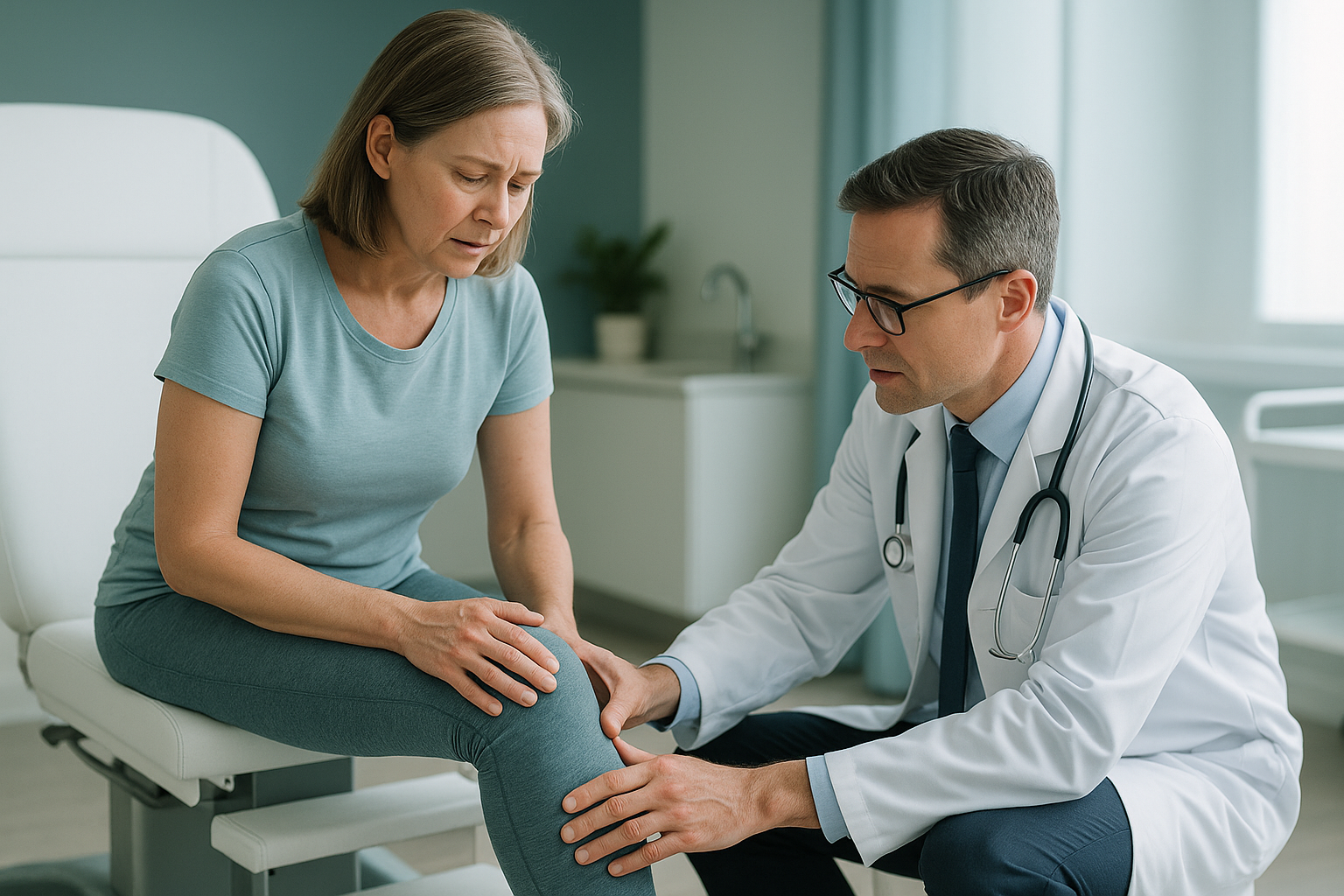
Why Do My Knees Hurt Going Down Stairs but Not Up?
Going downstairs forces your kneecap against the thigh bone with several times your body weight, far more than going up. Your quadriceps must control the descent eccentrically, and if the kneecap tracks poorly or the cartilage surface is worn, that compression causes pain in the front of the knee. Standing alignment imaging can reveal why.
Key takeaways
- Descending stairs loads the patellofemoral joint (where the kneecap meets the thigh bone) much more heavily than climbing.
- Poor kneecap tracking, weak hip or thigh muscles, and cartilage wear are the most common reasons it hurts.
- Lying-down scans relax the muscles and can miss alignment problems that only appear when you stand and bear weight.
- A standing whole-body scan shows how your hip, knee and foot alignment work together under real load.
Why does going downstairs hurt your knee more than going up?
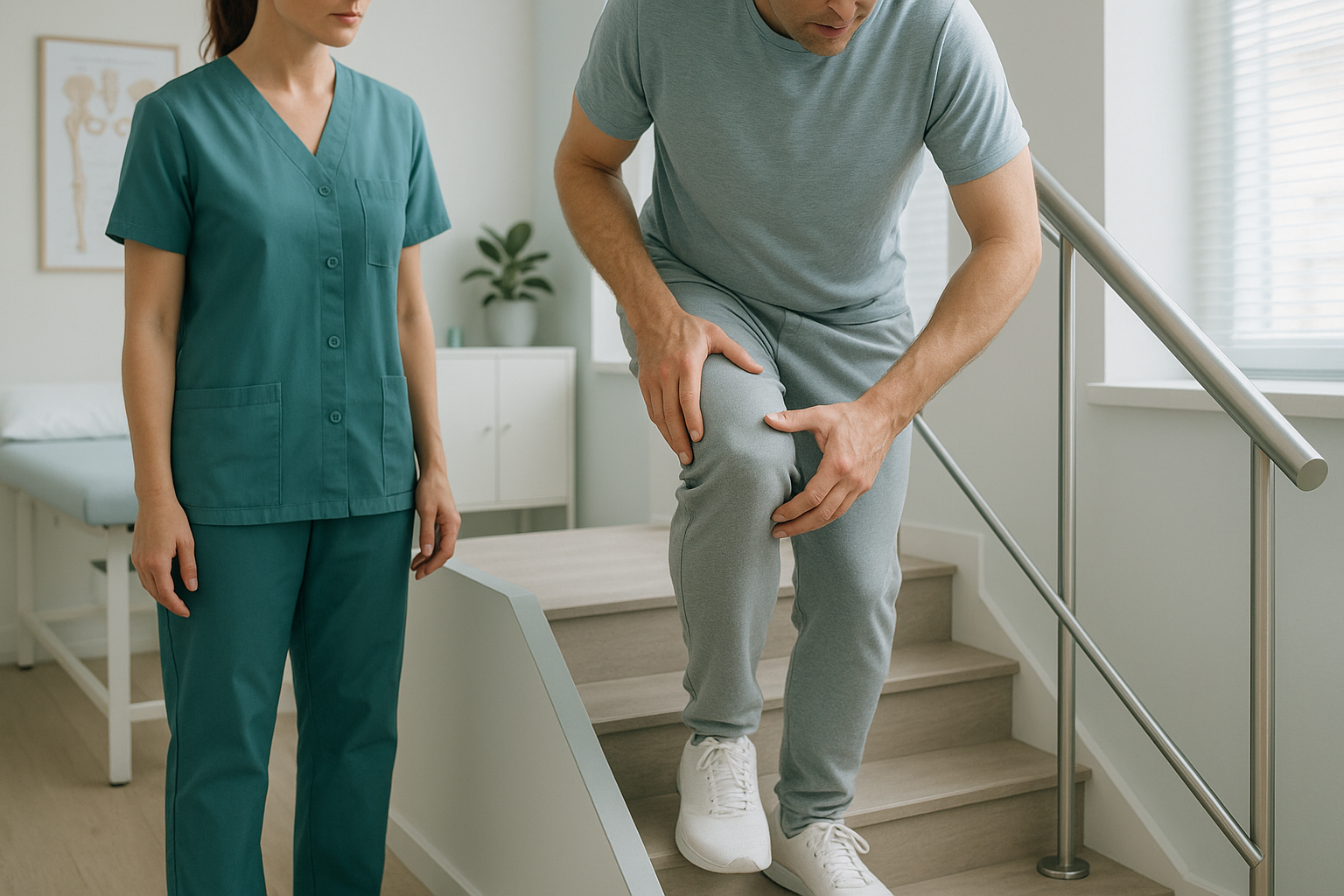
Descending stairs puts a much greater compressive load through the patellofemoral joint than climbing does. When you step down, your quadriceps (the large thigh muscles) have to work eccentrically, meaning they lengthen while braking your body weight. During that braking phase, the force across the kneecap can reach several times your body weight.
Going up is different. Your muscles shorten to push you upward, and the kneecap load is lower. That is why you might climb a full flight with no trouble, then wince on the way back down.
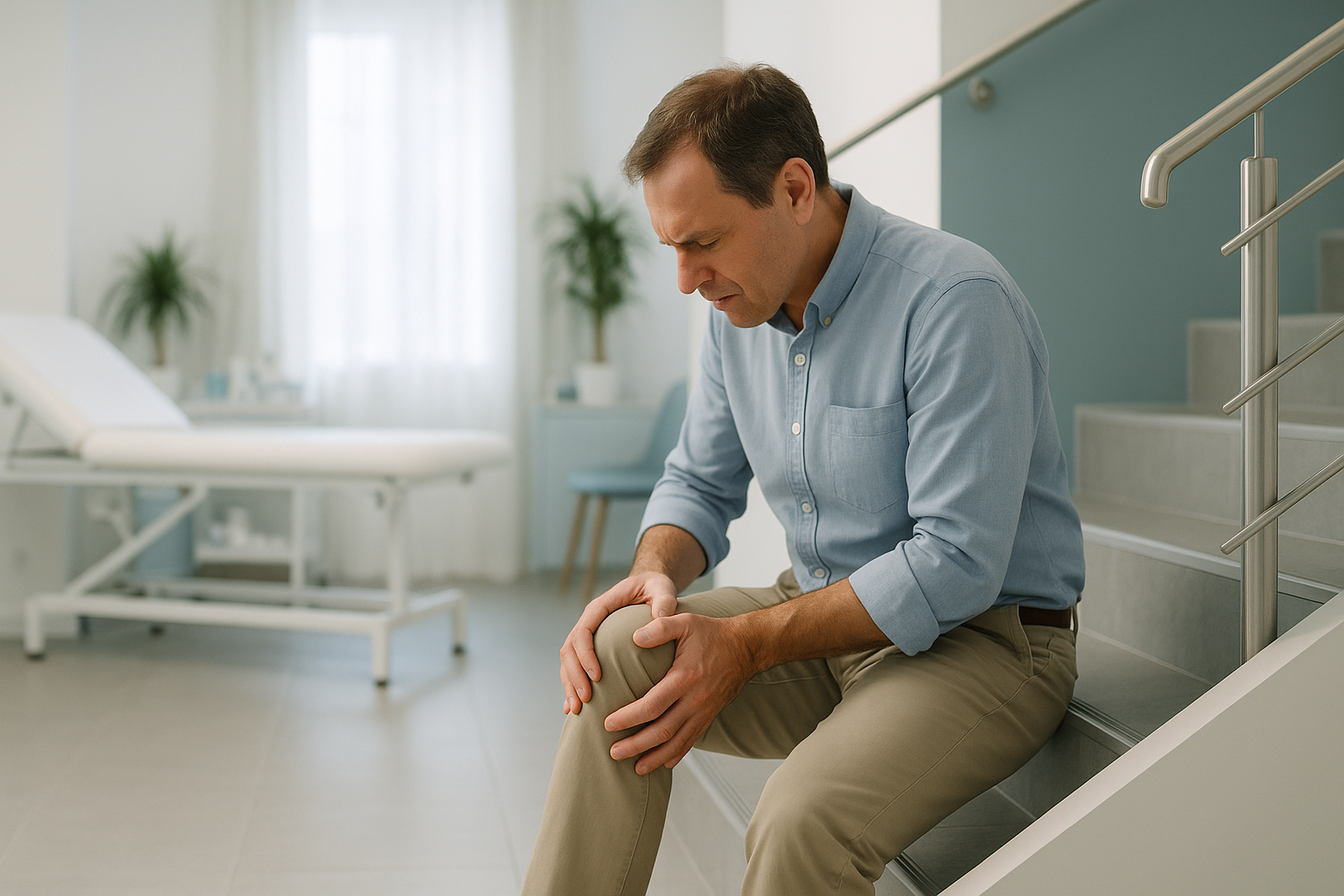
The same principle applies to downhill walking. A gentle slope might feel fine, but a steep hill forces the same eccentric braking pattern, and many people notice their knee hurts going downhill for exactly this reason.
What does stair-related knee pain feel like?
The pain typically centres on the front of the knee, around or behind the kneecap. You might also notice some of the following.
A dull ache in the front of the knee that worsens with each step down.
A gritty sensation under the kneecap when bending or straightening the leg on stairs.
A feeling that the knee buckles or cannot support you mid-step, usually going down.
The knee feels tight after sitting for a long time, then the first few stairs are the worst.
If you experience sudden locking, significant swelling, or your knee gives way with weakness or numbness in your leg, seek urgent medical attention from your GP, 111 or A&E. These could be signs of a more serious problem that needs prompt assessment.
What causes pain in the front of the knee on stairs?
Several conditions make the kneecap area vulnerable to the high loads of descending stairs. Often, more than one factor is at work at the same time.
The kneecap does not glide smoothly in its groove, irritating surrounding tissues. Learn more about patellofemoral pain syndrome.
The kneecap drifts to one side under load, increasing pressure unevenly. This is called patellar maltracking.
The cartilage on the underside of the kneecap softens or wears thin, a condition known as chondromalacia patella.
If the hip abductors or quadriceps are weak, the knee rotates inward on each step, overloading the kneecap.
Your body is a connected chain from your feet to your spine. A problem at one level, such as a flat foot, a rotated hip, or a leg-length difference, can change the way force travels through the knee. Pain often shows up away from its real cause, which is why looking at the knee alone can miss the full picture.
How is knee alignment assessed when you are standing up?
A standing, weight-bearing scan captures how your joints align under real load, the same conditions that cause your pain on stairs. Lying-down scans relax the muscles and can hide alignment problems that only appear when gravity is doing its job.
ScanAlign standing EOS imaging takes a single, low-dose image from your ankles to your hips (or your full body) while you stand naturally. The EOS system uses about 90% less radiation than a standard X-ray, around ten times less. Because it captures both legs in one image, your clinician can see whether the kneecap sits centrally in its groove, whether one leg is longer, and whether your hip or ankle alignment is contributing to the load on your knee.
When is MRI more useful? EOS shows bones, joints and alignment brilliantly. For soft tissue problems such as cartilage damage, ligament tears or nerve involvement, MRI is usually the better tool. Your clinician can advise which scan is right for you.
What can help with knee pain descending stairs?
ScanAlign is a diagnostic imaging clinic, not a treatment provider. The scan and report give you and your clinician the information needed to plan the right next step. Common approaches that clinicians consider include the following.
- Targeted strengthening. Physiotherapy focused on the quadriceps, hip abductors and gluteal muscles can improve how the kneecap tracks under load.
- Gait and footwear review. If foot position is contributing to poor knee alignment, orthotics or footwear changes may be recommended.
- Activity modification. Temporarily adjusting how you use stairs, for example taking them one step at a time or leading with the stronger leg going down, can reduce pain while rehabilitation takes effect.
- Clinical review. If imaging shows significant cartilage wear or structural misalignment, your clinician may discuss further options with you.
The important point is that the right approach depends on understanding the cause. A scan that captures your alignment standing up gives clinicians a much clearer starting point.
Wondering whether your knee alignment is part of the problem? A free video consultation can help you decide if a standing scan is right for you.
Book a free video consultationFrequently asked questions
Stairs increase the bending angle of the knee and the compression on the kneecap far beyond what flat walking requires. Walking on the level keeps the kneecap load relatively low, so many people feel fine on flat ground but struggle with steps.
It can be, but it is not always. Stair pain is a common early sign of wear in the cartilage behind the kneecap. It can also come from muscle weakness or poor alignment without any arthritis being present. Imaging helps clarify the cause.
Downhill walking uses the same eccentric braking pattern as descending stairs. Your quadriceps have to lengthen while controlling your descent, which pushes the kneecap harder against its groove. Uphill walking loads the joint differently and usually produces less kneecap compression.
Yes. Weak hip abductor muscles allow the thigh to rotate inward during each step, pulling the kneecap out of its ideal track. This is one of the most common alignment factors behind patellofemoral pain, and it is something a standing scan can help identify.
No. ScanAlign is a private self-pay clinic, and you can self-refer. You start with a free video consultation to discuss your symptoms, and the team will advise whether a scan is appropriate.
An EOS scan uses about 90% less radiation than a standard X-ray, around ten times less. This makes it one of the lowest-dose options available for weight-bearing skeletal imaging.
When you lie down, gravity is removed and your muscles relax. This can hide alignment problems that only appear when your joints bear weight. A standing scan captures your true posture and load distribution, giving clinicians a more accurate picture of what is happening at the knee.
They can. Flat feet tend to roll inward, which rotates the shin and changes the angle at the knee. Over time this can alter how the kneecap tracks and increase compression on one side. A full lower-limb alignment scan shows whether this is a factor for you.
You can find current pricing on the book a knee alignment scan page or start with a free video consultation to discuss what is included.
They answer different questions. EOS excels at showing bone alignment, joint spacing and kneecap position under real load. MRI is better for soft tissue detail like cartilage quality, ligaments and meniscus tears. Many patients benefit from both, depending on their symptoms. A free video consultation can help you decide.
Find out what is really going on in your knee
A free video consultation takes a few minutes. We will discuss your symptoms and help you decide whether a standing alignment scan is the right next step.
Book a free video consultationWritten by Abbas Dhami (Specialist Diagnostic Radiographer)
Sources
- Besier TF, Draper CE, Gold GE, Beaupré GS, Delp SL. Patellofemoral joint contact area increases with knee flexion and weight-bearing. Journal of Orthopaedic Research. 2005;23(2):345-350.
- Crossley KM, van Middelkoop M, Callaghan MJ, Collins NJ, Rathleff MS, Barton CJ. 2016 Patellofemoral pain consensus statement. British Journal of Sports Medicine. 2016;50(14):839-843.
- NHS. Knee pain: overview and causes. nhs.uk. Available at: https://www.nhs.uk/conditions/knee-pain/
This page is general information and not a diagnosis.
ScanAlign is the trading name of CoreMed Solutions Ltd and operates under The Harley Street Hospital's CQC licence.