
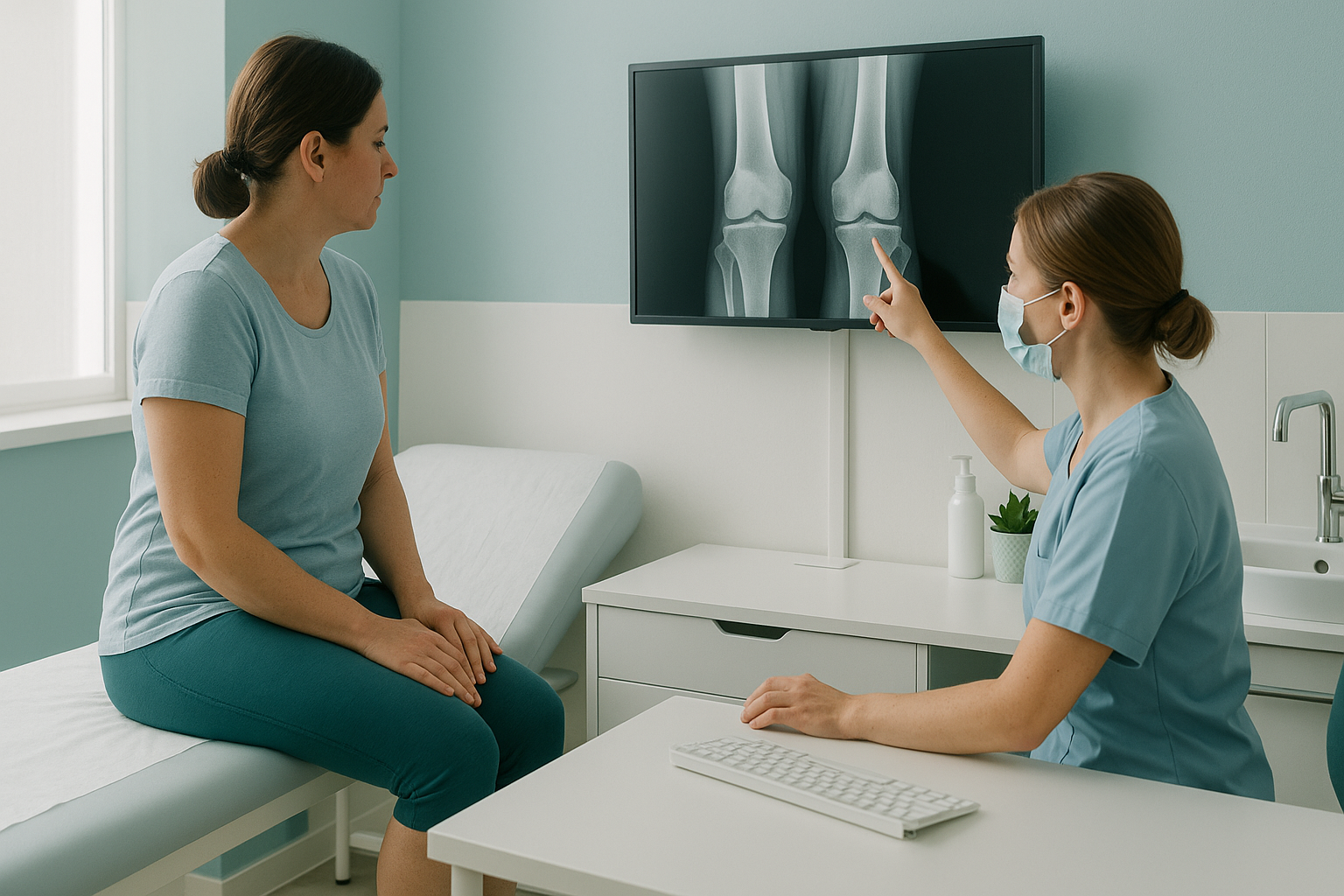
Where Can You Get an Alignment Check Before Knee Replacement in London?
ScanAlign, standing EOS imaging in Harley Street, offers full-leg weight-bearing scans at 19 Harley Street, London. The EOS system captures both legs from hip to ankle in a single standing image, giving your surgeon calibrated measurements for knee replacement planning. No GP referral is needed. Self-pay patients can attend the same week.
Key takeaways
- A full-leg standing x-ray shows true knee alignment under your body weight.
- Both legs are captured in one scan so your surgeon can compare sides.
- The EOS system uses about 90% less radiation than a standard x-ray, around ten times less.
- Images are calibrated for accurate surgical templating and DICOM-ready for transfer to your surgeon.
- You can self-refer. No consultant letter or GP referral is required.
Why does knee replacement imaging need to be done standing up?
Standing imaging shows how your knee actually bears weight. When you lie down for a standard x-ray, CT or MRI, your muscles relax and your joint spacing can change. A tilted pelvis, a bowed shin, or a slight leg-length difference may flatten out on the table, so the image looks better than reality. That means your surgeon could be planning on incomplete information.
Your body works as a connected chain from your feet to your hips. A problem at the ankle or hip can shift load through the knee, making it wear unevenly. A standing full-leg image captures that entire chain in one shot, so the true cause of misalignment is visible, not just the painful joint.
Captures weight-bearing alignment. Your surgeon sees the real angle between your thighbone and shinbone under load. Both legs appear side by side, so any asymmetry is immediately obvious. Measurements are calibrated to true size, ready for implant templating.
Muscles relax, alignment shifts. Lying-down x-rays or CT scans can understate how much the knee tilts inward or outward. They also capture only one joint at a time, which means the surgeon cannot see how the hip, knee and ankle relate to each other in the same image.
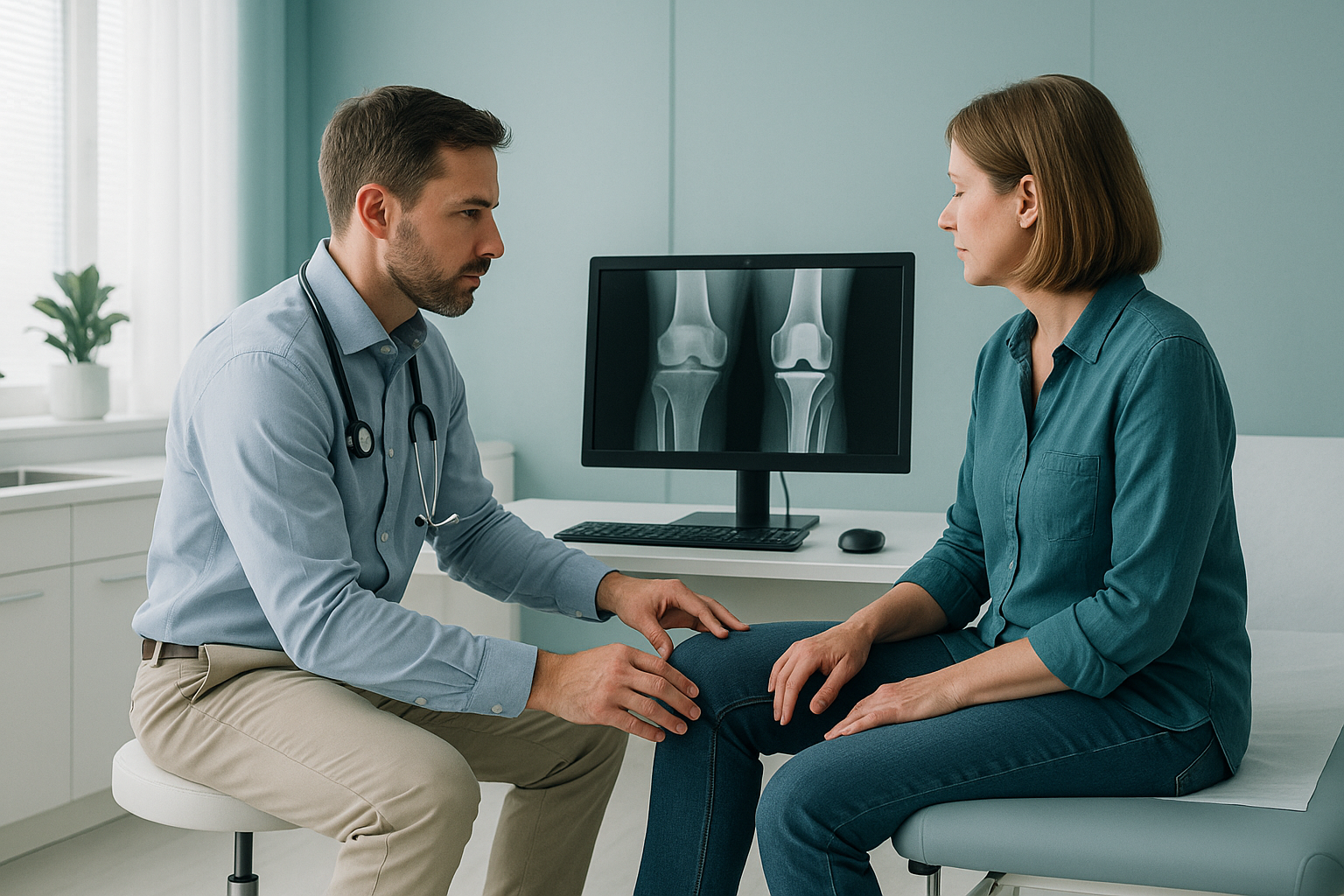
What is included in a pre-operative knee scan at ScanAlign?
Every appointment includes a standing full-leg EOS image, a detailed report from a specialist radiographer, and DICOM-format files ready for your surgeon. Here is what that covers.
When is MRI the better choice? EOS shows bones, joints and alignment in precise detail. For soft-tissue problems such as cartilage tears, ligament damage or nerve issues, MRI is usually the better tool. If your surgeon needs both, the two scans complement each other well.
How do you book knee replacement imaging in London?
The process is straightforward. You do not need a GP referral or a consultant letter to attend.
A short call with our specialist radiographer to confirm standing imaging is right for your situation and answer any questions.
You arrive at our central London clinic. The scan itself takes only a few minutes. You stand still in the EOS unit while it captures both legs from hip to ankle.
Your images and the specialist report are ready on the same day. Measurements are calibrated and surgeon-ready.
We send the full DICOM file set to your surgeon or hospital securely, so they can template the implant accurately.
Ready to get your alignment checked before surgery?
Book a free video consultationWho benefits from a standing knee alignment assessment?
Standing alignment imaging is most useful for people who are preparing for or reconsidering knee surgery. It also helps if you want a second opinion on whether surgery is truly needed.
- You are listed for knee replacement and your surgeon needs full-leg alignment data
- You want a second opinion on alignment before committing to surgery
- Your knee pain has not responded to treatment and you want to understand the bigger picture
- You have been told one leg is shorter or your knee bows inward or outward
- You suspect a ligament tear, meniscus injury or cartilage problem (MRI is usually better)
- You have sudden severe knee swelling, redness or fever (see your GP or A&E urgently)
- You cannot stand unaided for about 30 seconds during the scan
If you are a clinician, you can register to refer patients for standing EOS imaging directly.
Frequently asked questions about knee replacement imaging in London
No. ScanAlign accepts self-referrals. You can book directly without a GP letter or consultant referral.
Please visit our book pre-operative imaging page for current pricing and appointment details.
A standard x-ray usually captures the knee joint alone, often lying down. A standing full-leg EOS scan images both legs from hip to ankle under your own body weight, revealing the true mechanical axis your surgeon needs for accurate planning.
Yes. The EOS system uses about 90% less radiation than a standard x-ray, around ten times less. It is one of the lowest-dose imaging options available.
The scan itself takes only a few minutes. You stand still in the unit while it captures the image. The whole appointment, including positioning and checks, is brief and straightforward.
Absolutely. All images are provided in DICOM format, the medical standard. We can transfer them securely and directly to your surgeon or hospital on the same day.
Yes. Many patients attend ScanAlign specifically to get an independent, full-leg standing image before deciding on surgery. The calibrated data can support or challenge the original recommendation, helping you make a more informed decision.
ScanAlign is at 19 Harley Street, London, within The Harley Street Hospital. It is a short walk from Oxford Circus, Regent's Park and Bond Street stations.
EOS is designed for bones, joints and alignment. If you need imaging of ligaments, cartilage, discs or nerves, MRI is usually the better tool. Your free video consultation will help clarify which scan suits your needs.
Yes. EOS images are calibrated to true size, which means your surgeon can measure and template directly from the scan rather than relying on estimates from magnified standard x-rays.
Get the full picture before surgery
A standing full-leg scan shows your surgeon exactly what they need for precise planning. Start with a free, no-obligation video call.
Book a free video consultationWritten by Abbas Dhami (Specialist Diagnostic Radiographer)
Sources
- Paley, D. (2002). Principles of Deformity Correction. Springer. (Established reference on lower-limb mechanical axis and alignment principles.)
- Deschênes, S. et al. (2010). Diagnostic imaging of spinal deformities: reducing patients' radiation dose with a new slot-scanning X-ray imager. Spine, 35(9), 989-994. (Peer-reviewed evidence on EOS low-dose technology.)
- National Institute for Health and Care Excellence (NICE). Osteoarthritis: care and management. Clinical guideline [CG177]. (UK guidance on assessment before joint replacement.)
This page is general information and not a diagnosis.
ScanAlign is the trading name of CoreMed Solutions Ltd and operates under The Harley Street Hospital's CQC licence.