
Knee Replacement Surgery: What Are the Types, and Does Alignment Matter?
Knee replacement surgery replaces damaged joint surfaces with metal and plastic components. There are total and partial options. The long-term success of a knee replacement depends heavily on how well the new joint is aligned with your hip, ankle and spine, something that standard lying-down scans often cannot show.
Key takeaways
- Knee replacement surgery removes worn cartilage and bone, replacing them with artificial surfaces.
- Total and partial replacements suit different patterns of damage.
- Whole-leg alignment, from hip to ankle, affects how the new joint wears over time.
- Standing imaging shows alignment under real weight-bearing load, unlike lying-down scans.
- An EOS scan uses about 90% less radiation than a standard X-ray, around ten times less.
Knee replacement, also called knee arthroplasty, is one of the most common planned operations in the UK. It is usually considered when osteoarthritis or other joint damage causes pain and stiffness that no longer responds well to non-surgical management.
But surgery is only part of the picture. Your knee does not work in isolation. It sits between your hip and your ankle, and the angle of your whole leg affects how forces pass through the replacement. Getting that alignment right, both before and after the operation, can make a real difference to how long the new joint lasts and how well you move.
What are the different types of knee replacement?
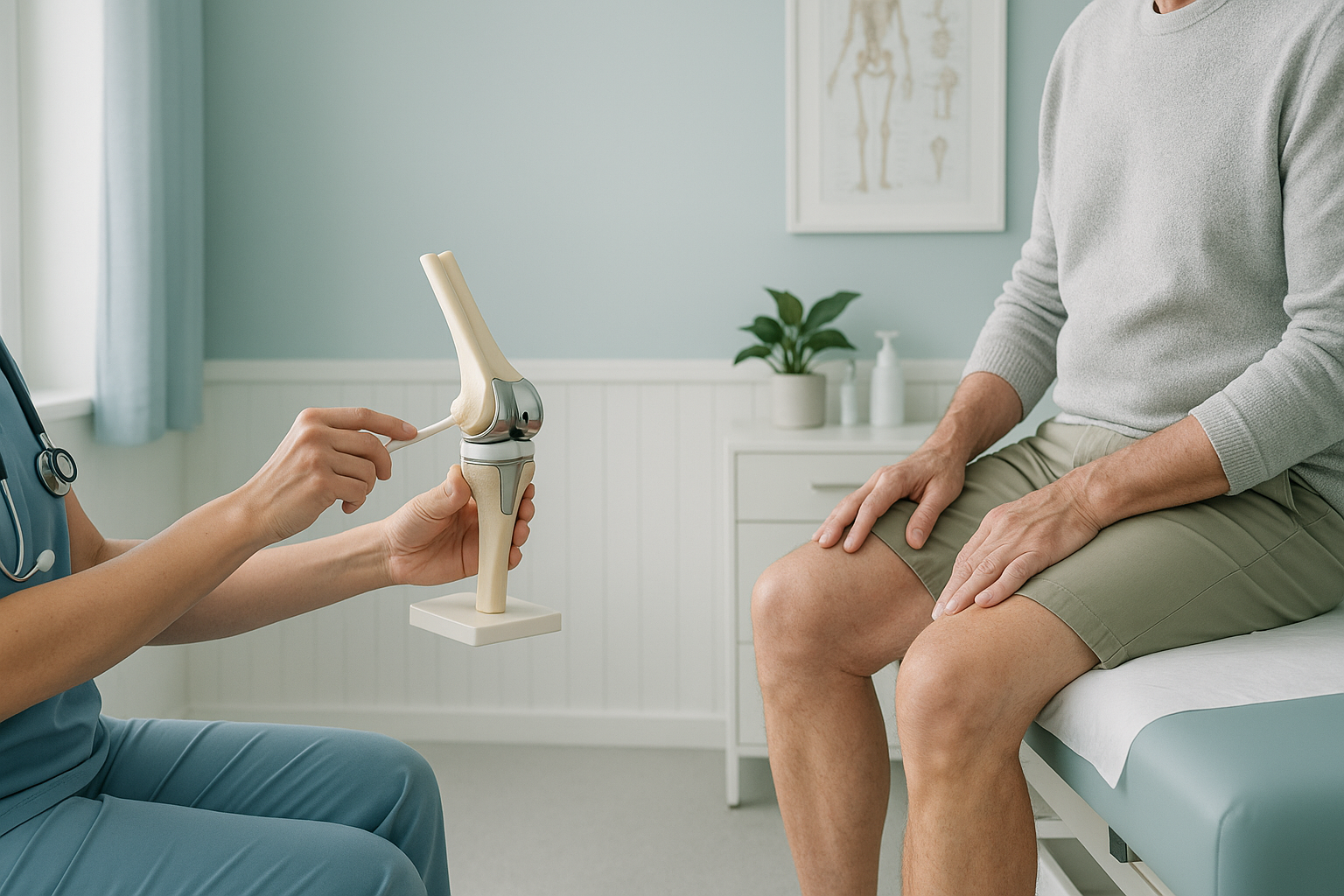
There are two main types. A total knee replacement resurfaces all three compartments of the joint. A partial (unicompartmental) replacement resurfaces only the damaged compartment, preserving healthy bone and ligament tissue.
All three compartments (inner, outer, kneecap) are resurfaced. Suitable when damage is widespread.
Only the worn compartment is replaced. Preserves more natural tissue and may allow quicker recovery.
A second operation to replace or repair a worn or loosened implant. Less common, but alignment assessment is especially important.
Your surgeon will recommend the type that suits your pattern of damage. In all cases, the position and angle of the implant within your leg matters greatly.
How do you know if knee replacement is right for you?
A knee replacement is usually considered after non-surgical options, such as physiotherapy, weight management and medication, have been fully explored. Common signs that you may be a candidate include persistent knee pain that limits daily activities, stiffness that makes walking or climbing stairs difficult, and pain that disturbs your sleep.
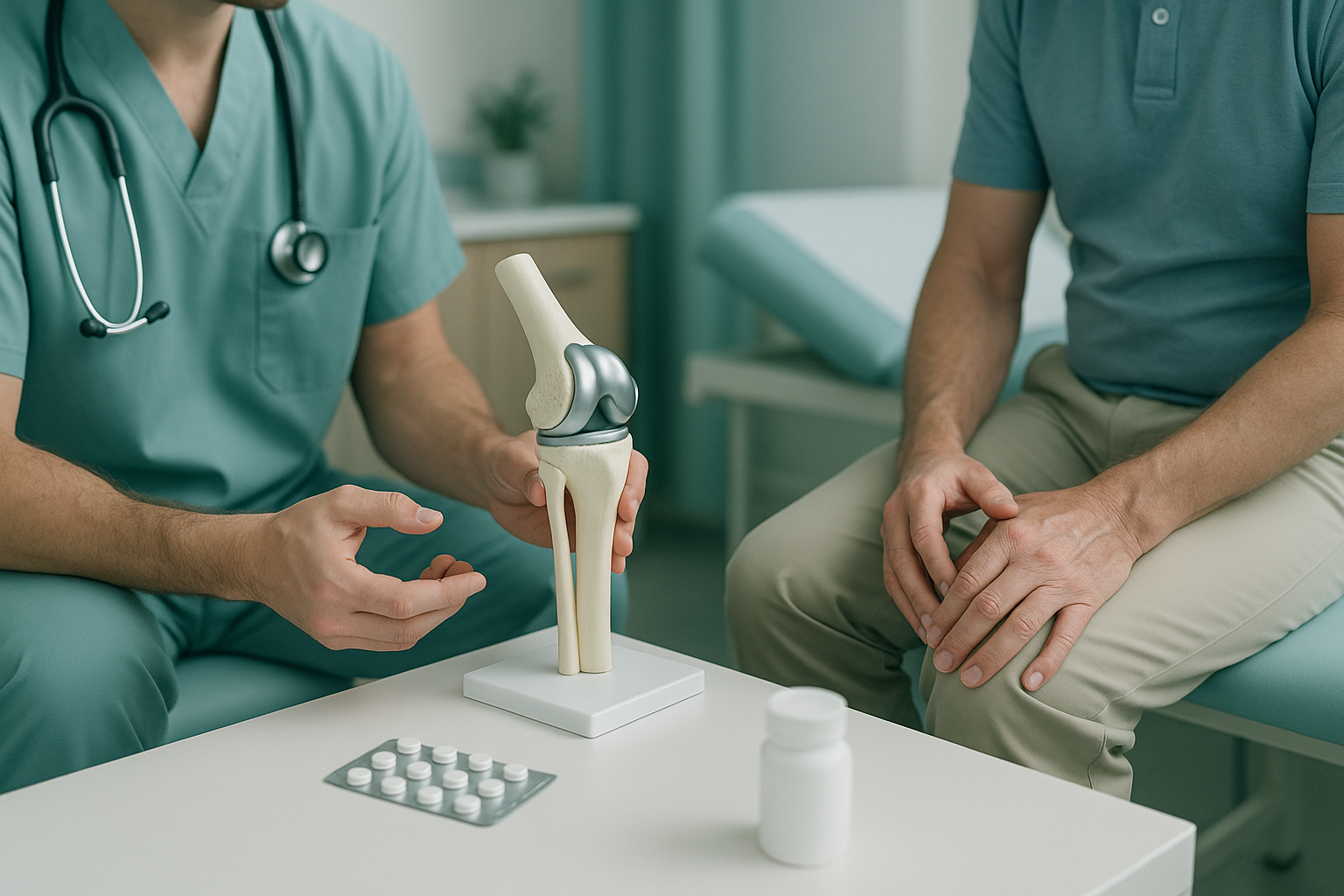
However, having a damaged knee on imaging does not automatically mean surgery is the best next step. It is important to understand how your knee fits within your overall posture and leg alignment first.
Considering a knee replacement? A standing whole-body scan can show your surgeon exactly how your leg aligns under load.
Book a free video consultationWhy does whole-body alignment matter for knee replacement?
Alignment matters because the forces travelling through your knee replacement are shaped by the position of your hip above and your ankle below. If your leg is not straight, one side of the implant takes more load than the other, which can lead to faster wear or loosening over time.
Your body is a connected chain from your feet to your head. A tilted pelvis, a stiff hip, or a flat foot can all change the angle at which force meets your knee. Pain often appears away from its true cause because the body compensates. For example, a hip that rotates inward may push the knee outward, creating uneven stress on the joint surface.
Standard imaging, such as a lying-down X-ray or MRI, relaxes the muscles and removes gravity. This can hide alignment problems that only appear when you are standing and bearing weight. A surgeon planning a knee replacement needs to see the real, loaded position of your leg, not the relaxed position you adopt while lying on a table.
A note on MRI. EOS imaging excels at showing bones, joints and alignment under load. For soft tissue detail, such as ligaments, cartilage or meniscus tears, MRI is usually the better tool. The two work well together, each answering different questions.
How does an EOS scan help before or after knee replacement?
An EOS scan captures a full-length, weight-bearing image of your entire body from head to feet in a single standing exposure. This gives your surgeon a true picture of your mechanical axis, the line from your hip centre through your knee to your ankle, while gravity and your muscles are doing their normal job.
Before surgery, this helps with planning the correct implant position. After surgery, it shows whether the replacement is sitting at the angle intended and whether your overall leg alignment has improved.
The EOS system uses about 90% less radiation than a standard X-ray, around ten times less. You stand inside an open cabin for a few seconds. There is no tunnel and no need to lie down.
To learn more about how standing imaging works, visit our EOS scan overview.
What affects knee replacement recovery time?
Recovery from knee replacement surgery varies from person to person. Common factors include your general fitness, weight, the type of replacement, and how well rehabilitation is followed. Most people return to everyday activities within a few months, though full recovery can take longer.
Alignment plays a role in recovery too. If the implant is well-aligned within your leg, forces are distributed evenly across the joint surface. This supports smoother movement and may reduce the risk of complications down the line. A standing post-operative scan can confirm that the replacement is positioned as planned under real weight-bearing conditions.
ScanAlign is a diagnostic imaging clinic. We do not perform surgery or provide treatment. We provide the imaging that helps your surgeon or physiotherapist make better-informed decisions about your care.
- Are considering a knee replacement and want full alignment data for your surgeon
- Have had a replacement and want to check implant position under load
- Have ongoing pain after a previous replacement
- Want a low-radiation standing image of your whole leg
- Need soft tissue or ligament assessment (MRI is usually better)
- Have sudden knee locking, giving way, or severe swelling, see your GP or A&E
- Have numbness, weakness or loss of bladder or bowel control, seek urgent medical attention
For details on scan safety, preparation and costs, visit our FAQs page.
Frequently asked questions about knee replacement
Knee replacement surgery, also called knee arthroplasty, removes damaged cartilage and bone from the knee joint and replaces the surfaces with metal and plastic components. It is most commonly performed for severe osteoarthritis.
A total knee replacement resurfaces all three compartments of the joint. A partial replacement only resurfaces the damaged compartment, preserving healthy bone and ligaments. Your surgeon will recommend the option that suits your pattern of wear.
Recovery varies. Most people return to everyday activities within a few months, but full recovery and the return of full strength can take up to a year. Factors like fitness, body weight and rehabilitation all play a part.
If the mechanical axis of your leg, the line from hip to ankle, is not straight, forces are distributed unevenly across the implant. Over time this can lead to faster wear on one side. Assessing alignment under standing, weight-bearing conditions gives the most accurate picture.
An EOS scan is a standing, full-body X-ray that captures your skeleton from head to feet in one image. It shows the true weight-bearing alignment of your leg, which helps surgeons plan implant positioning and check results after surgery.
Yes. The EOS system uses about 90% less radiation than a standard X-ray, around ten times less. It is a quick, open scan with no tunnel.
No. You can self-refer. The first step is a free video consultation where a specialist radiographer reviews your situation and confirms whether a scan is appropriate for you.
For current pricing information, please visit our FAQs page.
They answer different questions. EOS shows bones, joints and alignment under load. MRI excels at soft tissue detail, such as ligaments, meniscus and cartilage. Many patients benefit from both.
Yes. Metal implants are visible on the EOS image. A standing scan is a useful way to check implant position and whole-leg alignment after surgery, especially if you are experiencing ongoing discomfort.
Thinking about knee replacement?
A free video consultation with a specialist radiographer can help you understand whether a standing alignment scan is right for your situation.
Book a free video consultationWritten by Abbas Dhami (Specialist Diagnostic Radiographer)
Sources
- National Joint Registry (NJR). Annual reports on knee replacement outcomes in England, Wales, Northern Ireland and the Isle of Man. njrcentre.org.uk
- NHS. "Knee replacement." NHS conditions guidance. nhs.uk/conditions/knee-replacement
- Paley D. Principles of Deformity Correction. Springer, 2002. Widely referenced textbook on mechanical axis planning in lower-limb surgery.
This page is general information and not a diagnosis.
ScanAlign is the trading name of CoreMed Solutions Ltd and operates under The Harley Street Hospital's CQC licence.