
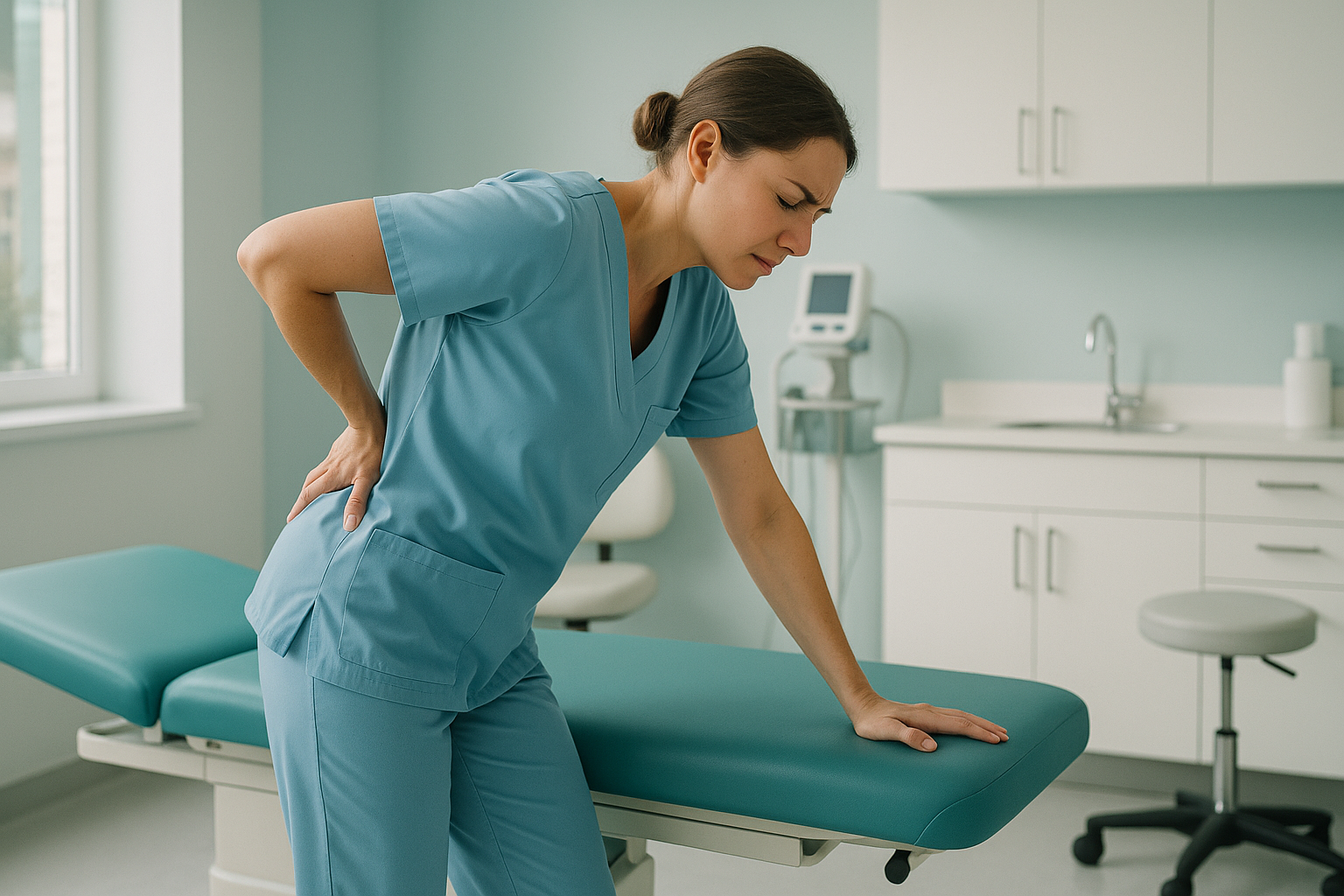
Why Do Nurses and Healthcare Workers Get Back Injuries?
Nurses back pain is driven by repeated patient handling, long shifts on hard floors, and awkward postures that build up over months and years. The cumulative load on the spine is rarely captured by a single incident report. A standing, weight-bearing scan can reveal alignment problems that standard lying-down imaging misses.
Key takeaways
- Patient handling and 12-hour shifts create a cumulative strain that builds over time, not just from one heavy lift.
- Staffing pressure often means fewer hands and more manual transfers, increasing risk further.
- Lying-down scans relax the muscles and can hide alignment shifts that only show under your body weight.
- A standing EOS scan images your full spine and pelvis upright, showing how load actually travels through your body on a ward.
- Understanding your alignment helps you, your physio, or occupational health plan the right next steps.
Why is back pain so common in nurses and healthcare workers?
Back pain is common in healthcare workers because the job demands repeated bending, twisting, and lifting in unpredictable situations. Unlike a gym, you cannot control the weight, the angle, or the timing. A patient who slips mid-transfer, an emergency that means running with a trolley, a night shift where staffing is thin. These moments add up.
Research consistently shows that nursing ranks among the highest-risk occupations for lower back pain. The Health and Safety Executive reports that health and social care workers suffer more musculoskeletal injuries than almost any other sector in the UK.
Transfers, repositioning, and rolling patients load the spine at awkward angles.
Hours on hard floors with minimal sitting exhaust the muscles that protect your spine.
Fewer staff means more manual transfers per person and less recovery between tasks.
Disrupted sleep reduces tissue recovery, leaving muscles more vulnerable to strain.
What does a patient handling back injury feel like?
A patient handling injury can be sudden, like a sharp catch during a transfer, or slow-onset, creeping in over weeks of busy shifts. Many nurses describe it as stiffness at the end of a run of shifts that never quite clears before the next one starts.
A deep, dull ache across the belt-line that worsens during or after a shift.
Difficulty straightening up after sleep, especially following night shifts.
Sharp twinges when leaning over a bed or turning with a load.
Referred discomfort down the buttock or leg, suggesting a muscle imbalance or spinal compensation.
A note on red-flag symptoms. If you develop sudden numbness, weakness in your legs, or any loss of bladder or bowel control, seek urgent medical attention. Contact your GP, call 111, or go to A&E. These symptoms need same-day assessment, not a routine scan.
How does cumulative load cause back injuries in healthcare workers?
Cumulative load means the total strain on your spine builds up over hundreds of small efforts, not just one dramatic event. Every time you lean over a bed, push a wheelchair, or catch a patient who starts to fall, your spine absorbs force. Over months and years, this can gradually shift your alignment.
Your body is a connected chain from your feet to your head. When one area, say your lower back, takes repeated asymmetric load, other regions compensate. Your pelvis might tilt. Your mid-back might stiffen. Your hips might move differently on each side. The pain you feel in one place may actually be driven by an alignment shift somewhere else entirely.

This is why a scan of just one area, taken lying down, often comes back looking normal. When you lie on a table, gravity is removed, muscles relax, and these subtle alignment shifts disappear. The scan looks fine, but you still hurt on your feet all shift.
How does a standing scan help with nurses' back pain?
A standing scan captures your skeleton the way it actually works, upright and under your own body weight. This is the position your spine is in when you are on the ward, transferring patients, or walking corridors for 12 hours.
An EOS scan images you from head to foot in a single standing exposure. It shows how your spine, pelvis, hips, and knees align under real weight-bearing conditions, with about 90% less radiation than a standard X-ray, around ten times less. Tilts, shifts, and compensations that only appear when you are upright become visible.
A conventional X-ray, CT, or MRI taken lying down removes the effect of gravity. Muscles relax, the spine straightens, and many alignment problems disappear from the image. The scan may look normal even if you are in pain every shift.
ScanAlign standing EOS imaging captures your full alignment in one low-dose image. The results give you, your consultant, or your occupational health team a clear picture of how your body is loading when it matters most.
When MRI is the better choice. EOS shows bones, joints, and alignment. If your clinician suspects a disc bulge, nerve compression, or soft-tissue damage, MRI is usually the better tool. The two types of imaging answer different questions and often complement each other.
What can healthcare workers do about persistent back pain?
The first step is understanding what is going on. Many healthcare workers push through pain for months, adjusting how they move without realising they are developing compensation patterns. Getting a clear picture of your alignment gives you and your treatment team a starting point.
- Report the injury. Even if it feels minor, logging it with occupational health creates a record and may open access to physiotherapy or workplace adjustments.
- Review footwear. Supportive shoes on hard ward floors make a measurable difference over a 12-hour shift.
- Prioritise recovery between shifts. Sleep, gentle movement, and avoiding heavy lifting on days off help your tissues recover.
- Use hoists and slide sheets properly. Manual handling training exists for a reason, but it also needs adequate staffing to be practical.
- Get the right imaging. If your pain has not settled, a standing alignment assessment can show whether a structural shift is involved, guiding your next conversation with a physio, GP, or consultant.
If shift work has left you with back pain that will not settle, find out whether alignment is part of the picture.
Book a free video consultationFrequently asked questions
No. ScanAlign is a private, self-pay clinic. You can book a standing spine scan directly without a referral from your GP or occupational health.
Yes. An EOS scan uses about 90% less radiation than a standard X-ray, around ten times less. It is one of the lowest-dose imaging methods available for full-body skeletal assessment.
Night shifts disrupt sleep and recovery. Your muscles fatigue faster, your pain threshold drops, and staffing is often leaner, meaning more manual handling per person. All of these increase the load on your spine.
When you lie down, gravity is removed and muscles relax. Alignment problems that only appear when you are standing and weight-bearing can disappear from the image. A standing scan may reveal shifts that a lying-down scan cannot capture.
Yes. The report is a detailed radiological assessment. You can share it with occupational health, your physio, your GP, or any treating consultant to help plan your return to work or workplace adjustments.
The scan itself takes under a minute. The full appointment, including positioning and discussion, is usually around 30 minutes. You remain fully clothed and simply stand still inside the scanner.
Anyone in a physically demanding healthcare role can benefit. That includes paramedics, care assistants, porters, physiotherapists, and any staff involved in patient handling or long shifts on their feet.
ScanAlign does not publish prices on individual pages. You can find current pricing and payment details on the cost and FAQs page.
The scan provides detailed diagnostic information about your alignment. It does not prescribe treatment. Your treating clinician uses the findings alongside your history to recommend the right next steps.
As with any X-ray-based imaging, EOS scans are not performed during pregnancy. If you are or may be pregnant, please let the team know before booking.
Back pain from the job you love?
A free video consultation lets you talk through your symptoms with a specialist radiographer and find out whether a standing alignment scan is the right next step.
Book a free video consultationSources
- Health and Safety Executive. Work-related musculoskeletal disorders in Great Britain (HSE annual statistics). hse.gov.uk
- Yassi A, Lockhart K. Work-relatedness of low back pain in nursing personnel: a systematic review. International Journal of Occupational and Environmental Health, 2013;19(3):223-244.
- NHS England. Musculoskeletal health in the NHS workforce. england.nhs.uk
Written by Abbas Dhami (Specialist Diagnostic Radiographer)
This page is general information and not a diagnosis.
ScanAlign is the trading name of CoreMed Solutions Ltd and operates under The Harley Street Hospital's CQC licence.