

Sore Lower Back: What Causes It and When Should You Get Assessed?
A sore lower back is usually caused by muscle strain, joint stiffness or poor alignment, not serious disease. Most episodes settle within weeks. But if your pain keeps returning or gets worse when standing or walking, the problem may be how your whole body distributes load. A standing, weight-bearing scan can reveal alignment issues that lying-down imaging misses.
Key takeaways
- Lower back pain is extremely common and rarely a sign of something dangerous.
- Pain often comes from alignment problems elsewhere in the body, not just the lower back itself.
- Standard imaging is done lying down, which relaxes muscles and can hide weight-bearing alignment faults.
- A standing whole-body EOS scan captures your skeleton under natural load from head to feet.
- If you have numbness, weakness, or loss of bladder or bowel control, seek urgent medical attention.
What is lower back pain and why is it so common?
Lower back pain is discomfort felt anywhere between the bottom of your ribs and the top of your legs. It is one of the most common reasons adults visit a GP, and most people will experience it at some point.
Your lower back (the lumbar spine) carries the majority of your upper body weight. It depends on good alignment from the structures above and below it. Your pelvis, hips, knees and even your feet all influence how load travels through your lumbar spine. When something is out of balance anywhere in this chain, your lower back often picks up the extra work.

That is why lower back pain so often comes back. If the real cause is a tilted pelvis, uneven leg length or a shift in your hip alignment, treating the lower back alone may not be enough.
What does a sore lower back feel like?
Lower back pain can show up in many ways. The pattern of your symptoms can give clues about what is going on.
A persistent ache that worsens after sitting or first thing in the morning.
Discomfort that increases with weight-bearing activity, then eases when you sit or lie down.
A sudden jolt after bending, lifting or twisting, sometimes with muscle spasm.
Pain that comes and goes over months or years, never fully resolving.
What causes lower back pain?
Most lower back pain comes from mechanical causes, meaning the way the structures of your spine and pelvis move and bear weight. Serious underlying conditions are uncommon.
Overuse, awkward lifting or prolonged sitting can overload soft tissues.
A pelvic tilt, leg length difference or shifted centre of gravity adds uneven load.
Age-related changes in the joints and discs of the lumbar spine (spondylosis).
Slouching, desk work or prolonged standing in a poor position over months or years.
An important point many people miss is that your lower back pain may not originate in your lower back at all. Your body works as a connected chain. If your pelvis tilts, your hip is stiff on one side or one leg bears more weight, your lumbar spine compensates. Over time, this compensation leads to pain. That is why imaging only the painful area can miss the real problem.
When should you worry about lower back pain?
Most lower back pain is not dangerous. However, certain symptoms need urgent medical attention. If you experience any of the following, contact your GP, call 111, or go to A&E straight away.
- Numbness or tingling in your groin or between your legs (saddle area).
- Loss of bladder or bowel control.
- Sudden weakness in one or both legs.
- Severe pain after a fall or injury.
- Unexplained weight loss alongside back pain.
These are rare, but they do require immediate assessment. For persistent or recurring lower back pain without these red flag symptoms, an alignment assessment can help you understand what is driving the problem.
How is lower back pain assessed with a standing scan?
Most imaging for lower back pain is done while you lie down. X-rays, CT and MRI all capture your body in a relaxed, unloaded position. That means your muscles are not working, gravity is not acting through your spine, and any alignment faults that only appear when you stand may be hidden.
An EOS scan takes a different approach. You stand naturally in the machine while it captures your entire skeleton from head to feet in a single image. This shows exactly how your spine, pelvis, hips, knees and ankles align under your own body weight.
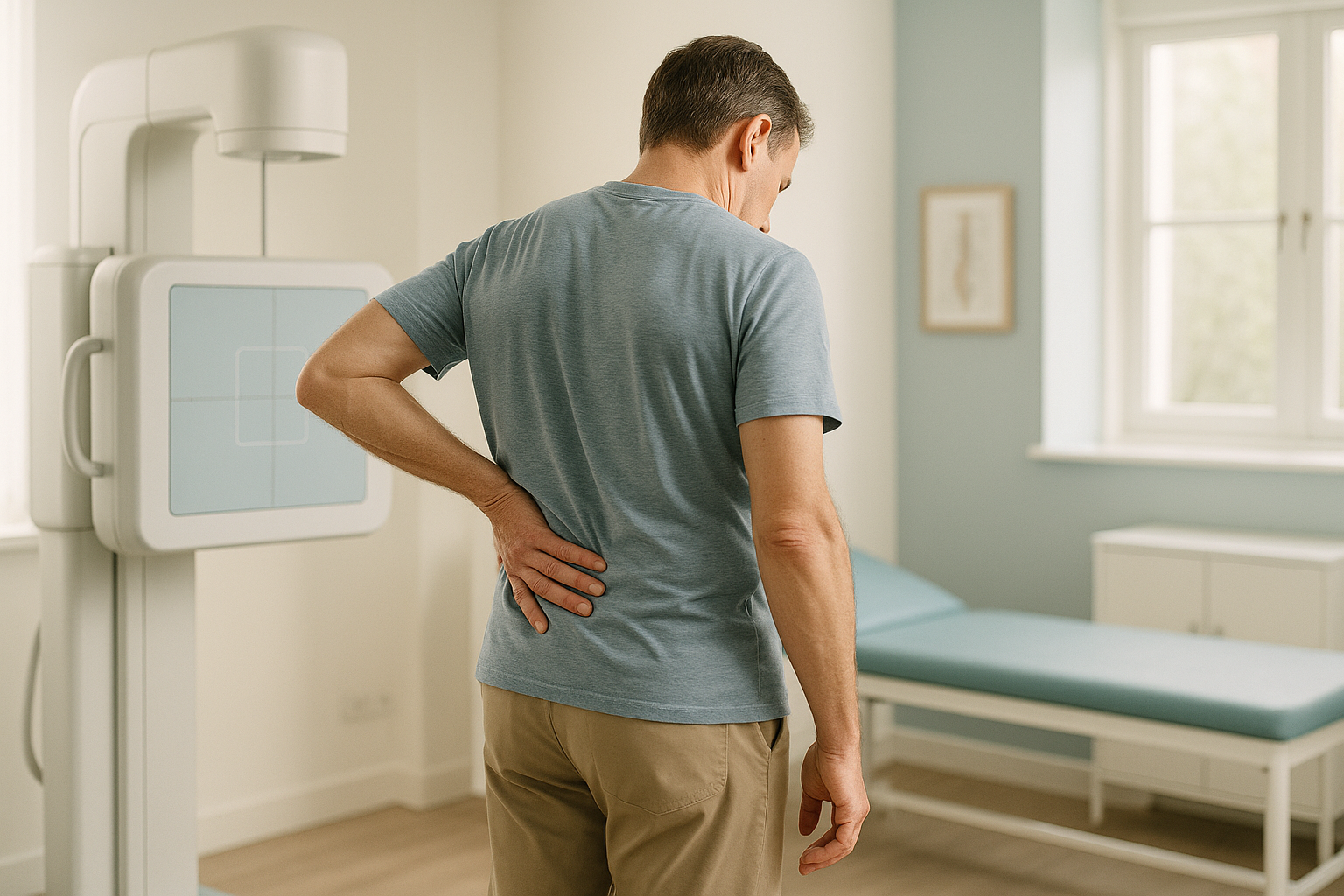
Because the EOS system uses about 90% less radiation than a standard X-ray, around ten times less, it is comfortable for routine use. The scan itself takes only a few seconds while you stand still.
Your results show how each part of your body contributes to (or takes away from) the support of your lower back. This can change the whole direction of your treatment by revealing issues a single-area scan would miss.
When MRI is the better choice: EOS excels at showing bone alignment, joint position and overall posture under load. If your clinician suspects a disc problem, nerve compression or soft-tissue injury, MRI is usually the more appropriate tool. The two types of imaging answer different questions, and in some cases both are useful.
What is the best way to relieve lower back pain?
Staying active is one of the most consistently supported approaches. Bed rest beyond a day or two tends to make things worse, not better. Gentle walking, swimming and targeted core exercises are generally recommended by the NHS and most orthopaedic guidelines.
However, if your pain keeps returning, general exercise alone may not be enough. This is where understanding your alignment matters. If a pelvic tilt or hip imbalance is loading your lower back unevenly, a physiotherapist or surgeon can create a more targeted plan once they can see the full picture.
ScanAlign does not provide treatment. It provides the diagnostic imaging that helps your treating clinician understand the underlying cause. You do not need a GP referral, and you can share your results with any specialist.
Wondering whether your lower back pain could be an alignment problem? A free video consultation with our team can help you decide if a standing scan is the right next step.
Book a free video consultationFrequently asked questions about lower back pain
Standing loads your lumbar spine differently from sitting. If your pelvis, hips or legs are slightly out of alignment, gravity increases the uneven stress on your lower back when you are upright. This is exactly the kind of problem a standing whole-body scan is designed to show.
Yes. A tilted pelvis, stiff hip joint or uneven leg length can force your lumbar spine to compensate, leading to pain in your lower back rather than at the original source. Whole-body imaging helps identify these connected causes.
An EOS scan captures your entire skeleton in a single standing image. Because you are upright and weight-bearing, it reveals how your spine, pelvis, hips and legs align under natural load. This can uncover alignment issues that lying-down scans miss. Learn more about how an EOS scan works.
Yes. The EOS system uses about 90% less radiation than a standard X-ray, around ten times less. You can find more detail on our FAQs and safety page.
No. ScanAlign accepts self-referrals. You can book directly without seeing your GP first.
Pricing details are on our FAQs page. A free video consultation before booking helps you understand whether a scan is the right step for you.
When you lie down, gravity is removed and your muscles relax. Alignment faults that only appear under your own body weight may straighten out on the table, so the image looks normal even though your pain is real.
Usually not. Lower back pain when standing is most often caused by mechanical alignment or posture issues. However, if you also have numbness, weakness in your legs, or any loss of bladder or bowel control, seek urgent medical attention from your GP, 111 or A&E.
EOS is excellent for bone and joint alignment but does not show soft tissues such as discs or nerves in detail. For suspected disc problems, MRI is usually the better choice. In some cases both scans provide useful, complementary information.
Stay gently active, avoid prolonged bed rest, and use over-the-counter pain relief if needed. If the pain does not improve within a few weeks, or if it keeps coming back, an alignment assessment may help find the underlying cause. If you have red flag symptoms such as numbness, weakness or loss of bladder or bowel control, seek medical help immediately.
Find out what is really behind your lower back pain
A free video consultation with our team will help you decide if a standing whole-body scan is the right next step.
Book a free video consultationWritten by Abbas Dhami (Specialist Diagnostic Radiographer)
Sources
- NHS. "Back pain." nhs.uk, 2023. Overview of causes, self-care and when to seek help.
- National Institute for Health and Care Excellence (NICE). "Low back pain and sciatica in over 16s: assessment and management." NICE guideline NG59, 2016 (updated 2020).
- Illés T, Somoskeöy S. "The EOS imaging system and its uses in daily orthopaedic practice." International Orthopaedics (SICOT), 2012; 36(7): 1405-1411.
This page is general information and not a diagnosis.
ScanAlign is the trading name of CoreMed Solutions Ltd and operates under The Harley Street Hospital's CQC licence.